

Wall Bed with Sofa Guide for Small Spaces That Work
You’re sitting in a studio apartment where the sofa is comfortable enough for morning coffee, but the same room must become a bedroom before bedtime. Or perhaps your guest room spends most days as an office, workout space, or craft room, then needs to welcome an overnight visitor without a frantic furniture shuffle. A wall bed with sofa can solve that conflict, but only if the unit fits the room, anchors securely, and works with a suitable mattress.
The important questions go beyond appearance. Will the sofa remain in place when the bed lowers? Can the delivery team get the cabinet through the hallway? Does your ceiling provide enough height? Is the mechanism matched to the mattress, and does the higher upfront cost make sense for how often you’ll use it?

Introduction to Living Large in a Small Footprint
A wall bed with sofa turns one footprint into two useful settings. During the day, you have a living area with seating. At night, the bed comes down from its cabinet or wall unit, creating a dedicated sleep surface without requiring a separate bedroom. The arrangement suits studio apartments, compact guest rooms, home offices, and any space where a conventional bed would dominate the floor.
This idea has a long practical history. William Murphy developed his hideaway-bed design in the early 1900s, and the category became popular as housing shortages increased demand for smaller homes and more efficient floor use. It grew from a functional problem, not merely a decorative trend. People needed rooms that could adapt as housing became denser and household needs changed.
A simple apartment example makes the appeal clear. In the morning, the resident raises the bed and keeps the sofa, table, and walking route available for work or relaxation. At night, the sleep surface comes down in the same room. The furniture doesn’t create more square footage, but it helps the room perform more than one job.
Who benefits most from the format
This solution makes the most sense when daily flexibility matters more than easy relocation. A renter should check the lease and installation rules before ordering, while a homeowner may value a permanently anchored unit as part of a long-term room plan. A frequent host may prioritize sleep comfort, whereas an occasional guest host may prefer a simpler sofa bed.
Use the room’s full routine as your test:
- Studio resident: needs a real sleeping area without giving up daytime seating.
- Guest-room owner: wants the room to function as an office or hobby space between visits.
- Small household: needs furniture that can change roles without storing a separate bed.
- First-time buyer: wants a clear way to compare fit, mechanism, mattress requirements, and long-term value.
By the end of the buying process, you should be able to measure the wall, sketch the open-bed footprint, identify the anchoring surface, and compare the complete cost rather than judging the sofa alone.
What a Wall Bed With Sofa Really Is and How It Works
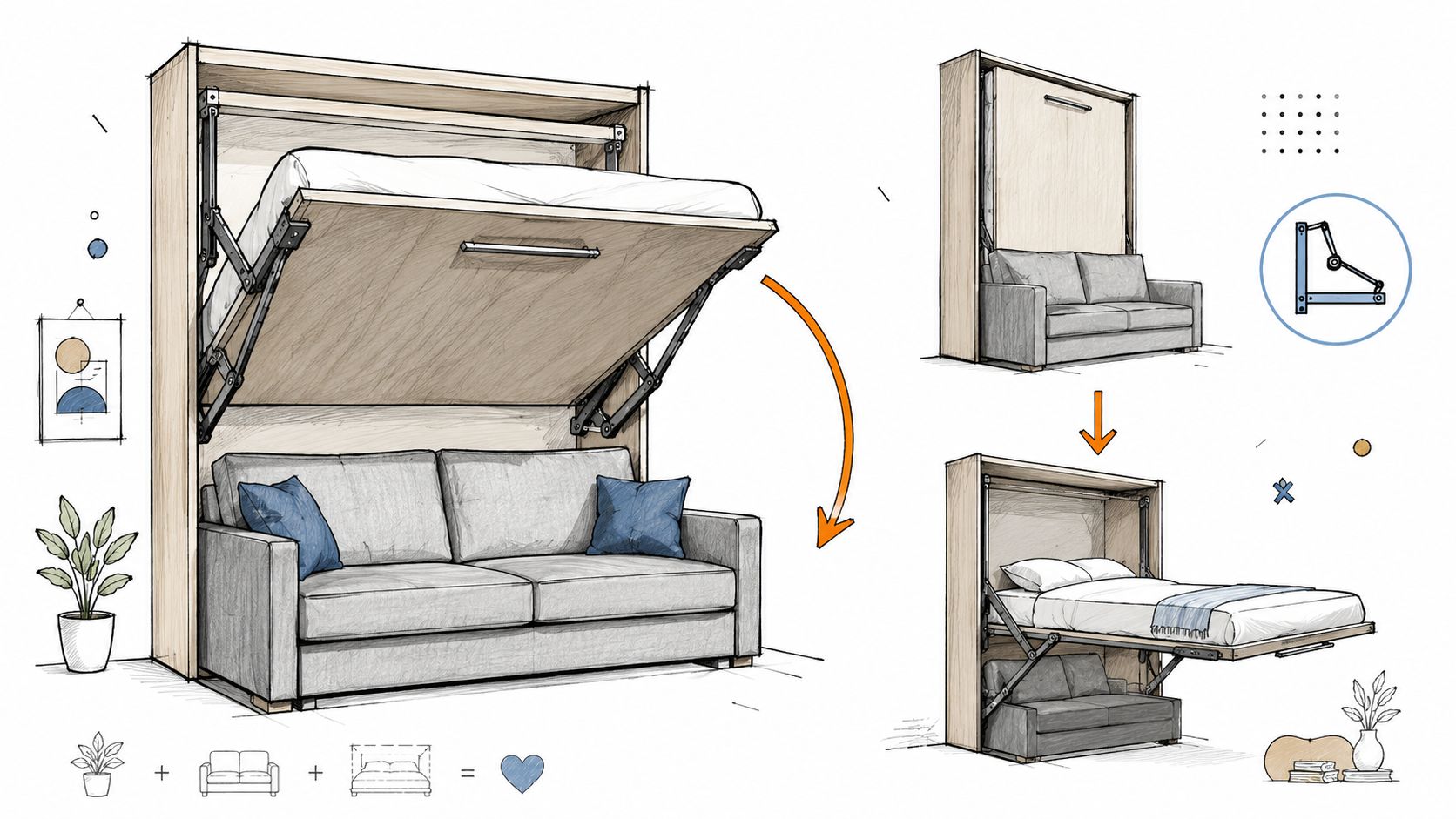
Think of the unit as a balanced garage door combined with a couch. The bed panel pivots from a fixed cabinet or wall structure, while a spring or gas-piston lift assists its movement. The sofa sits in front of, below, or within the same furniture system, depending on the design. When the bed is stored, the sofa remains available. When the bed is lowered, the sofa may fold, move, or sit beneath the sleeping platform according to the model.
The conversion usually follows a simple sequence:
- Remove or secure anything the manufacturer says can’t remain on the bed.
- Release the locking or holding mechanism.
- Pull the bed panel down with the intended handles.
- Lower it until the support legs or platform settle into position.
- Reverse the movement in the morning, keeping hands clear of hinges and moving panels.
The lift doesn’t make the bed weightless. It balances the assembly so the user isn’t handling its full mass at once. The mattress is part of that balance, which is why a replacement mattress can’t be chosen only by comfort preference.
The structure matters more than the upholstery
A wall bed depends on being permanently secured to a building’s rigid structure — real wall framing or masonry, not the sofa, a decorative cabinet, or drywall alone. That distinction changes how you evaluate the product. The sofa is the visible living-room feature, but the bed assembly transfers forces through the hardware, frame, and wall connection. Stud or masonry anchoring, clear installation instructions, and an appropriate load rating should be procurement priorities — ask the manufacturer directly for their documented anchoring requirements and load rating for the specific model, rather than assuming a general figure applies.
For shoppers comparing construction styles, wall beds from Futonland provide one retail category to examine alongside other wall-mounted and cabinet-based options. Focus first on how the unit attaches and operates, then judge finish, fabric, and styling.
How It Compares to Sofa Beds and Futon Sofas
A wall bed with sofa and a traditional sofa bed both convert seating into sleeping space, but they solve the problem differently. A sofa bed folds a mattress into the sofa’s own frame. A wall bed stores its sleeping platform vertically, usually leaving the sofa in its daytime position or integrating it into a separate movement path.
A futon sofa typically uses a flexible mattress that folds at the sofa’s hinge. It can be straightforward and adaptable, but the sleep feel and conversion experience depend heavily on the frame and mattress combination. For shoppers who want to compare formats beyond wall-mounted systems, convertible sofa beds offer another group of configurations to review.
Wall Bed With Sofa vs. Sofa Bed vs. Futon Sofa at a Glance
| Feature | Wall Bed With Sofa | Sofa Bed | Futon Sofa |
|---|---|---|---|
| Sleep surface | Often accommodates a separate mattress selected within the unit’s specifications | Mattress is integrated with the sofa frame | Mattress folds with the frame and contributes to both seating and sleeping comfort |
| Daytime floor use | Can reclaim the bed footprint when stored | Sofa remains in its full floor position | Sofa remains in its full floor position |
| Conversion | Requires lowering or raising a wall-mounted bed assembly | Requires unfolding and restoring the sleeper frame | Requires folding the back or frame between positions |
| Room planning | Needs wall width, ceiling height, anchoring, and open-bed clearance | Needs clearance in front of the sofa for the folded bed | Needs clearance for the back and seat movement |
| Best fit | A studio or multi-use room used for sleeping regularly | Occasional guests who need a familiar sofa format | Buyers who want a simpler convertible sofa with a flexible mattress feel |
A studio resident who sleeps in the room every night may value the dedicated bed platform and the ability to recover daytime floor area. A homeowner who hosts a guest for a short visit may accept the larger permanent sofa footprint of a sleeper sofa to avoid wall installation.
The choice also depends on what you want to reset each morning. With any convertible product, you’ll need a routine for bedding, cushions, and nearby objects. A wall unit can produce a cleaner daytime layout, but only if the open-bed footprint and sofa movement have been planned carefully.
Benefits and Trade-Offs You Should Weigh Honestly
The strongest benefit is role separation inside one room. The sofa handles daytime seating, while the wall bed supplies a dedicated sleep platform at night. Unlike a room with a conventional bed and separate couch, the stored bed doesn’t need to occupy the main floor area all day.
A second benefit is mattress choice. Because the bed platform and sofa are distinct parts of the system, the sleeping experience isn’t defined solely by a sofa cushion or a folded seat. That can matter for a studio resident who sleeps there nightly, or for guests who stay long enough to notice the difference between a proper mattress and a compact sleeper surface.
The category also has genuine commercial staying power — multifunctional sleep furniture has been a well-established part of the furniture market for decades, not a novelty purchase, which is worth keeping in mind when weighing the upfront cost against how long you expect to use it.
Where the trade-offs appear
Installation is the first major compromise. A properly secured wall bed isn’t as casual to position as a freestanding sofa. You’ll need to identify suitable studs or masonry, verify the wall condition, and follow the manufacturer’s anchoring method.
The second compromise is open-bed clearance. A compact room may look spacious with the bed stored, yet become difficult to move through after deployment. The third is total cost. The purchase can include more than the visible cabinet and sofa, such as delivery, assembly, mattress compatibility, custom upholstery, and future hardware service.
Use this honest screening list:
- Choose it confidently if the room serves multiple roles and sleeping comfort matters often.
- Pause before buying if you can’t anchor to the wall or can’t maintain a safe open-bed path.
- Compare alternatives if guests sleep over rarely and the room already has enough floor space.
- Calculate value over time by considering how often the room changes function, not just the checkout price.
Value test: the premium makes more sense when the unit solves a daily space problem, not when it only provides an occasional emergency bed.
Planning Your Room and Getting Measurements Right
A wall-bed sofa can fit the wall and still fail in daily use. Measure the room before comparing finishes. Record the installation wall, ceiling height, doors, windows, outlets, trim, vents, and anything that could meet the cabinet or bed panel. A door swing may block the sofa, while a ceiling fixture can interrupt the cabinet’s vertical path.
A queen configuration may use roughly 65 inches of wall width and about 88 to 92 inches of wall height when vertical. Mattress compatibility varies significantly by mechanism — treat any specific thickness or minimum-weight figure as belonging to one particular product line, then verify the exact frame, mattress, and mechanism requirements directly with the manufacturer before ordering.
A practical fit workflow
First, map the vertical cabinet. Measure from the finished floor to the lowest ceiling obstruction. Include crown molding, sprinkler heads, lights, and sloped sections. The sofa may look low, but the stored bed can require a tall, unobstructed path.
Next, map the open bed. Mark the expected mattress length and width on the floor with painter’s tape. Add room for support legs and a walking route around the bed. Then return the chair, side table, desk, or coffee table to its usual position. Test the route to the doorway. A clear path on an empty floor may disappear once the room is furnished.
Allow space for the bed to open fully, not just enough room for the mattress outline. This clearance is the difference between a layout that works on paper and one that works at night.
Then, test the sofa relationship. Ask whether the sofa stays in place, folds, slides, or pivots during conversion. Two models with similar closed dimensions may need very different floor areas when opened. Confirm where the mechanism moves and whether nearby furniture must be relocated.
Delivery access deserves its own drawing
Measure the building entrance, hallway turns, elevator or stair route, apartment door, and final room entrance. Note low ceilings and tight corners throughout the route, not only beside the installation wall. A cabinet can fit the room yet fail to reach it without a different delivery plan.
Use the sizing chart for furniture dimensions as a starting reference, then confirm the retailer’s packed dimensions. Keep your sketch, photographs, and measurements together. The installer can use them to identify access problems, anchoring needs, and clearance risks before delivery day.
Choosing Mattresses, Upholstery, Mechanisms, and Care
A wall bed with sofa works as one coordinated system. The mattress changes lift balance, the mechanism controls opening force, upholstery determines daily upkeep, and the wall connection supports the cabinet. Choosing these parts separately can produce furniture that looks suitable but operates poorly.
Start with the mattress specification rather than its marketing label. Confirm the exact frame’s permitted thickness, weight, flexibility, and construction. A mattress that is too thick can stop the bed from closing properly. One that is too light can disturb the counterbalance. Foam, hybrid, and other options may be available through futon mattresses, but the final choice must match the wall-bed manufacturer’s requirements.
Match the lift to the routine
Spring-lift mechanisms are used across twin through king sizes, and some manufacturers rate their systems for very substantial loads. That capacity describes one specific mechanism, not a general figure that applies across all wall-bed brands — ask for the rated range, approved mattress weight, and adjustment or servicing procedure for the exact model you’re considering.
Gas-piston systems appear in some models because they can reduce opening force and create a smoother feel. Springs and pistons each suit different designs. Check whether the mechanism stays controlled with your chosen mattress, and confirm that replacement parts and service instructions are available.
A useful apartment example is a guest room that becomes an office each morning. A mattress that makes the lift difficult can turn a daily conversion into a chore, even if the sofa and cabinet fit the room.
Safety rule: anchor the bed to suitable studs or masonry exactly as instructed. A sofa’s weight, a decorative cabinet, or drywall alone cannot serve as the structural connection.
Upholstery and maintenance choices
For children, pets, or frequent guests, select fabric according to your cleaning routine. Tightly woven, durable upholstery may be easier to maintain than a delicate texture. Removable or custom covers can make future refreshing simpler. Ask how the sofa cushions attach, whether covers can be replaced, and which cleaning method the fabric manufacturer permits.
Keep the operating area clear, inspect visible hardware, and follow the manufacturer’s maintenance schedule. Do not modify lift components, add unapproved weight, or force a panel that feels uneven. Professional assembly makes sense when the unit is heavy, wall construction is uncertain, or the instructions require precise anchoring. These requirements affect total cost and long-term value, so include installation and future service in the buying decision, not only the sofa’s appearance.
Finding Your Ideal Futonland Wall Bed With Sofa
The buying order should be fit first, mechanism second, mattress third, and style fourth. Starting with fabric or cabinet color is understandable, but those choices can’t rescue a unit that blocks a door or exceeds the wall height. A quick room drawing gives you a more reliable shortlist than browsing photographs alone.
Begin by recording the wall width, ceiling height, open-bed footprint, access route, and anchoring surface. Then ask each retailer for the assembled and packed dimensions, the sofa’s movement during conversion, the required mattress range, and the installation method. These answers reveal whether the product belongs in your room before you spend time comparing upholstery.
Build a shortlist around use
For nightly sleeping, put mattress support and easy conversion at the top of the list. For a guest room that doubles as an office, prioritize the daytime footprint, desk clearance, and how quickly the room can be reset. For a family space, consider upholstery cleaning and whether children can operate or access moving parts safely under adult supervision.
Futonland is one option for comparing wall beds, cabinet beds, convertible sofa beds, mattresses, covers, and related space-saving furniture. Its stated services include nationwide delivery to the contiguous United States and Hawaii, white-glove assembly and debris removal in New York City, custom cut-and-sew covers, design help, financing, and furniture removal services in New York City. Treat those services as part of the purchase evaluation, especially when installation access or upholstery replacement could affect the total value.
Calculate the real cost
Write down the complete project cost rather than comparing sofa prices alone:
- Furniture: include the wall-bed cabinet, sofa, hardware, and any required mattress.
- Installation: confirm whether assembly and wall anchoring are included or billed separately.
- Delivery access: ask about stairs, elevators, tight hallways, and appointment requirements.
- Future upkeep: check warranty terms, replacement covers, hardware service, and mattress compatibility.
- Room value: consider how often the unit frees the room for work, movement, guests, or everyday living.
A wall bed with sofa earns its space when it changes the room’s usefulness repeatedly and safely. Measure your room now, mark the open-bed footprint with tape, and contact a qualified retailer or installer with those measurements before ordering. That conversation will help you choose a unit that fits through the door, anchors to the structure, operates with the right mattress, and delivers lasting value instead of an expensive storage problem.
Measure your wall, ceiling, access route, and open-bed footprint today. Then use those details to request model-specific dimensions, mattress requirements, anchoring instructions, and a complete delivery and assembly quote before you purchase.