Your Guide To Queen Size Futon Sofa Beds For Modern Living
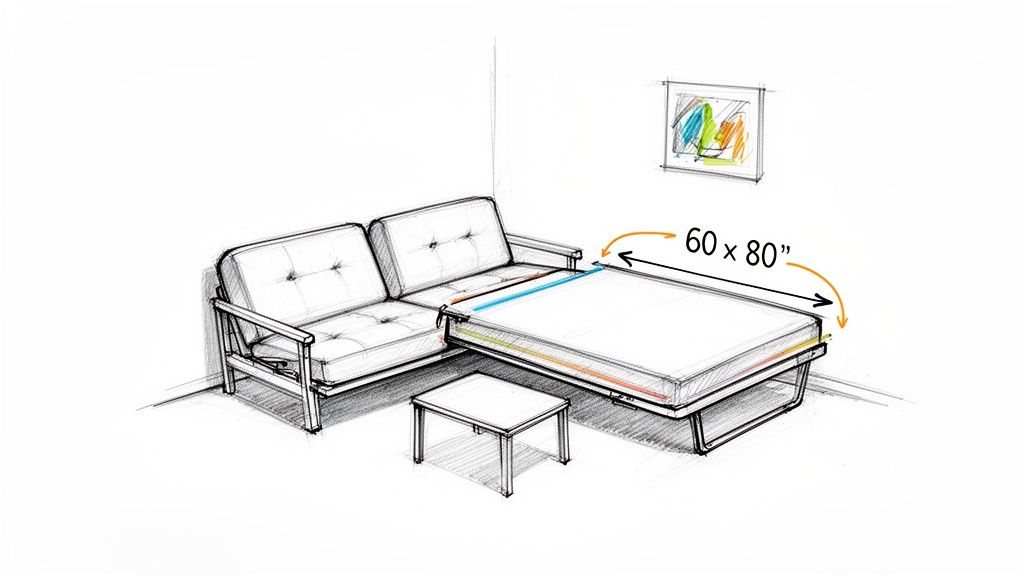
A queen size futon sofa bed isn’t just another piece of furniture; it’s the smartest way to furnish a modern space. It gives you a generous 60×80-inch sleeping area—the same as a standard queen bed—all tucked into the clean footprint of a stylish sofa. It’s the perfect answer for anyone trying to get the most out of their square footage without giving up on comfort or style.
Why a Queen Futon Sofa Bed Is a Small Space Game Changer
Ever stood in a studio apartment or a tight spare room, wondering how you’ll ever fit both a decent guest bed and a sofa you actually want to sit on? You’re not alone. Furnishing smaller homes often feels like a series of compromises, forcing you to pick between a lumpy, awkward pull-out couch or sacrificing precious floor space to a bed that just sits there.
This is exactly where the queen futon sofa bed shines. It’s more than just furniture; it’s a strategic design move that elegantly solves the classic small-space problem by merging two must-have items into one seamless, functional piece.
The Modern Futon Advantage
First things first: forget the lumpy, flimsy futons from your college dorm days. Today’s queen futon sofa beds are engineered for serious comfort and longevity, easily going head-to-head with traditional furniture. The magic is in its design philosophy.
A traditional sofa bed tries to hide a thin, flimsy mattress and a clunky metal mechanism inside its frame. A modern futon, on the other hand, is built around a single, high-quality mattress that acts as both the seat cushion and the sleeping surface. The result is consistent comfort, whether you’re sitting or sleeping.
Think of it this way: a traditional sleeper sofa is like stuffing a cheap air mattress into a suitcase. It’s a temporary fix that almost always disappoints. A queen futon is more like a high-end convertible car—purpose-built from the ground up to excel in both modes without any compromises. This thoughtful approach delivers a far better experience for both everyday lounging and a restful night’s sleep.
To help you see the difference clearly, here’s a quick breakdown:
Queen Futon Sofa Bed vs Traditional Sofa Bed at a Glance
| Feature | Queen Futon Sofa Bed | Traditional Sofa Bed |
|---|---|---|
| Comfort | Uses one thick, supportive mattress for both sitting and sleeping. | Hides a thin, often uncomfortable mattress on a metal grid. |
| Mechanism | Simple, smooth conversion—often just a click-clack or slide. | Heavy and clunky pull-out mechanism. |
| Durability | Fewer moving parts and a solid mattress mean a longer lifespan. | Complex mechanisms can break; thin mattresses wear out fast. |
| Mattress | You can choose your ideal mattress (firm, plush, organic). | You’re stuck with the mattress it comes with. |
| Space | More compact and sits closer to the wall. | Requires significant clearance in front to pull out the bed. |
As you can see, the modern futon is designed for real life, prioritizing comfort and simplicity where it matters most.
Built for Real-World Living
The sheer versatility of a queen futon sofa bed makes it the perfect fit for all kinds of living situations. This isn’t just a niche trend; the numbers prove it. Queen and full sizes have rocketed in popularity, now making up over 55% of total revenue in the global futon mattress market. Valued at $4.1 billion, the entire sector is poised for major growth as more people discover these clever solutions.
Here’s where it really makes a difference:
- Studio Apartments: It’s your main sofa by day and a spacious, genuinely comfortable bed by night. No need to cram two large pieces of furniture into one room.
- Guest Rooms: Instantly turn a home office or den into a welcoming guest suite. Your visitors will thank you for sparing them from an old pull-out.
- Family Rooms: It offers a durable, cozy spot for movie nights that can easily handle sleepovers without any fuss.
By blending practical function with clean, modern aesthetics, a queen futon sofa bed empowers you to make every square foot count. To find more clever ways to furnish compact areas, check out our selection of living room furniture for small spaces.
Measuring Your Space for a Perfect Fit
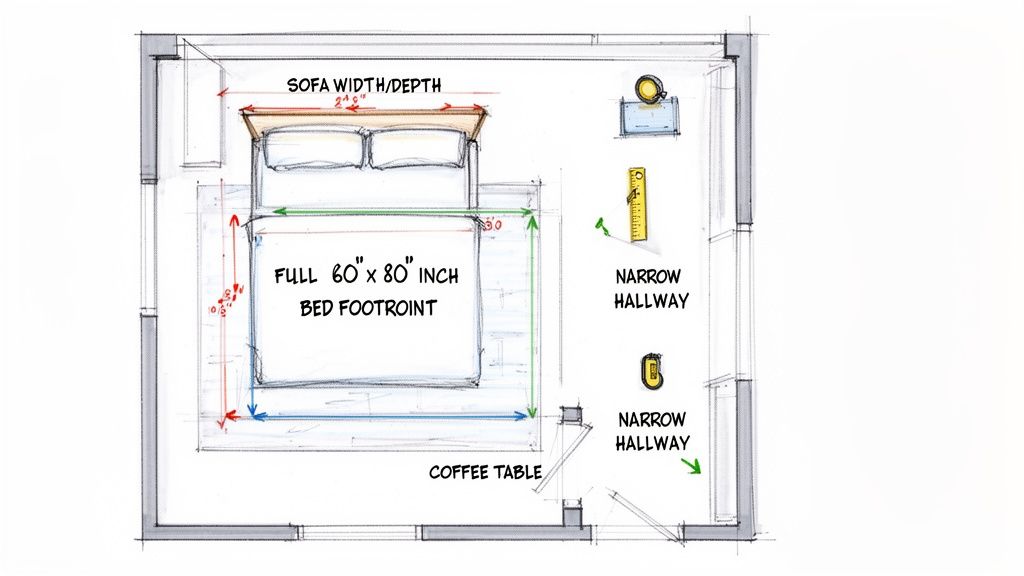
We’ve all heard the horror stories. Someone falls in love with a piece of furniture at the showroom, only to get it home and realize it won’t fit through the front door. Or worse, it crams into the room and completely overpowers the space.
With a multifunctional piece like a queen size futon, measuring isn’t just a good idea—it’s everything. Taking the time to do it right prevents those massive headaches and guarantees your new investment actually looks and feels at home.
Think of your futon as a performer that needs its own stage. It doesn’t just sit there; its main act is converting from a sofa to a bed. That means you have to plan for enough room for it to perform its signature move without bumping into walls, coffee tables, or anything else in its way.
Charting Your Futon’s Two Personalities
[Image demonstrating how to measure wall space, depth, and total projection for a sofa bed]
A queen size futon sofa bed lives a double life, and you need to account for both its forms. Grab a tape measure, because this is the most critical first step before you even start browsing.
1. The “Sofa” Dimensions (Upright Position):
- Width: Measure from the outer edge of one arm to the other. This tells you exactly how much wall space it will command.
- Depth: This is the distance from the very front of the seat cushion to the absolute back of the frame. It dictates how far the futon will jut out into your room.
- Height: Measure from the floor to the highest point of the futon’s back. This is key for fitting it under windowsills, shelves, or that piece of art you love.
2. The “Bed” Dimensions (Converted Position):
- Sleeping Footprint: When laid flat, a standard queen mattress is 60 inches wide by 80 inches long. This is the non-negotiable floor space it will occupy as a bed.
- Total Projection: Now, measure from the wall to the outermost edge of the fully converted bed. This is often longer than the 80-inch mattress because of how the frame extends. Don’t skip this one!
Before you get your heart set on a specific model, it’s a good idea to learn how to properly measure your room for new furniture. Mastering this step prevents that sinking feeling when you realize your new purchase is just a few inches too big.
Planning for Clearance and Pathways
Once you have the futon’s numbers, it’s time to map them out in your actual room. It’s not enough for the futon to just squeeze in; you need “breathing room” to actually use it without a struggle.
A super-effective trick is to use painter’s tape to mark the futon’s sofa and bed footprints on your floor. This simple visualization shows you its real-world scale and how it will impact your daily flow.
Here are the key clearance zones to keep in mind:
- Conversion Clearance: Make sure there’s enough open space in front of the futon to let it open completely. You really don’t want to have to haul your coffee table out of the room every time a guest stays over.
- Walkway Clearance: Try to maintain at least 30-36 inches for your main walking paths around the furniture. This keeps the room from feeling cramped and lets you move around freely.
- Door and Hallway Clearance: This is the final boss of furniture delivery. Measure the width and height of every doorway, elevator, and stairwell on the delivery path. And don’t forget to look out for tight corners or low ceilings that can stop a delivery in its tracks.
By planning for these details, you can confidently pick a queen futon that feels like it was made for your space. For a detailed breakdown of different sizes, our comprehensive futon sizing charts have all the info you need.
Choosing the Right Mattress for Ultimate Comfort
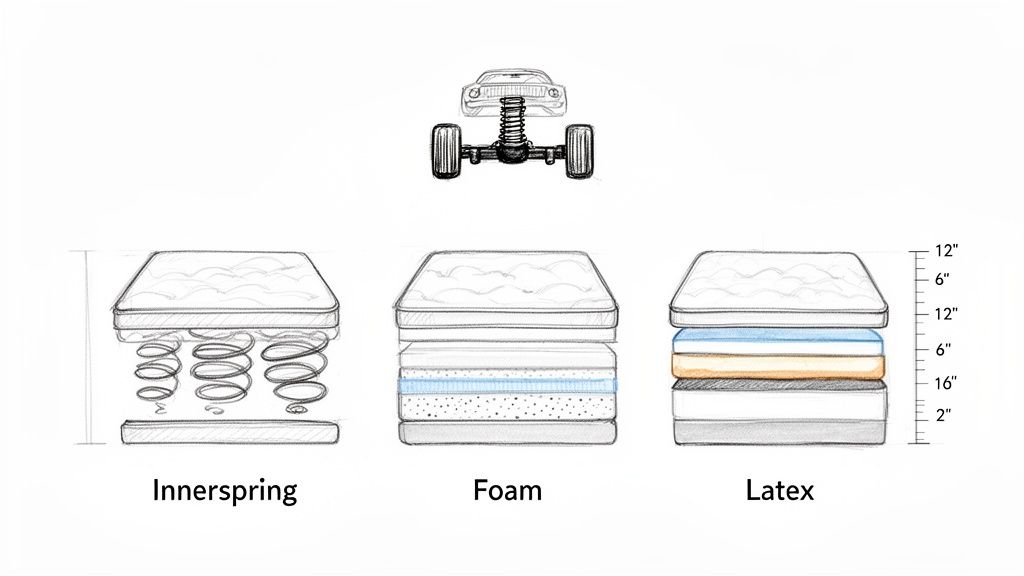
The frame might be the skeleton, but the mattress is the heart and soul of your queen size futon sofa bed. It’s the single most important part of the equation, determining whether you’re settling in for a movie marathon or hosting guests for a week. A great mattress transforms a futon from just a practical piece of furniture into a genuinely luxurious spot for rest.
Choosing the right one can feel a little overwhelming with all the different materials and terms out there. But it really all boils down to a simple idea: how the mattress supports you.
Decoding Mattress Types: Innerspring vs. Foam
Think of a mattress like a car’s suspension system. A sports car has a firm, responsive ride that lets you feel the road, while a luxury sedan has a soft, cushy suspension that absorbs every bump. Neither one is “better”—it’s all about the experience you prefer. Futon mattresses work in a similar way, with two main “suspension” types.
Innerspring Mattresses: The Supportive Classic
An innerspring mattress is like that sports car suspension. It uses a network of steel coils to provide a firm, bouncy, and highly responsive feel.
- Firm Support: The interconnected coils create a supportive surface that’s great for both sitting and sleeping because it resists sagging.
- Excellent Airflow: The open space between the springs allows air to circulate freely, making it a cooler option for sleeping—a big plus for hot sleepers.
- Familiar Feel: It offers that traditional mattress bounce that many people are used to and prefer.
This type is often the perfect choice if your futon will get a lot of use as a sofa, as the springs hold their shape exceptionally well under the focused pressure of sitting.
Foam and Latex Mattresses: The Contouring Innovator
Foam and latex mattresses are like the luxury sedan’s ride. They’re designed to absorb pressure and mold to your body’s unique shape, giving you targeted relief right where you need it.
- Pressure Relief: These materials cradle your shoulders and hips, which can be a total game-changer for side sleepers.
- Motion Isolation: If you’re sharing the bed, you’re far less likely to feel your partner tossing and turning. A true relationship saver!
- Quiet Operation: Unlike some spring systems, foam and latex are completely silent.
These are fantastic choices if your futon will serve as a primary or frequent guest bed, since their contouring properties excel at providing all-night comfort. If you want to dive deeper, exploring a wide range of futon mattresses can help you pinpoint the style that suits you best.
The Rise of Healthier Materials
These days, what’s inside your mattress matters more than ever. A growing awareness of indoor air quality has created huge demand for materials that are better for both you and the environment. Many modern futon mattresses now feature low-VOC (Volatile Organic Compound) and organic materials.
Low-VOC mattresses are made without certain industrial chemicals that can “off-gas” into your home. Choosing materials like organic cotton, natural wool, or Talalay latex helps create a cleaner, healthier indoor environment, which is especially important in smaller living spaces like city apartments.
These natural materials also come with some amazing performance perks:
- Organic Cotton: Soft, breathable, and naturally hypoallergenic.
- Natural Wool: A fantastic temperature regulator, it keeps you cool in the summer and warm in the winter. It’s also a natural fire retardant.
- Natural Latex: Derived from rubber trees, it’s incredibly durable, responsive, and resistant to dust mites and mold.
How Thickness Impacts Your Comfort
Finally, let’s talk about mattress thickness. This isn’t just about looks; it directly affects both sitting and sleeping comfort in a big way. Futon mattresses typically range from a slim 6 inches to a plush 12 inches.
- 6-8 Inches: Best for occasional use or on tri-fold frames that need more flexibility. They provide a firm, sofa-like sitting surface.
- 8-10 Inches: This is the versatile sweet spot. This thickness offers a great balance of support and cushioning, making it suitable for daily sitting and frequent sleeping.
- 10-12 Inches: The peak of luxury. These thicker mattresses deliver a truly bed-like experience, perfect if your futon is your main sleeping surface.
The futon sofa bed world is growing fast, on track to become a $1.2 billion market by 2035, partly because of these incredible comfort innovations. In North America, where over 30% of homes under 1,000 square feet use hybrid furniture, these pieces are essential. A quality queen futon sofa bed is built to last, with core materials rated for 8-10 years of daily use and the ability to support up to 600 pounds.
Understanding Frames and Conversion Mechanisms
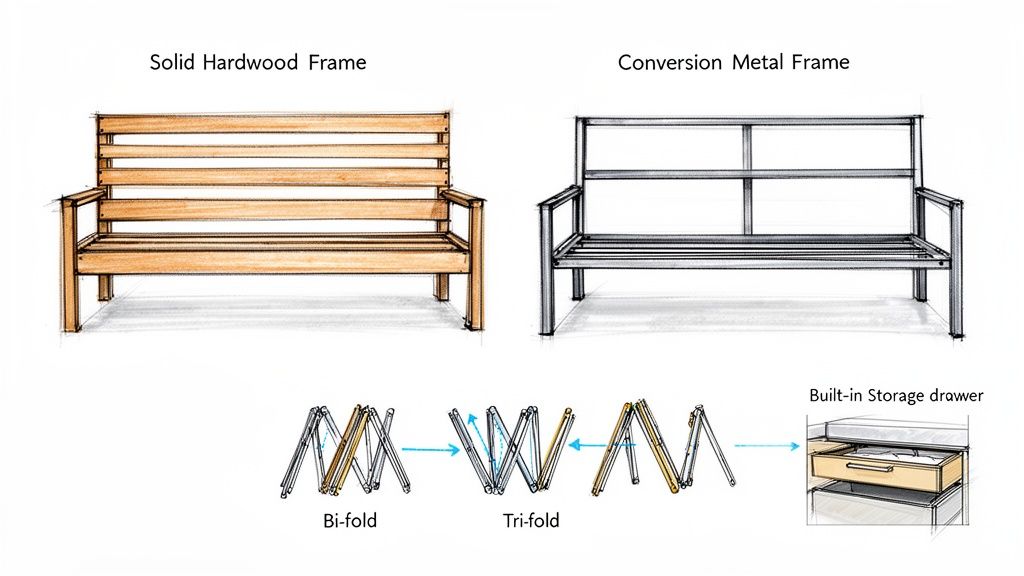
A truly great queen size futon sofa bed is built on a strong, dependable foundation. While the mattress gets all the attention for comfort, the frame is the unsung hero—the skeleton that dictates the futon’s long-term durability, its overall style, and just how easy it is to use every single day.
Think of the frame like the chassis of a car. A well-engineered chassis provides a stable, smooth ride for years, while a flimsy one will feel rickety and unreliable no matter how nice the seats are. Investing in a quality frame is what keeps your futon a sturdy, functional piece of furniture instead of becoming a wobbly disappointment down the line.
Hardwood vs. Metal Frames
The material your futon frame is made of does more than just define its look; it directly impacts its strength and how long it’ll last. The two main options you’ll find are solid hardwood and metal, and each one brings something different to the table.
Solid Hardwood Frames:
Hardwood is the gold standard for futon frames, and for good reason. It’s prized for its exceptional durability and timeless aesthetic. Woods like oak, maple, and cherry offer incredible strength, resisting warping and wear over the years.
- Longevity: A well-crafted hardwood frame can easily last for a decade or more, making it a fantastic long-term investment.
- Stability: The natural weight and rigidity of hardwood create an incredibly stable base for both sitting and sleeping, which means no annoying creaks or wobbles.
- Style Versatility: Hardwood can be finished in a huge range of stains and paints, so it can fit into just about any decor, from rustic to mid-century modern.
Metal Frames:
Metal frames offer a sleek, modern, and often more budget-friendly alternative. They are typically lighter than their wood counterparts, which can be a huge plus for renters or anyone who anticipates moving.
- Affordability: Metal frames are generally less expensive, making them a great entry-point option without a huge upfront cost.
- Lightweight Design: Their lower weight makes them much easier to move and assemble.
- Modern Aesthetic: With clean lines and minimalist profiles, metal frames are a perfect match for industrial or contemporary design schemes.
While both materials have their place, the choice really comes down to your priorities—the unmatched durability of wood or the lightweight, modern appeal of metal. To see a curated selection, you can explore a variety of sturdy and stylish futon frames and find the perfect match for your home.
Bi-Fold and Tri-Fold Conversion Mechanisms
How your futon transforms from a sofa into a bed all comes down to its conversion mechanism. The two main types are bi-fold and tri-fold, and understanding the difference is key for planning your space and choosing the right mattress.
A bi-fold mechanism is the most common for queen size futon sofa beds. It works by folding the mattress in half lengthwise, with one section forming the seat and the other forming the backrest.
Bi-Fold Frame Analogy: Imagine folding a book in half. The spine is the hinge, and the two covers become the seat and back. This simple, robust design can support thicker, more luxurious mattresses, making it ideal for a futon you plan to sleep on frequently.
A tri-fold mechanism, on the other hand, folds the mattress into three sections. This design usually has a smaller footprint when it’s a sofa because the mattress is tucked away more compactly. The trade-off is that it requires a thinner, more flexible mattress to handle that extra fold, which can sometimes compromise sleeping comfort.
Practical Features That Elevate Functionality
Beyond the core materials and mechanisms, some frames come with brilliant features designed to make life in a smaller space a whole lot easier. One of the most valuable additions you can find is built-in storage.
Many modern queen futon frames come with large drawers integrated right into the base. These are perfect for stashing away pillows, blankets, and extra bedding, keeping your living area tidy and clutter-free. This feature is especially impactful in studio apartments where every square inch of storage counts. In fact, as futons evolved from their initial U.S. retail boom, these practical enhancements became a huge selling point; today, an estimated 40% of models include storage drawers.
The demand for such functional pieces is part of a larger trend toward space-saving furniture, where full and queen variants now command over 55% of futon mattress revenues. These durable pieces are built to last, with frames tested to withstand 20,000 open-close cycles and upholstery designed to resist over 50,000 abrasion rubs. Discover more insights about these durable furniture trends by exploring our convertible sofa beds. This focus on engineering ensures your queen size futon sofa bed isn’t just a stylish choice, but a lasting and practical investment.
Matching Your Futon to Your Home Decor
A queen size futon sofa bed shouldn’t just be a problem-solver for your space; it should be a key player in your room’s overall design. When you get the frame and upholstery right, your futon goes from a purely practical piece to a stylish centerpiece that genuinely reflects your personality.
Think of your futon as a blank canvas. The frame sets the foundational tone—a warm oak frame can lean classic or mid-century, while a sleek black metal one feels more industrial or minimalist. But the real transformation happens with the upholstery, which is like the outfit that brings its character to life.
Finding the Perfect Fabric
The fabric you choose is always a balance between looks and lifestyle. For a busy household with kids, pets, or frequent guests, performance fabrics are an absolute game-changer. These materials are engineered to resist stains, moisture, and fading, making them incredibly durable and a breeze to clean.
On the other hand, if your futon is destined for a more formal living room or a dedicated guest space, you can explore more sophisticated textures. Materials like woven linen, soft chenille, or even vegan leather can give your futon a high-end, bespoke look that easily rivals traditional designer sofas.
The Power of a Custom Cover
One of the biggest advantages of a futon is the ability to completely change its look with a new cover. This is where you can truly make the piece your own and sync it with your home’s decor—a feature that traditional sofa beds just can’t match.
A futon cover is like a new paint job for your room’s most important piece of furniture. It’s an affordable and simple way to update your style, adapt to seasonal color palettes, or just refresh your space without buying a whole new sofa.
This flexibility is unmatched. You could start with a neutral gray cover for a calm, minimalist vibe, then swap it for a bold jewel tone a year later to make a statement. You could even have multiple covers to rotate throughout the year. If you’re looking for inspiration, exploring different styles of custom futon covers shows you just how much a simple fabric change can accomplish.
Aligning with Popular Design Styles
Your queen size futon sofa bed can effortlessly become the anchor for some of today’s most popular interior design themes. It all comes down to matching the frame and fabric to the core principles of each style.
Here’s how you can make it work:
- Scandinavian Modern: This style is all about clean lines, function, and natural materials. Pair a light-colored wood frame (like birch or pine) with simple, neutral upholstery in gray, beige, or a soft pastel.
- Minimalist Japandi: A fusion of Japanese minimalism and Scandinavian function, Japandi focuses on natural textures and a calm, uncluttered feel. Go for a dark wood or black metal frame and pair it with a textured, organic fabric in an earthy tone like cream, charcoal, or muted green.
- Classic Mid-Century: Defined by organic shapes and tapered legs, this style is truly timeless. A solid walnut or teak-finished wood frame with angled arms is the perfect base. Finish the look with upholstery in a classic mid-century color like mustard yellow, teal, or burnt orange.
By carefully choosing these elements, your queen futon becomes more than just a place to sit and sleep—it becomes an intentional part of your home’s story.
Your Common Questions Answered
When you’re diving into the world of futons, a few questions always pop up. Getting clear, real-world answers is the last step before you can feel truly confident in your choice. Let’s tackle the most common things buyers want to know about comfort, durability, and making sure everything fits together.
How Comfortable Is a Futon for Everyday Sleeping?
Absolutely. A high-quality queen futon can be just as comfortable as a traditional bed, sometimes even more so. The secret is all in the mattress. When you go for a premium, thicker mattress—think 8 to 12 inches—built with a solid core like innersprings or high-density foam, you’re getting consistent, all-night support.
Forget those old-school sofa beds where you’re stuck sleeping on a flimsy mattress with a metal bar digging into your back. A modern futon uses one solid mattress for both sitting and sleeping. Pair that with a sturdy hardwood frame, and you have an even, comfortable foundation that plenty of people happily use as their primary bed.
The bottom line is simple: Don’t skimp on the mattress. A great mattress on a solid frame isn’t a compromise; it’s a legitimate, comfortable bed that just happens to double as a stylish sofa.
What Is the Average Lifespan?
How long your queen futon sofa bed lasts really comes down to its parts and how you use it. A well-made frame crafted from solid hardwood is a true long-term investment, easily lasting 10 to 15 years—or even longer with a little care. These frames are built tough enough to handle being converted daily without getting wobbly or weak.
The mattress has a lifespan closer to a conventional one, typically around 7 to 10 years. Its durability is a direct reflection of its quality. By picking a reputable brand for both the frame and the mattress, you can be sure your futon will stay a reliable and comfortable piece of furniture for years.
Can Any Queen Mattress Fit Any Queen Frame?
This is a super important question, and the short answer is no, not always. While the dimensions are standard (60×80 inches), the way the frame folds determines what kind of mattress will work.
- Bi-Fold Frames: These are the most common and flexible. They fold the mattress once, right down the middle, and can handle thicker, more luxurious mattresses, often up to 12 inches.
- Tri-Fold Frames: These bend the mattress in two places, so they need a more flexible and usually thinner mattress (typically 6-8 inches). A mattress that’s too thick or stiff just won’t be able to make those folds correctly.
Always double-check the frame manufacturer’s specs for the recommended mattress thickness. This guarantees you’ll get a perfect fit and a piece of furniture that operates smoothly.
Ready to find the perfect queen size futon sofa bed that fits your space and style? Explore the extensive collection at Futonland and discover versatile, high-quality solutions for modern living. Shop now at Futonland.com.