Glass Top Dining Table Set: Pros, Cons & Care Guide
You’re probably looking at a dining corner that has to do too much. It has to work for dinner, coffee, laptop time, maybe a quick meeting, maybe guests on the weekend. In a small apartment, that usually means every piece needs to earn its footprint.
That’s why a glass top dining room table set gets attention so quickly. On a screen or in a showroom, it seems to solve the whole problem at once. It looks lighter than wood. It lets the room breathe. It doesn’t visually block flooring, rugs, or daylight. In a tight layout, that matters.
But glass is one of those materials that can look better in a product photo than it feels in daily life. Some people love it for years. Others get tired of wiping it down after the first week. The difference usually isn’t style. It’s lifestyle, traffic, and whether you’re buying for how your home looks at 2 p.m. or how it behaves at 8 a.m. on a Tuesday.
Is a Glass Dining Set Right for Your Home
A lot of shoppers arrive at glass for the same reason. They’re furnishing a smaller room, they don’t want a bulky visual block in the center of it, and a solid wood table feels too heavy. In that moment, glass makes perfect sense. It reads clean, modern, and spatially generous.
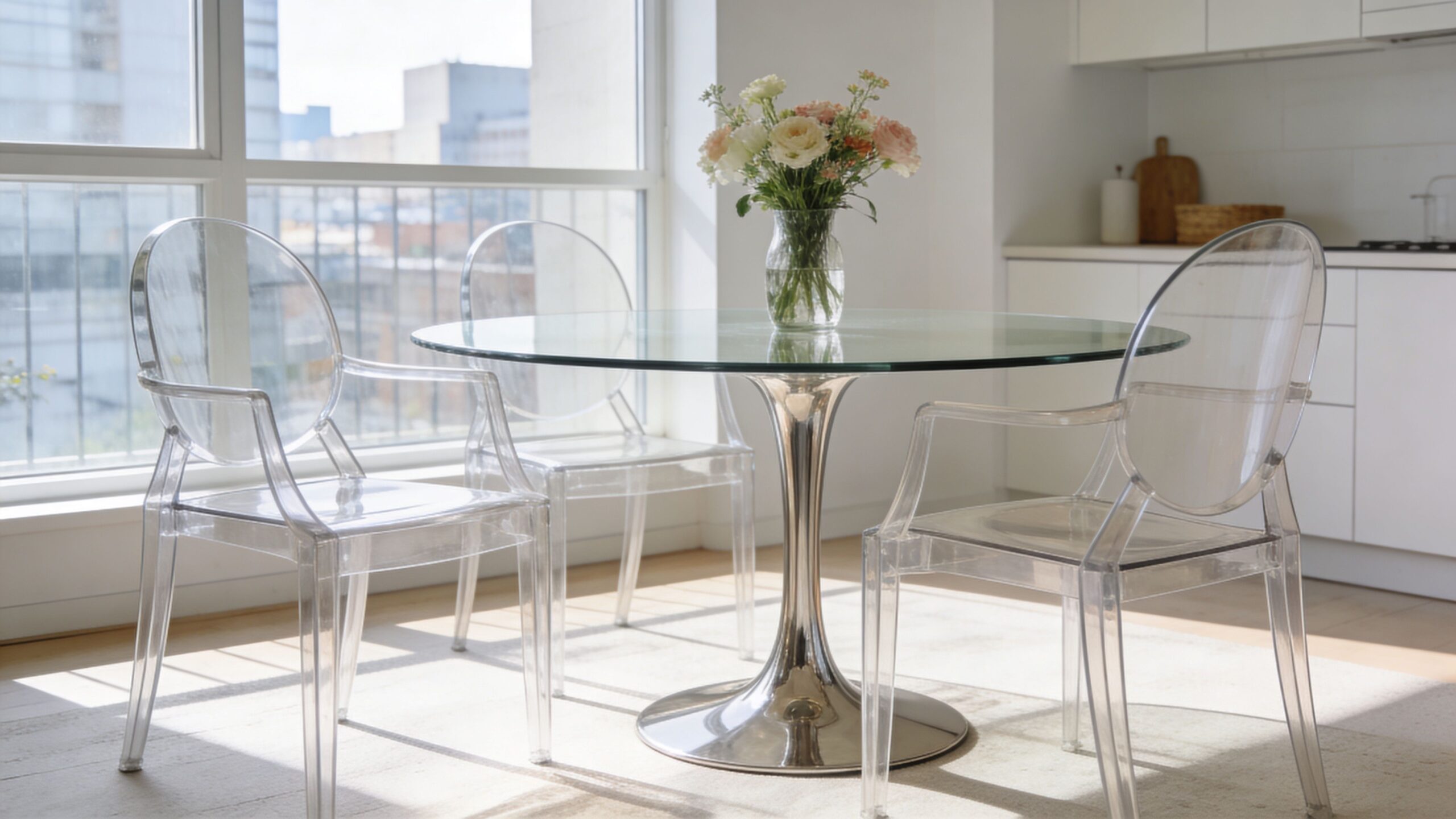
That appeal isn’t new. Durable glass for tables traces back to the late 1600s, when English and French glassmakers developed lead crystal and improved plate glass processes, making glass strong enough for furniture for the first time. Glass has been part of dining design for centuries because it does something few materials can do. It adds presence without adding visual weight.
If you’re browsing kitchen and dining room furniture, the right question isn’t “Does glass look good?” It usually does. The better question is whether your home will support the trade-offs that come with it.
Where glass works best
Glass usually works well in homes with these conditions:
- Limited square footage where a wood slab would make the room feel crowded
- Design-led interiors that lean modern, transitional, or minimalist
- Adults or careful households where the table won’t take constant impact
- Multi-use dining areas where visual lightness matters as much as function
Where buyers tend to regret it
Glass is often a weak fit when the table has to absorb rough everyday use.
Glass looks open and polished. It also records almost everything that touches it.
If your dining table doubles as a kids’ craft station, homework desk, daily office, drop zone, and meal surface, you need to think beyond the first impression. That’s where the smart decision happens.
The Honest Truth: Pros and Cons of Glass Tables
The best reason to buy a glass dining table is visual. The best reason not to buy one is practical. Both are real.
What glass does very well
A glass top can rescue a cramped dining area. In a railroad apartment, a small eat-in kitchen, or an open-plan living room where every sightline matters, it keeps the room from feeling chopped up. You still get a full dining surface, but the eye reads more floor, more rug, and more air.
Glass is also easy to wipe after meals. Sauces, wine splashes, coffee rings, and oily fingerprints don’t soak in the way they can with porous materials. If you want a surface that doesn’t hold onto stains, glass is appealing.
Another plus is flexibility. A clear top can work with almost any chair style or base finish. It can lean warm with walnut, crisp with chrome, softer with upholstered chairs, or more architectural with black metal.
Practical upside: In small apartments, glass often solves a space problem that wood can’t. It gives you full function without the same visual bulk.
There’s also a reason designers use it when a base deserves attention. If the pedestal or sculptural frame is the star, a transparent top lets you see it.
What owners get tired of
Now the hard part. Glass shows everything.
It shows fingerprints from breakfast, sleeve marks from work calls, dust in afternoon light, and smudges that seem to appear right after you cleaned it. If you like a spotless table, you’ll be wiping often. If you don’t like wiping often, glass can become annoying fast.
Damage is another issue. A scratch in wood can sometimes blend into character. A scratch or chip in glass usually doesn’t. It reads as damage. The same goes for edge chips. Once they happen, they tend to stay visible.
Noise matters too. Plates, mugs, keys, and laptops all sound harder on glass than on wood. Some people don’t mind that crisp sound. Others find it cold and tiring, especially when the table is used all day.
The family and pet question
Be blunt with yourself here: if you have young children, very active pets, or a tight apartment where people brush past furniture constantly, don’t choose glass casually.
Even with tempered glass — which is what any dining table should use — safety isn’t the same as invulnerability. Table-glass injuries are a real and recurring category of household accidents, and children are disproportionately involved, mainly because collisions and falls near furniture are simply more common at kid height.
In a narrow apartment layout, the issue often isn’t just breakage. It’s daily collision risk, unstable traffic flow, and how close chairs, corners, bags, and bodies move around the table.
A quick decision guide
| If this sounds like you | Glass may work | Glass may frustrate you |
|---|---|---|
| You want the room to feel larger | Yes | |
| You hate visible smudges | Yes | |
| You host adults and use placemats | Yes | |
| Your table doubles as a heavy-duty work surface | Yes | |
| You have young kids running around the table | Yes | |
| You want a clean modern look with minimal bulk | Yes |
A glass table isn’t high-maintenance in the abstract. It’s high-visibility. Every bit of life shows up on it.
Understanding Glass Table Construction and Materials
Most problems with a glass dining table start before delivery. They start when the buyer doesn’t know what they’re looking at. The top matters. The base matters just as much. Sometimes more.
The top should be tempered glass
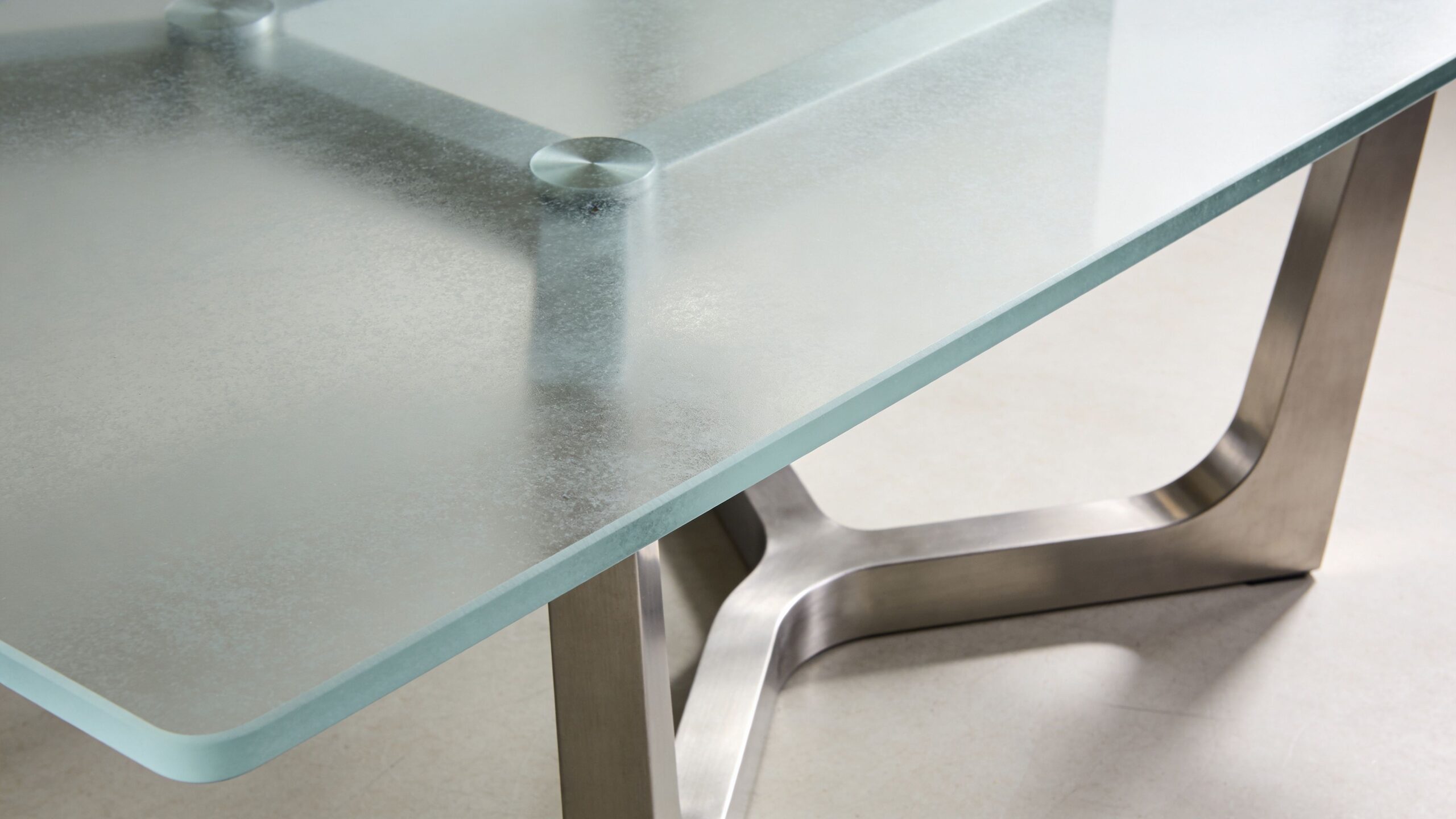
For dining use, tempered glass isn’t a nice extra. It’s the standard you want. Tempered glass goes through a thermal treatment that leaves the surface under compressive stress, which makes it significantly stronger than standard annealed glass of the same thickness. When it does break, it fractures into small, blunt granules instead of sharp shards — the property that safety glazing standards like ANSI Z97.1 are built around.
That’s the minimum threshold for a serious dining table. If a product listing is vague about the glass type, press for a clear answer before buying.
Thickness affects feel, not just specs
Thickness changes how substantial a table feels and how stable the top behaves across a span. A thinner glass top can look elegant, but on a larger table it may feel less confidence-inspiring. Heavier tops tend to feel calmer and more anchored, especially when the table sees regular daily use.
If you’re shopping dining tables, pay attention to the relationship between the top and the base. A thick tempered top on a weak or underscaled base still won’t feel right. Good construction is a pairing, not a single feature.
Clear, frosted, and tinted glass
These are style choices, but they also affect day-to-day experience.
Clear glass
Clear glass is the cleanest and most open-looking option. It’s also the most revealing. You see the base, the rug, the floor, and every crumb, streak, and fingerprint. For a room that needs airiness, clear is usually the most dramatic choice.
Frosted glass
Frosted glass softens the look. It diffuses what’s below and tends to feel less stark. If you want some of the lightness of glass without the same degree of visual exposure, frosted can be easier to live with. It also suits people who like modern finishes but don’t want the top to feel too glossy.
Tinted glass
Tinted glass adds mood. Bronze or gray tones can make a table feel more tailored and less sharp than fully clear glass. It works well in interiors with black metal, smoked finishes, or darker upholstery.
Edge finish changes the personality
A lot of buyers focus on shape and forget the edge. That’s a mistake, because the edge finish changes both comfort and appearance.
- Flat polished edges look crisp and contemporary
- Beveled edges catch light and feel a bit dressier
- Rounded or softer profiles generally feel less severe in tighter family spaces
If you tend to bump furniture in narrow walkways, softer lines are usually easier to live with than sharp, hard geometry.
Base materials do more than support the top
The base decides whether the table feels warm, cool, heavy, sculptural, casual, or formal.
Wood bases
Wood under glass softens the material. This is often the best way to keep a glass top from feeling cold. Walnut, oak-look, or mixed wood tones make the piece easier to integrate into apartments that already have wood flooring and warmer finishes.
Metal bases
Metal creates a cleaner, sharper look. Black metal feels graphic. Chrome or polished steel reads more contemporary and reflective. Metal can be excellent visually, but it needs to feel solid, not flimsy.
Mixed-material bases
These usually give the best balance in real homes. A wood-and-metal base can make the table feel less sterile while still looking current.
The smartest glass tables don’t rely on the glass for style. They pair a safe top with a base that brings warmth, stability, and enough visual substance to ground the room.
A glass top dining room table set should feel resolved from every angle. If the base looks underbuilt, the whole set will feel temporary no matter how elegant the glass looks.
How to Choose the Right Size and Style for Your Space
The easiest way to buy the wrong dining set is to measure only the table and ignore how people move around it. In apartments, circulation matters as much as dimensions.
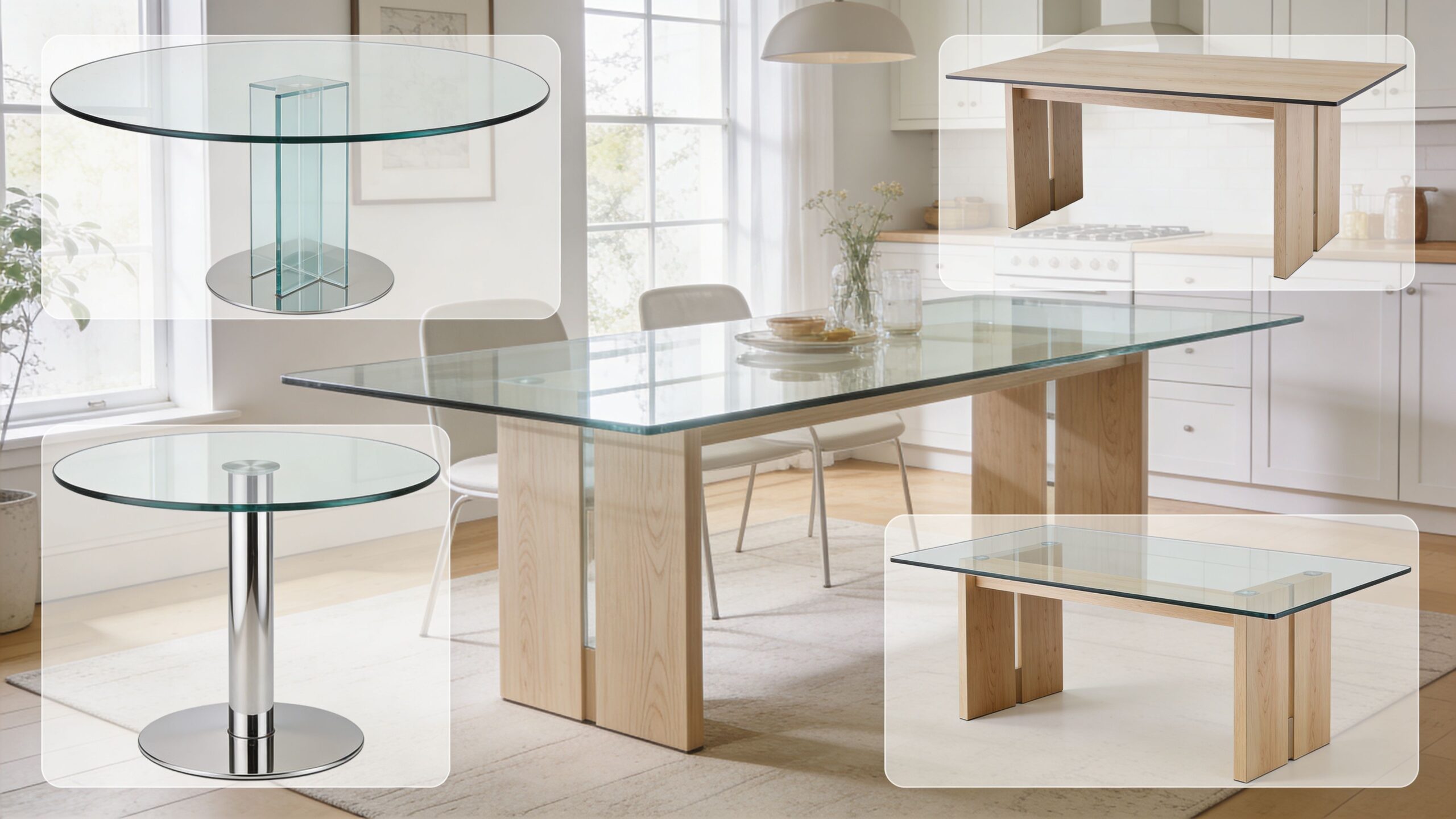
Start with ergonomics, not style
Good dining comfort has very boring numbers behind it, and that’s a good thing. Standard dining table height runs about 30 inches, which pairs well with a chair seat around 18 to 19 inches high — that gap gives most people comfortable thigh clearance. A table width of at least 36 inches gives each diner roughly 24 inches of personal space at the table.
That means a beautiful table can still feel wrong if the chairs sit too high, the apron crowds knees, or the top is too narrow for place settings and elbows.
Measure the room the way you’ll actually use it
A dining table in a catalog exists by itself. Yours won’t. It will exist next to a sofa, radiator, wall, island, sideboard, or kitchen run.
Use this approach before you buy:
- Map the table footprint with painter’s tape on the floor.
- Pull chairs out realistically, not just halfway.
- Walk around it carrying something, because that’s how the room will be used.
- Check sightlines from the entry, living area, and kitchen.
If the taped shape already feels crowded, the actual set won’t feel better once chairs and people are added.
Shape matters more with glass
Glass visually lightens any shape, but the shape still controls movement.
Round tables
Round glass tables are often the easiest fit in tight dining corners. No corners means easier circulation, fewer sharp points in narrow walkways, and a softer visual rhythm. They work well when the table also serves as a casual workspace because you can shift position easily.
Rectangular tables
Rectangular glass tables are better when you need defined seating and more serving surface. They suit longer walls and open-plan spaces where the dining zone needs clearer structure.
Pedestal versus legged bases
Pedestal bases usually improve flexibility because there are fewer legs competing with chairs. Traditional corner legs can work, but in a compact room they often limit where chairs can tuck.
If the room is tight, prioritize a shape that helps movement first. A beautiful table that disrupts traffic will always feel too big.
Matching chairs to the table
The base and the chairs need to talk to each other, but they don’t need to match exactly.
Here are a few combinations that tend to work:
- Glass with wood base plus upholstered chairs creates warmth and helps a modern table feel more livable.
- Glass with black metal base plus slim chairs suits urban interiors, especially if the room already has black fixtures or industrial notes.
- Glass with sculptural pedestal plus simple chairs keeps the focus where it belongs.
- Glass with acrylic or very airy chairs can work in tiny rooms, though too much transparency can start to feel cold.
If you’re shopping dining chairs and benches, don’t judge them by silhouette alone. Think about seat height, back width, and whether the chair can tuck cleanly under the table without hitting supports.
A simple style matrix
| Table base | Best look | Good chair partner |
|---|---|---|
| Wood | Warm modern, transitional, Scandinavian | Upholstered or wood-frame chairs |
| Black metal | Urban, contemporary, minimal | Slim upholstered or metal-frame chairs |
| Polished metal | Glam, modern, formal | Tailored upholstered chairs |
| Pedestal mixed material | Sculptural, design-forward | Simple side chairs that don’t compete |
One more honest note. Extendable glass tables exist, but people expecting frequent, easy expansion are often happier with a non-glass material if that flexibility is a real priority. Simplicity usually wins with glass.
Daily Care, Durability, and Long-Term Maintenance
The sales pitch for glass is usually “easy to clean.” That’s only half true. Glass is easy to wipe. It is not always easy to keep looking perfect.
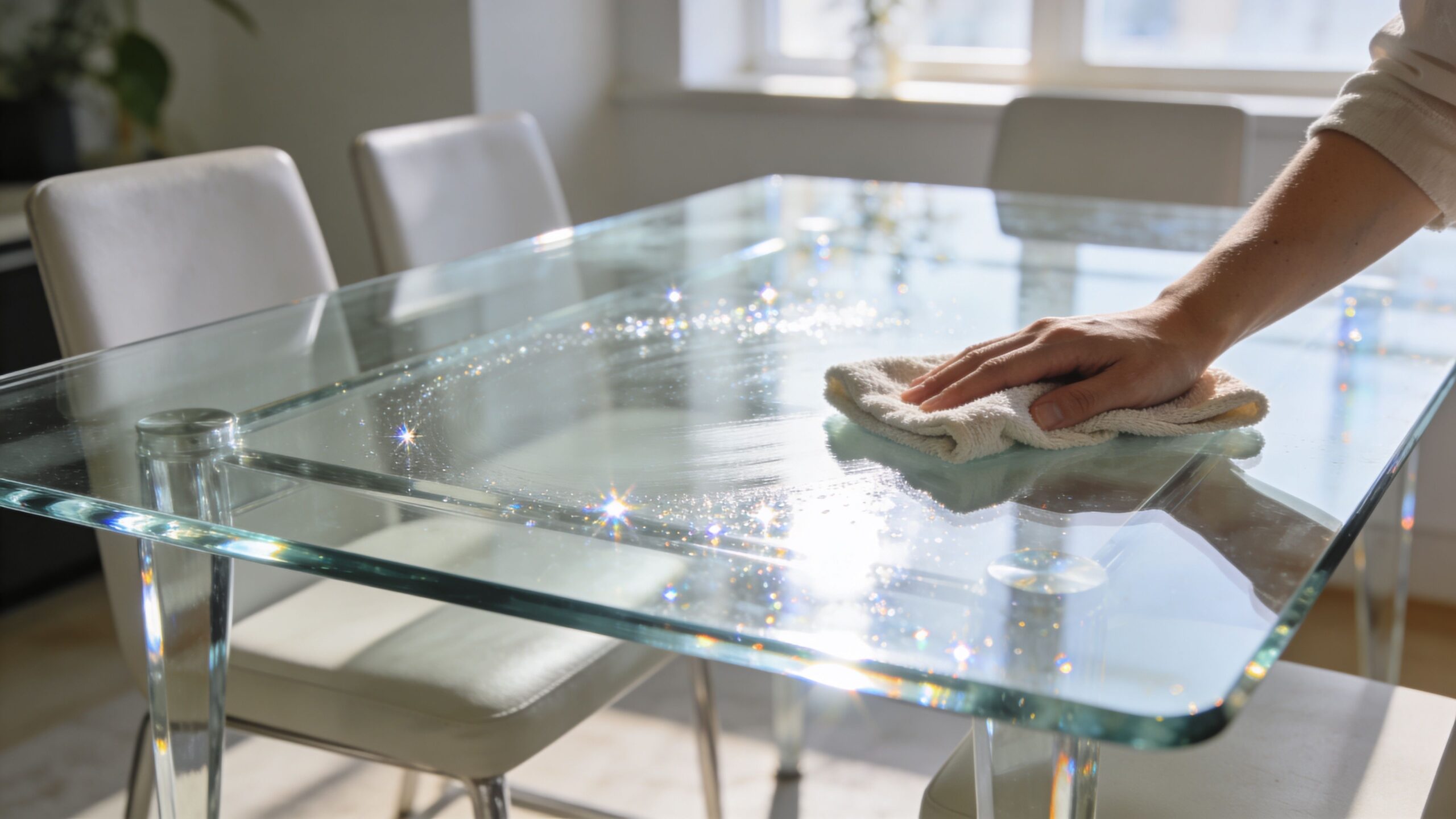
For long-term ownership, the primary issue isn’t one spill. It’s the accumulation of streaks, mineral haze from hard water, and fine scratches that build up under daily utensil and object contact.
What daily care actually looks like
If you own a glass table and want it to stay attractive, consistency matters more than aggressive cleaning.
- Use microfiber cloths instead of paper towels, which tend to push residue around.
- Clean lightly but often so grime doesn’t build up into haze.
- Dry the surface after wiping rather than letting moisture evaporate on its own.
- Treat the edges carefully because residue often collects where the top meets the base or pads.
Prevention matters more than cleaning
A lot of wear can be avoided before it starts.
Use barriers on purpose
Placemats aren’t just decorative on glass. They reduce abrasion from plates, laptops, notebooks, and anything with a rough underside. Coasters matter too, especially if your water leaves mineral residue.
Keep grit off the surface
Tiny debris does more damage than is commonly expected. Salt crystals, crumbs, rough ceramic bottoms, and even decorative objects can drag across the top and leave fine scratches.
Don’t slide heavy items
Lift, don’t drag. That applies to centerpieces, serving bowls, laptop stands, and storage trays.
Glass ages best in homes where people use it deliberately. If your household tends to slide, drop, stack, and shuffle objects all day, the top will show that history quickly.
What doesn’t age well
Some buyers assume scratches can be “fixed later.” Usually, that’s not a good plan. Minor marks may become less noticeable with careful upkeep, but chips and deeper scratches tend to remain visible. Once edge damage happens, replacement is often more realistic than repair.
A glass dining table can still be a smart buy. It just needs to match the way you live. If you want a table you can ignore, glass probably isn’t it. If you’re comfortable maintaining it and protecting it, it can stay handsome for a long time.
Buying and Delivery for Your Dining Set
Buying a glass dining set isn’t only about choosing a finish. In the city, the bigger issue is logistics. Can the table get through the building, into the apartment, and assembled without turning delivery day into a problem?
That’s where service matters. A glass top and a substantial base can be awkward to move, and many buyers underestimate how difficult that becomes in walk-ups, elevators, narrow entries, and small dining areas where there isn’t much room to maneuver during setup.
Browse Futonland’s dining sets, especially if you’re already comparing complete table-and-chair combinations rather than building a set piece by piece. Futonland offers free NYC delivery over a qualifying purchase amount, white-glove assembly, debris removal, financing, price match support, and design help in-home or online.
Why those services matter for glass
- Delivery complexity because large tops and heavy bases are difficult in apartment buildings
- Assembly quality because a table can look fine but still feel wrong if it isn’t properly installed
- Decision fatigue because many buyers are balancing finish, scale, safety, and chair pairing at once
- Budget pressure because dining sets can become expensive once seating is added
What helps reduce buyer regret
| Need | Why it matters with glass |
|---|---|
| Professional delivery | Reduces handling risk in tight halls and stairwells |
| Assembly option | Helps the set feel stable and properly aligned |
| Financing | Makes a full set easier to buy at once instead of in stages |
| Design guidance | Helps avoid mismatched scale, finish, or chair height |
For a category that can feel deceptively simple, support makes a real difference. Glass is unforgiving of mistakes. That includes measuring mistakes, handling mistakes, and base-selection mistakes.
Frequently Asked Questions About Glass Dining Sets
Can a chipped or deeply scratched glass tabletop be repaired?
Usually, not in a way that makes it disappear. Very minor surface issues may become less noticeable with careful cleaning and selective polishing, but chips and deeper scratches tend to remain visible. That’s why prevention matters so much more with glass than with forgiving materials like wood.
Are glass dining tables safe for families with young children?
They can be safer when made with tempered glass, but “safer” isn’t the same as “ideal.” Tempered glass is the right material for a dining surface because it’s designed to break into blunt granules rather than dangerous shards. Even so, households with young children still need to think about collisions, hard edges, and the reality of fast daily movement around the table.
How much weight can a glass dining table hold?
There isn’t one universal answer because weight capacity depends on the thickness of the tempered glass, the span of the top, and the structure of the base. A well-built table with a substantial metal or wood base will behave very differently from a lighter design with a more delicate frame.
Is clear or frosted glass better for daily use?
It depends on what bothers you more. Clear glass looks lighter and more open. Frosted glass is often easier visually because it softens what you see through the top and can feel less exposed in everyday use.
Is a glass top dining room table set good for a workspace too?
It can be, but only if you’re disciplined about protection. Laptops, notebooks, chargers, ceramic mugs, and desk accessories can all leave wear over time. If your dining table is also your daily office, placemats or a desk pad help a lot.