Inexpensive Futons with Mattresses: What to Actually Look For
A lot of inexpensive futons with mattresses get bought for the same reason. One room has to do two jobs.
It might be a second bedroom that’s an office most days. It might be a studio where every square foot matters. It might be the extra room in a one-bedroom where guests stay a few times a month, but no one wants to give up the space to a full-time bed.
That’s where a futon makes sense — not as a “cheap substitute,” but as practical furniture that sits, sleeps, and fits a tighter budget better than buying a sofa and a bed separately.
Your Smart Guide to Inexpensive Futons with Mattresses
Most budget buyers aren’t looking for luxury. They’re looking for a setup that doesn’t waste money.
A common situation: you move into a new apartment, furnish the primary bedroom first, handle the living room next, and then look at the last room with whatever budget is left. That room still needs to work — somewhere to sit, somewhere for a guest to sleep, and something that doesn’t make the space look temporary. That’s where inexpensive futons with mattresses earn their place — a decent set solves the room without forcing you into a frame now and a mattress later, or a sofa that looks fine but sleeps terribly.
What budget buyers usually get wrong
The mistake isn’t buying inexpensive. The mistake is buying blind.
Many shoppers compare one sticker price to another and stop there. They don’t separate frame quality from mattress quality, don’t ask whether the mattress is thick enough for proper sleep, and don’t check whether the frame is solid wood, light metal, or something engineered to look stronger in photos than it is in use. That’s where buyer’s remorse starts — the set looked like a deal, and the daily experience says otherwise.
What matters
A budget futon is a smart purchase when the trade-offs are clear. For occasional guest use, you can accept more firmness and a simpler mattress. If you’re sitting on it every day and sleeping on it often, the frame matters more than most listings admit, and the mattress needs to be judged as a sleep surface, not a decorative add-on.
Buy for the way the room will be used most often, not for the photo that sold you on the listing.
The right inexpensive futon isn’t the lowest price on the page. It’s the one that gives you a durable frame, an honest mattress, and a realistic path to upgrade later if your needs change.
Frame vs. Mattress: Understanding the Value Equation
A futon set is not one product. It’s two. The frame handles structure, conversion, and long-term wear. The mattress handles comfort, support, and most of the sleep experience. Budget shopping gets much easier once you judge those two parts separately.
The frame is the long-term purchase
If you choose well, the frame stays with you through moves, guest-room changes, and mattress upgrades — which makes it the piece worth protecting. A solid frame that opens and closes smoothly, sits level, and holds up under repeated use has lasting value. A weak frame becomes a replacement problem: once the mechanism starts sticking or the joints loosen, even a decent mattress can’t save the experience.
The mattress is the replaceable layer
Entry-level packages usually include a mattress that’s good enough for the price, not exceptional for the price — and that’s not a flaw. It’s the honest trade-off that makes inexpensive futons with mattresses possible. Many buyers are satisfied with a practical starter mattress because it gets the room functional now. Later, if the room turns into a more frequent sleep space, the mattress can be upgraded without replacing the whole setup.
Why packages often make more sense
Buying frame and mattress together usually gives a cleaner value equation than piecing everything together separately, because you can judge the balance of the set: does the mattress match the frame’s intended use, and is the bundle meant for a guest room, a studio, or more regular sleeping?
- Room is for guests first: prioritize a sturdy frame and accept a simpler mattress.
- Room is used daily as seating: focus on frame stability and an easy conversion mechanism.
- Someone will sleep on it often: don’t spend your whole budget chasing a stylish frame while ignoring mattress comfort.
- Budget is tight today: choose the strongest frame you can afford and plan to improve the mattress later if needed.
The smartest budget purchase is often not the softest mattress in the room. It’s the setup that keeps working after the first year.
What to Look for in a Budget-Friendly Frame
You notice frame problems long before the mattress gives out — the seat starts to rock, the back refuses to lock in cleanly. What looked like a bargain begins to feel temporary after a few months of normal use. A budget futon doesn’t need ornate arms or a premium finish. It needs sound structure, decent hardware, and a conversion mechanism that can handle real life.
Start with the material, not the styling
Solid wood usually gives the best long-term value. Pine and rubberwood are common affordable choices and hold up well when the frame is built properly — they don’t have the visual weight of oak or maple, but they’re still real furniture materials.
Engineered wood is where many low-priced futons start to disappoint. MDF and particleboard can look fine online, especially under dark finishes, but weak spots tend to show up at joints, screws, and moving sections. Once those areas loosen, the whole futon feels less stable. Compare futon frame styles and construction and judge structure before styling.
Check the stress points
On an inexpensive futon, the weak points are predictable — the places that carry weight, absorb motion, or move every time the piece converts.
- Main joints: the frame should sit tight at corners and connection points, without visible gaps or twisting.
- Slat spacing and support: even support helps the mattress wear evenly and keeps the seat from feeling inconsistent.
- Hardware quality: bolts, brackets, and hinges should look sized for the frame, not like generic parts added to hit a price target.
- Conversion action: a futon should open and close without jerking, scraping, or excessive force.
This matters more than finish color or curved-arm styling — a cleaner silhouette doesn’t fix weak joinery.
Wood and metal fail differently
Metal frames have a place — for a low-use guest room or temporary setup, a simple metal frame is serviceable, and often lighter and cheaper. The trade-off is comfort and feel: many entry-level metal futons have more flex, more noise, and less visual warmth. Wood frames usually feel steadier as a sofa and pair better with thicker mattresses if you plan to upgrade later. A strong wood frame can stay in service for years while you replace an entry-level mattress with something better — often the smarter investment than a cheaper all-in-one set you’ll replace entirely when one part fails.
Match the frame to the room’s job
For occasional overnight guests, a straightforward hardwood frame does the job without pushing the budget. For frequent opening and closing, ease of conversion becomes part of durability. Wall-hugger and bi-fold designs are worth a close look if the futon will be converted often — they reduce awkward handling and make the piece more livable day to day.
Buy the frame as if you want to keep it. If money is tight, accept a simpler mattress now and improve it later — that approach leads to less regret than a flimsy frame with a nicer-looking surface.
Choosing a Futon Mattress That Won’t Disappoint
Most disappointment with inexpensive futons starts with the mattress, not the frame. Buyers assume “included” means “good enough for anything.” Usually it means “good enough for the price and the intended use.”
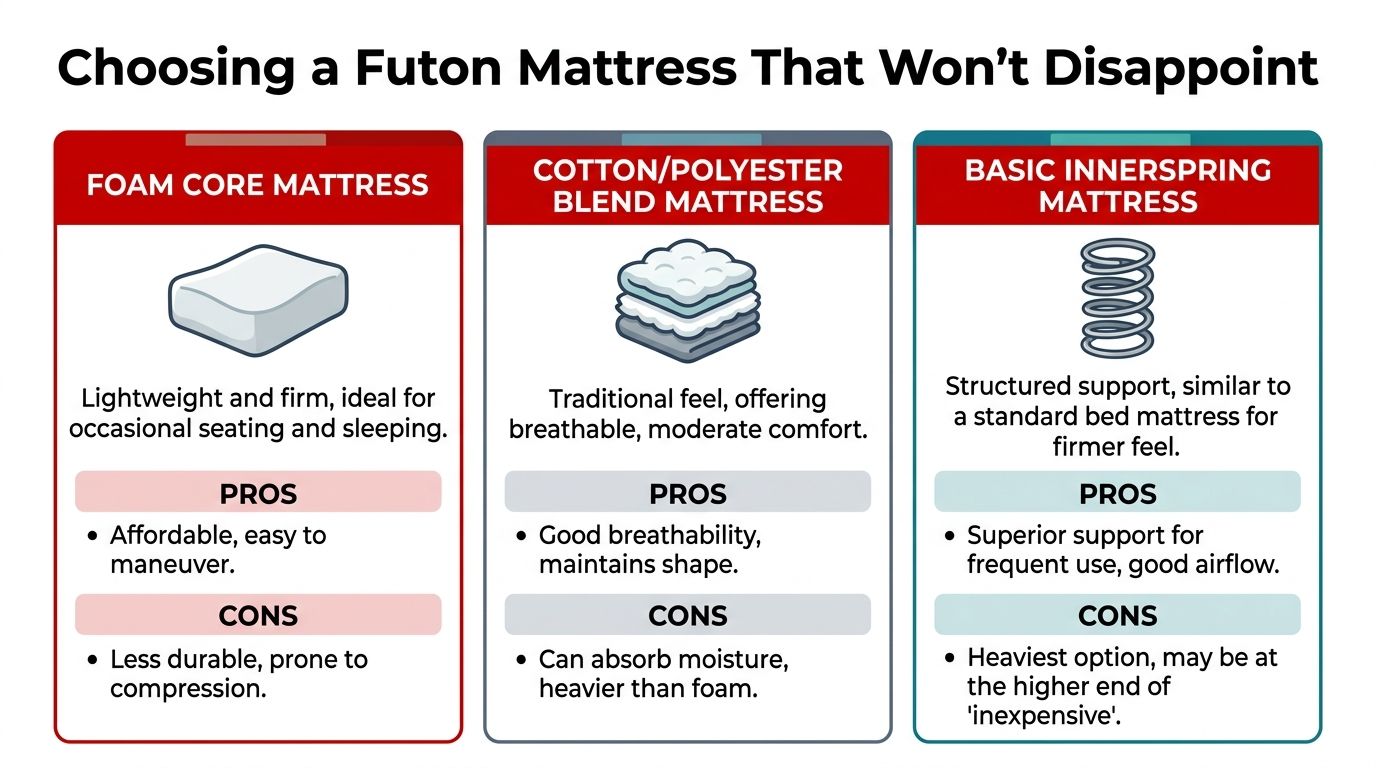
What entry-level mattresses feel like
In lower-priced sets, the most common mattress is a cotton or basic foam construction in a modest thickness. For occasional guests, that’s reasonable. For someone sleeping on it every night, the limits show up faster — cotton lacks the resilient binding of foam or spring construction and compresses noticeably faster under repeated folding. Our futon mattress buying guide covers this trade-off in more detail.
The three budget mattress paths
| Mattress Type | Relative Cost | Best For | Key Trade-Off |
|---|---|---|---|
| Cotton | Lowest in this category | Guest rooms, light use, tight budgets | Lowest cost, but faster compression and lumping over time |
| Basic foam or foam blend | Mid-entry range | Occasional sitting and sleeping | Lighter and easier to handle, but quality varies widely |
| Basic innerspring | Higher within the inexpensive range | More frequent sleeping, firmer support | Heavier and less convenient to convert regularly |
Cotton is honest, but not forgiving
Cotton’s advantage is straightforward value — usually the lowest-cost way to get a futon mattress, and it avoids some odor issues that come with cheap foam. The downside is predictability: cotton compresses, and if the futon gets used often as both sofa and bed, expect that change in feel and height over time. For a guest room, that trade-off is often acceptable. For a primary sleeper, it becomes noticeable.
Foam can help, but cheap foam needs scrutiny
Foam or cotton-foam blends feel more stable out of the gate and are often easier to live with if the futon gets folded frequently. The caution is material quality — some budget foam mattresses feel decent at first and then lose support quickly, or arrive with strong odor. If you’re shopping foam, ask what kind of foam is inside and whether the seller gives any real information beyond “plush” or “supportive.” A vague listing usually means a basic mattress.
Innerspring can be the better sleeper choice
A basic innerspring mattress often feels more familiar to people who dislike the denser, flatter feel of cotton, and can provide better support for frequent use. The trade-off is weight — a heavier mattress makes daily conversion more effort, and on a lighter frame that extra mass matters more.
Covers matter more than shoppers think
A weak cover shortens the useful life of a decent mattress. Once fabric starts wearing, shifting, or tearing at stress points, the mattress underneath ages faster and looks rough sooner. Look for durable upholstery, neat stitching, and a cover that can handle regular friction from sitting and folding. Removable covers are practical for a guest room, office, or family space where spills happen. Compare upgrade paths in futon mattresses to see how much comfort changes without replacing the frame.
If you’re shopping under a strict budget, accept a basic mattress only when the frame is worth keeping.
How to Shop Smart and Avoid Hidden Costs
The cheapest futon listing is often not the cheapest futon to own. A good shopping process catches the costs and risks that don’t show up in the first product photo.
Check the all-in price, not the headline price
Delivery changes the math fast. A listing can look like a bargain until shipping gets added late in the process — local pickup, regional delivery, and in-home service can all affect cost. Compare the total delivered price to your location, not just the number on the collection page. Compare bundled options in free shipping futon sets and packages — don’t assume every package is priced the same way.
Confirm what’s included
This catches a lot of first-time buyers. Some listings show a styled room photo with a frame, mattress, and cover, but price only the frame. Others include the mattress but not the cover. Some package listings are complete, some are partial, and some make you work to figure out which.
- Frame only or full set: read the title and specs carefully.
- Mattress thickness: if listed, treat it as a clue to likely comfort level.
- Cover inclusion: if the image shows one, verify it’s in the package.
- Assembly expectations: large furniture may arrive in multiple pieces or boxes.
Ask about materials
Off-gassing and material quality are often left out of budget furniture listings, but they matter — cheap foam shouldn’t get a free pass just because the price is low. Ask what materials are used, and if the seller can’t answer clearly, take that seriously.
Return policy is part of the value
Large online marketplaces can make returns on furniture and mattresses frustrating, expensive, or impractical. A fair policy matters more on a budget purchase because you have less room for error. Seeing a futon in person when possible helps too — testing conversion, inspecting the wood, and feeling the mattress usually tells you more than ten product photos.
Before you click buy, answer three questions: What is the delivered price, what exactly is included, and what happens if the piece arrives wrong or doesn’t work for your room?
Putting It All Together: A Smart Purchase Strategy
A common budget-futon mistake happens after the first week — the frame is loose, the seat sags, and the low price no longer feels low because replacing the whole setup costs more than buying better the first time.
The practical approach: put more of the budget into the frame, then choose the best mattress your use case supports today. If the futon handles occasional guests, an entry-level mattress is enough. If the room later becomes a real sleeping space, upgrading the mattress is far easier and cheaper than replacing a weak frame. A decent frame stays with you through moves, room changes, and mattress upgrades — a cheap mattress is easier to outgrow than a cheap frame is to repair.
Where budget choices make sense
Lower-priced wood frames are a smart buy if the structure is sound, the conversion feels smooth, and the hardware doesn’t feel flimsy. In that range, the compromise usually shows up in the mattress — less thickness, less support, comfort that works better for sitting than nightly sleep. That trade-off is reasonable for a guest room, office, or small apartment that needs flexibility first.
What separates honest value from a bad deal
Price alone doesn’t tell you much — two futons can look similar online and perform very differently at home. The better buy has a frame that opens without strain, sits level, and feels stable under weight. The weaker buy hides its problems in rough joints, thin slats, soft hardware, or a mattress that feels spent too quickly.
Seeing a futon in person helps, as does talking to someone who can explain what the package includes, how the frame is built, and whether the mattress is meant for guests or regular sleep.
Buy inexpensive if it fits the room and the job — just buy in the right order. Frame first. Mattress second. Browse futon sets to compare current options.