

Best Beds for Studio Apartments: NYC Buying Guide 2026
A studio apartment bed has two jobs: sleep well at night, disappear (or double as seating) by day. The five realistic options are futons, sofa beds, Murphy or cabinet beds, daybeds with trundles, and platform storage beds. Which one fits depends on three things: whether it’s your primary bed or a guest bed, how much floor space you have, and your budget.
Comparing Your Options
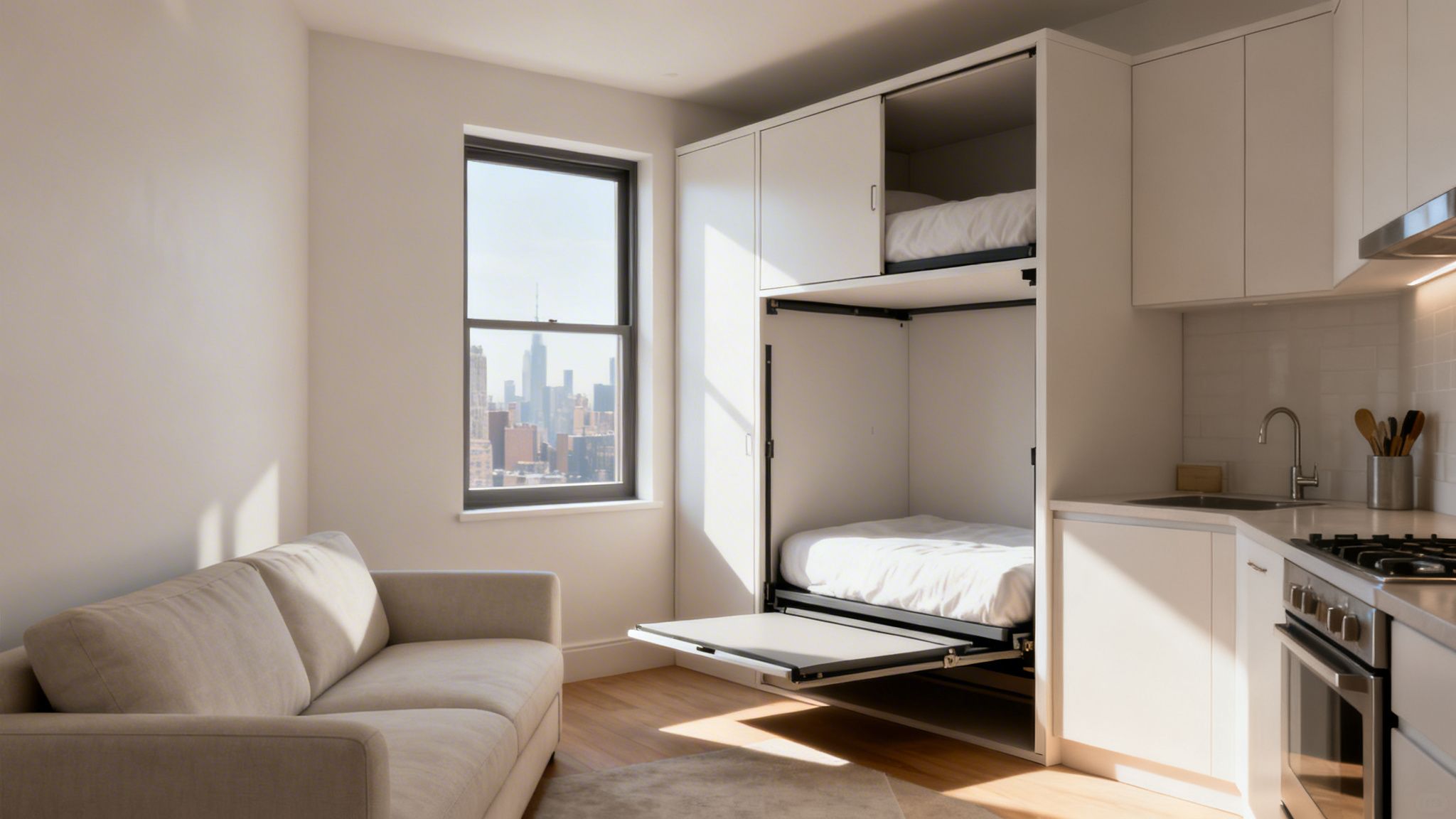
Visiting a Futonland showroom in the Upper West Side, Greenpoint, or Newark lets you test all three before deciding.
| Bed Type | Best For | Closed Footprint | Guest Comfort | Price |
|---|---|---|---|---|
| Futon | Budget, daily use, customizable mattress | 80″W × 38″D | Good to Excellent | $ |
| Sofa Bed | Formal living room look, daily use | 85″W × 40″D | Good to Excellent | $$ |
| Murphy/Cabinet Bed | Maximum floor space, daily use | 85″H × 65″W × 16″D | Excellent | $$$$ |
| Daybed with Trundle | Permanent seating, frequent guests | 80″W × 40″D | Fair to Good | $$ |
| Platform Storage Bed | Permanent bed, needs drawer/closet storage | 80″L × 60″W (Queen) | Excellent | $$$ |
The clearest first filter: futons, sofa beds, and Murphy/cabinet beds fold or hide away and reclaim floor space daily. Daybeds and platform beds stay put permanently but work double duty as seating or storage.
Futons: Budget-Friendly and Customizable
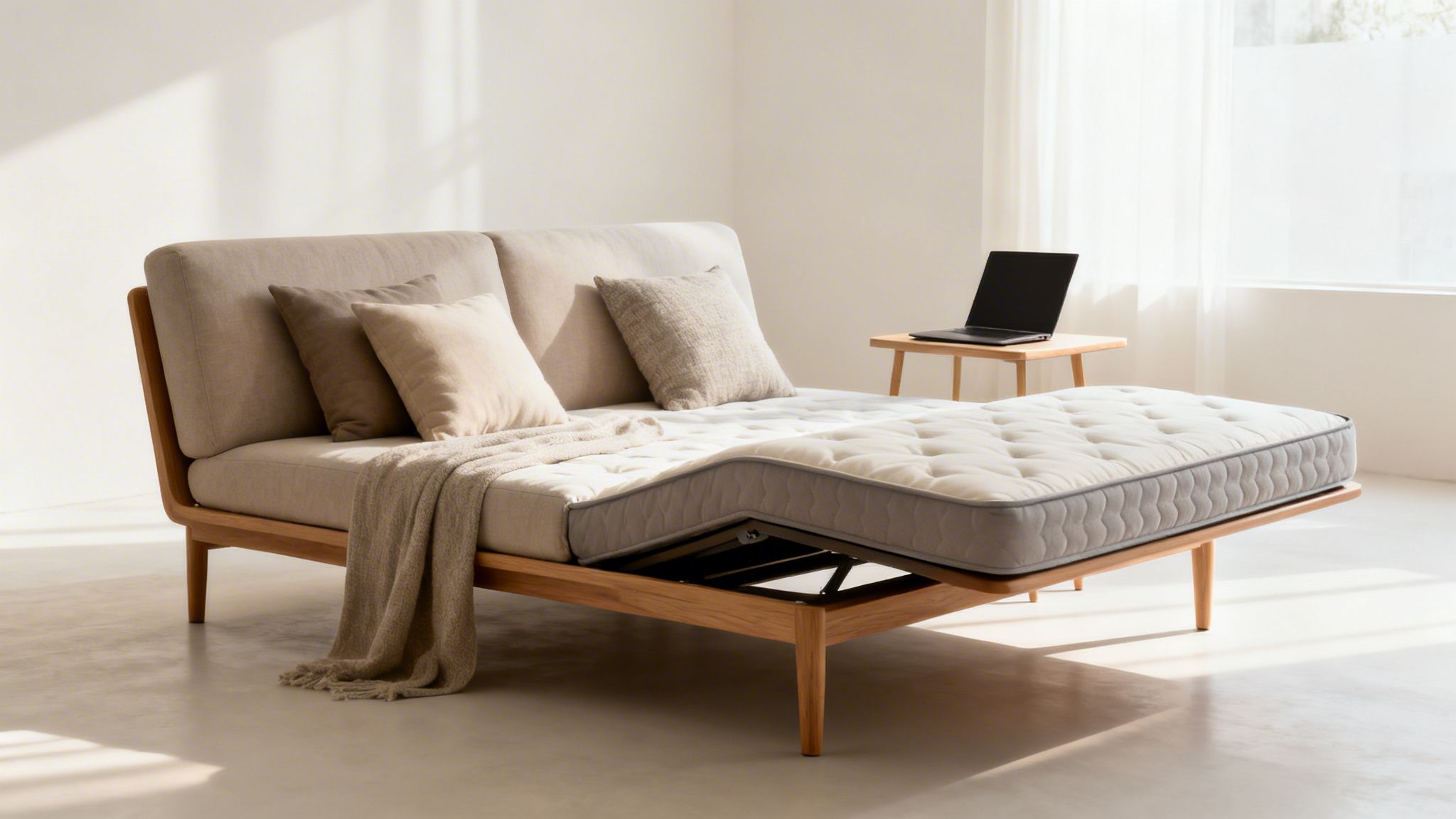
A modern futon separates the frame from the mattress, which is its main advantage: you choose exactly the sleep surface you want — firm innerspring, plush memory foam hybrid, or a budget cotton-foam blend — independent of the frame.
| Pros | Cons |
|---|---|
| Cheapest convertible option; frees budget for a better mattress | Manual conversion — lifting and adjusting, not a one-motion mechanism |
| Mattress upgradeable independent of frame | More casual look than a sofa bed |
| Frame is light and easy to move or rearrange | Need a separate plan for bedding storage when folded |
For daily sleeping, don’t skimp on the mattress — at least 8 inches thick, in innerspring/pocket coil for traditional support, memory foam hybrid for pressure relief, or high-density foam for a firmer, budget-durable option. Browse the full range of futons and mattresses.
Sofa Beds: A Living Room That Doubles as a Bedroom
A sofa bed looks and sits like a standard sofa, with the mattress built in. Where a futon trades style for flexibility, a sofa bed trades flexibility for style — you get a genuine sofa profile but can’t swap the mattress later.
| Pros | Cons |
|---|---|
| Looks like a real sofa, not a convertible bed | Heavy — a real concern in a walk-up |
| Premium mechanisms (pop-up, glide-out) convert in under a minute | Mattress is fixed; can’t be upgraded separately |
| Higher-end models use real mattresses, not thin pads | Costs more than a comparable futon setup |
Because of the moving mechanism, test it in person before buying: open and close it yourself, sit on it as a sofa and lie down on it as a bed, and check the frame for wobble. See the full convertible sofa bed collection.
Murphy and Cabinet Beds: Reclaim the Whole Floor
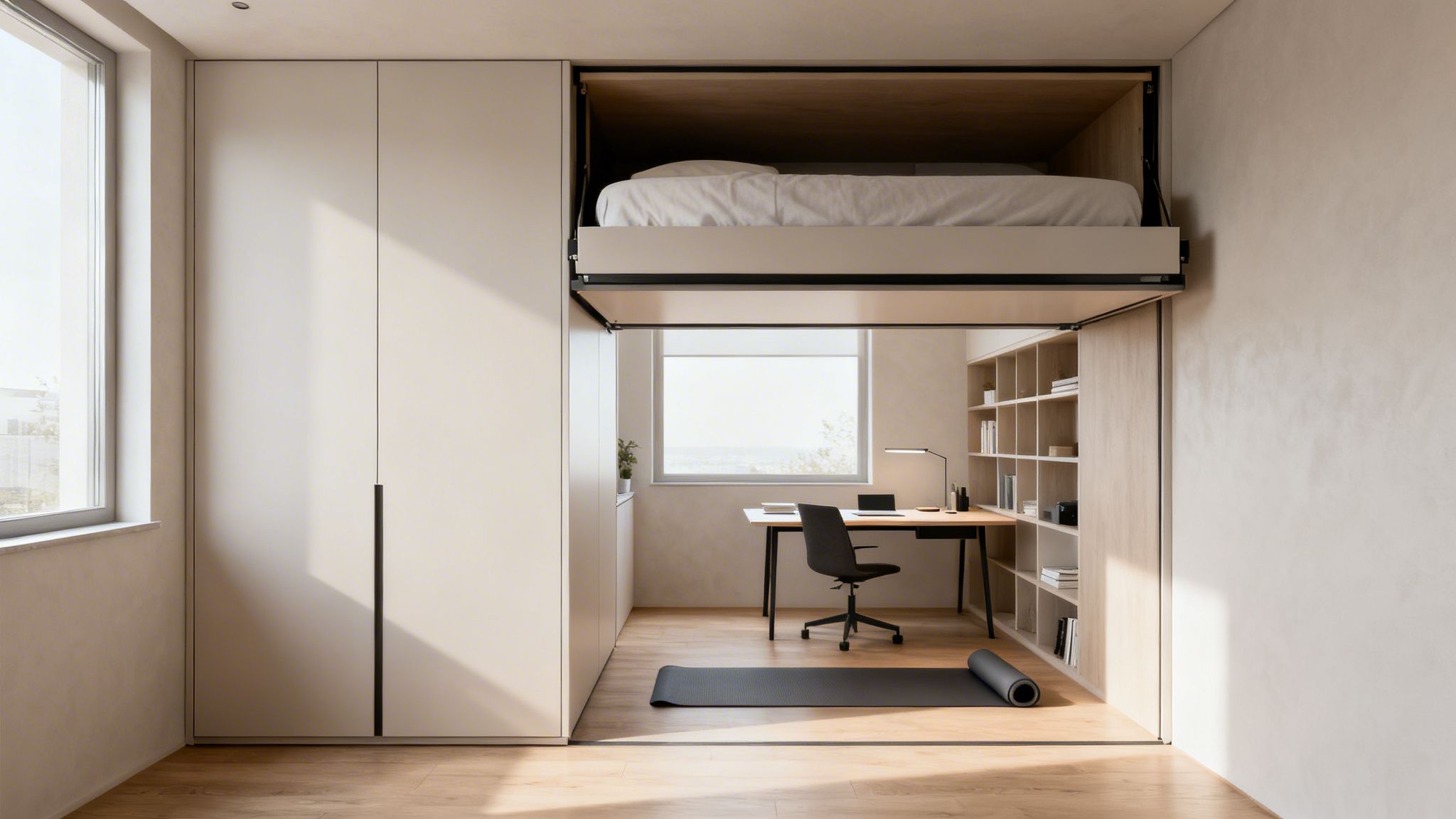
Murphy beds fold up into a wall-mounted cabinet; cabinet beds do the same thing as a freestanding, unmounted piece. Both give back the entire floor, not just part of it — the difference that separates them from futons and sofa beds.
| Pros | Cons |
|---|---|
| Entire floor reclaimed when closed | Highest upfront cost of the five options |
| Holds a standard mattress up to 11″ — full sleep comfort | Murphy beds need professional wall mounting |
| Often integrates shelving, desk, or storage | Murphy beds become a fixed part of the apartment |
If you rent and can’t mount to the wall, a cabinet bed is the alternative: a queen-size mattress folds into a freestanding, low-profile chest, with the front panel folding down to unfold the bed. Because it’s not attached to the wall, it moves with you. Common features on cabinet bed models include a base storage drawer for bedding and built-in USB/power outlets. See wall beds and cabinet beds.
Daybeds and Platform Storage Beds: Permanent, Multi-Purpose
These don’t fold away, but they solve a different problem: getting more function out of a bed you’re keeping in place all the time.
Daybed with Trundle
A three-sided frame gives a daybed a sofa-like profile for daytime lounging; a second, lower mattress (the trundle) slides out from underneath for a guest. Guest comfort is fair to good — trundle mattresses run thinner than the main mattress — which makes this best for occasional, short-stay guests rather than long visits. Footprint is a standard twin (about 80″L × 40″W) that doubles in width to roughly 80″ × 80″ when the trundle is deployed. See daybeds.
Platform Storage Bed
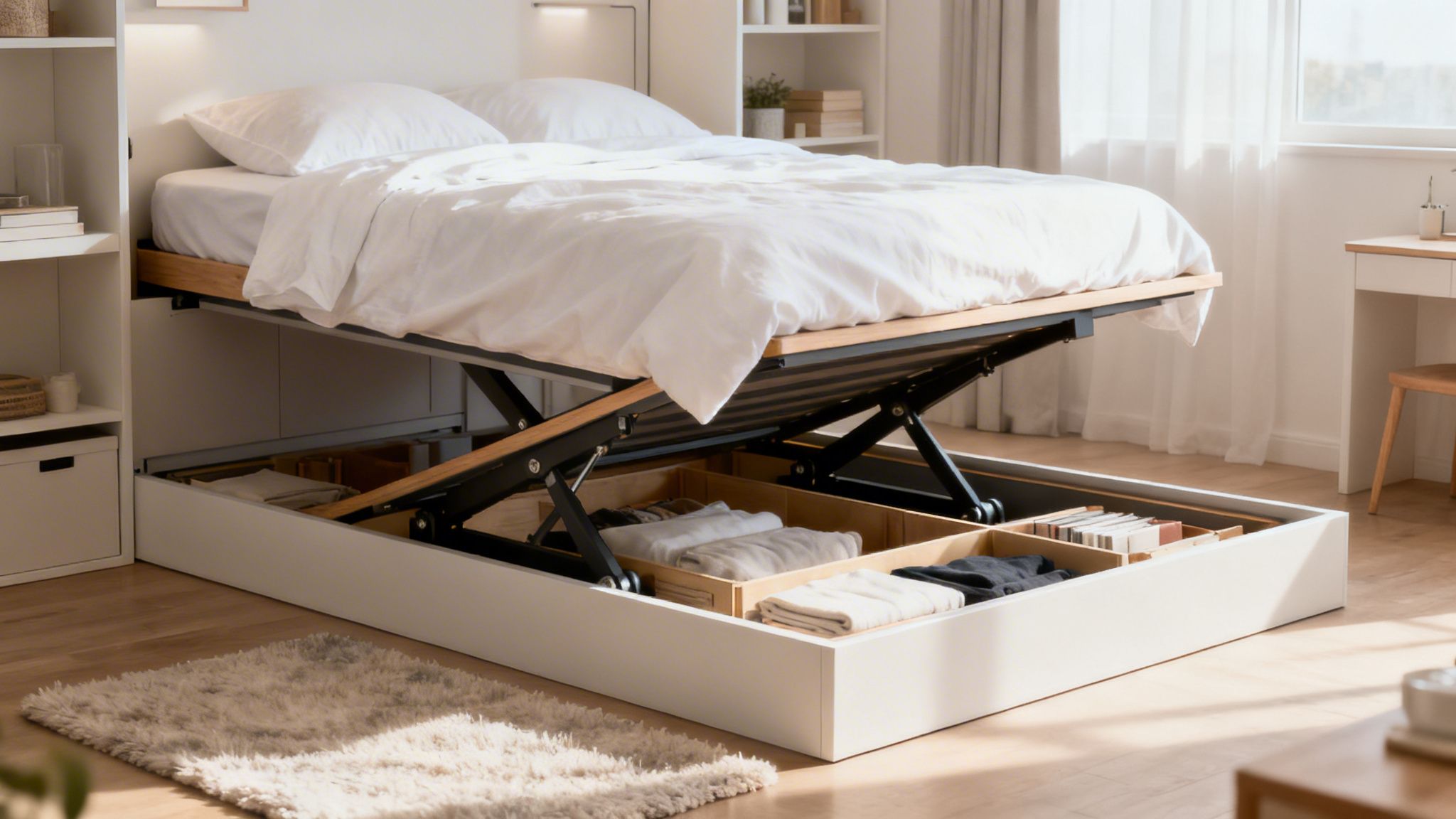
A platform bed with built-in storage functions as a bed and a dresser in one, offering roughly 20–40 cubic feet of hidden storage in a studio where closet space is usually the scarcest resource. Two mechanisms:
- Drawer storage: drawers built into the base — good for frequently accessed items, but confirm you have clearance to fully open them.
- Hydraulic lift (ottoman-style): the whole mattress platform lifts, exposing one large cavity — better for bulky, infrequently accessed items like luggage or seasonal bedding.
Since it’s a standard frame, mattress choice is unrestricted — sleep quality depends only on the mattress you pick. Footprint doesn’t change from a standard bed of the same size (a queen platform is about 60″W × 80″L), but drawer models need extra clearance on the drawer side.
Platform Beds for Studios: What to Know
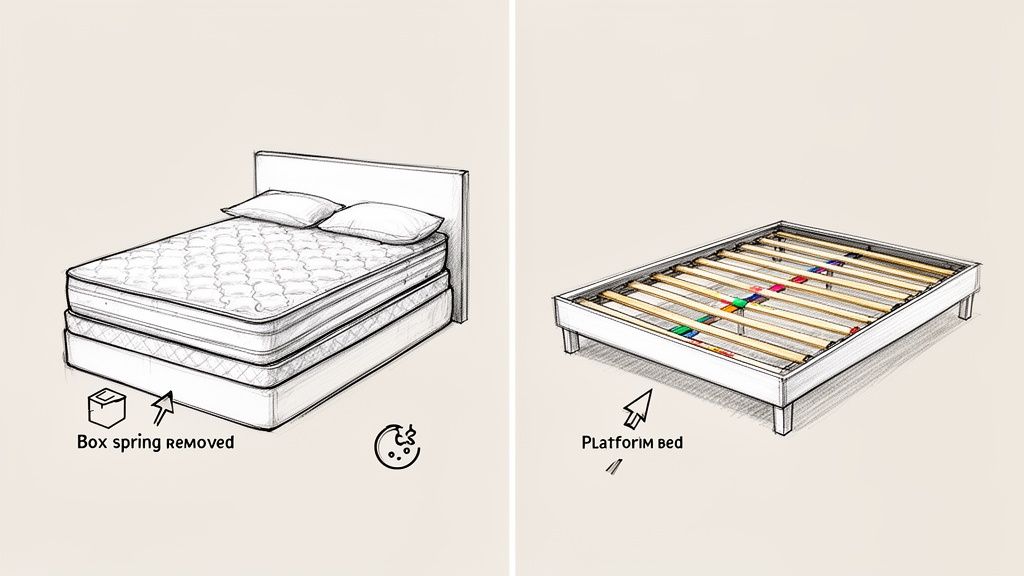
Why Platform Beds Don’t Need a Box Spring
One of the biggest questions people have about platform beds is how they can possibly work without a box spring. It’s a fair question, especially if you’ve only ever slept on a traditional bed setup. The answer is pretty simple and has everything to do with both history and how much mattresses have evolved.
Back in the day, box springs were non-negotiable for two reasons. First, they were basically shock absorbers for old-school innerspring mattresses, which didn’t have much support on their own. Second, they gave the bed that classic, elevated height most people were used to.
The Shift to Integrated Support
But mattress technology has completely changed the game. Today’s most popular mattresses—memory foam, latex, and hybrids—don’t need any help with shock absorption. In fact, they perform best on a firm, flat, and totally consistent surface. This prevents them from sagging and makes sure you get even support from head to toe.
And that’s exactly what a platform bed delivers. Its built-in support system, whether it’s a series of sturdy wooden slats or a solid deck, acts as both the foundation and the frame in one neat package.
Think of it this way: a box spring is like an old suspension system for a classic car, designed for bumpy roads. A platform bed is like the smooth, integrated chassis of a modern electric vehicle—it’s built for today’s technology and provides all the support needed in one streamlined package.
By building the foundation right into the frame, a platform bed cuts out the need for that extra layer. This gives you a more direct, reliable support system that’s perfectly in sync with how modern mattresses are made.
Functional Benefits of Going Box Spring Free
Ditching the box spring isn’t just about getting with the times; it comes with some real, practical perks that make it a smart move for a lot of people.
- Cost Savings: This is the big one. By not having to buy a separate box spring, you can save a good chunk of cash—often hundreds of dollars. That’s money you can put toward a better mattress or other furniture for your bedroom.
- Sleek, Low-Profile Aesthetic: Platform beds naturally sit lower to the ground, which creates a clean, minimalist vibe. This lower profile can make a room feel more open and spacious, a huge win for smaller apartments and city living.
- Enhanced Mattress Performance: Giving your mattress a solid and even base helps it keep its shape over time. This prevents it from dipping and sagging prematurely, which can extend its lifespan and make sure you’re getting the comfort you paid for.
Since you’re skipping the box spring, it’s key to pair your platform bed with the right mattress for the best support. It also helps to learn more about the differences between boxsprings and other foundations to feel confident in your choice. This functional, all-in-one design is really what defines a platform bed frame today.
Slatted vs. Solid Foundations
The type of support system is another critical difference you’ll find. A slatted platform bed uses a series of wooden or metal slats spaced across the frame to hold up the mattress. This is the most common design out there, largely because the gaps between the slats allow for excellent airflow, which helps keep your mattress cool, dry, and fresh.
In contrast, a solid platform bed uses a single, flat sheet of material (like plywood or particleboard) for a completely even and firm surface. This offers maximum, unyielding support, which can be a great choice for certain heavy mattresses or for sleepers who prefer an exceptionally firm feel.
Many buyers favor slatted designs for their ventilation, which helps reduce the risk of mold in humid climates. These frames also save a crucial 12-18 inches in vertical space compared to traditional beds, a huge advantage for maximizing ceiling height in lofts and small rooms.
Choosing the right platform bed comes down to what you value most—be it sleek design, clever storage, or a specific type of mattress support. To make it easier, here’s a quick breakdown to help you decide.
Platform Bed Bookcases: Storage at the Headboard
Some buyers assume this category means one very specific bed. It doesn’t. There are three practical ways to build the same core function, and each one suits a different room and budget.
The Fully Integrated Bookcase Bed
This is the straightforward option. The headboard and bed frame are designed as one unit, so the shelves sit exactly where you need them. It looks finished because everything lines up in height, depth, and finish from the start.
Many models in this category are larger than people expect — wide headboards with multiple compartments, adjustable shelves, and sometimes small wheeled drawers built directly into the base for organized bedside storage.
What works:
- Clean visual result: it looks intentional, not improvised.
- Useful reach zone: books, chargers, and small essentials stay close to the pillow.
- Simple planning: you buy one main piece instead of trying to match two.
What doesn’t:
- Less flexibility later: if you move or redecorate, you can’t separate the storage from the bed.
- Bulk at the headboard: in a very shallow room, the extra depth matters.
- Longer assembly: more parts, more hardware, more alignment work.
The Captain’s Bed Hybrid
This version is for people who need storage everywhere, not just at head level. You get the bookcase-style headboard, plus under-bed drawers or cubbies. In a room with no dresser space, that can be the difference between a calm bedroom and one with bins shoved into every corner.
The trade-off is access. Under-bed drawers need clearance to open. If your bedroom layout is already tight, the storage may exist on paper but feel awkward in real life.
A captain’s bed is strongest when the room lacks closet space. It’s weaker when the walking path around the bed is already narrow.
This style also asks you to be honest about what you store. Daily clothing, extra linens, and guest bedding make sense. Rarely used items often get forgotten and turn the bed into deep storage you stop maintaining.
The Modular Platform Bed Plus Separate Bookcase
This is the option many shoppers overlook, and it’s often the smartest one. Instead of buying a prebuilt bookcase bed, you combine a low platform bed with a separate bookcase placed behind, next to, or slightly offset from the head area.
That approach gives you more control over width, shelf height, and budget. It also makes moving easier because the room relies on two simpler pieces rather than one large integrated unit. If you already own one of them, the savings can be meaningful without needing a custom build.
A modular setup works best when:
- You rent and may move again.
- You want to replace the bed later but keep the shelving.
- You need unusual proportions that integrated frames don’t offer.
- You want the storage effect without a permanent built-in look.
For shoppers comparing low-profile frames first, looking at platform bed options by size and style is the practical starting point.
Bookcase Bed Configurations at a Glance
| Configuration | Best For | Flexibility | Assembly Effort | Futonland Solution |
|---|---|---|---|---|
| Integrated bookcase bed | Buyers who want one finished piece | Low | Moderate to high | Pair a platform bed with built-in headboard shelving |
| Captain’s bed hybrid | Rooms short on dresser or closet space | Low | High | Choose a storage-focused platform bed with headboard shelving |
| Modular bed plus bookcase | Renters, movers, and layout tinkerers | High | Moderate | Combine separate platform bed and shelving categories |
Which One Usually Works Best
The integrated bed wins on neatness. The captain’s bed wins on raw storage. The modular solution wins on adaptability.
In practice, small urban bedrooms often reward adaptability. Radiators, odd corners, closet swing, and outlet placement create too many exceptions for one-size-fits-all advice. That’s why the modular route deserves more attention than it gets.
Measuring a Small Room for a Bed
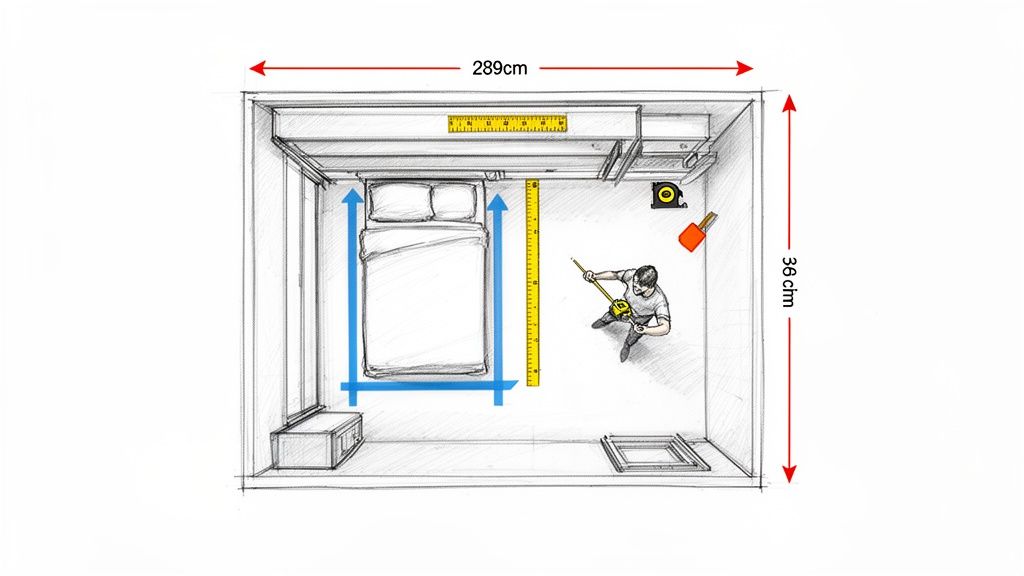
Buying furniture without measuring your room first is the number one mistake people make when decorating a small space. It’s an easy trap to fall into. You see the perfect bed online, you get excited, you click “buy”—and then it arrives. That’s when you get the sinking feeling that it won’t fit through the door, or worse, it leaves you with no room to actually walk.
This guide will make sure that never happens to you.
We’ll teach you how to measure with confidence, thinking beyond just the simple length and width of the floor. To really nail it, you have to think of your room like a dance floor, not a parking spot. It’s not enough for the bed to just fit; you need space to move, live, and breathe comfortably.
Thinking in Three Dimensions
A great layout considers the entire volume of your room, not just a flat floor plan. So, before you even start dreaming about bed sizes, grab a tape measure and jot down these crucial dimensions.
Start with the basics: measure the length and width of the room to get your total square footage. But don’t stop there. Measure the ceiling height—this is absolutely essential if you’re even remotely considering a vertical solution like a Murphy bed or a loft bed.
Next, you need to account for all the permanent fixtures that eat into your usable space.
- Doorways and Hallways: Measure the width and height of every single door frame your new bed will have to pass through. And don’t forget to account for the door swing—the arc it makes when opening—because that can easily block drawers or the bed itself.
- Windows and Sills: Note the location, width, and height of all your windows. A bed crammed under a low sill can look awkward, while a tall headboard might block all your precious natural light.
- Outlets and Switches: Map out exactly where your electrical outlets, light switches, and vents are. You really don’t want your new bed to block the only usable outlet on that wall.
Measuring is about understanding your room’s unique choreography. You need to know where every door swings, where every drawer pulls out, and how much clearance you have to walk, ensuring your new bed fits into the flow of your daily life.
Visualizing the Footprint
Once you have your numbers, it’s time to bring them to life. Abstract measurements on a piece of paper can be tough to visualize, so here’s a simple trick designers use: get some painter’s tape and mark the exact dimensions of your potential bed right on the floor.
This physical outline shows you precisely how much floor space the bed will command. You can see immediately if it’s going to block a closet, feel way too close to your desk, or make the main walkway uncomfortably narrow.
With the tape on the floor, walk around it. Try opening nearby drawers or closet doors. Does everything still function smoothly? This simple, practical test is the single best way to prevent a purchase you’ll regret. You can also explore detailed sizing charts to compare standard mattress dimensions and find the perfect fit.
Choosing the Right Bed Size
The size of the bed you choose has a massive impact on your room’s overall feel and function. While it’s tempting to go for the biggest, most luxurious bed possible, sometimes a slightly smaller size can make the entire room feel more open and usable.
Queen sizes are among the most popular. They offer a great balance for couples without completely overwhelming a typical bedroom.
However, the fastest-growing segment right now is the Twin-XL. It’s the go-to for compact dorms and first apartments common among students and young professionals. By prioritizing usable space over a few extra inches of mattress, you create a much more balanced and comfortable living environment.
Planning Your Studio Layout Around the Bed
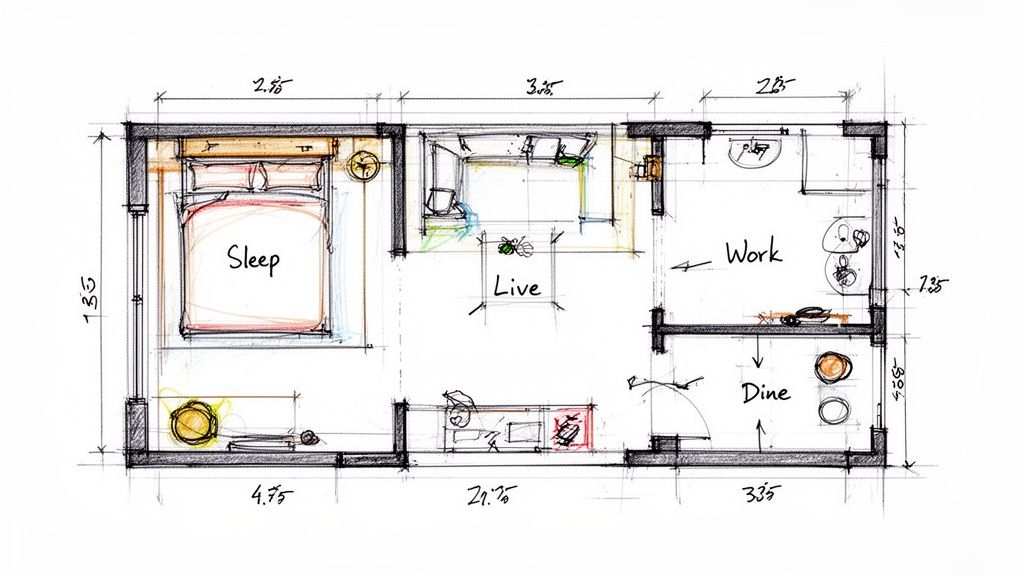
Before you even think about falling in love with a piece of furniture, you need a game plan. A solid layout is the absolute foundation of a studio that feels both functional and beautiful. Think of yourself as an urban planner for your own small space—every “district” needs a clear purpose, whether it’s for sleeping, working, or just kicking back.
Jumping straight to shopping is a classic rookie mistake. It almost always ends with a sofa that eats the entire room or a desk that just doesn’t fit your daily routine. Taking a few minutes to plan will save you a world of frustration (and money) down the line.
This process guarantees every piece you bring in has a home and a job, helping you sidestep that dreaded cluttered, disorganized feeling for good.
Measure Everything Twice
First thing’s first: grab your tape measure. Don’t just guess your square footage; get precise measurements of the entire apartment. And I’m not just talking about wall-to-wall.
You need to map out every little quirk and architectural detail. Note the exact location and dimensions of:
- Windows and Doors: Measure their width, height, and how far they are from the corners. Don’t forget to account for the swing of each door!
- Outlets and Switches: Knowing where your power sources are is crucial. It dictates where lamps, your TV, or your work-from-home setup can actually go.
- Radiators or Vents: These fixtures stick out and can’t be blocked, which definitely impacts where your furniture can live.
- Awkward Nooks or Columns: Document any weird architectural features. You’ll have to work around them, so it’s better to know their exact size from the start.
Once you’ve got your numbers, sketch out a simple, to-scale floor plan. You can use graph paper or a free online tool. This little map is your most powerful weapon. It lets you “test drive” furniture arrangements without breaking your back, helping you find the best furniture for studio apartments that fits your space like a glove.
Define Your Functional Zones
Now, look at your blank floor plan and start creating zones. The whole trick to studio living is creating distinct areas for different activities, making one room feel like many. Your main zones will probably be for sleeping, living, dining, and maybe working.
Think about the natural flow of the space. Where does the sunlight hit? What’s the main path from the front door to the kitchen? Use these clues to guide your placement. For example, the sleep zone usually works best in a corner far from the entrance to create a sense of privacy.
A great way to visually separate these areas is by using area rugs or furniture itself as a border. An open-backed bookcase can create a division between your bed and living area while still allowing light to pass through, maintaining an open feel.
You can also get creative with dedicated dividers. Our guide on room dividers has a bunch of great ideas for creating these separations without closing off your space.
Prioritize Your Lifestyle Needs
Okay, this is the most important part. Your studio has to work for how you actually live, not how you think you should live. Get real about your daily habits.
Do you work from home most of the week? A comfortable, ergonomic workspace is a non-negotiable. Love having friends over for movie night? A high-quality, spacious sleeper sofa should be at the top of your list.
This need for adaptable furniture is a huge trend.
Once you know your priorities, you can make smart trade-offs. If you rarely cook big meals, maybe that bulky dining table can be swapped for a sleek lift-top coffee table or a slim console that doubles as a desk. This strategic thinking ensures your space and your budget go toward the things that truly matter to you.
How to Choose
Measure the full delivery path, not just the final spot — doorways, hallway turns, and stairwells are where deliveries actually fail. For convertible beds, measure both the closed and open footprint; a sofa bed that looks compact closed may need several feet of clearance to fully open.
Decide what the bed’s primary job is. If it’s your nightly bed, prioritize mattress quality and comfort — cabinet beds, platform storage beds, or a futon with an upgraded mattress are the strongest options. If it’s mainly for occasional guests, prioritize daytime function and looks — a daybed with trundle or a sofa bed fits better.
Test convertible mechanisms in person before buying. A description can’t tell you whether a hinge is smooth or whether a mattress is actually supportive. This matters more for sofa beds and Murphy/cabinet beds, where the mechanism is complex, than for platform beds or daybeds, where there’s nothing to test.
Frequently Asked Questions
Can I Sleep on a Futon or Sofa Bed Every Night?
Yes, if you choose a quality mattress rather than the cheapest option. Look for pocketed coils, memory foam, or dense foam at least 5–6 inches thick (8 inches or more for a futon used nightly). A thin mattress will feel poor and break down quickly regardless of the frame.
What’s the Best Option for Frequent Guests?
A cabinet bed or a premium sofa bed gives guests the closest experience to a real bed — cabinet beds typically fit mattresses up to 11 inches thick. A daybed with a pop-up trundle is a flexible alternative, since the trundle can form a second twin bed or push together with the main bed for a larger sleeping surface.
How Does Delivery and Assembly Work in a Walk-Up?
White-glove delivery services (Futonland offers this) handle stairs, full assembly in the apartment, and packaging removal, which matters most for bulky pieces like sofa beds and cabinet beds that are impractical to carry and assemble solo.
Which Option Needs the Least Assembly or Installation?
Futons and daybeds generally require the least setup. Murphy beds require professional wall mounting. Sofa beds and cabinet beds are heavier and benefit from professional assembly even though they don’t need wall mounting.
Seeing a futon, sofa bed, and cabinet bed side by side is the fastest way to judge scale and mechanism quality — visiting a Futonland showroom in the Upper West Side, Greenpoint, or Newark lets you test all three before deciding. Explore the full range of space-saving beds or start with futons.
Will a Platform Bed Feel Too Low?
The low-slung design is a signature look, but whether it feels “too low” really comes down to personal taste and physical needs. The average platform bed sits somewhere between 10 to 18 inches from the floor to the top of your mattress. For comparison, a traditional bed with a box spring can easily be 25 inches high or more.
A lower height can make a room feel bigger and more open, which is why it’s a go-to for modern, minimalist design. On the other hand, if you have knee or back issues, getting in and out of a lower bed might feel like a chore. The best advice is to test out beds at different heights in a showroom to see what feels most comfortable for your body.
How Can I Create Storage When I Don’t Have Closets?
You have to get creative and make your furniture work harder for you. Look for pieces that have built-in storage solutions. Think platform beds with drawers underneath, a sectional sofa with a hidden storage chaise, or even an ottoman that opens up to store blankets and pillows.
Also, don’t forget to think vertically! Tall, narrow bookcases or wall-mounted shelving draw the eye upward and make use of space that would otherwise be wasted.
Should I Bother with a Room Divider in My Studio?
It really depends on your layout and what you’re trying to achieve. A physical divider can definitely create a nice sense of separation and privacy, but it can also make a small space feel even more cramped.
A great alternative is to use an area rug to visually create different “zones” for living and sleeping. Open-backed bookcases are another fantastic option because they divide the space while still letting light filter through, keeping things feeling bright and airy.
Pro Tip: Using furniture to create zones is often more effective than a solid screen. A well-placed sofa or console table can define the “living room” from the “bedroom” without visually shrinking your apartment.
For those with an eye for style, the clean lines of Scandinavian silhouettes with custom covers can perfectly capture that Japandi vibe. Futons offer strong value by making every inch count in a small studio.