
Fabric for Sofa Set Guide to Durability and Style
You’re comparing sofa sets, and the decision seems simple at first. One fabric looks elegant, another feels softer, and a third promises easier cleaning. Then real life enters the room: coffee near the armrest, children climbing over the cushions, a dog shaking off rain, or an occasional guest sleeping on the sofa. The right fabric for a sofa set has to handle more than a showroom light.
Fabric affects comfort, appearance, maintenance, and how confidently you can use the furniture every day. A beautiful textile can disappoint if it pills quickly or traps pet hair. A highly engineered performance fabric can feel wrong if it’s too stiff for a small living room where people spend long evenings relaxing.
This guide gives first-time buyers, small-space dwellers, and families a practical way to compare upholstery. You’ll learn how fibers and weaves work, what abrasion numbers measure, why cleanability and wear resistance are separate concerns, and how finish chemistry fits into health and sustainability decisions. By the end, you should be able to create a shortlist based on your household instead of choosing by color alone.
Choosing Fabric for Your Sofa Set
A sofa set often becomes the busiest piece of furniture in the home. Someone may eat breakfast on it, work from it, nap on it, or use it as a bed when visitors arrive. The upholstery touches skin, clothing, toys, pet paws, and whatever happens to be in someone’s hand during a movie.
That’s why comfort and durability need to be considered together. A tightly woven synthetic may resist everyday friction and clean easily, while a wool blend may offer a warmer hand and strong wear performance. Neither automatically wins, because the better choice depends on who uses the sofa, how often they use it, and how much maintenance they’re willing to do.
Practical rule: Choose the fabric for the hardest regular task your sofa must perform, not for the quietest day in your household.
Start with the room’s real job
A family-room sofa needs a different specification from a formal sitting-room set. Daily seating, children’s activities, pets, and frequent guests place repeated stress on the seat deck, front edges, and arms. A guest-room sleeper may spend much of its time unused, but its fabric still needs to tolerate conversion, sleeping, and occasional cleaning.
Small apartments create another challenge. When one sofa handles lounging, working, dining, and sleeping, upholstery becomes part of the room’s infrastructure. In that setting, removable covers, a practical color, and a fabric that doesn’t easily snag may matter as much as a luxurious surface.
The three questions that simplify the choice
Before looking at swatches, answer these questions:
- Who uses the sofa? Children, pets, frequent guests, and everyday sleepers all change the performance requirement.
- What happens on the sofa? Quiet conversation, meals, naps, home-office work, and overnight sleeping create different forms of wear.
- How will you maintain it? Decide whether you’ll vacuum regularly, spot clean promptly, wash removable covers, or prefer a low-intervention material.
The fabric sofa sets available from Futonland can be evaluated with those questions in mind. Look beyond the color name and ask about fiber content, weave, abrasion testing, finish, cover construction, and care instructions. Once those basics are clear, style becomes easier because you’re choosing among fabrics that can suit your routine.
Understanding Sofa Fabric Types and How Weaves Work
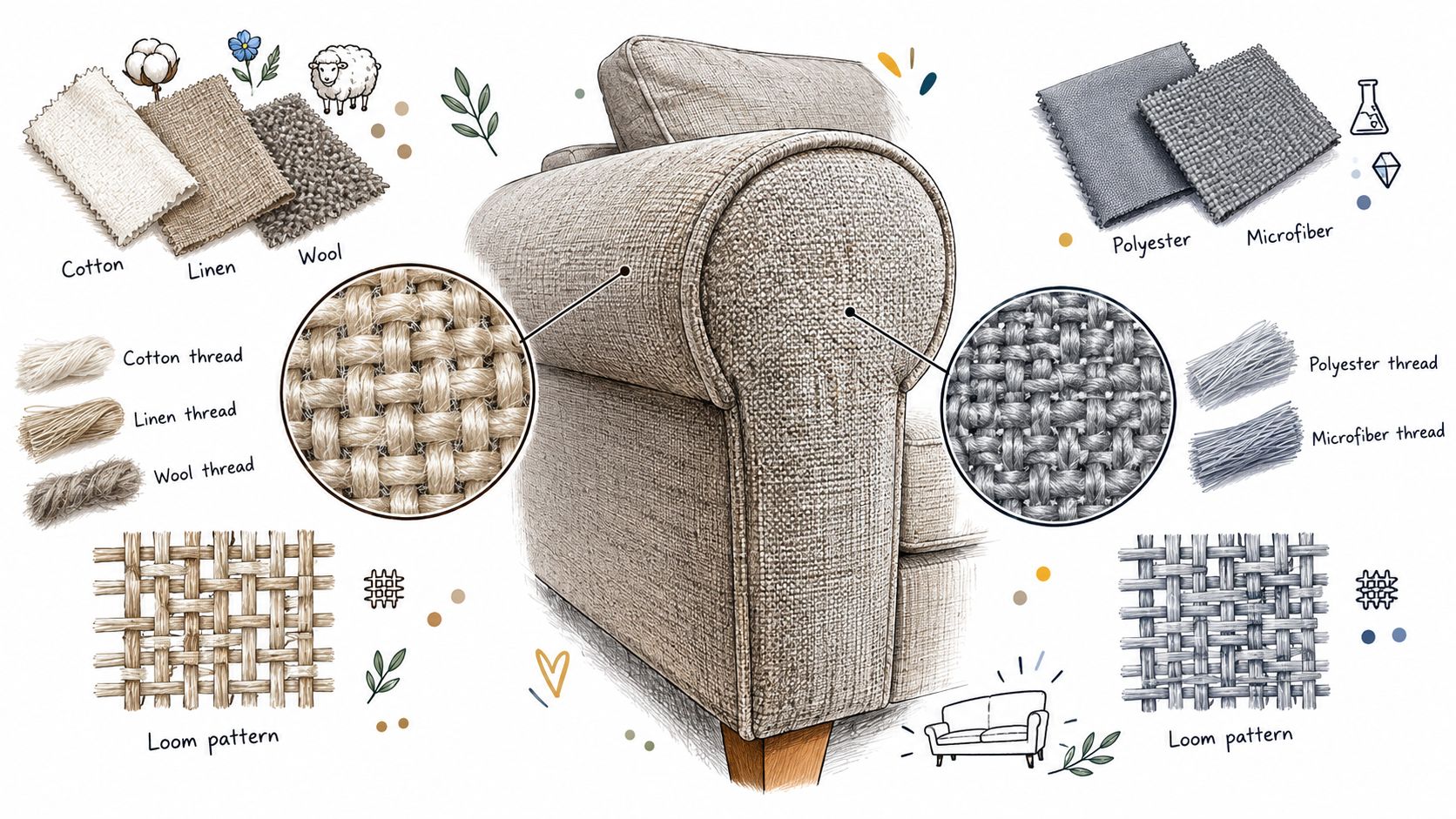
Choosing upholstery starts with two separate questions: what the fiber is and how the yarns are arranged. Fiber affects touch, breathability, and care. Construction affects how the surface handles crumbs, friction, claws, and repeated sitting. The same fiber can behave quite differently in a compact weave than in a loose, raised texture.
Fiber is the material, not the whole performance story
Cotton has a familiar, breathable feel and suits relaxed rooms. Linen feels cooler and more textured, but it can crease and develop a deliberately casual appearance. Wool feels warm and resilient. Polyester, microfiber, and blended textiles are often selected for consistent color, close construction, and easier routine care.
A blend can pair the soft hand of a natural fiber with the stability or cleanability of a synthetic component. That label alone does not explain how the sofa will perform. Ask for the fiber percentages, cleaning code, finish details, and abrasion result. A family sofa used every day needs a different balance from a guest sleeper that is converted only occasionally. Sleeping and conversion also add friction along folds, edges, and contact points.
Cleanability depends partly on finish chemistry, not just fiber. A textile may receive a treatment that helps spills bead briefly or makes some marks easier to remove, while another relies mainly on its dense construction and prompt care. Ask whether the finish is part of the fabric specification and whether the care instructions allow the cleaning method you plan to use.
Weave controls where wear and dirt collect
A tight flat weave works like a canvas tote. Closely seated yarns leave fewer openings for crumbs, claws, and loose threads to catch. A looser weave resembles an open-knit sweater. Its relaxed texture may look inviting, yet loops and raised yarns can pull more easily.
Pile fabrics, including velvet-like upholstery, use raised fibers that reflect light in different directions. They can feel plush, but pressure marks and shading may show when someone sits in the same place repeatedly. Chenille and bouclé also depend on surface texture, so check for loose loops and snag risk. Rub a sample in more than one direction, since a finish that looks even in a showroom may change under use.
Test the swatch like a small piece of the sofa
Hold the sample near a window, press it with your palm, and inspect both sides. Bend it gently to see whether the backing appears. Run a clean sleeve across the surface, then check whether the yarns recover or remain flattened.
The frame and suspension underneath also influence comfort. Before ordering, Futonland fabric by the yard can help you assess upholstery as a construction material, not merely a decorative color.
How Durability Is Measured and What Rub Counts Mean
Abrasion ratings answer a narrow question: how well does the fabric resist surface wear in a controlled test? They don’t predict every aspect of sofa life. They don’t automatically tell you whether a textile resists stains, fading, pilling, stretching, pet claws, or poor cleaning technique.
In North America, upholstery suppliers commonly refer to Wyzenbeek testing under ASTM D4157, which uses back-and-forth double rubs. Outside North America, Martindale testing under EN/ISO 12947 is widely used and applies a figure-eight motion under controlled pressure. Because the motions differ, a Wyzenbeek result and a Martindale result shouldn’t be treated as interchangeable numbers.
Match the rating to the job
Industry guidance commonly treats under 15,000 Wyzenbeek double rubs as light-use upholstery, 15,000 to 30,000 or more as medium use, and 30,000 to 50,000 or more as heavy family-room use. Around 40,000 Martindale cycles is often associated with heavy-duty contract or high-traffic seating. These figures are useful comparison points, but they’re not a promise that a sofa will last for a specific period.
Sofa Fabric Durability at a Glance
| Use Level | Wyzenbeek Double Rubs | Martindale Cycles | Best For |
|---|---|---|---|
| Light use | Under 15,000 | Lower-use specification | Formal rooms and occasional seating |
| Medium use | 15,000 to 30,000 or more | Mid-range upholstery | Regular seating with moderate traffic |
| Heavy use | 30,000 to 50,000 or more | Around 40,000 for heavy-duty applications | Busy family rooms and high-traffic seating |
Don’t pay for the wrong kind of strength
A guest-room sofa that opens occasionally doesn’t necessarily need a commercial-grade abrasion rating. A family sectional used every day, especially one that doubles as a sleeping surface, deserves more attention to seat-edge wear and construction.
A high rub count also won’t stop a drink from leaving a mark. Higher-performance upholstery constructions typically fall somewhere in the range of 50,000 to 100,000 or more Martindale cycles, compared with roughly 15,000 to 30,000 cycles for more basic upholstery grades. Use abrasion as one filter, then check stain protection, care instructions, and the finish applied to the fabric.
Stain Resistance, Pet Friendliness, and Everyday Care
A family sofa may handle daily sitting well yet become frustrating after one spilled drink. A guest sofa that occasionally becomes a bed faces a different routine. Wear resistance and cleanability solve different problems. Abrasion protection limits damage from friction, while a practical weave or stain-resistant finish gives you more time to blot food, mud, or liquid before it sets.
Synthetic microfibre often suits busy rooms because its smooth surface can be easier to vacuum and wipe. Wool and wool blends may resist rubbing effectively, but their cleaning requirements depend on the construction and care label. Cotton, linen, and faux leather can behave differently in wear tests, so “durable” should not automatically mean “easy to clean.” Use abrasion information as one filter, then examine the finish, cleaning code, and cover design.
Compare the problems your home creates
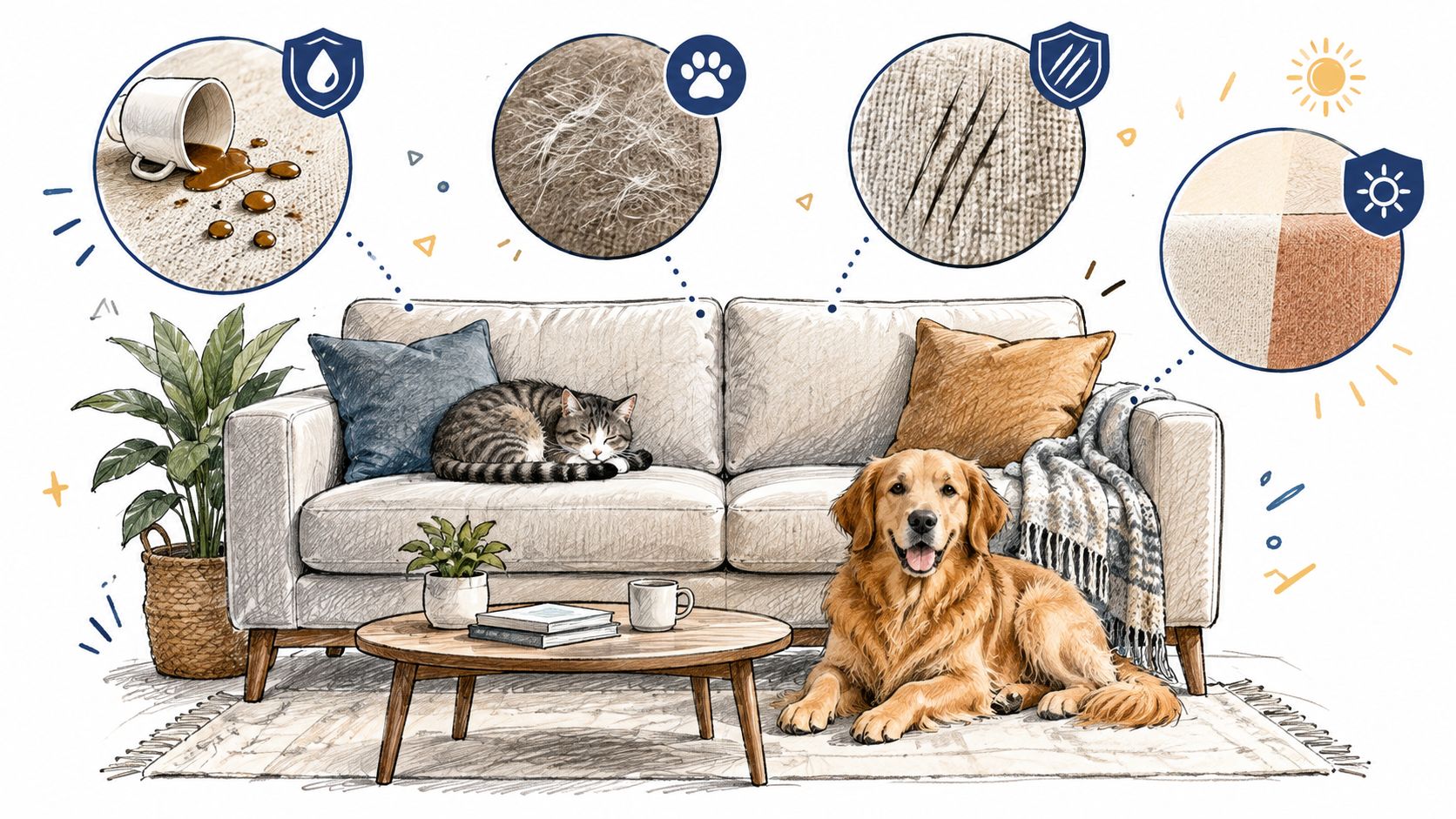
Spills favor upholstery with a suitable stain-resistant finish and clear spot-cleaning instructions. The finish can slow absorption, but it does not replace prompt blotting or the care label.
Pet hair is more noticeable on some colors and textures. Smooth, closely woven fabric is usually simpler to vacuum, while deep pile and open textures can hold hair and crumbs. Claws create a separate concern. A strong fabric may still snag when its surface has exposed loops or a loose construction.
Sunlight can change color over time, particularly beside a bright window. Check whether the manufacturer provides lightfastness information, and consider blinds or curtains if direct exposure is unavoidable. Dark upholstery may hide small marks while making fading easier to see.
Build a care routine you’ll actually follow
Vacuum the seat, back, arms, seams, and space beneath removable cushions with an upholstery attachment. Blot spills instead of rubbing them into the yarns. Test any cleaning product in a hidden area first, then follow the sofa manufacturer’s instructions. If the covers come off, confirm whether washing is permitted and whether replacement covers can be ordered.
For flexible seating, Futonland futon covers can let you refresh or change the cover instead of replacing the whole piece. The right fabric depends on the routine you can maintain: a daily family sofa needs forgiving cleanability, while an occasional guest sleeper may benefit more from removable, replaceable coverage and straightforward care.
Eco-Friendly Options, Style, Texture, and Color Choices
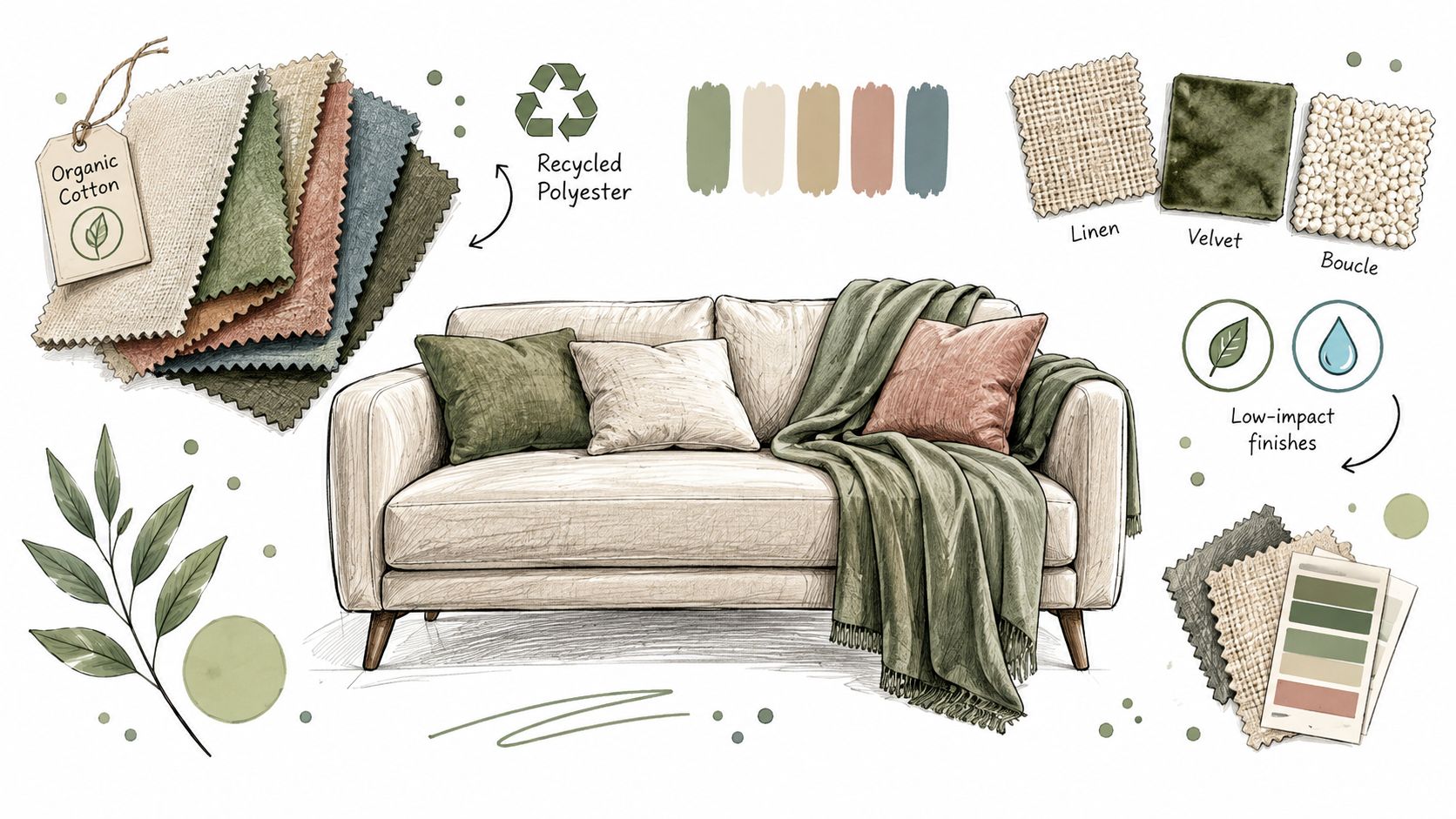
Sustainability isn’t a single fabric category. It involves fiber origin, recycled content, manufacturing choices, finish chemistry, expected service life, and what happens when the cover is replaced. An organic fiber can still receive treatments you may want to investigate. A recycled synthetic can extend the useful life of a sofa while raising different questions about end-of-life disposal.
Natural and recycled fibers continue to draw strong interest in upholstery design, which makes sense for shoppers who want a sofa that feels responsible without sacrificing everyday function.
Look at the finish as well as the fiber
Indoor air quality considerations raise questions about off-gassing from flame retardants, stain repellents, and antimicrobial treatments. Water-based treatments generally emit fewer VOCs than solvent-based alternatives. Ask the retailer which finishes are used, whether the fabric carries relevant certifications, and whether the manufacturer provides material transparency.
That doesn’t mean untreated fabric is always the right answer. A finish that helps a family clean spills may reduce premature replacement, which is also part of a product’s practical sustainability. The sensible comparison is between the full specification, not between a natural fiber label and a synthetic fiber label in isolation.
Let texture support the room
A linen-look flat weave can suit Scandinavian or Japandi interiors because it adds quiet texture without dominating the room. Velvet creates a more directional, luxurious surface, while bouclé brings softness and visual depth but may need extra care around claws and loose loops. A tightly woven chenille can offer texture without the open structure of a highly looped textile.
For color, start with the room’s light and the sofa’s workload. Warm neutrals can soften a compact space, but a heavily used pale seat may demand more frequent attention. Mid-tone, heathered, or subtly patterned fabrics can disguise small variations in texture and everyday marks better than a perfectly flat solid.
A sustainable choice should work in your home long enough to avoid an avoidable replacement.
Request Futonland fabric swatch samples and view them in morning, afternoon, and evening light.
Cost, Use Cases, and Finding the Right Fabric for Your Home
Price usually reflects more than color. Fiber content, yarn quality, weave complexity, backing, performance treatments, and cover construction can all influence the final cost. A highly textured fabric may require more complex production than a simple flat weave, while a stain-resistant finish adds another layer of specification.
The upholstery industry offers shoppers a broad range of materials because it serves residential and commercial furniture demand at global scale. That range helps explain why buyers now see more performance weaves, cleaning features, colors, and textures at different price levels than in past decades.
Match the fabric to the assignment
Hardworking family room: prioritize a close construction, a substantial abrasion specification, and a finish that supports stain care. Choose a color and texture that won’t make every crumb or pressure mark obvious. If pets use the sofa, inspect the surface for loops and snag points.
Compact studio or home office: consider how often the sofa converts between activities. A medium-use textile may be appropriate if the piece isn’t occupied continuously, but easy vacuuming and a visually forgiving color can make a small room feel easier to manage.
Guest-room sleeper: focus on conversion points, sleeping comfort, and occasional cleaning. You may not need the highest commercial rating, but the fabric should tolerate handling when the sofa opens and closes and shouldn’t be so delicate that guests must avoid using it.
College apartment or first home: favor practical construction, flexible styling, and manageable maintenance. A neutral cover can work through different decorating phases, while a replaceable cover may be more useful than paying for a costly textile that doesn’t match your future space.
Use a three-part decision filter
Ask yourself:
- Frequency: is the sofa used every day, occasionally, or mainly when guests visit?
- Cleaning willingness: will you maintain the surface regularly, or do you need maximum forgiveness?
- Style longevity: will you still like the color and texture if your room changes?
If two fabrics look equally attractive, choose the one whose care routine you’ll realistically follow. A moderately priced fabric that suits your habits can offer better practical value than an expensive textile that makes you nervous about normal use.
Your Practical Buying Checklist and Next Steps with Futonland
Bring this checklist to a showroom or keep it beside your laptop while comparing sofa sets:
- Confirm the test method: ask whether the abrasion result uses Wyzenbeek double rubs or Martindale cycles. Don’t compare the figures as though they were the same scale.
- Ask for the fiber breakdown: find out whether the upholstery uses cotton, linen, wool, polyester, microfiber, a blend, or another construction.
- Inspect the surface: look for tightness, exposed loops, backing visibility, pilling risk, and how the fabric feels against your arm.
- Ask about the finish: clarify stain resistance, flame-retardant treatment, antimicrobial treatment, VOC information, and recommended cleaning method.
- Test the swatch at home: view it in natural and artificial light, place it beside your flooring and walls, and check whether pet hair or crumbs will be conspicuous.
- Verify cover details: confirm whether covers can be removed, washed, replaced, or custom made, and whether they remain compatible with the mattress and frame.
- Plan the delivery: check doorway measurements, stairs, elevator access, assembly requirements, packaging removal, and the service area before ordering.
Futonland offers fabric sofa and sleeper options alongside custom cut-and-sew covers, mattress and cover compatibility, design help, white-glove assembly and debris removal, nationwide delivery to the 48 contiguous states and Hawaii, and furniture removal services in New York City. Those services are practical considerations when your sofa set must fit a specific room, convert for sleeping, or receive a replacement cover later.
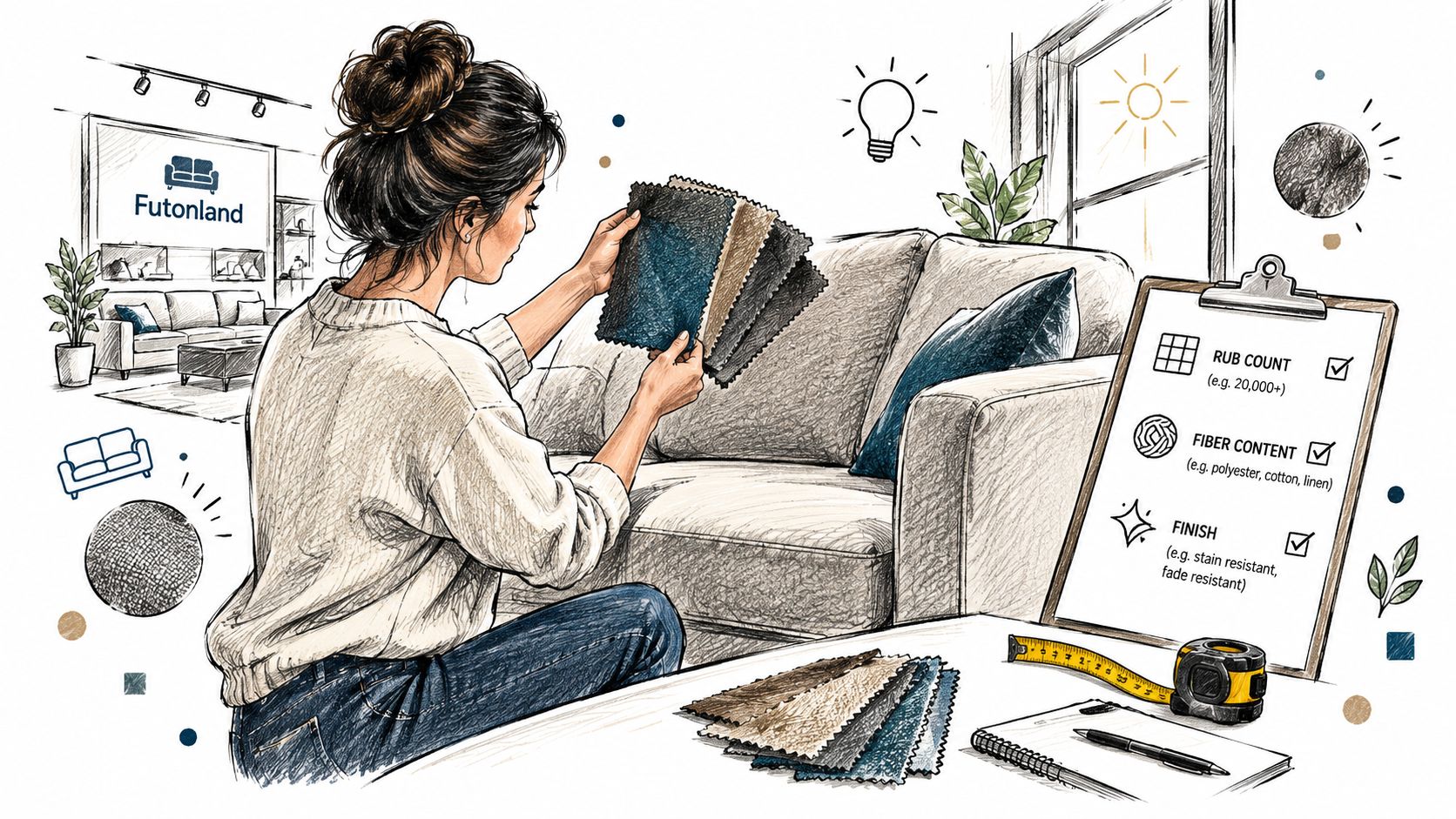
Order swatches before committing, test them in your actual room, and ask the showroom team to explain the abrasion method, finish chemistry, care label, and cover options. When you choose for your household’s hardest regular use, you won’t have to sacrifice comfort or style to get a sofa set you can live with confidently.
Order your fabric swatches from Futonland, compare them under your home’s real light, and contact the design team with your room measurements and daily-use requirements before selecting your sofa set.