

Space Saving Beds Queen: A Practical Buyer’s Guide
You’re looking at a small room that has to do too much. In a 350-square-foot studio, the bed may occupy the only comfortable living area, forcing the sofa against the kitchen or leaving no clear path to the window. In a guest room, the problem looks different: the room works perfectly as an office or reading space until visitors arrive, then the bed has to appear without a wrestling match.
A queen space-saving bed can solve that problem, but only if the room can accept its full operating footprint. The mattress is just one part of the decision. Wall width, ceiling height, cabinet depth, mattress thickness, door swing, and the daily effort required to convert the room matter just as much.
Why a Queen Sleeper Makes Sense in a Small Room
A queen makes sense when the room needs to sleep two adults without asking them to compromise every night. A standard queen mattress measures 60 by 80 inches, giving two adults substantially more shoulder room than a twin or full. Children, occasional guests, or one adult can sleep comfortably on smaller formats, but couples usually notice the difference immediately.
A queen wall bed is a sensible direction for a studio couple, a frequently used guest room, or a home office that regularly hosts two people. A full can work when floor space is extremely tight, while a twin is sensible for a child’s room or a room intended for one sleeper. A convertible sofa earns its keep when daytime seating matters more than mattress comfort, but most sofa beds introduce compromises in mattress thickness, sleeping surface, or conversion effort.
The guest-night calculation
A queen also preserves the room’s usefulness beyond one visit. Buyers often choose a smaller sleeper to save space, then regret losing a proper two-adult sleep surface when family or friends stay over. Queen bedding is widely familiar, replacement sheets are easy to source, and the format remains attractive to renters or future buyers who want a genuine bed rather than occasional seating.
The wall-bed category has grown well beyond a niche furnishing choice as more urban dwellers need one room to serve multiple functions.
Room-first rule: Choose the largest sleeper your room can operate safely, not the smallest bed that technically fits.
Ceiling and wall placement can veto the idea
Vertical Murphy beds need serious height. As a rough planning figure, a queen model commonly needs somewhere in the high-80s to low-90s in inches of ceiling clearance — but this varies meaningfully by manufacturer, so treat it only as a starting estimate. A ceiling below eight feet rules out many vertical designs, especially when crown molding, lighting, or an uneven floor reduces usable height.
A horizontal wall bed may solve the ceiling problem, but it needs a wider wall. Windows, radiators, closets, and doors can eliminate otherwise promising locations. Measure the wall you have, including trim and obstructions. The right queen sleeper is the one that opens without blocking the apartment’s only doorway or trapping someone between the bed and the kitchen.
Types of Queen Space Saving Beds Compared
Start by separating the five formats you’ll encounter. They all save space, but they save it in different ways, and the wrong mechanism can make a small room harder to use.
Vertical wall beds
A vertical wall bed stores the mattress upright inside a cabinet. It suits a narrow wall and a room with generous ceiling height, such as a studio with a long living area or a guest room that needs shelving on both sides. The cabinet stays relatively shallow when closed, but the open bed projects far into the room, so the layout must preserve a clear path in front.
Its weakness is unforgiving height and anchoring. If the ceiling is low or the wall contains no reliable structural fixing points, don’t force this format.
Horizontal wall beds
A horizontal wall bed folds sideways rather than upward. It works well under lower ceilings and on a broad wall, including a basement guest room, office, or studio where the short dimension of the room is limited. A queen horizontal unit generally needs a wide wall — often close to or exceeding 85 inches, though this varies by model.
The tradeoff is width. It may consume the wall where you wanted a desk, television, or wardrobe.
Cabinet beds
A cabinet bed stands independently and unfolds from a dresser-like cabinet. It usually avoids permanent wall mounting, which makes it appealing for renters, guest rooms, and rooms where the wall structure is uncertain. Some cabinet beds use a tri-fold queen mattress and can convert quickly.
The weakness is floor clearance. The cabinet itself occupies floor area, and the unfolded mattress still needs room for circulation. For a quick overview of wall-mounted alternatives and cabinet-style solutions, browse queen wall bed options.
Daybeds with trundles
A daybed keeps a mattress visible as seating and stores another sleeping surface below. It suits a child’s room, flexible office, or guest room that benefits from an open shelf-like appearance. The format avoids daily cabinet operation because the upper mattress remains in place.
Its limitation is comfort and capacity. The lower trundle can be less convenient to access, and the second sleeper may not receive the same feel or clearance as the primary sleeper.
Sofa beds and futon hybrids
A sofa bed or futon hybrid earns its footprint twice, as seating during the day and sleeping furniture at night. It’s often the better answer for a studio where the room needs a sofa more than a permanent bed cabinet. Look for a mechanism that converts without removing heavy cushions and a mattress that doesn’t create a pronounced fold line.
The compromise is everyday sleep quality and conversion labor. If the bed will be used nightly by a couple, a dedicated wall or cabinet bed generally makes more sense.
| Type | Folded Depth | Best Room | Key Tradeoff |
|---|---|---|---|
| Vertical wall bed | Roughly 16 to 21 inches closed, varies by model | Studio or guest room with high ceiling | Needs substantial height and careful anchoring |
| Horizontal wall bed | Roughly 16 to 21 inches closed, varies by model | Low-ceiling guest room or wide office | Requires a broad wall |
| Cabinet bed | Cabinet depth varies by design | Rental, guest room, or office | Uses floor space even when closed |
| Daybed with trundle | Upper frame remains in the room | Kids’ room or occasional guest room | Lower sleeper gets less convenient access |
| Sofa bed or futon hybrid | Sofa depth remains in place | Studio or lounge area | More conversion effort and possible comfort compromises |
Room Measurements and Clearance You Must Check
A queen sleeper fails before delivery when its footprint is treated as a product-photo detail. Measure the installation wall, the open-bed zone, the ceiling, and every route the crew must use.
Four measurements decide the fit
Wall width comes first. A queen mattress is 60 inches wide, so reserve at least 65 inches of clear wall width for trim, cabinet sides, handles, and shelves. Horizontal models need considerably more. Measure around outlets, baseboards, windows, and radiators, not just the empty drywall.
Cabinet depth changes the room immediately. Queen Murphy cabinets commonly project somewhere in the range of 16 to 22 inches, though this varies by manufacturer and model. In a narrow room, that projection can turn a usable walkway into a daily obstacle.
Ceiling height determines orientation. Below 84 inches, most vertical Murphy beds are poor choices. Between 84 and 96 inches, some vertical designs work if the ceiling is level and unobstructed. Above 96 inches, taller cabinetry and trim become easier to accommodate. Treat these as planning bands, then verify the manufacturer’s installation drawing.
Open depth is the measurement buyers underestimate. A queen wall bed can project roughly 85 to 92 inches from the wall when open. The mattress also needs about 30 to 36 inches of usable side or foot clearance in many layouts. Leave about 24 inches beside the cabinet where a dresser, closet door, or drawer must swing.
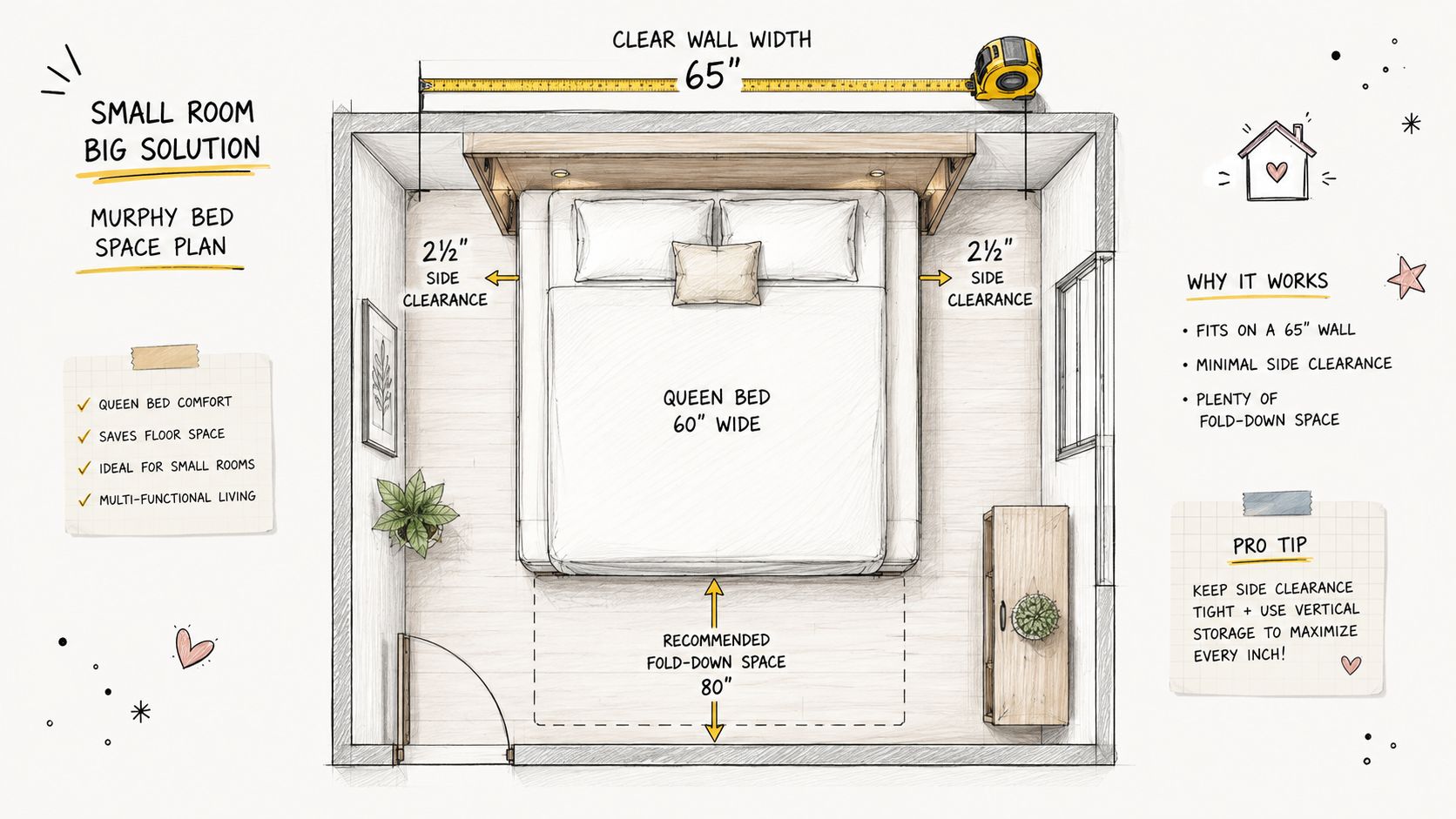
Use a Queen Murphy bed sizing chart to confirm mattress dimensions, then mark the closed cabinet and open bed with painter’s tape. Walk the delivery route, open nearby doors, and stand where someone will make the bed. Measure twice, mock the footprint once, and order only after the taped layout works.
Choosing the Right Mattress for a Folding Bed
A folding bed succeeds or fails with its mattress. Thickness, weight, and flexibility determine whether the mechanism closes cleanly, stays balanced, and remains comfortable for nightly use.
Most queen wall beds accept mattresses in the 6 to 12 inch range, but the frame and mechanism set the actual limit. Hard-close designs may allow only about 10 to 11 inches, while a mattress above roughly 11 inches can block closure or place extra strain on the hardware. Follow the product specification, not a generic mattress guide.
Latex, high-density memory foam, and pocketed coil hybrids generally fit folding systems better than bulky traditional innersprings. They offer pressure relief without excessive flexing or a deep pillow-top profile. A comfort-top mattress can suit a soft-close mechanism, but add a topper only when the manufacturer approves it.
Match the mattress to the mechanism
Capacity varies sharply by model. Check the exact weight rating in the manufacturer’s documentation and compare it with the combined weight of sleepers, mattress, bedding, and any topper — that combined figure, not just the mattress alone, is what the mechanism actually has to lift and support every day. Exceeding that limit makes lifting harder, accelerates hardware wear, and can create unsafe movement. Don’t rely on a general industry safety claim in place of the actual product’s stated rating; ask the retailer directly for the documented capacity of the specific model you’re buying.
| Mattress Type | Ideal Thickness | Weight per Queen | Best Mechanism Match | Watch Out For |
|---|---|---|---|---|
| Latex foam | Manufacturer limit, often medium profile | Confirm with supplier | Wall-bed mechanism rated for its weight | Dense construction can add weight |
| High-density memory foam | Within the stated maximum | Confirm with supplier | Wall bed or cabinet bed rated for foam | Heat retention and excessive thickness |
| Pocketed coil hybrid | Low to medium profile | Confirm with supplier | Strong wall bed with adequate clearance | Thick comfort layers may prevent closure |
| Traditional innerspring | Only if specifically approved | Confirm with supplier | Mechanism designed for that mattress | Bulky edges and poor folding compatibility |
| Tri-fold foam mattress | Folded dimensions must match cabinet | Confirm cabinet rating | Cabinet bed | Creases and topper bunching |
Check the complete dressed mattress, not the bare mattress alone. Sheets and protectors should fit tightly because loose bedding can bunch at the foot during conversion. Open and close the bed repeatedly before committing to daily use.
For a tight apartment move, protect foam mattresses from sharp bends and compression during transport. For foam-based cabinet options, compare folding foam beds, then verify the closed height, mattress thickness, cabinet rating, and warranty requirements before ordering.
Delivery, Assembly, and Removal Services
A queen folding bed can become a building-access problem before it becomes a bedroom project. The cabinet, frame, mattress, and hardware may arrive in several boxes or as one large crate, while the intended wall often offers less working space than product photos suggest. Plan the delivery route and installation service around the actual clearance, not the showroom layout.
Choose the service tier deliberately
Curbside delivery suits a capable DIY team with a clear entrance, suitable tools, and enough help to lift the shipment. It does not cover carrying the pieces through the building, cabinet assembly, wall anchoring, mechanism alignment, or packaging removal.
Threshold delivery brings the shipment inside the front door. Choose it only if you can manage stairs, tight turns, room protection, and assembly yourself. You still need to keep the path clear and protect finished floors and walls.
White-glove delivery is the right choice for a wall bed that needs anchoring, alignment, and opening-cycle testing. Confirm that the crew assembles the cabinet, secures it to the wall, checks the mechanism, levels the doors, and removes all packing materials. Some warranties require an approved technician, so read the installation terms before selecting the lowest service tier.
Book removal and haul-away before delivery day. The same crew can often remove an old platform, dismantle a sleeper sofa, or take away a mattress more efficiently than a separate appointment. Confirm what the service accepts, since disposal terms vary.
Prepare the building, not just the bedroom
Measure hallway width, stair turns, elevator clearance, doorway height, and the final wall section. In a New York apartment, freight-elevator schedules and building loading rules can determine whether delivery succeeds. Ask the super about floor protection, insurance documents, and a reserved service window.
Clear rugs and décor, remove doors if the route requires it, identify structural studs, and photograph existing wall conditions. Walls can be uneven, studs may not align with the cabinet, and incorrect hardware can halt installation.
Review Futonland store locations and ask about available delivery, assembly, and removal arrangements before ordering. Put every promised service in writing, including packaging removal, mattress setup, old-furniture disposal, damage reporting, and responsibility for wall repairs. A queen wall bed is a poor fit if the crew cannot reach the installation wall or the building will not permit the required delivery window.
Price Ranges and Value Tips for Queen Sleepers
Price differences usually reflect the mechanism, cabinet construction, and installation complexity more than the basic fact that the bed is queen size. Spend your budget on the parts that move and carry weight, not on decorative panels that don’t improve daily use.
What the main price bands buy
Entry cabinet beds generally sit under about $1,500, with basic piston lifts and laminate finishes. They suit occasional guests and renters who need a compact freestanding solution. Inspect the mattress quality, hinge feel, and cabinet stability carefully, because a lower purchase price can come with fewer finish choices and less durable hardware.
Mid-range wall beds commonly fall around $1,800 to $3,500. This tier may add soft-close hardware, real wood veneer, integrated shelving, and a more convincing furniture finish. It is the practical range for a guest room or studio where the bed will convert regularly but doesn’t need extensive custom millwork.
Premium Murphy systems can run from $3,500 to $6,000 or more, particularly when they include custom cabinetry, desks, sofas, sectionals, or built-in storage. You’re paying for coordinated room planning and finish integration as much as for the sleeping surface.
| Price Band | Typical Range | Mechanism Quality | Finish and Features | Best For |
|---|---|---|---|---|
| Entry cabinet bed | Under about $1,500 | Basic piston lift | Laminate, simple storage | Occasional guests and renters |
| Mid-range wall bed | About $1,800 to $3,500 | More refined, often soft-close | Veneer, shelving, furniture-grade cabinet | Studios and regular guest use |
| Premium Murphy system | About $3,500 to $6,000 or more | Heavy-duty integrated system | Custom millwork, desks, sofas, storage | Full-room conversions |
These bands are directional, not quotes. A compatible mattress, tax, delivery, assembly, removal, and building charges may sit outside the advertised product price.
Spend first on: the lifting mechanism, anchoring method, mattress compatibility, and installer quality. Cosmetic upgrades come after those four.
Compare flat-packed and pre-assembled versions, inspect floor models, and ask about last-of-line closeouts. Bundling delivery with the mattress can simplify scheduling, while checking building amenity surcharges before checkout prevents an unpleasant move-in bill. In co-ops and condos across New York and Jersey City, large-furniture rules can add cost or restrict delivery windows, so confirm those conditions early.
Layout and Styling Ideas for Small Spaces
A queen sleeper should anchor the room rather than look like an object dropped into leftover space. Start by deciding where the open bed will go, then arrange the closed cabinet, desk, sofa, and lighting around that operating position.
In a studio, place the folded cabinet facing the kitchen zone when possible. That keeps the sleeping surface away from the cooking path and lets the living area sit opposite the cabinet. Use a shallow sofa or two compact lounge chairs rather than a deep sectional, and keep the main walking aisle at least 24 inches wide.
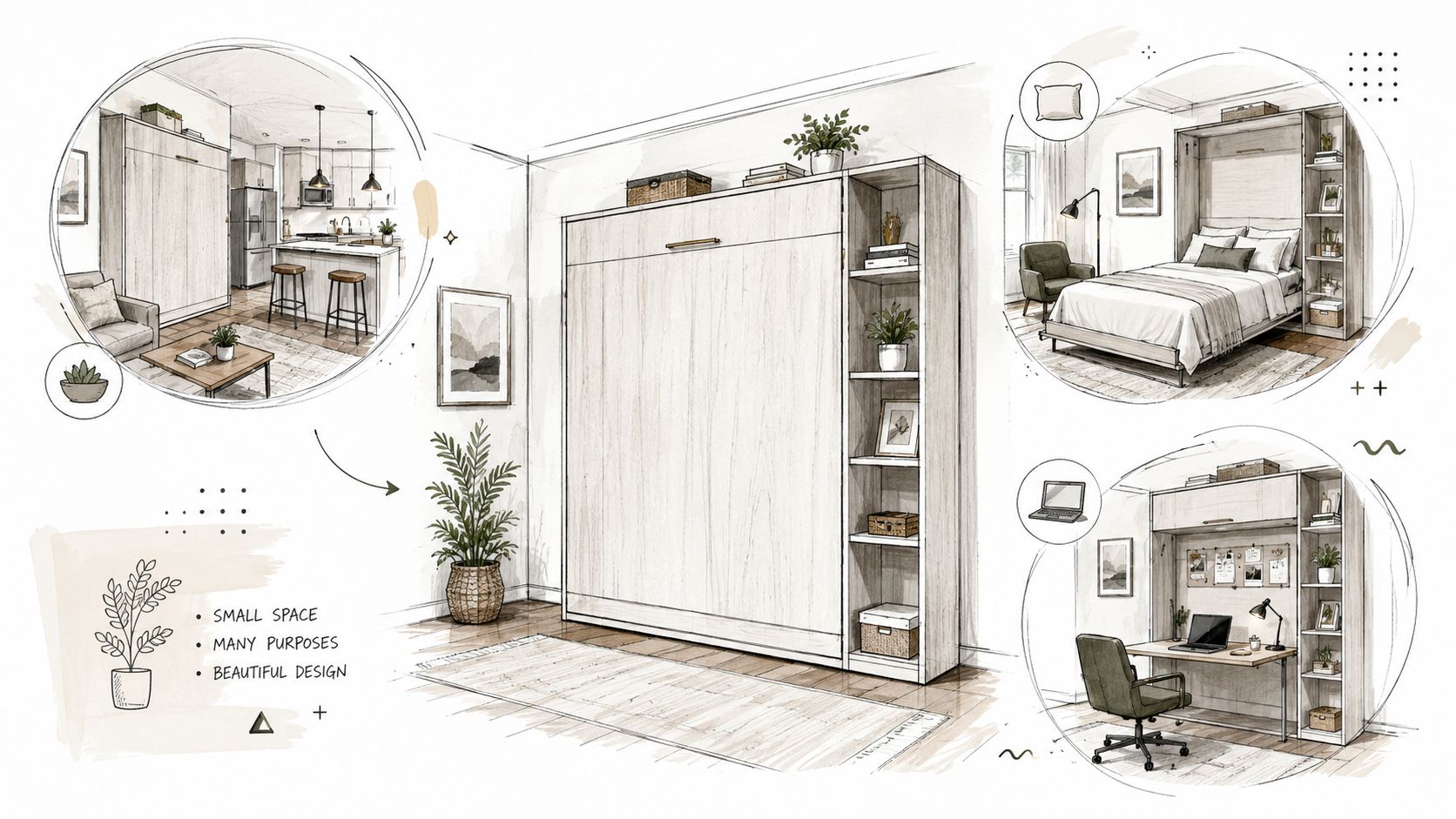
Three layouts that work
A guest room can become a reading nook when the bed is closed. Put a low-profile sofa opposite the cabinet, add a floor lamp or wall sconce, and use a narrow side table that can move when guests arrive. Keep Murphy doors from opening toward the room’s doorway, because that creates a collision point during conversion.
A home office needs more discipline. Place the desk outside the bed’s swing arc, with about 30 inches of separation where the work surface or chair would otherwise interfere. Wall-mounted nightstands, pendant lights, and sconces free the floor and eliminate furniture that must be moved before opening.
Make the closed cabinet recede
Choose paint with light-reflecting qualities, a vertical stripe wallpaper, or a cabinet finish that matches the surrounding wall. A mirror opposite the cabinet can widen the visual field, but avoid positioning it where the open bed or moving doors can strike it.
Use a dresser under 16 inches deep when you need clothing storage without taking over the circulation zone. When the bed is stowed, style the cabinet top like a console with books, a small lamp, or a shallow tray. Remove fragile objects before opening, and keep the top clear enough that daily conversion doesn’t become a chore.
Frequently Asked Questions About Queen Space Saving Beds
How long does a queen Murphy or cabinet bed last?
A quality hardwood frame can serve for roughly 10 to 15 years, depending on construction and use. Guest-room use is gentler because the mechanism cycles occasionally. Daily conversion places more demand on pistons, hinges, fasteners, and anchoring points, so installation quality matters as much as the wood species.
Listen for changes in the movement cycle. New scraping, uneven lifting, cabinet separation, or a bed that no longer stays balanced deserves attention before continued use.
How much weight can it hold?
Many queen wall beds are rated for 500 to 1,000 pounds including the mattress, but the rating belongs to the specific mechanism, not to the queen label. Get the documented capacity for the exact model you’re buying from the manufacturer directly, rather than relying on a general industry figure.
Don’t treat a generous rating as permission to add unapproved mattress toppers, storage baskets, or heavy bedding. Excess load can make the piston system difficult to lift and place additional stress on the frame and wall anchors.
What warranty should I expect?
Frame coverage commonly falls between one and five years, while some hardware components carry lifetime coverage. Read the exclusions carefully. A warranty may depend on approved installation, correct mattress thickness, documented assembly, or using the mechanism only within its stated load range.
Keep the invoice, installation paperwork, model number, and photographs of the completed anchoring. Those records can make a service claim much easier.
Is a queen space-saving bed suitable for everyday couple sleeping?
Yes, if the room supports the open footprint and both sleepers accept the conversion routine. A properly matched queen wall bed can offer a more familiar sleep surface than many sofa beds, but it still differs from a traditional platform bed in noise, movement, and the need to fold the bed away each morning.
Size down to a full when one sleeper uses the room or when the queen open depth blocks essential circulation. Size up to a king only when the room can absorb the larger operating area and the mechanism explicitly supports that format. For most couples in a compact apartment, queen is the sensible middle ground, provided the ceiling, wall, mattress, and daily workflow all pass inspection.
Measure your wall, ceiling, delivery path, and open-bed footprint before you shop. Then compare queen wall beds, cabinet beds, and convertible alternatives against the way you use the room, and speak with a space-saving furniture specialist before ordering a mechanism that may not fit your building or mattress.