
TV Stands with Glass Shelves: 2026 Buyer’s Guide
You’re probably looking at a living room where the TV stand can’t disappear into the background. In a studio, one-bedroom, or open-plan apartment, it sits in full view from the sofa, the dining table, sometimes even the bed. That’s why the choice between solid shelving and glass shelving matters more than people think.
A lot of shoppers already know the look they want. They don’t want a heavy box under the TV. They want something lighter, cleaner, and more architectural. But once glass enters the conversation, the practical questions show up fast. Will it hold a receiver? Is tempered glass safe? Will cables look worse because everything is visible?
Those are the right questions. TV stands with glass shelves can work beautifully in city apartments, but only when the stand is chosen with the same care as the TV sitting on it.
Why Choose a TV Stand With Glass Shelves
A bulky media cabinet can make a small room feel shorter and tighter. You notice that immediately in apartments where the TV wall is also the main living area. Closed bases in dark finishes can work, but they tend to read as visual mass. Glass shelves do the opposite. They let light pass through, they keep sightlines open, and they make the setup feel less crowded.
That matters in homes where one piece has to do several jobs. A TV stand may sit next to a sleeper sofa, face a dining nook, or share space with a desk. In those layouts, a stand with open glass shelving often feels more appropriate than a deep, all-solid cabinet. You still get storage, but the piece doesn’t dominate the room.
A lot of buyers also prefer glass because it treats electronics as part of the design. If you’ve got a clean soundbar, a game console, a turntable, or a streaming box you like looking at, open shelving turns those items into part of the arrangement instead of something to hide. That’s very different from the old entertainment-center mindset.
Where glass shelving works best
Glass shelves usually make the most sense in spaces like these:
- Open-plan living rooms: The stand is visible from multiple angles, so a lighter frame looks more intentional.
- Studios and guest spaces: Open shelving keeps the room from feeling blocked off.
- Contemporary interiors: Metal, glossy finishes, and glass pair well with cleaner lines.
- Tech-forward setups: If you want your components accessible, glass makes that easy.
Glass shelving is rarely the right choice for someone who wants to hide everything. It is the right choice for someone who wants the setup to look edited, not concealed.
The broader market supports that preference. The global television stand market is valued at USD 2.84 billion in 2025, and floor-standing models, which often incorporate glass shelving, hold a 45.2% market share according to Coherent Market Insights on the television stand market.
If you’re comparing silhouettes and layouts, browsing a full range of TV stands and entertainment centers helps clarify whether you want pure open shelving, a mixed glass-and-wood frame, or a hybrid piece with some concealed storage.
The Practical Appeal of Glass Over Wood or MDF
The aesthetic case for glass is obvious. The practical case is what usually decides the purchase.
Painted wood and MDF shelving can look great on day one, but they show wear in familiar ways. Corners chip. Dark finishes telegraph dust. Lacquered surfaces can show rubbing and edge wear. Open glass shelves age differently. They don’t peel, and they don’t get that rubbed-through look that lower-priced painted shelving can develop over time.
What glass does better in daily use
Glass has a few practical advantages that matter in everyday apartment life:
- Cleanup is simpler: Dust, fingerprints, and spills wipe off without the surface absorbing residue.
- Visual weight stays low: Even when you add components, the shelving still reads lighter than a solid shelf stack.
- Your equipment stays visible: Remote sensors, indicator lights, and display screens are easier to monitor.
- It pairs well with modern hardware: Streaming devices, consoles, and slim audio components usually look better on an open shelf than inside a dark cubby.
That last point matters more than people expect. Many entertainment setups now combine decorative and functional items on the same unit. A glass shelf can hold a console on one level and books or objects on another without making the whole stand look overloaded.
Where wood or MDF still wins
Glass isn’t automatically better. It’s better for a certain kind of buyer.
If you want to hide a cable box, stash board games, or keep kids’ accessories out of sight, enclosed wood storage is easier to live with. If you move furniture around often, some people also prefer the visual forgiveness of wood. Smudges show on glass until you wipe them off. On the other hand, scratches and chips tend to read harsher on painted MDF than on clear or tinted glass.
A quick comparison helps:
| Feature | Glass shelves | Wood or MDF shelves |
|---|---|---|
| Visual feel | Airy, open, contemporary | Solid, grounded, often heavier |
| Cleaning | Wipes clean easily | Can trap dust in corners and textured finishes |
| Wear pattern | Shows smudges, less prone to peeling | Can chip, peel, or rub at edges |
| Display effect | Highlights components and decor | Emphasizes the furniture more than the equipment |
| Cable concealment | Harder to hide mess | Easier with closed storage |
Practical rule: Choose glass when you want display, access, and visual lightness. Choose enclosed wood when your priority is concealment.
That preference isn’t niche. As noted earlier, floor-standing designs with open appeal hold a major share of the market, which reflects how many buyers want a stand that feels stable without looking bulky.
Decoding Glass Types Weight Capacity and Safety
Most hesitation around tv stands with glass shelves comes down to one issue. People don’t want to guess about safety.
That caution is sensible. Glass is not wood. It doesn’t flex and fail the same way, and it shouldn’t be judged by looks alone. The first thing to check is whether the shelf is tempered glass. For this category, that’s the baseline, not a bonus feature.
What tempered glass actually means
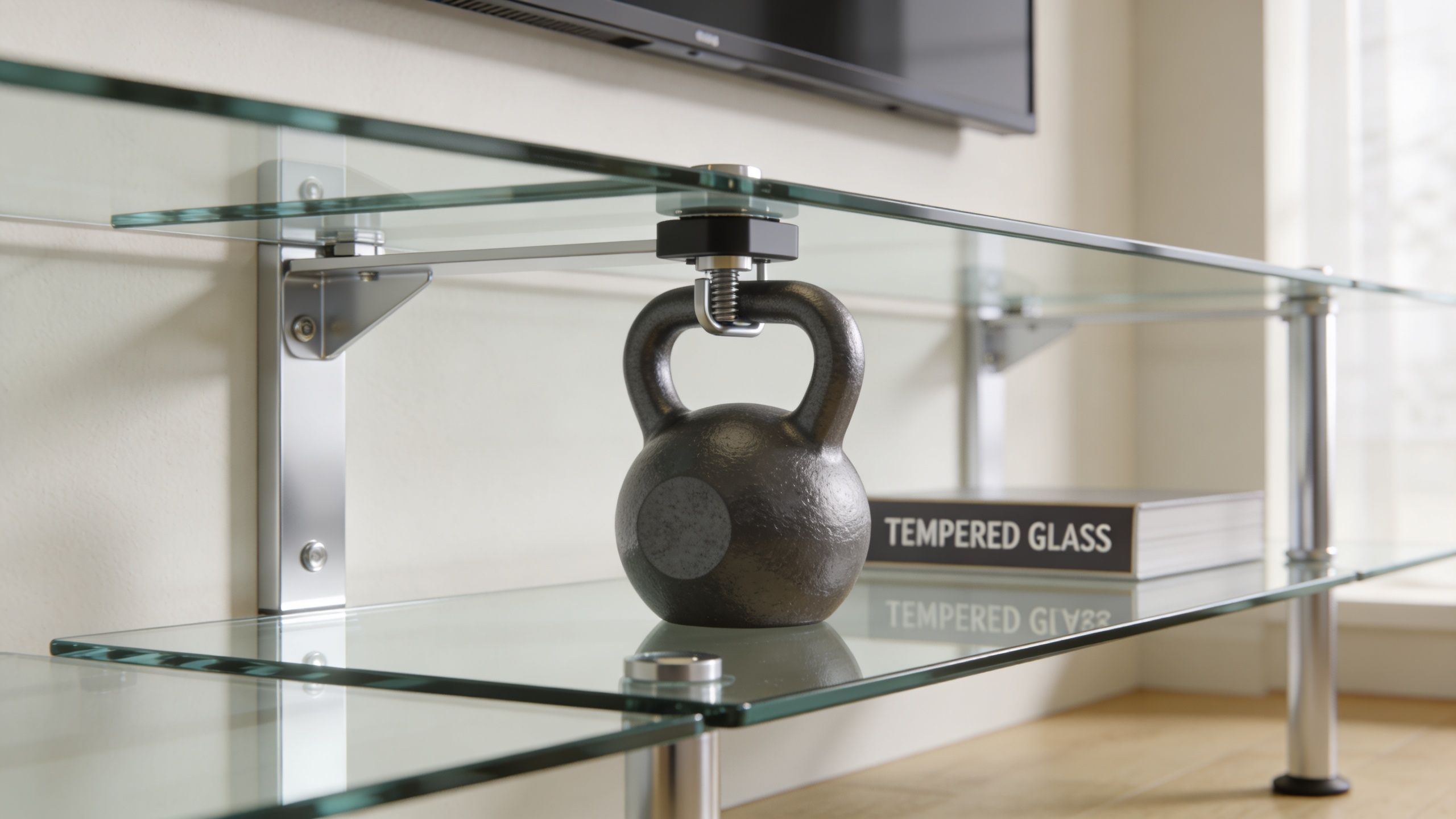
Tempered glass is processed so that if it fails, it breaks into small granules rather than large sharp shards. That’s the behavior you want in a household with pets, kids, or frequent foot traffic around the TV area.
It’s also built for real component loads. According to AVF Group product specifications for a glass-shelf TV stand, tempered glass shelves are designed to support 20 to 40 kg per shelf, and they fracture into small, relatively harmless granules if broken.
That doesn’t mean every shelf can hold every device. It means you need to read the rating and use it correctly.
The mistake buyers make with shelf loads
People often think shelf capacity is just about total weight. In practice, placement matters too.
A receiver, console, or speaker placed squarely and evenly on a shelf is one thing. A concentrated load pushed onto one corner is another. Glass handles distributed weight better than careless point loading. If a component has small feet and all the pressure sits on a tiny area, that’s a different stress pattern than an item with a broad, stable base.
Use this checklist before you buy:
- Confirm tempered glass: If the listing is vague, ask. Don’t assume.
- Read the per-shelf rating: Shelf capacity matters more than the total stand capacity for most buyers.
- Check your heaviest component first: Receivers and larger audio gear usually decide whether the shelf plan works.
- Look at shelf spacing: A shelf can support the weight but still be useless if the component height is too tight.
- Avoid edge loading: Keep heavier devices centered and fully supported.
Put the heaviest component on the shelf position designed to support it best, usually the lowest practical open shelf.
Safety in homes with children or pets
Many retailer listings fall short. They mention tempered glass briefly, then move on. What buyers need is a plain explanation of how the shelf behaves, what the load rating means, and how to avoid misuse.
In family homes or tighter apartments, I’d also pay close attention to edge exposure and traffic patterns. If the stand sits along a narrow walkway, a sharply projecting corner matters. If a dog’s tail or a child’s toy regularly clips the lower level, that changes what shape and layout make sense.
A glass shelf stand can be a smart, durable choice. It just needs to be treated like a load-bearing piece of furniture, not a decorative afterthought.
Sizing Your Stand for Perfect TV Compatibility
A stand can have beautiful glass shelving and still be wrong for the TV, with shoppers often focusing on screen size alone and missing the structural match.
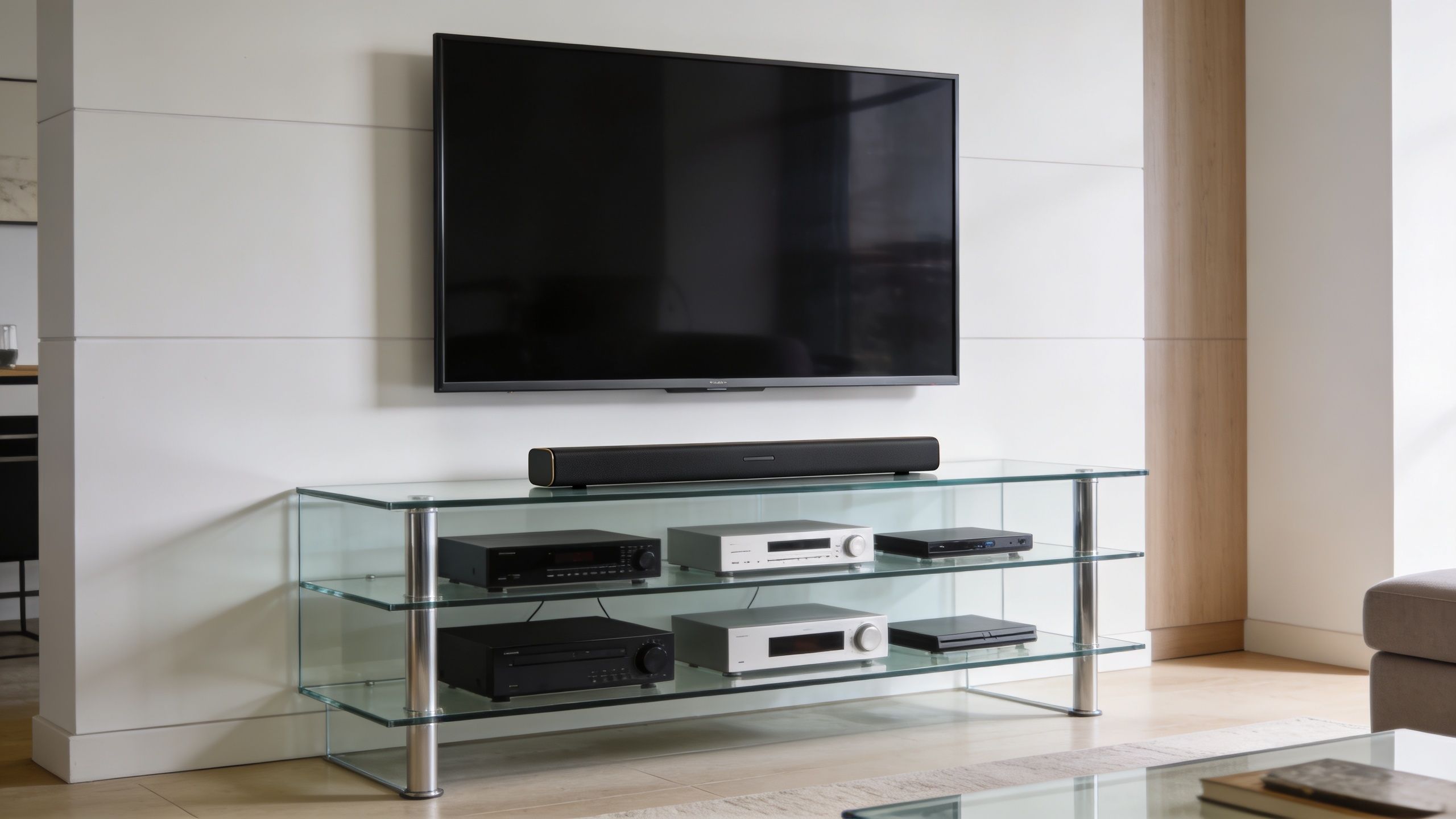
Start with the footprint. Measure the wall, the walkway clearance, and the stand width you can live with. In a compact apartment, the right stand isn’t the biggest one that fits. It’s the one that supports the TV safely without making the room harder to move through.
The compatibility checks that matter
If the stand includes an integrated mount, or if you’re pairing it closely with a mounted screen, check VESA compatibility first. According to this explanation of TV stand mount compatibility and VESA patterns, stands rated for TVs up to 65 inches typically support VESA patterns up to 400×400mm.
That’s the bolt pattern on the back of the TV. If the pattern doesn’t match, the mount doesn’t fit. Simple as that.
There’s also a stability issue. TV weight and mounting position create rotational force, or torque. If the screen sits too far from the stand’s support axis, the base has to resist more twisting force. That’s why a mount rating isn’t just paperwork. It’s part of the safety design.
A simple buying checklist
When I help shoppers narrow this down, these are the checks that matter most:
Stand width first
The stand should read wider than the TV, both visually and physically. A too-narrow base looks top-heavy even when it technically fits.TV weight second
Check the stand’s supported screen weight, not just its shelf ratings.VESA pattern third
Match the back of the TV to the mount specification if the unit includes a bracket system.Room circulation last
Make sure the stand depth doesn’t crowd the path around the seating area.
A quick reference table helps keep the decision clean:
| Check | Why it matters |
|---|---|
| Stand width | Prevents a top-heavy look and improves perceived stability |
| TV weight rating | Protects the structure and mount system |
| VESA pattern | Confirms the TV can actually attach to the integrated mount |
| Depth | Affects walking space and cable clearance |
| Shelf spacing | Determines whether your gear fits below the screen |
If you need help translating furniture measurements to room fit, Futonland sizing charts are useful for comparing dimensions before you commit to a layout.
A TV stand should fit the room twice. Once on paper, and once in the way you actually move through the apartment.
Mastering Cable Management With Open Shelving
Open glass shelving looks clean only when the wiring is disciplined. If the cables droop, knot, or bunch behind the unit, the whole effect collapses.
This is the trade-off big-box listings tend to underplay. Glass doesn’t hide your mistakes. It asks you to build a cleaner setup.
What works with open shelving
The best cable management starts with the stand itself. Look for rear routing points, central supports that hide drops, or back panels that break up the view from the front. If a stand gives you only one open hole and no routing structure, expect more visible clutter.
After that, the setup work matters:
- Bundle by function: Keep power cables together, signal cables together, and label them before final placement.
- Use short runs where possible: Extra cable length creates loops and visual noise.
- Clip vertical drops: Letting cords hang freely behind glass shelves almost always looks messy.
- Leave service slack: You want enough give to pull a console forward without redoing the entire setup.
A tidy system also makes maintenance easier. When you swap a streaming box or add a game console, you won’t have to unravel everything from scratch.
Why cable separation matters
There’s a technical side here too. The stand isn’t just holding electronics. It’s organizing how those electronics live together.
The verified guidance for modern TV stand cable systems notes that bundled cables can interfere with signal quality, and that separation helps reduce crosstalk and other issues in multi-device setups. It also notes that rear cable panels with individual routing channels work better than a single pass-through when you’re managing several devices in a compact footprint. That’s useful in apartments where the stand sits close to the wall and every inch behind the unit counts.
A cleaner setup in real rooms
For a simple streaming setup, cable management is easy. TV power, one HDMI run, one soundbar connection, done.
For a fuller living room arrangement, it’s different. Add a game console, router, speaker cable, charging lead, and power strip, and open shelving starts to reveal every shortcut. At that point, I’d rather see a stand with fewer, better-managed visible elements than one overloaded with gear.
Try this sequence when setting up:
- Place the stand first and decide which shelf gets the heaviest equipment.
- Route power before signal cables.
- Test the devices while the stand is still slightly off the wall.
- Tighten and clip only after everything works.
- Push the unit back with enough clearance for ventilation and cable bend radius.
Open shelving rewards restraint. Fewer visible devices, cleaner routing, better result.
Matching Styles and Finishes to Your Home Decor
Glass shelving changes the mood of a TV stand, but the frame and finish decide the direction. Clear glass with chrome or polished metal feels very different from smoked glass in a dark wood frame.
That’s why “modern” is too broad to be useful. Buyers usually respond better when they think in room personalities.
Three looks that work especially well
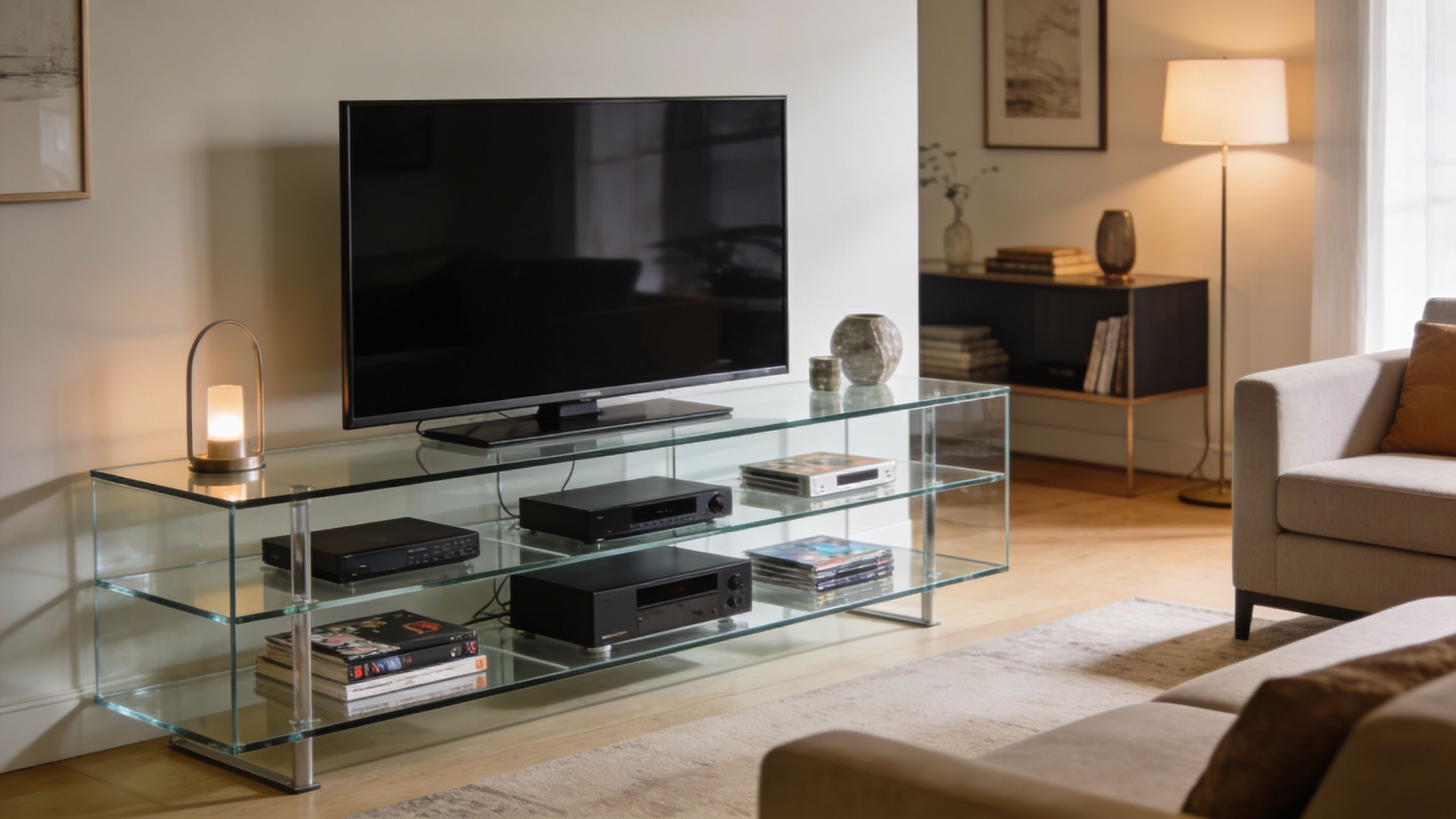
A few combinations consistently make sense in apartments:
Clear glass with metal for a loft-like look
This works best when the room already has clean lines, lighter flooring, and minimal visual clutter. Clear shelves almost disappear, which helps the TV wall stay sharp instead of heavy. If you’ve got a sectional, a low coffee table, and not much ornament, this style keeps the room crisp.
Smoked glass with dark wood for a softer modern feel
This is a good answer for people who like contemporary furniture but don’t want the room to feel cold. Smoked glass hides dust and wiring a bit better than clear glass, and a darker frame gives the stand more presence without becoming bulky.
Glass with mixed materials for transitional spaces
Some buyers want open shelving but still need the room to feel warm. A stand that combines glass display shelves with wood or textured framing can bridge that gap. It’s often the easiest choice in homes where the TV area sits near more traditional seating.
Choosing by room behavior, not just style label
Think about what the room asks from the stand:
- Highly visible room: Go lighter and cleaner, because the stand will be seen from several angles.
- Busy family area: Favor forgiving finishes and a layout that doesn’t expose every cable.
- Decor-led setup: Glass shelves can display books, ceramics, or audio gear without the stand feeling overstuffed.
- Mixed-use room: If the TV area also functions as a guest or work zone, avoid anything too visually dense.
That demand for contemporary, modular display furniture is substantial. In 2023, entertainment centers featuring glass shelves captured a 38.83% revenue share in the market, driven by demand for sleek, modular storage according to Grand View Research on the entertainment furniture market.
If you’re trying to coordinate the stand with seating, tables, and storage, it helps to look at the larger living room furniture collection instead of treating the media unit as a standalone purchase.
The Futonland Advantage From Delivery to Assembly
The hardest part of buying a glass-shelf TV stand often isn’t choosing it. It’s getting it into the apartment, up the stairs or elevator, and assembled without putting stress on the glass or the frame connections.

That’s where specialized retail matters. Major retailers often don’t provide much quantitative detail on glass shelf safety, including certification and impact-resistance information, which leaves buyers to fill in the blanks themselves, as noted in this Wayfair category page review gap analysis.
For NYC shoppers, the service side matters just as much as the product page. White-glove assembly reduces the chance of rushed installation, misaligned hardware, or overtightened connections. Debris removal also matters more than it sounds when you’re unpacking furniture in a compact apartment. If you want to see where that support is available, Futonland store locations are listed online.
A good glass-shelf stand should look light, hold weight sensibly, and fit the room without drama. The right buying process should do the same.