
How To Arrange Furniture In a Small Bedroom for Maximum Space
Arranging furniture in a small bedroom isn’t about brute force; it’s about having a plan. Before you move anything, measure your space, identify your anchor piece (almost always the bed), and sketch a simple floor plan. That small amount of prep is what turns a cramped room into a setup that feels calm, functional, and easy to live in.
Your Blueprint for a Spacious Small Bedroom
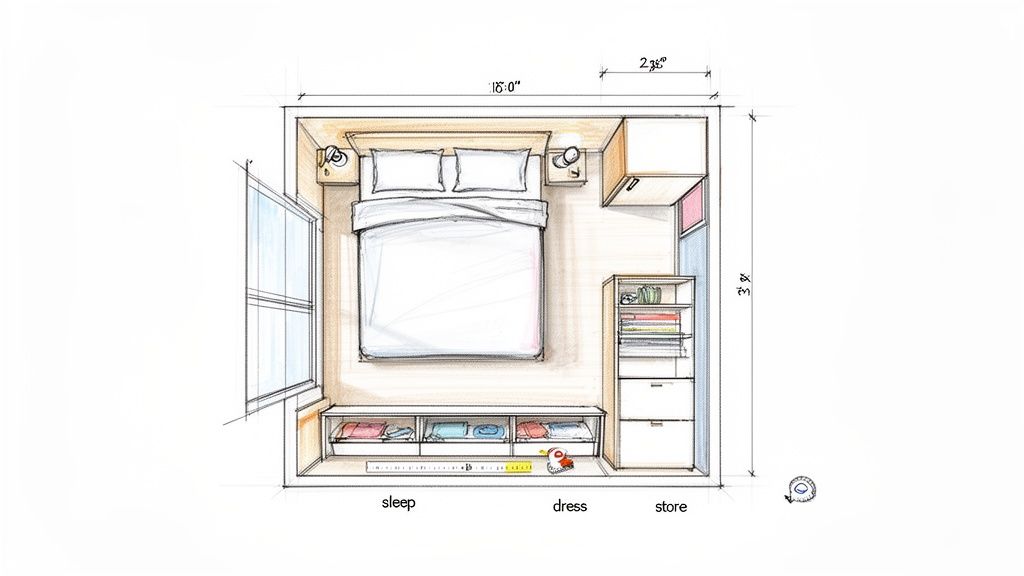
Staring at the four walls of a tiny bedroom can feel like you’re trying to solve a puzzle with no right answer. It’s tempting to start shoving furniture around and hope it works out, but that usually leads to blocked pathways, awkward corners, and a room that still feels stressful. The real key is a simple blueprint first—one that balances how you want the room to look with how you need it to function every day.
Start by measuring everything: the room’s length and width, ceiling height, window locations, and the swing of every door (including closet doors). This is the foundation for every other decision. A few minutes now can save you from realizing later that your dresser blocks the closet or your bed frame steals the only usable walkway.
Define Your Zones and Priorities
Even a small bedroom can have “zones” that make it feel more organized. Zoning simply means giving each part of the room a job—sleeping, dressing, storage, and sometimes working. Ask yourself what the room truly needs to do.
- Sleep-focused: The bed is the star. Prioritize comfort, access, and a calm layout.
- Multi-functional: You’re balancing sleep with a desk, reading corner, or dressing area.
- Storage-centric: The mission is to reduce clutter and maximize closet/drawer space.
Identify Your Room’s Hero Piece
Every good room layout has an anchor—your “hero piece.” In a bedroom, it’s the bed. Where it goes sets the entire room up for success (or struggle). In most small bedrooms, the best starting point is against the longest uninterrupted wall, since it usually frees up the most usable floor space.
A well-placed bed doesn’t just save space; it creates balance. Once the bed is positioned correctly, the rest of the furniture decisions become much clearer.
Once your hero piece has a home, you can build a smart layout around it. This is also where multifunctional furniture starts to matter: a storage bed can reduce (or eliminate) the need for a bulky dresser, while a convertible futon or wall bed can completely change how the room functions during the day.
Mastering Your Floor Plan Before You Move Anything

This is where the biggest wins happen. A little planning saves you a lot of trial-and-error (and back pain). You don’t need fancy software—graph paper works perfectly, or you can use a free online room planner.
Create a Simple Scaled Layout
Put your room measurements on paper using a basic scale (for example, 1 inch = 1 foot, or one graph square = 6 inches). Then measure your furniture the same way—especially the bed, dresser, desk, and any storage pieces.
Next, make to-scale cutouts (or simple rectangles) for each piece and move them around your floor plan. You’ll be able to test multiple layouts quickly and spot problems instantly, like a dresser that blocks a drawer, or a desk that can’t be used comfortably.
Define the Room’s Primary Purpose
Before you lock in a layout, be honest about priorities. This is what separates a room that looks good from one that actually works.
- Besides sleeping, what’s the one essential activity that must happen here?
- How much clothing storage do you truly need?
- Will one or two people use the room daily?
- What’s the biggest frustration with the current setup? (No floor space, blocked closet, no bedside surface, etc.)
If you’re comparing different bed sizes or convertible pieces, having precise dimensions matters. The sizing charts can help you compare footprints before anything arrives.
Planning isn’t just about making things fit. It’s about making the room easy to move through, easy to use, and easier to keep clean.
Don’t Forget the Fixed Elements
Map the parts of the room you can’t move. These often dictate the best layout more than the room’s size does.
- Outlets: Mark each one so you don’t end up with a lamp you can’t plug in.
- Door swings: Bedroom door, closet doors, drawers, and window access.
- Natural light: Note where daylight falls so you don’t put a desk in a dark corner (or a bed where sunrise is harsh).
- Vents/radiators: Leave airflow clearance for comfort and safety.
Choosing Furniture That Works Smarter, Not Harder
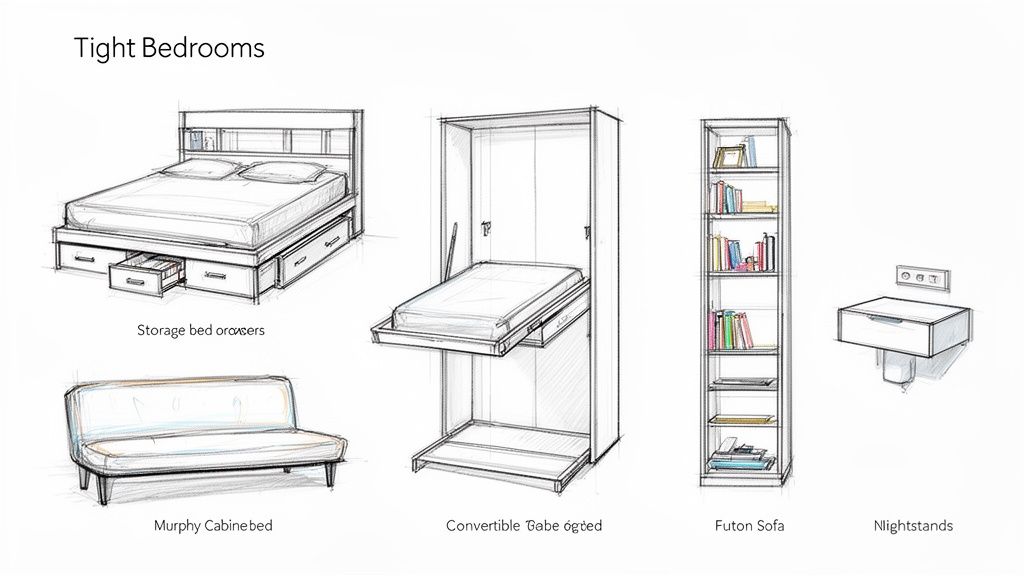
In a small bedroom, every piece should earn its place. The best strategy is choosing furniture that does more than one job—without making the room feel crowded.
The Bed: Your Room’s Hardest Worker
The bed uses the most floor space, which makes it your biggest opportunity. A bulky, high-profile bed frame can visually shrink the room. A sleek, low-profile platform bed can make the space feel calmer and more open.
If you’re short on storage, a bed with built-in drawers is often the fastest way to reclaim floor space. Instead of adding a dresser, you move storage into the bed footprint you already “pay for.”
Consider Convertible Options for Multi-Use Rooms
If your bedroom also needs to function as a home office, guest room, or studio living space, convertible furniture can be a game-changer.
- Murphy beds (wall beds): Fold up to free floor space for daytime use. See options in space-saving wall beds.
- Convertible futons and sofa beds: Give you a true seating area that can become a bed at night.
- Murphy cabinet beds: Freestanding and flexible (no wall installation), with a clean footprint when closed.
When your bed can transform or disappear, the room stops being “small.” It becomes adaptable—open when you need it, cozy when you want it.
Go Vertical for Storage and Surfaces
Small bedrooms feel tighter when the floor is crowded. Shifting storage upward can make the room feel instantly cleaner.
- Tall, narrow chests: Same storage, less wall width.
- Floating shelves: Useful storage without visual heaviness.
- Wall-mounted nightstands: Free up floor space and make cleaning easier.
- C-tables: Slide under the bed edge for a small, flexible surface.
Proven Layouts for Common Small Bedroom Shapes
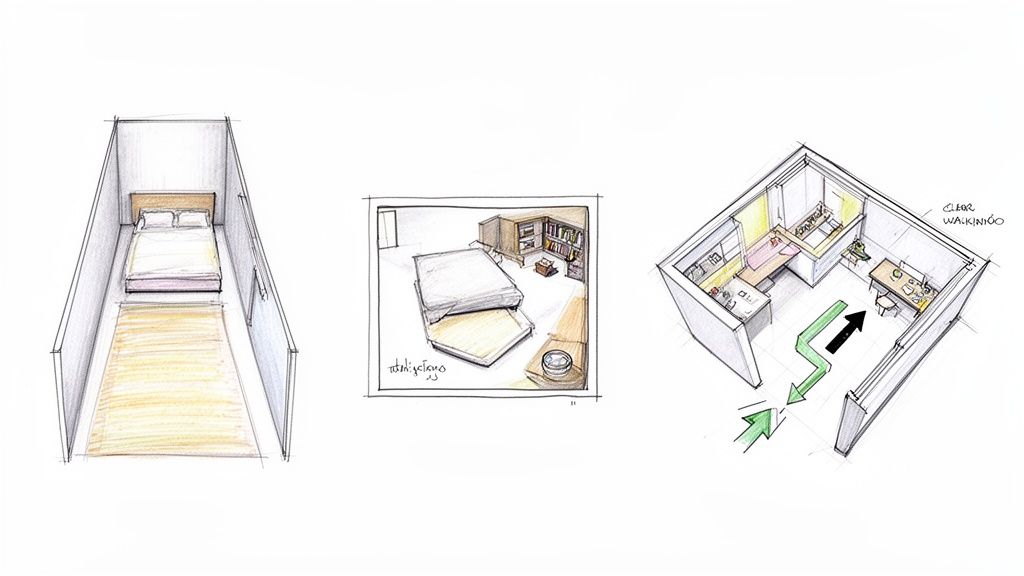
Room shape matters. A long, narrow bedroom needs different strategies than a small square room. Use these proven approaches as starting points, then adjust based on door swings, windows, and your must-have pieces.
Long and Narrow Bedrooms
Avoid lining everything along one wall—it creates a tunnel effect. Instead, place the bed against a long wall if it improves the walkway and use the short walls for taller storage (like a chest of drawers). Consider a rug placed perpendicular to the length of the room to visually widen the space.
Small Square Bedrooms
In small square rooms, perfect symmetry can make the room feel rigid. Don’t be afraid to offset the bed slightly to create a usable corner for a desk, a chair, or vertical storage. Corner placement can also open up a surprising amount of floor space.
Awkward or L-Shaped Rooms
Treat the “L” like two zones: put the bed in the main area, and use the nook for a desk, wardrobe, or reading corner. Awkward layouts often become easier once each section has a clear purpose.
Finishing Touches That Create the Illusion of Space
Lighting That Saves Surface Space
Large lamps eat up nightstand space. Use wall-mounted sconces, plug-in sconces for rentals, pendant lights, or slim floor lamps to keep surfaces clear and add layered light.
Mirrors and Color That Open the Room
Light, neutral wall colors help reflect light and make walls feel farther away. Add personality through textiles and art rather than dark, heavy furniture. A large mirror placed opposite a window can bounce natural light through the room and visually expand it.
Window Treatments That Make the Room Look Taller
Hang curtain rods higher than the window frame and extend them wider than the window. This makes windows look larger, lets in more light, and makes ceilings feel higher. Choose lighter fabrics to avoid a heavy, closed-in feel.
Common Questions About Arranging a Small Bedroom
Can I put my bed in front of a window?
Yes—if it’s the layout that works best. Use a low-profile or open headboard so light isn’t blocked, and leave a little space for airflow and window access.
What minimum walkway space should I aim for?
- Main pathway: 30–36 inches if possible
- Beside the bed: 24 inches on at least one side (18 inches can work in tight rooms)
- In front of dressers/closets: around 30 inches for comfortable access
Does the bed have to be centered?
No. Centering looks classic, but it’s not always the most space-efficient. Off-center placement can unlock a corner for storage or a small desk and often improves movement through the room.
How do I add a workspace without it feeling cluttered?
Use compact or vertical solutions: a floating desk, ladder desk, or secretary desk that closes. Keep it in a low-traffic corner and choose a visually light chair (slim frame or armless) to reduce bulk.
At Futonland, we focus on space-saving solutions that make small rooms feel easier to live in—storage beds, convertible futons, and wall beds designed for modern layouts. Explore furniture made for small spaces at https://futonland.com.