

Murphy Bed vs Sofa Bed: A Complete Buying Guide
When you’re trying to decide between a Murphy bed vs sofa bed, the choice really comes down to what you need most. If you want fantastic sleep quality and the ability to reclaim your floor space every day, a Murphy bed is the clear winner, especially for nightly use. But if you need a full-time couch that can double as a bed for occasional guests, a sofa bed offers that perfect two-for-one functionality.
Decoding Your Space-Saving Sleep Solution
Choosing the right multi-purpose furniture is a big deal, especially when you’re trying to make every square foot count in a small apartment or home. Both Murphy beds and sofa beds are champs at saving space, but they go about it in completely different ways. This affects everything from comfort and daily use to the entire feel of your room.
A Murphy bed is, first and foremost, a real bed. It’s designed to fold up vertically into a cabinet, which means the entire footprint of the bed vanishes, giving you back a huge patch of open floor for work, exercise, or just living.
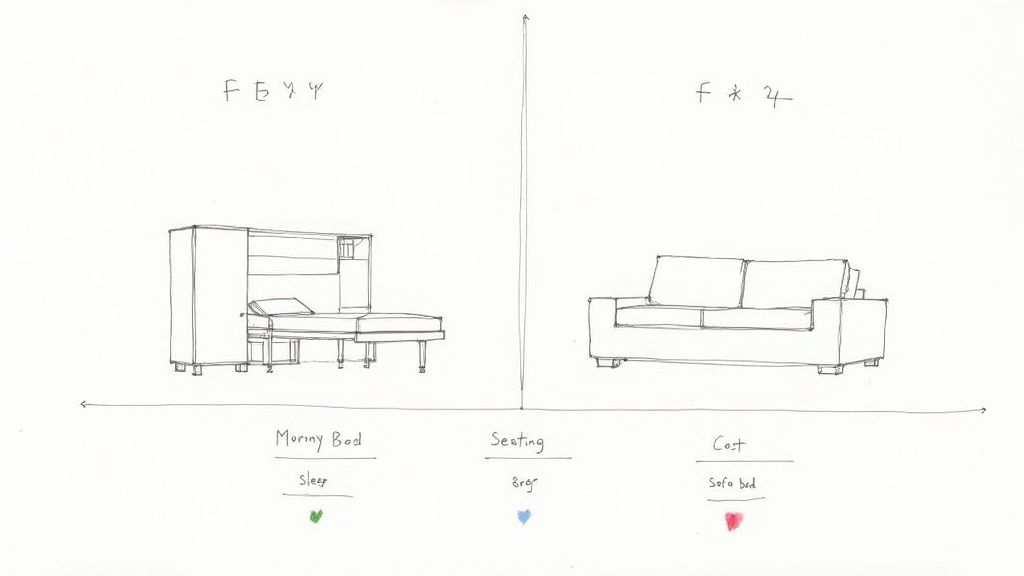
On the other hand, a sofa bed is a couch with a mattress tucked away inside. It’s a permanent seating fixture that transforms when you need it. The fundamental difference is simple: one is a bed that disappears, and the other is a sofa that converts. Understanding this is the first step to figuring out which one fits your life, your guests, and your space.
To get straight to the point, here’s a quick look at how they stack up against each other.
At a Glance Key Differences Between Murphy Beds and Sofa Beds
This table breaks down the most important distinctions between Murphy beds and sofa beds, giving you a clear, side-by-side view to help you decide.
| Feature | Murphy Bed | Sofa Bed |
|---|---|---|
| Primary Function | A real bed that folds away to maximize floor space. | A sofa that converts into a temporary sleeping area. |
| Sleep Comfort | Excellent. Uses a standard, comfortable mattress up to 12″ thick. | Fair to Good. Relies on a thinner, foldable mattress with support bars. |
| Space Impact | Reclaims the entire bed footprint, offering maximum open space. | Occupies a fixed footprint as a sofa, requiring clearance to unfold. |
| Installation | Requires secure wall-mounting, often needing professional help. | No installation required; it’s a freestanding piece of furniture. |
| Typical Cost | Generally higher initial investment due to the mechanism and cabinet. | More budget-friendly, with a wide range of price points available. |
Ultimately, a Murphy bed is an investment in sleep quality and open space, while a sofa bed is a practical solution for seating and occasional guests. Your choice depends on which of those functions is your top priority.
The Growing Demand for Smart Space Saving Furniture
The choice between a murphy bed vs sofa bed has never been more relevant. As cities get denser and our living spaces seem to shrink, the hunt for clever, multifunctional furniture has exploded. It’s a real challenge for homeowners and renters alike—how do you get the flexibility you need without giving up on style or comfort?
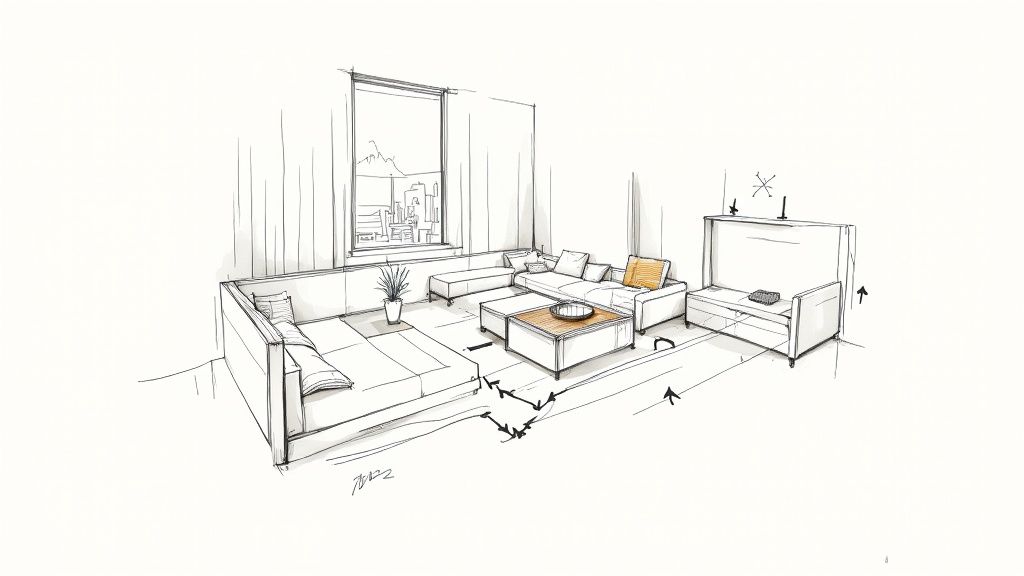
This isn’t just about cramming more into less square footage. It’s about adapting our homes to how we actually live now. A single room might have to pull triple duty as a home office, a guest room, and maybe even a personal gym. Furniture can’t just sit there anymore; it has to transform with our needs, making every single inch count.
Urbanization and Market Trends
The biggest force behind this shift is simple: urbanization. More people are flocking to cities, and the average apartment size is getting smaller, which has forced all of us to rethink traditional furniture. This reality is what’s fueling the space-saving furniture market, where Murphy beds and sofa beds are the star players.
The numbers really tell the story. The global wall bed market—which is home to Murphy beds—was valued at USD 2.77 billion in 2024. It’s projected to hit USD 5.24 billion by 2035, growing at a steady clip of 5.96% annually. For context, the entire multifunctional furniture market, which includes sofa beds, is much larger at USD 15.9 billion, but it’s growing a bit more slowly. If you want to dig into the data, you can check out the wall bed market growth report from Market Research Future.
What does this tell us? While both options solve a problem, the faster growth in the Murphy bed sector hints that more and more people are prioritizing top-tier sleep quality and getting as much open floor space back as possible.
Key Takeaway: The rise of flexible furniture is a direct result of smaller, more expensive living spaces. Consumers are investing in solutions that allow rooms to serve multiple purposes, from a home office by day to a comfortable bedroom by night.
A Focus on Efficiency and Style
Of course, this is about more than just pure necessity. Our tastes have changed, too. Gone are the days of accepting clunky, purely functional pieces. Today, we expect smart furniture to blend right into our home’s design, and manufacturers have definitely gotten the memo.
Modern Murphy beds are often hidden inside beautiful cabinetry that includes integrated shelving, desks, or even built-in lighting, turning them into a genuine architectural feature. At the same time, the best contemporary sofa beds come with high-end upholstery and sleek designs that can go head-to-head with any traditional sofa.
This blend of function and form is what makes the decision so interesting for today’s style-conscious buyers. It’s no longer just about saving space; it’s about enhancing it.
A Detailed Comparison of Core Features
Deciding between a Murphy bed and a sofa bed boils down to a few critical questions about how you live and what you value most. Beyond the obvious differences, things like sleep quality, daily convenience, and long-term value are what will really shape your experience. Let’s break down the core features side-by-side to help you figure out which is the right fit for your home.
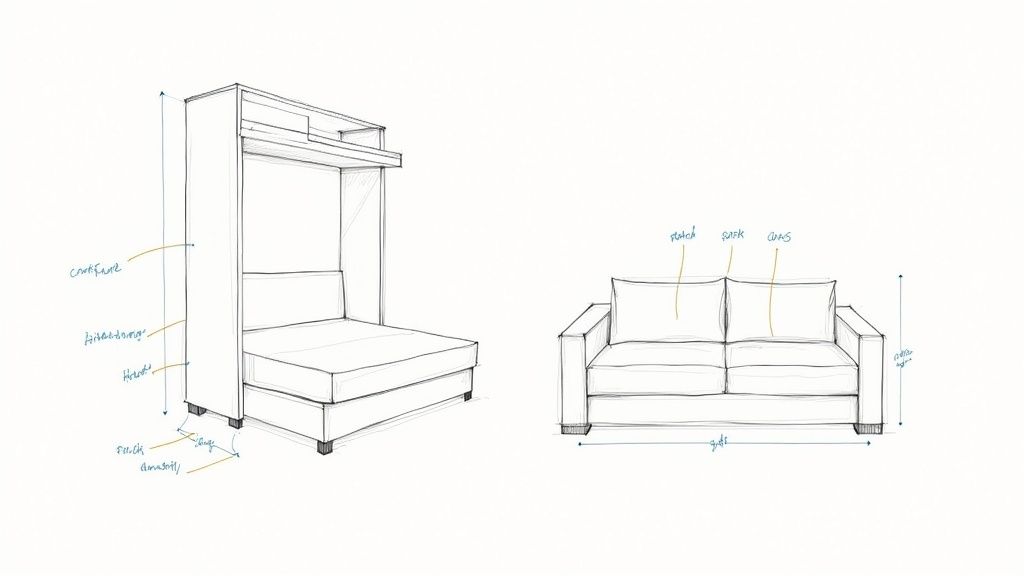
This isn’t just about pros and cons; it’s a realistic look at what it’s like to actually live with each one.
Sleep Comfort and Mattress Quality
Let’s be blunt: the biggest difference in the murphy bed vs sofa bed debate is sleep comfort. This isn’t a small detail—it’s the whole ballgame if the bed will see frequent use.
A Murphy bed is basically a real bed that folds up. Its superpower is that it holds a standard, high-quality mattress, often up to 12 inches thick. This means zero compromises. Whether you’re a memory foam fanatic, a latex lover, or a hybrid enthusiast, you can use the exact mattress you’d put on a normal bed.
Sofa beds, on the other hand, have to cram a mattress into a foldable frame. That engineering necessity limits both the thickness and the quality of the mattress. Most use thin, foldable mattresses that sit on a metal support bar—and yes, you can often feel that bar right through the mattress.
The Bottom Line on Comfort: If this bed is for you every night, or for guests staying more than a weekend, a Murphy bed is the only choice for a genuinely restful sleep. A sofa bed is perfectly fine for occasional, short-term use where having a couch is the priority.
Space Impact and Footprint
Both are designed to save space, but they do it in completely different ways, which dramatically affects your room’s layout and feel.
A Murphy bed works vertically. When it’s folded up, it disappears into the wall, completely freeing up the floor. This is a game-changer for studio apartments, home offices, or kids’ rooms where having wide-open space during the day is everything.
A sofa bed has a permanent horizontal footprint. It’s a sofa, after all, so it’s always taking up a chunk of the room. When you pull it out, you need a ton of clearance in front, which can make a narrow room feel instantly cramped. If you’re considering this route, check out our guide on convertible sofa beds to see how different designs can navigate tricky layouts.
Visualizing the Space Impact:
- Murphy Bed: Picture a 5′ x 7′ area of open floor that becomes a full bedroom at night.
- Sofa Bed: Think of a permanent 3′ x 7′ sofa that needs another 4′ in front to open, dominating the center of the room.
Daily Use and Convenience
How much work is it to go from living room to bedroom and back? The answer really depends on the mechanism and your patience.
Modern Murphy beds use sophisticated piston or spring-lift systems that make opening and closing them almost effortless. Seriously, it takes less than a minute. You can even leave the sheets and a light blanket on, so it’s ready to go. This easy transition makes it a practical choice for everyday sleeping.
A sofa bed is more of a process. You have to take off all the cushions, haul out the heavy metal frame, unfold the mattress, and then make the bed from scratch. Doing that in reverse every morning can start to feel like a real chore.
Cost and Overall Investment
When you’re looking at the price, think beyond the initial sticker shock. You have to consider the total investment, including installation and long-term value.
Sofa beds are almost always cheaper upfront. You can find them at a huge range of price points, making them a budget-friendly choice. Plus, they’re just another piece of furniture—no installation costs.
Murphy beds are a bigger initial investment. The price covers the cabinetry, the lifting mechanism, and often, professional installation (which you definitely want for safety). But here’s the flip side: a well-integrated Murphy bed can actually add perceived value to your home, especially in a small condo or multifunctional room.
Durability and Lifespan
How long will your investment last? This is another area where the two options really diverge.
Murphy beds are built to last. The mechanisms are engineered for thousands of cycles, and the cabinetry is usually made from solid wood or high-quality composites. A well-made Murphy bed can easily last for decades.
A sofa bed’s lifespan is often much shorter, especially with regular use. That folding mechanism is its weak point and can wear out over time. The mattress also takes a beating from being constantly folded and unfolded. It’s no surprise that in the multifunctional furniture market, wooden furniture maintains a solid 43% share, showing that people are willing to invest in durable materials for pieces like Murphy beds.
Ideal Use Cases for Each Furniture Type
Moving beyond technical specs is where the Murphy bed vs. sofa bed decision really comes into focus. You have to think about the purpose of your room. Understanding the perfect environment for each piece makes it much easier to see which one fits your home and lifestyle. These aren’t just pieces of furniture; they’re solutions to very specific spatial problems.

Let’s walk through some real-world scenarios where one option is the clear winner. Visualizing how each one would actually function in your own space is the key to making a choice you’ll be happy with for years to come.
When a Murphy Bed Is the Clear Winner
A Murphy bed is the superior choice when your primary goal is to maximize usable floor space without sacrificing sleep quality. It truly shines in situations where a room needs to serve completely different functions by day and by night.
Think about these common setups:
- The Home Office Guest Room Combo: You need a functional, professional workspace Monday through Friday. A Murphy bed, especially one with an integrated desk, lets the room be a dedicated office. Then, when visitors arrive, it seamlessly transforms into a comfortable guest suite with a real mattress.
- The Studio Apartment Primary Bed: In a studio, your living room is your bedroom. A Murphy bed allows you to reclaim the entire footprint of your bed during the day, creating a spacious and open living area. It’s the closest you can get to having a separate bedroom.
- The Child’s Playroom and Bedroom: Kids need floor space to play, build, and imagine. Folding a Murphy bed away each morning transforms the room from a cozy bedroom into an expansive play area, effectively doubling its utility.
A Murphy bed is an investment in spatial transformation. It’s for those who refuse to let a bed dominate a room’s purpose, demanding that every square foot serves multiple, distinct functions throughout the day.
Situations Where a Sofa Bed Shines
A sofa bed, on the other hand, is the perfect solution when adding permanent seating is just as important as having an extra sleeping spot. It’s the go-to for rooms that are primarily social spaces. For other versatile options that don’t require wall mounting, you might also be interested in our guide to folding beds.
Consider these ideal use cases:
- The Living Room for Occasional Guests: Your living room’s main job is to host movie nights, conversations, and daily relaxation. A sofa bed provides comfortable seating 95% of the time and becomes a convenient guest bed for short stays without disrupting the room’s primary function.
- The Basement or Family Den: This is often a secondary social space for teens, gaming, or casual hangouts. A sofa bed offers the perfect, low-maintenance seating and an easy place for sleepovers.
- The “Just-in-Case” Guest Solution: If you only have guests a few times a year for a night or two, a sofa bed is a practical and cost-effective choice. It fulfills the need for a guest bed without the installation or higher cost of a Murphy bed.
Market Adoption and Regional Preferences
The choice between these two is also influenced by bigger trends in housing and work. Where you live can actually say a lot about which option makes more sense. For instance, North America is the dominant market for Murphy beds, holding about 40-48% of the global market share. This is largely driven by high rates of urbanization and the permanent shift toward remote work.
This puts a huge premium on creating multifunctional rooms, like home offices that can also serve as guest rooms. As you can see from the Murphy bed market trends, in mature markets where optimizing every inch is a necessity, the Murphy bed often comes out on top.
A Practical Checklist Before You Buy
Choosing between a murphy bed vs sofa bed moves from an idea to a real-life decision once the tape measure comes out. Before you even think about adding one to your cart, walking through a practical checklist will save you from headaches, hidden costs, and the disappointment of buying something that just doesn’t fit.
This is the step that separates a successful purchase from a frustrating one. From ceiling height to doorway clearance, every inch counts long before delivery day.
Measure Everything Twice
The golden rule of buying large furniture is to measure your space meticulously. Forgetting this is the single most common—and costly—mistake people make. You have to account for the furniture in both its compact and expanded forms.
- For a Murphy Bed: Measure the wall width, and even more importantly, the ceiling height. Vertical beds need enough room to tilt down without scraping the ceiling or hitting a light fixture. Next, measure how far it will extend into the room when open to make sure it doesn’t block a doorway or a key walkway.
- For a Sofa Bed: Measure the spot where the sofa will sit day-to-day. Then, pull out your tape measure again for the full area it will consume when the bed is pulled out. Don’t stop there—measure every doorway, hallway, and stairwell it needs to pass through on delivery. Sofa beds are notoriously bulky and don’t bend.
For a clearer picture of how different bed sizes will map out in your space, you can explore comprehensive furniture sizing charts to visualize the layout.
Assess Your Wall and Floor Structure
The integrity of your home’s structure is a huge deal, especially when you’re considering a Murphy bed. This isn’t just a piece of furniture; it’s a permanent installation that depends on your wall for safety and support.
A Murphy bed has to be anchored securely to wall studs. If you’re dealing with plaster walls, metal studs, or concrete, you’re going to need special hardware and probably a professional’s help. Trying to mount it on drywall alone is a recipe for disaster. On the other hand, sofa beds are freestanding, which makes them a far simpler option for renters or anyone who doesn’t want to modify their walls.
Crucial Insight: Don’t think of professional installation for a Murphy bed as a luxury—it’s a safety essential. The tension mechanisms that lift the bed are incredibly powerful, and a botched installation can lead to serious injury or damage to your home.
Plan for Delivery and Assembly
Getting your new furniture from the warehouse into the right room is another phase that needs a solid plan. Both beds have their own unique logistical hurdles you need to prepare for.
Sofa beds usually show up fully assembled or in a few massive pieces. Their weight and rigid shape can make navigating tight corners and stairs a nightmare. Always check what the delivery service includes. Will they just drop it at your curb, or will they help you get it inside?
Murphy beds tend to arrive flat-packed in multiple boxes. While this makes it easier to get the parts into your room, the assembly is a serious undertaking that can take hours. We can’t recommend white-glove delivery and assembly services enough. They handle the heavy lifting, the tricky construction, and even haul away all the packaging.
Consider Sustainable and Healthy Materials
Finally, give some thought to what your new furniture is made of. For anyone who is eco-conscious or mindful of their health, this is a key part of the decision.
Keep an eye out for pieces made with sustainable materials and non-toxic finishes.
- Look for FSC-certified wood, which guarantees the lumber was sourced from responsibly managed forests.
- Opt for low-VOC (Volatile Organic Compound) finishes to help maintain healthy indoor air quality.
- Choose natural or organic mattress options, which is a huge perk for Murphy beds since you can pick your own.
Making Your Final Decision with Confidence
So, how do you choose? The whole murphy bed vs sofa bed debate really just boils down to your own priorities. Once you get clear on how you live and what you need from the room, the right choice becomes obvious. This isn’t just about picking furniture; it’s about investing in a piece that makes your home work better for you, every single day.
One is a champion of amazing sleep and wide-open spaces, while the other is all about dual-function seating and simple convenience. A Murphy bed is a real commitment to reclaiming your floor space and giving sleepers a genuinely restorative night on a proper mattress. A sofa bed, on the other hand, is the practical pick when a living area needs to stay a living area, offering a comfy couch that can handle occasional guests without any drama.
The Three Questions to Ask Yourself
To feel totally confident in your final choice, just take a minute to answer these three questions. Your honest answers will point you straight to the right solution for your home.
- What’s its main job? Is this for someone sleeping here every single night, or for guests who only visit a few times a year? For daily use, nothing beats a Murphy bed. For the occasional visitor, a sofa bed is plenty.
- What’s the goal for the room? Is your top priority getting back every inch of floor space for a home office, gym, or playroom? Or is it more important to have a permanent, comfortable seating area for socializing?
- What’s my true, all-in budget? Don’t forget to look past the price tag. Factor in potential delivery and professional installation fees, which are almost always necessary for a Murphy bed.
Answering these questions honestly takes this from a theoretical comparison to a practical decision that’s all about you. It’s the best way to make sure the furniture you bring home actually fits your space, your lifestyle, and your budget.
Once you have your answers, you’ll know whether you need the space-saving power of a Murphy bed or the simple utility of a sofa bed. If a Murphy bed wins out, the next step is just as important: finding the perfect mattress. You can explore a huge variety of high-quality mattress options for space-saving beds to guarantee the best sleep experience possible.
Your Questions, Answered
Even with all the details, you probably still have a few questions floating around. Let’s tackle some of the most common ones that come up when you’re trying to choose between a Murphy bed vs sofa bed.
Can I Use My Own Mattress with a Murphy Bed?
Yes, and that’s one of its biggest selling points! You can absolutely use a standard mattress with most Murphy beds, which means you don’t have to give up the comfort you’re already used to.
Just be sure to check two critical details. First is the mattress thickness—most systems are designed for a mattress between 10 to 12 inches thick. Anything thicker, and the bed might not close properly. Second, pay close attention to the weight limits of the lifting mechanism to make sure it operates safely.
Are Modern Sofa Beds Actually Comfortable for Sleeping?
They’ve come a long, long way. Forget those old stories about lumpy pull-outs with a metal bar digging into your back. Many modern sofa beds now come with much better mattresses, like memory foam or high-density foam, that feel more like a real bed.
That said, while they’re more comfortable than ever for a few nights, they generally can’t compete with a Murphy bed that uses a completely separate, high-quality mattress. For guests staying over a weekend, a good sofa bed is perfectly fine. For more regular use, a Murphy bed still has the edge on sleep quality.
How Much Does Professional Murphy Bed Installation Cost?
The price for professional installation can really vary depending on where you live, how complex the unit is, and what your walls are made of. On average, you can expect to pay somewhere between $300 and $800 for a standard installation.
If you have concrete walls or metal studs, that cost can go up since the job requires special tools and more labor. It might seem like a lot upfront, but professional installation is the best way to guarantee the bed is mounted securely and works just as it should. It’s a worthwhile investment for peace of mind.
Do Murphy Beds Damage Walls?
When installed correctly, a Murphy bed won’t cause any real damage. The cabinet is anchored directly into the wall studs with heavy-duty screws, a process that leaves a few small holes—nothing more than what you’d get from mounting a big-screen TV.
For homeowners, patching these holes is a simple fix if you ever decide to move the bed. Renters, however, should definitely get permission from their landlord first. A Murphy bed is a semi-permanent fixture, unlike a sofa bed you can just pick up and move, so it’s not always the best fit for temporary living situations.
At Futonland, we specialize in smart, stylish furniture that helps you make the most of your space without sacrificing comfort. Take a look at our handpicked collection of high-quality sofa beds and other space-saving solutions perfect for today’s home. Find your ideal fit at https://futonland.com.