
Durable Hardwood Sleeper Sofas: What Actually Holds Up
Most sleeper sofa advice starts in the wrong place. It starts with style, size, or sale price. For a piece that has to work as both seating and a bed, those aren’t the first questions. The first question is simpler: how long will this hold up once people live on it?
A cheap sleeper can look fine on day one. Problems show up later. The frame starts talking every time someone sits down. The mechanism fights back when you open it. The mattress loses support. What looked like a bargain turns into a replacement project.
That’s why durable hardwood sleeper sofas deserve a different buying lens. Instead of asking only what it costs today, ask what it costs per year, how it performs under repeated use, and whether it still feels solid after the novelty wears off. Buyers in small apartments, guest rooms, and family spaces need furniture that earns its footprint. A sleeper sofa isn’t decor first. It’s equipment for daily life.
Why Your Next Sleeper Sofa Should Be an Investment, Not an Expense
Low price is often the most expensive way to buy a sleeper sofa.
A sleeper is one of the few pieces of furniture that gets tested in two modes every week. It has to feel solid as a seat, open without a fight, close without shifting out of line, and still offer a bed someone will use. That workload is why the sticker price tells only part of the story. The better question is what the sofa costs you over the years you own it.
Price matters, but cost per year matters more
Buyers who focus only on the tag in the showroom usually miss the true expense. A cheaper sleeper often reaches the failure point sooner, then starts charging you in other ways: uncomfortable sitting, a bed guests avoid, repairs that do not fully solve the problem, and early replacement.
Cost per year is the cleaner way to judge value. If a hardwood sleeper stays dependable for years longer than a budget model, the higher upfront price can be the lower ownership cost. It also keeps the room working the way it should. You are not shopping again in a few years because the first buy wore out under normal use.
Treat a sleeper sofa the way you’d treat a mattress or a dining table. It is a working piece, not a short-term accessory. If you want a frame style that reflects that approach, hardwood futon frames built for repeated daily use are a useful benchmark for what durable construction looks like.
What buyers usually underestimate
Visible features sell sofas. Hidden construction decides whether they age well.
The common miss is easy to understand. Fabric, arm shape, and color are right in front of you. Long-term stability is buried inside the piece. Yet that hidden structure affects almost everything a buyer notices six months later, including whether the seat still feels level, whether the bed opens in one motion, and whether the sofa still feels worth the floor space it takes up.
A durable hardwood sleeper usually pays off in four practical ways:
- Longer useful life: it stays serviceable instead of becoming the next furniture problem.
- Better daily function: the bed operation stays more consistent with repeated use.
- Steadier comfort: the sofa keeps a firmer, more planted feel under normal household use.
- Lower replacement pressure: you can postpone the next major furniture purchase.
Why the math matters even more in small homes
In a studio, office-guest room, or apartment living room, a sleeper has no room for excuses. If it fails as a sofa, the room becomes less livable. If it fails as a bed, the whole point of owning it starts to disappear.
That is why a well-built hardwood sleeper is often the more disciplined purchase, not the indulgent one. You are buying years of use, fewer compromises, and a piece that earns its footprint every day.
The Foundation of Durability: Deconstructing the Hardwood Frame
A sleeper sofa frame is the part most buyers never see clearly, yet it does most of the hard work. It functions as a house foundation. If the base shifts, every visible finish above it suffers with it.

What kiln-dried hardwood actually means
Kiln-dried hardwood isn’t just a nicer-sounding material label. It refers to wood that has been dried in a controlled process to remove excess moisture before the frame is built. That matters because wood that holds too much moisture is more likely to warp, twist, or crack later.
For sleeper sofas, that risk is bigger than it is on a standard couch. Convertible furniture has moving parts, shifting loads, and repeated opening stress. A frame that changes shape can throw the whole system out of alignment. Kiln-dried hardwood frames — particularly oak, ash, or beech — are widely considered the standard for durable sleeper sofas precisely because they resist that warping and cracking better than green or improperly dried wood.
Why hardwood beats shortcut materials
Not all wood-based frames are equal. Solid hardwood and lower-cost sheet materials may look similar once upholstered, but they don’t behave the same under stress.
Here’s the practical difference:
- Oak, ash, and beech: dense, stable, and better suited to repeated load and motion.
- Plywood blends: can be useful in some engineered applications, but quality varies widely.
- MDF and particleboard: usually the wrong choice for high-stress convertible furniture because edges, fasteners, and joints tend to be weaker under repeated strain.
The problem with low-cost frames isn’t always immediate collapse. More often, it’s gradual failure. You start hearing creaks. The bed doesn’t pull out cleanly. The seating deck feels less firm. The sofa looks the same from across the room, but it stops behaving like a quality piece.
A sleeper sofa can hide a weak frame for a while. It can’t hide it forever.
The warmth factor buyers shouldn’t ignore
Hardwood also brings something that steel-only or composite-heavy builds often don’t. It has visual and tactile warmth. In wood-forward interiors, especially Scandinavian, Japandi, and mid-century rooms, the frame itself can add character instead of just disappearing under upholstery.
That matters most in futon-style designs and exposed-wood sleepers. A solid wood frame can feel more at home in a living space because it reads like furniture, not machinery. If you’re comparing styles with visible wood structure, browsing hardwood futon frames helps clarify what real wood construction looks like across different silhouettes.
What to ask before you buy
If the product listing says only “wood frame,” that’s not enough. Ask what kind. Ask whether it’s solid hardwood. Ask whether it’s kiln-dried. Vague wording usually means the frame isn’t the selling point.
A strong sleeper starts with material honesty. If the seller can’t tell you what the frame is made of, treat that as useful information.
Beyond the Frame: Joinery, Mechanisms, and Support Systems
A strong frame alone won’t save a badly built sleeper. Good wood still needs good assembly. The easiest way to explain it is skeletal: hardwood is the bone, but joinery and hardware are the joints. Weak joints make even solid material fail early.
What solid construction looks like underneath
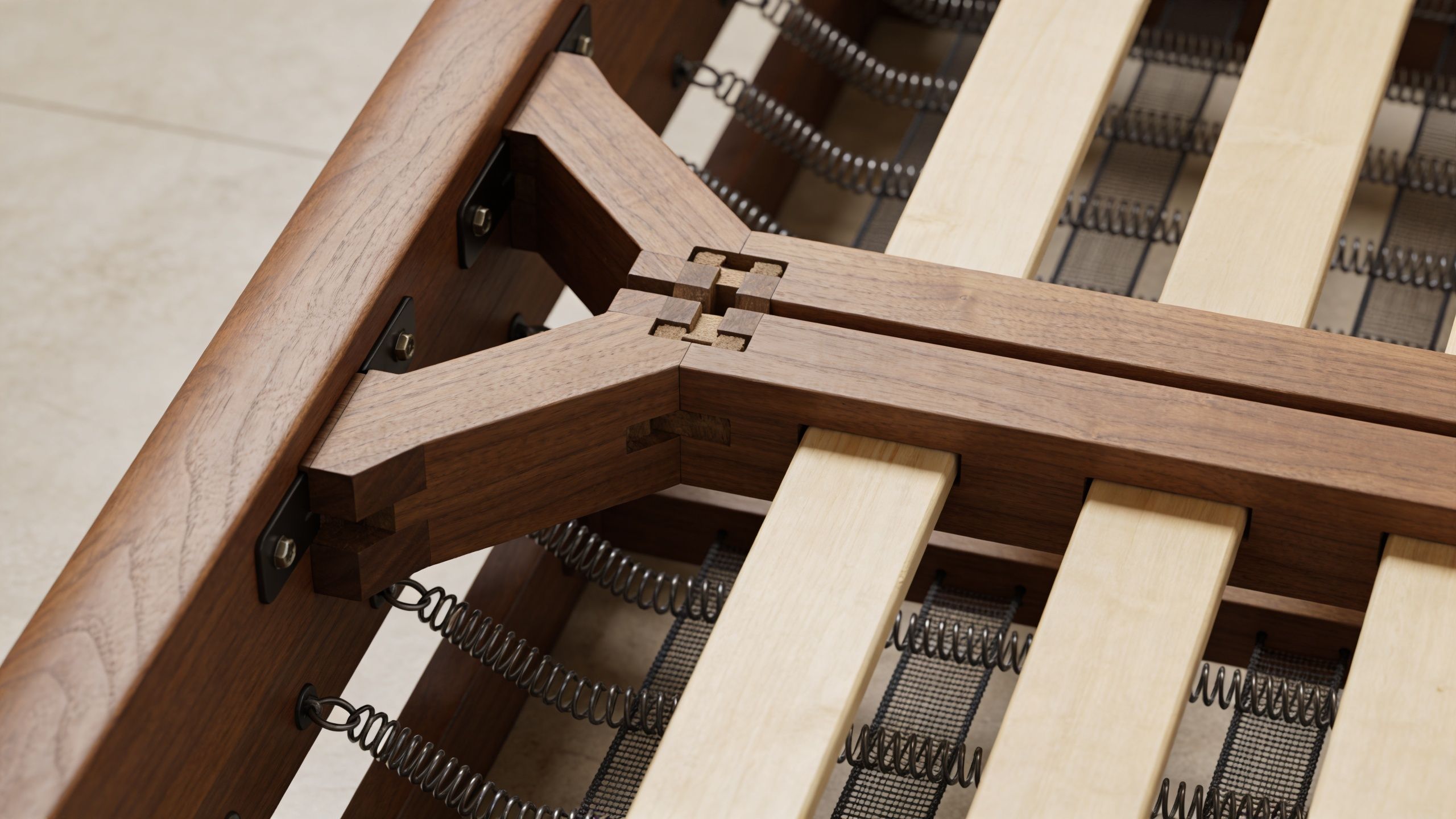
When you inspect a sleeper sofa in person, look below the cushions and under the seat deck. You want evidence that the frame was assembled to resist movement.
The best signs include:
- Corner blocks: these reinforce stress points where rails meet.
- Dowels and screws: they help lock parts together more reliably than flimsy staples alone.
- Clean attachment points: hardware should look deliberate, not improvised.
- Even support: the structure should feel balanced across the seating area.
A sleeper sofa experiences torque every time the bed opens. Loose joinery lets that force travel through the frame. Over time, the sofa starts feeling less planted. That’s usually when buyers describe a piece as “cheap,” even if they can’t identify the exact reason.
The mechanism is where weak sleepers give up
The conversion system does the toughest work in the whole product. It’s the moving part people interact with most aggressively. If the mechanism is underbuilt, daily use exposes it fast.
A kiln-dried hardwood frame gives a mechanism a stable structure to work against, which is a big part of why frame material and mechanism longevity are so closely tied together — a solid, well-joined frame is what lets the conversion system withstand repeated stress without the whole assembly warping, creaking, or twisting out of alignment over time. Ask any manufacturer for the mechanism’s rated weight capacity and cycle rating directly rather than assuming.
If a mechanism feels jerky in a showroom, it won’t get smoother after months of use.
What smooth operation should feel like
You don’t need to be a technician to judge a mechanism. Open it. Close it. Pay attention to resistance and stability.
| What you feel | What it often means |
|---|---|
| Smooth motion | Parts are aligned and the frame is supporting the action properly |
| Balanced weight | The system was engineered to move without excessive strain |
| Minimal side-to-side play | Joints and hardware are holding position |
| No scraping or binding | The mechanism isn’t fighting the frame |
A bad mechanism tells on itself early. It clunks, catches, drifts sideways, or asks for more force than it should.
Don’t overlook the support system
The bed support under the mattress matters almost as much as the mechanism. A mattress can only perform as well as the surface holding it up. If the support platform flexes too much or creates pressure points, sleep comfort drops fast.
When comparing options such as convertible wood designs or platform-style sleepers, a useful reference point is the variety of futon frames, where the frame-and-support relationship is easier to see than it is inside a fully upholstered sofa bed.
The takeaway is simple. Don’t buy based on wood species alone. Buy based on how the wood, joinery, and mechanism work together.
Choosing Upholstery and Mattresses for Real Life
A hardwood frame can give you a long service life. Cheap fabric and a forgettable mattress can still make the sofa feel worn out in a few years. That is how a lower sticker price turns into poor value.

Fabric specs that matter in normal homes
Upholstery decides how long the sofa keeps looking respectable under daily use. On a sleeper, that matters more because the surface handles sitting, shifting, sheet friction, and repeated cleaning.
The first spec worth checking is double rub count — the standard measure of a fabric’s abrasion resistance under repeated contact. For a family room, apartment, or any space where the sleeper gets regular use, ask for this number directly and compare it against other fabrics you’re considering; higher generally means better wear resistance, though the exact threshold worth targeting varies by how heavily the piece will be used.
That number should not be the only filter. A fabric can test well and still be annoying to live with if it grabs pet hair, shows every spill, or wrinkles after one overnight guest. Performance fabrics usually earn their price because they lower maintenance and help the sofa look presentable longer. That improves cost per year just as much as frame durability does.
Softness is not the same as durability
Shoppers often choose with their fingertips first. That is how delicate upholstery ends up on a sofa bed that gets used like a workhorse.
A tighter weave usually holds up better than a plush, delicate surface. The trade-off is feel. Some soft fabrics feel warmer and more luxurious on day one, but they can show crushing, pilling, or wear paths sooner. For busy homes, textured performance weaves are often the safer buy. For a guest room that sees occasional use, a more decorative fabric can make sense.
Match the upholstery to the job.
Mattress quality decides whether the bed stays in rotation
A sleeper sofa only keeps its value if people are willing to sleep on it. If guests avoid it, or if the owner ends up adding toppers just to make it tolerable, the purchase stops making financial sense.
For foam mattresses, density matters more than showroom softness. Higher-density foam usually resists body impressions better and holds its support longer than lower-density foam. Ask the manufacturer for the specific density rating rather than judging by feel alone — a mattress that feels soft and plush in a five-minute showroom test doesn’t tell you how it will perform after months of nightly use.
That is what buyers should measure against price. Spending more upfront for a mattress that stays comfortable for years often costs less than replacing an underbuilt one early.
How to test comfort without turning it into a science project
Use your body, not just your hand.
- Press the mattress and cushions: they should recover without lingering dents.
- Lie down in your normal sleep position: pressure at the shoulder, hip, or lower back shows up fast.
- Check the edge: a weak edge makes getting in and out of bed harder and can make the sleep surface feel smaller.
- Ask whether the mattress can be replaced or upgraded later: that extends the usable life of the whole piece.
If you want a cleaner comparison of sleep surfaces, looking at different futon mattress constructions helps because the layers and materials are easier to evaluate when they are not buried inside a sofa bed.
A durable sleeper pays off when all three layers hold up together. Frame, fabric, and mattress. If one fails early, the annual cost of ownership rises fast.
The Smart Buyer’s Checklist for Evaluating Sleeper Sofas
Most shoppers need a process more than a pitch. A sleeper sofa can look substantial online and still disappoint once it’s in the room. The best defense is a simple inspection routine that forces you to look past styling.
Use this checklist in a showroom, or adapt it for product pages and customer service questions when buying online.
Sleeper Sofa Durability Checklist
| Component | What to Check | Why It Matters |
|---|---|---|
| Frame material | Confirm the listing says kiln-dried hardwood or solid hardwood, not just “wood” | Vague language often hides lower-grade construction |
| Overall stability | Sit on the front rail and shift your weight side to side | A solid base feels planted instead of loose or tippy |
| Joinery | Look under cushions for corner blocks, dowels, and screwed connections | Strong materials still need strong joints |
| Conversion mechanism | Open and close it yourself if possible | Smooth action now usually means fewer frustrations later |
| Alignment | Check whether the bed opens evenly and sits flat | Misalignment points to future wear or mechanism trouble |
| Support surface | Feel for even support under the mattress | Inconsistent support hurts sleep quality |
| Upholstery | Ask for the rub-count spec if it isn’t listed | Fabric durability affects how quickly the sofa looks tired |
| Cushion recovery | Press firmly and watch how the foam rebounds | Slow or weak recovery can signal lower resilience |
| Warranty language | Read what is covered on frame and mechanism | Clear coverage usually reflects confidence in construction |
| Product photos | Look for underside, frame, or open-mechanism images | Brands that show the build tend to be less evasive |
| Reviews | Focus on comments about use after delivery, not first impressions | Longevity issues rarely show up in unboxing praise |
What to do in a showroom
A quick in-person inspection tells you more than a long product description.
Start with movement. Sit down, stand up, and lean on the arms. Then operate the bed. Listen for noise. Feel for drag. Watch whether the structure stays square while moving.
After that, inspect the less glamorous details. Flip up cushions. Look underneath. If a salesperson can’t answer basic construction questions, that’s not a minor issue.
What to do online
Online shopping requires a different kind of discipline. Read the specification section before you look at color options. Search the page for terms tied to structure, not styling. If needed, contact the retailer and ask direct questions about frame material, mechanism design, and mattress construction.
This is also where one retailer’s category depth can help. Futonland’s sleeper and frame-related collections make it easier to compare wood-forward convertible options across styles without relying only on staged lifestyle photos.
A good checklist doesn’t make the decision for you. It keeps you from making the wrong one for avoidable reasons.
The Real ROI: Your Hardwood Sleeper’s Lifespan and Value
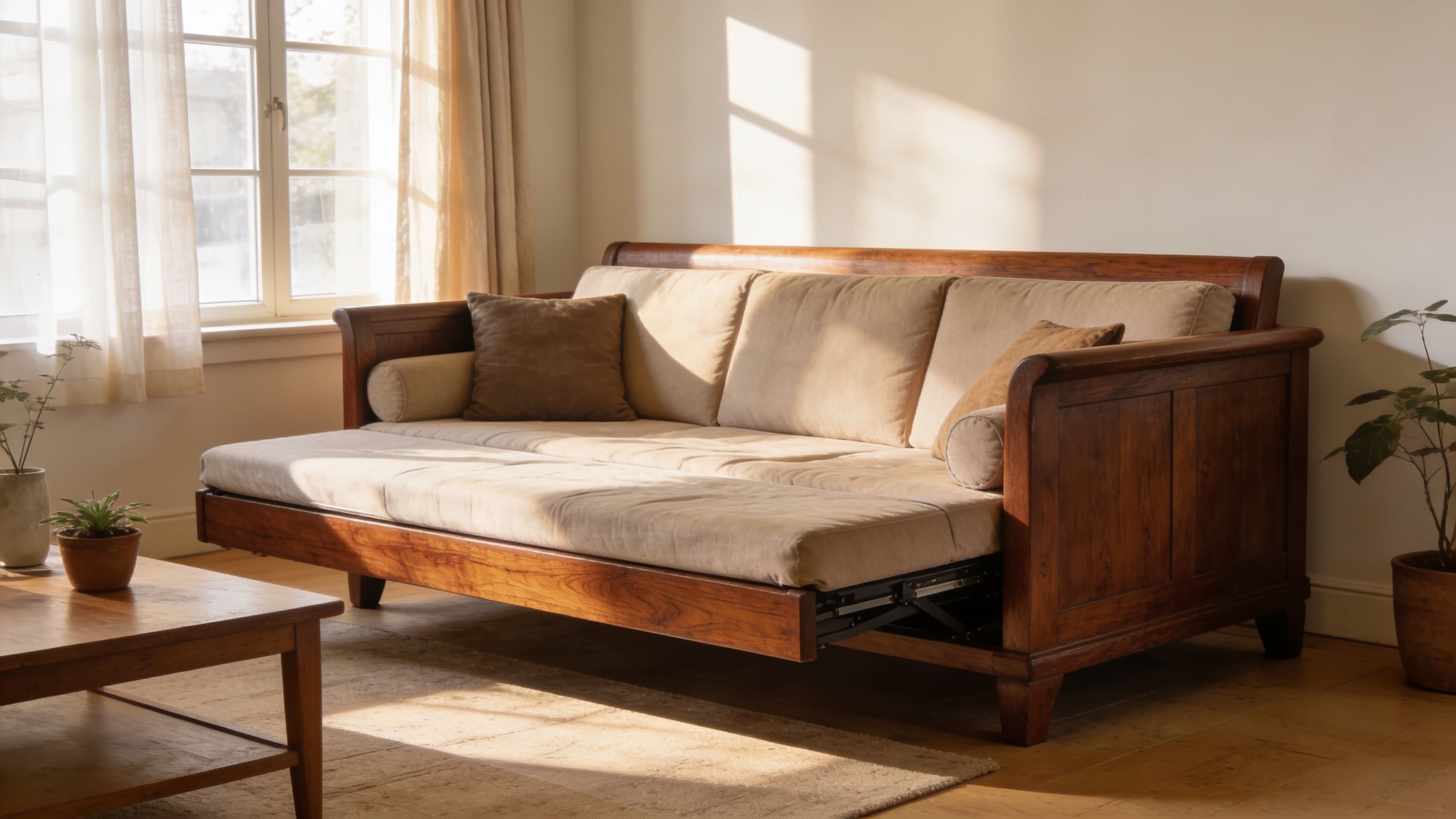
Cheap sleeper sofas usually lose the value argument once you measure ownership over years instead of checkout-day price. A hardwood model asks for more money upfront, but it often asks for less from you later: fewer repairs, fewer comfort complaints, fewer reasons to replace the whole piece early.
The price tag matters less than the cost per year
Stop comparing sleeper sofas as single purchases. Compare them as annual costs tied to actual use.
A low-priced sleeper can still be expensive ownership if it loosens, sags, or starts resisting the bed mechanism after a few years. A better hardwood-framed piece often stays in service long enough to spread that higher upfront cost across many more years. The result is usually a lower cost per year, plus better day-to-day usability during that time.
That second part matters.
A sleeper sofa is not a decorative bench. It gets sat on, leaned on, opened, closed, and judged by guests. If the frame stays square, the bed opens without a fight, and the seat still feels supportive years in, the owner is getting value every week, not just preserving resale potential.
Real return includes fewer replacement decisions
The hidden cost in cheap furniture is interruption. You start noticing the arm wobble. Then the deck feels uneven. Then you begin browsing replacements long before the sofa has failed.
A durable hardwood sleeper changes that pattern. It keeps doing its job, so you are not shopping again on an inconvenient timeline or paying for delivery twice in the same decade.
The return shows up in practical ways:
- The seat keeps its shape longer, so daily sitting stays comfortable
- The bed function remains usable instead of becoming an occasional compromise
- Guests get a sleep surface that feels planned, not improvised
- The frame still looks appropriate in the room after years of use
- You avoid replacing an entire sofa over one worn textile component
That last point gets overlooked. If the upholstery is serviceable and the structure is still sound, a refresh can cost far less than a full replacement. For pieces with replaceable fabric components, replacement futon covers for worn or dated upholstery can extend useful life without sending a good frame to the curb.
Long-term value depends on what you keep
Hardwood earns its return slowly. The payoff is not dramatic on day one. It shows up in year five, when the sofa still feels stable, and in year eight, when the mechanism still opens without a wrestling match.
That is the true ownership test. You are not buying wood for bragging rights. You are buying time, usable comfort, and fewer forced upgrades.
Buyers who focus only on the initial number often miss the larger bill. Buyers who look at cost per year, maintenance options, and how the piece performs as both seating and a bed usually make the better decision.