
Home Office In Small Space: Ideas That Actually Work
So, you think you need a whole room for a home office? Think again. The secret to carving out a functional home office in a small space isn’t about wishing for more square footage—it’s about seeing the potential in the space you already have. The goal is to create a dedicated zone, even a tiny one, that tells your brain it’s time to work. Getting this right is the first step to turning a compact home into a productive powerhouse.
Carving Out Your Workspace in a Compact Home
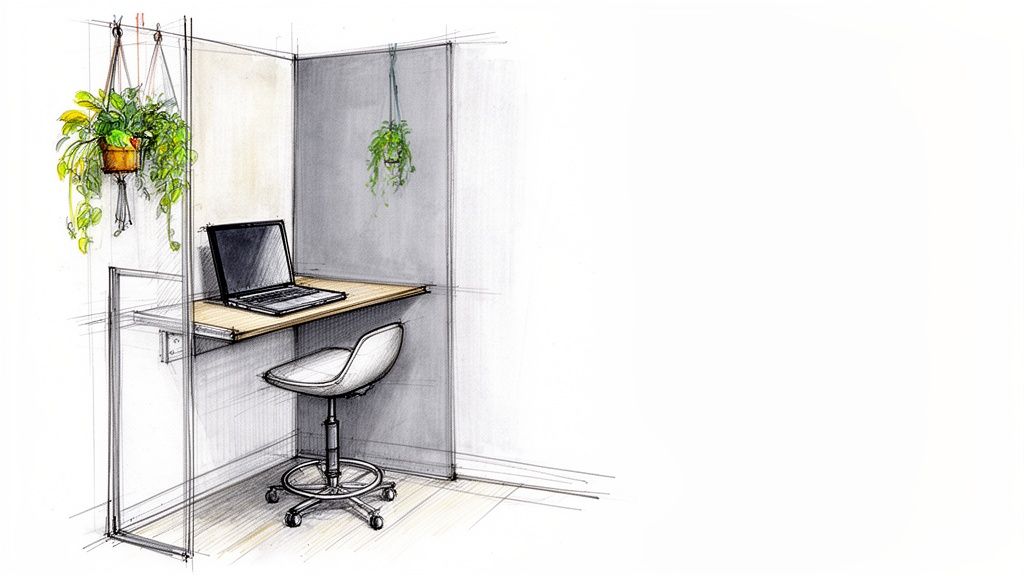
With so many of us working from home now, a dedicated workspace feels less like a luxury and more like a necessity. But for anyone living in an apartment or a smaller house, the idea of a separate office can feel completely out of reach. Good news: you don’t need a spare room to build a space where you can actually get things done.
Forget what you don’t have and start looking for pockets of opportunity. That awkward corner in your living room? The unused nook under the stairs? Even a wide hallway has potential. Your mission is to find a spot—no matter how small—that you can claim as your professional headquarters.
Defining Your Professional Zone
Creating a clear boundary is more about psychology than it is about physical walls. When your “office” is just a corner of a multi-use room, you need clear signals that help your brain switch into focus mode when you sit down and, just as importantly, disconnect when you’re done for the day. This separation is key to keeping work from bleeding into your personal time.
You can create these boundaries pretty easily:
- Use an area rug: Just placing a small rug under your desk and chair can visually cordon off the space.
- Strategic lighting: A dedicated desk lamp that you only turn on during work hours acts like a mental on/off switch.
- Physical dividers: In an open-plan space, a bookshelf can do double duty as storage and a divider. You can even explore options like room dividers to create a tangible sense of separation without making the space feel cramped.
The most effective small home offices aren’t just about clever furniture; they’re about creating intentional boundaries. A designated zone, no matter its size, tells your brain, “This is where work happens,” making it easier to be productive and, just as importantly, to switch off at the end of the day.
Assess Your Daily Workflow Needs
Before you even think about buying furniture, take a minute to get real about what you actually do all day. A one-size-fits-all approach just doesn’t work for a home office in a small space. A little honesty about your workflow will guide every single decision you make from here on out.
Ask yourself a few critical questions:
- What’s my main activity? Are you on video calls all day and need a quiet, presentable background? Or are you a creative who needs a big, clear surface for projects and sketches?
- What equipment can I not live without? Do you absolutely need two monitors, or can you get by with just your laptop? Make a list of every essential item.
- How much storage do I really need? If you’re mostly paperless, you won’t need bulky filing cabinets. But if you have a printer, supplies, and files, you need a plan for where they’ll go.
Answering these questions first will keep you from buying a huge desk when a simple wall-mounted shelf would have been perfect. This is the foundation for a space that isn’t just small, but incredibly smart and built just for you.
Finding Your Footprint with Smart Layout Strategies
Once you’ve nailed down what your workday actually needs, the fun part begins: hunting for the perfect spot. Every home, no matter how small, has hidden potential just waiting to be claimed. It’s all about looking beyond the obvious and seeing the possibilities in those overlooked nooks and crannies.
Let’s face it, the hybrid work revolution has forced us to get creative. A 2024 Gallup survey found that a massive 55% of remote-capable employees are now hybrid, with another 26% fully remote. For those of us in city apartments often under 500 square feet, this shift means multifunctional furniture isn’t just a trend—it’s essential.
Uncovering Hidden Office Nooks
Your future home office might be hiding in plain sight. With a little shift in perspective, that awkward or underused area can transform into a seriously functional workstation.
Here are some unconventional spots to consider:
- The “Cloffice” (Closet Office): That spare closet can become a brilliant, self-contained office. Just remove the doors, add a work surface and some shelving, and you’ve got a dedicated zone you can literally shut away at 5 p.m.
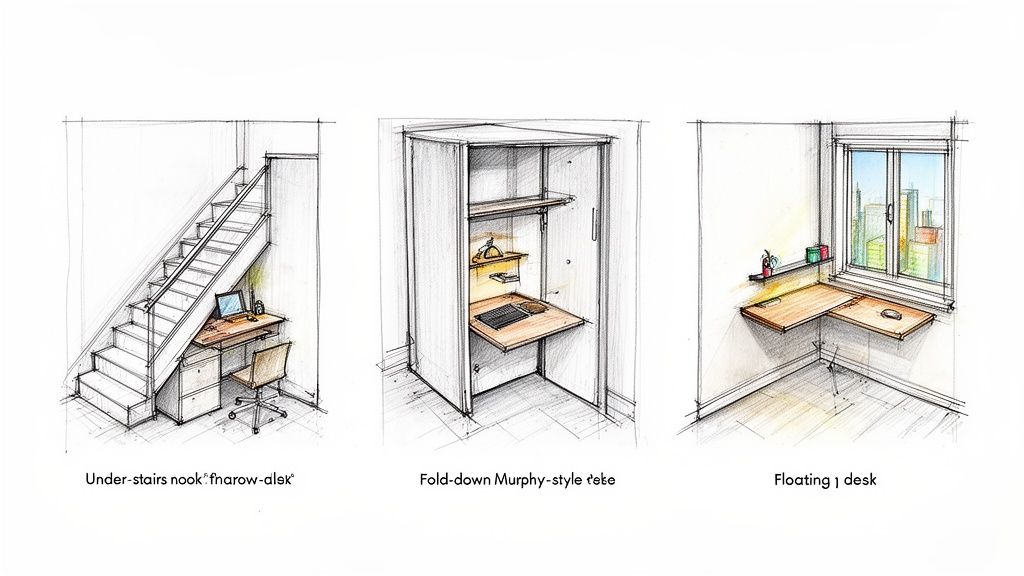
- Under the Stairs: The often-forgotten triangle under a staircase is prime real estate for a built-in desk. Its angled shape creates a naturally cozy and enclosed feeling that’s amazing for focus.
- The Hallway Landing: A wider-than-average hallway or a landing at the top of the stairs can easily fit a shallow console desk or a wall-mounted fold-down unit without getting in the way.
- The Awkward Corner: We all have one—that odd corner where nothing seems to fit right. It’s the perfect candidate for a custom-fit corner desk, which gives you maximum surface area without eating up the room.
Choosing Your Desk Layout
The desk you choose is the heart of your workspace. In a home office in a small space, the goal is to get all the function you need while keeping as much open floor as possible. This is where wall-mounted and foldable options really come into their own.
Floating & Wall-Mounted Desks
These desks are the champions of minimalism. By mounting directly to the wall with no legs, they create an illusion of space and make cleaning the floor underneath a total breeze. They are perfect for narrow spots like hallways or for keeping an airy feel in a living room.
Fold-Down & Murphy Desks
The ultimate space-saver, a fold-down (or Murphy) desk basically disappears when you’re not using it. It folds up against the wall, often looking like a shallow cabinet. This is, hands down, the best choice for multi-purpose rooms where you need every inch back after work hours.
A critical first step is to measure your potential space meticulously. Knowing the exact dimensions will prevent costly mistakes and help you visualize how a desk will fit. Don’t forget to consult detailed sizing charts to understand standard furniture footprints before you start shopping. For a solid reference, you can check out https://futonland.com/sizing-charts.
Comparing Layouts Side-By-Side
Choosing the right layout means balancing your daily needs with the room’s physical limits and your own personal style. What works for a graphic designer in a studio might not suit a project manager in a tiny guest room. Exploring versatile computer workstations and desks can give you some great layout strategies.
To help you decide, here’s a quick comparison of the most popular small-space options.
Small Space Office Layout Comparison
| Layout Type | Best For | Pros | Cons |
|---|---|---|---|
| Floating Desk | Narrow spaces and minimalist rooms where preserving floor space is the top priority. | Creates an airy, open feel. Easy to clean under. Visually unobtrusive. | Limited surface area. Requires sturdy wall installation. Lower weight capacity. |
| Corner Desk | Awkward corners and rooms where you need to maximize every inch of desk space. | Uses otherwise wasted space efficiently. Often provides generous surface area. | Can feel bulky. May require specific room dimensions to fit properly. |
| Fold-Down Desk | Studio apartments and multi-use rooms (e.g., guest room, living room) where the office must vanish. | Frees up floor space completely when closed. Excellent for work-life separation. | Small workspace. Limited storage options. Requires wall installation. |
| “Cloffice” | Homes with an underutilized closet, especially if you need to hide work clutter completely. | Can be completely hidden away. Provides built-in vertical storage potential. | Can feel cramped. May lack natural light and require dedicated lighting. |
Ultimately, the best layout feels like a seamless part of your home while giving you a dedicated, comfortable place to be productive. By thinking creatively and choosing a setup that supports your workflow, you can build a small-space office that works just as hard as you do.
Choosing Furniture That Works as Hard as You Do
When you’re carving out a home office in a small space, every piece of furniture has to earn its keep. You simply don’t have the luxury of single-purpose items. Your furniture needs to be clever, adaptable, and ready to pull double—or even triple—duty.
Think of each piece not just for what it is, but for what it could be. That simple ottoman? It’s a hidden filing cabinet. That bed in the guest room? It’s a concealed workspace waiting to be revealed. This mindset is the secret to creating a truly functional office that doesn’t swallow your living area whole.
The Rise of Transformer Furniture
Multifunctional furniture has become a cornerstone of modern design, especially for city apartments and compact homes where remote work is the new normal. We’ve moved past niche gadgets into a full-blown trend favoring versatile designs—think ergonomic desks that fold away or modular pieces that adapt on the fly.
Let’s look at a few “transformer” pieces that can make a huge difference in a tight spot.
- Murphy Bed & Desk Combos: This is the ultimate space-saving power move. By day, you have a full-sized, functional desk. By night, the whole unit seamlessly converts into a comfortable bed, hiding your entire office setup without you having to clear a single thing off your desk.
- Convertible Sofa Beds with Integrated Tables: Absolutely perfect for a living room office. These sofas often have a back cushion that folds down to reveal a small, sturdy work surface. It’s an instant laptop desk that disappears the moment guests arrive.
- Lift-Top Coffee Tables: A super popular and accessible option. The tabletop lifts up and forward, transforming into an ergonomic-height work surface. Even better, the hollow base provides fantastic hidden storage for your laptop, notebooks, and pens.
A pro tip from someone who’s seen it all: If you can, always test the transformation mechanism in person. A smooth, easy-to-operate conversion is what makes these pieces practical for daily use. A clunky or difficult mechanism will quickly become a frustration you just stop using.
Prioritizing Ergonomics Without the Bulk
One of the biggest mistakes I see people make is sacrificing ergonomics to save space. You might think that stylish dining chair will do the job, but after a few eight-hour days, your back and shoulders will tell you a different story.
The good news? You don’t need a massive, corporate-style chair to get proper support.
Focus on finding a chair that offers key adjustments without a huge footprint. Look for essentials like adjustable height, lumbar support, and armrests that can flip up and out of the way. This allows the chair to tuck neatly under the desk when you’re done, instantly freeing up precious floor space. Many modern ergonomic chairs also feature breathable mesh backs, which provide excellent support while having a lighter visual profile, making a small room feel less crowded.
To explore a range of options that strike the right balance, you can check out this guide on office furniture, including desks and chairs, to find a solution that fits your specific needs and space.
Smart Storage Disguised as Decor
Your storage solutions should also work undercover. Forget the traditional metal filing cabinet and opt for furniture that hides its organizational power in plain sight.
Here are a few of my favorite smart swaps:
- Storage Ottomans: Ottomans are perfect for stashing away printers, reams of paper, and other supplies you don’t need every second. If you choose one with a firm, flat top, it can even double as extra seating or a side table.
- Narrow Bookshelves or Ladder Shelves: These pieces use vertical space brilliantly without jutting far into the room. They offer plenty of storage for books and supplies while also giving you a place to display decorative items, helping your office blend right into your home’s decor.
- Rolling Carts: A slim, multi-tiered rolling cart can be your mobile office command center. At the end of the day, just tuck it into a closet or an unused corner to completely clear your workspace and reclaim your room.
When you’re shopping for these items, pay close attention to the build quality. Check for sturdy joints, drawers that glide smoothly, and durable materials. Multifunctional furniture often gets a lot more daily wear and tear, so investing in a well-made piece will absolutely pay off in the long run.
Mastering Vertical Space for Ultimate Organization
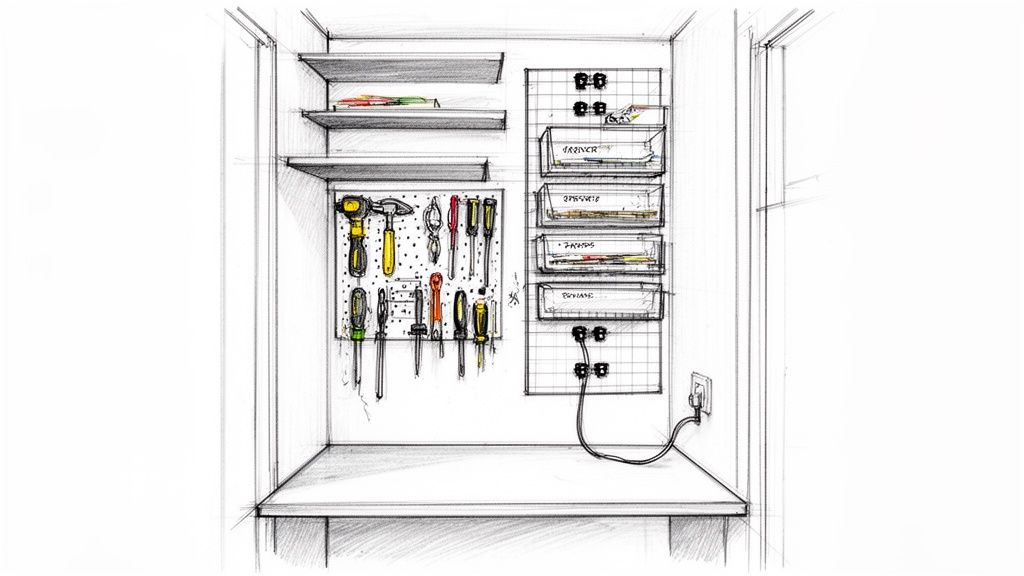
When your floor plan is tight, the golden rule is simple: if you can’t build out, you have to build up. Learning to master vertical storage is probably the single most effective trick for any home office in a small space. By shifting your organization from the floor to the walls, you reclaim that precious desk surface and create a workspace that finally feels open and ready for deep focus.
Think of your walls as a blank canvas just waiting to become a high-efficiency storage system. This whole approach is about keeping your essential tools—from pens to paperwork—within arm’s reach but off your primary work area. The result? A clean, clutter-free desk that helps you minimize distractions and actually get things done.
Going Vertical with Smart Shelving and Grids
The secret to great vertical storage is picking solutions that fit your workflow and your style. Long gone are the days when a clunky, oversized bookshelf was your only option. Today’s solutions are sleek, modular, and incredibly versatile.
Consider these powerful options to get your supplies off the desk and onto the walls:
- Floating Shelves: These minimalist shelves are a total game-changer. They give you a clean look without the visual clutter of brackets, making them perfect for displaying a few inspiring items alongside necessary supplies in small bins or magazine files.
- Wall-Mounted Grids & Pegboards: For the ultimate in customizable storage, you really can’t beat a wall grid or a classic pegboard. You can endlessly rearrange small shelves, cups, and hooks to hold everything from scissors and charging cables to notebooks and headphones.
- Ladder Bookcases: Leaning, ladder-style shelves provide tons of vertical storage without needing to be permanently mounted. They offer a stylish, less bulky alternative to traditional bookcases, and you can explore a variety of functional book shelves to find one that fits your space perfectly.
The real goal here is to create a system where everything has a designated home. When your stapler, sticky notes, and important files each have their own spot on the wall, you’ll spend less time searching and more time working. This simple shift can make a tiny office feel surprisingly spacious and streamlined.
Taming the Cable Spaghetti Monster
Nothing makes a small space feel more chaotic and cluttered than a tangled mess of wires. A jumble of charging cables, monitor cords, and power strips—what many of us call ‘cable spaghetti’—can instantly ruin even the most organized desk setup. Getting those cables under control is a non-negotiable step for a clean, professional-feeling workspace.
Fortunately, managing them is easier than it sounds. You can start with a high-quality power strip that has both standard outlets and USB ports to consolidate your charging station. From there, a few simple, DIY-friendly solutions can hide the rest.
- Adhesive Cable Clips: These small, peel-and-stick clips are perfect for routing individual cords along the back of your desk or down a table leg.
- Fabric Cable Sleeves: A zippered neoprene sleeve can bundle multiple cords running from your computer into a single, neat tube.
- Under-Desk Cable Trays: A small metal basket or tray mounted to the underside of your desk is a fantastic way to hold your power strip and all the excess cable length completely out of sight.
The rise of hybrid work has made these clever solutions more important than ever, especially in big cities. In New York City, for instance, a projected 16% drop in office demand is pushing more people to optimize their apartments. This trend means finding ways to neatly conceal printers, files, and chargers is crucial for creating a home office that actually works.
Designing for Productivity with Light and Ambiance
A great home office in a small space is so much more than a desk and chair—it’s an environment that actually helps you focus and think clearly. Two of the most overlooked elements are lighting and ambiance. These are the invisible forces that can either drain your energy or supercharge your productivity.
Getting them right is what turns a cramped corner into a place you genuinely want to work. The goal is to make the space feel intentional and motivating, not like a temporary setup you just squeezed in somewhere.
Harnessing the Power of Light
Good lighting is a non-negotiable for productivity. It can completely change your mood and energy levels. So many people make the mistake of relying on a single, harsh overhead light, which is a fast track to eye strain and headaches after a few hours at the computer.
The secret is to think in layers. A layered lighting strategy combines three different types of light that work together to create a comfortable, functional space. If you lack natural lighting overhead, integrating floor and table lamps is a great way to build these layers:
- Ambient Light: This is your room’s overall illumination, usually from a ceiling fixture or natural light from a window. It sets the baseline brightness.
- Task Light: This is direct, focused light right where you need it. A slim, adjustable LED desk lamp is perfect for lighting up your keyboard and notes without creating glare on your screen.
- Accent Light: While not strictly essential in a tiny office, accent lighting can add a lot of personality. Use it to highlight a piece of art or a plant to give the space some depth.
Working with Natural Light
If you can, set up your desk to take advantage of natural light. Studies show that getting some daylight during the workday improves focus and can even help you sleep better at night. The sweet spot is placing your desk so the window is to your side.
Why not right in front of it? Facing a window directly creates a strong backlight, making your screen hard to see and straining your eyes. If the window is directly behind you, you’ll get a distracting glare on your monitor. A side-on position gives you all the benefits without the drawbacks.
Pro Tip: If your layout is fixed and you can’t avoid screen glare, don’t worry. A good anti-glare screen filter combined with some light-filtering blinds gives you total control, keeping your workspace comfortable all day long.
Crafting an Inspiring Ambiance
The look and feel of your office have a massive impact on your mindset. A cluttered, bland space feels draining, but a well-curated one can spark creativity and keep you motivated. This is where you get to play with color, texture, and personal touches.
Even if you can’t paint, you can bring in colors that help you focus. Blues are known to have a calming effect, while greens are great for creativity. You don’t need much—a new mousepad, a pen holder, or a small print for the wall can do the trick.
Adding a bit of greenery also makes a huge difference. A small snake plant or a succulent is low-maintenance, thrives in various light conditions, and brings a welcome touch of nature to your desk alongside your other home decor and accents.
Finally, make the space yours. A few personal items—a favorite mug, a photo of your family, an inspiring quote—can transform a sterile corner into your personal productivity haven. Just be selective. A couple of meaningful items are great; too many just create visual clutter that competes for your attention.
Your Small Space Office Questions Answered
Even with the best game plan, setting up a home office in a small space can throw a few curveballs your way. This is where we tackle the common, real-world questions that pop up when you’re trying to get everything just right. Here are some clear, practical answers to help you perfect your new workspace.
How Can I Create a Boundary Between Work and Life in a Studio Apartment?
When your living room is also your office, creating separation is all about strong visual and physical cues. You’re essentially training your brain to recognize when it’s time to work and—more importantly—when it’s time to unplug.
A physical partition is one of the most effective tricks in the book. A stylish, lightweight folding screen can instantly hide your desk from view, while a tall, open-backed bookshelf divides the room without killing your natural light. This creates a real boundary that helps you mentally clock out.
Another powerful technique is to “zone” your area with specific decor.
- Use an area rug: Just placing a small rug under your desk and chair visually defines the space as a dedicated work zone.
- Implement task lighting: A dedicated desk lamp that you only switch on during work hours acts as a powerful psychological trigger. When the lamp goes off, the “office” is officially closed.
The ultimate solution for a studio is often transformable furniture. A wall bed that conceals a full desk or a sleek cabinet that hides your entire setup allows your space to completely transition back into a calming home environment at the end of the day.
What’s the Best Desk for a Very Narrow Space Like a Hallway?
For those really tight spots, a traditional desk just won’t cut it. The goal is to find something with a minimal footprint that doesn’t block the path. Your two best friends here are floating desks and fold-down desks.
A floating desk is basically a legless, shelf-like surface mounted directly to the wall. This design is brilliant for narrow areas because it keeps the floor completely clear, making the space feel airy and uncluttered. Look for one that’s fairly shallow—around 15 to 20 inches deep is usually plenty for a laptop and a notebook without sticking out too far.
The other fantastic option is a fold-down or “Murphy” desk. This one is a master of disguise. When you’re not working, it folds up flat against the wall, often looking like a shallow cabinet or a simple decorative panel. It’s the perfect fix for high-traffic hallways where you need to reclaim every inch of space after hours. It literally makes your office disappear.
My Apartment Has Terrible Lighting. How Can I Brighten My Small Office?
Working in a poorly lit space is a huge productivity killer. It leads to eye strain, fatigue, and just a general lack of motivation. The good news is you don’t need a major electrical overhaul to fix it. A few strategic moves can make a dark corner feel bright and energizing.
First, make the most of whatever natural light you have. Hang a large mirror on the wall opposite your main window. This simple trick bounces light all around the room, instantly making the whole space feel bigger and more open.
Second, think in layers instead of relying on a single overhead fixture.
- Start with ambient light: This is your room’s main light source.
- Add focused task light: An adjustable LED desk lamp is non-negotiable for lighting up your work surface without causing glare.
- Consider accent light: A slim floor lamp tucked into a corner can add a warm glow and get rid of dark shadows.
When you’re buying light bulbs, pay attention to the color temperature. Look for bulbs that mimic natural daylight, which is typically around 5000K. This crisp, cool light is known to boost focus and reduce eye fatigue. Finally, stick to a light color palette on the walls and in your decor. Whites, soft grays, and light pastels will reflect light rather than absorb it, making your small office feel much bigger and brighter.
At Futonland, we believe that smart design can transform any space. Discover our curated collection of convertible sofas, Murphy cabinet and chest beds, and compact office furniture designed to make your home work for you. Explore the possibilities at https://futonland.com.