

Wall Bed vs Murphy Bed: A Complete Buyer’s Guide
Let’s settle an old debate right away: the term ‘Murphy Bed’ is technically a brand name, one that became so popular it’s now used for all wall beds, much like people say Kleenex instead of tissue. The thing is, while every Murphy bed is a wall bed, not all modern wall beds stick to that original design. Those differences are exactly what you need to know before buying one.
What Is The Real Difference Between A Wall Bed And A Murphy Bed

The biggest split between a traditional Murphy bed and a modern wall bed comes down to what’s happening behind the scenes—the lifting mechanism. The original Murphy bed, patented way back in the early 1900s, relied on a powerful, coiled spring system to do the heavy lifting. Today, the term “wall bed” is a much bigger umbrella, covering everything from those classic spring designs to newer, smoother piston-lift systems.
This isn’t just a random evolution. It reflects a huge surge in demand for smart, space-saving furniture. The global wall bed market was worth about USD 3.5 billion in 2023 and is expected to hit nearly USD 7.0 billion by 2035. With more people living in smaller urban spaces, multifunctional furniture isn’t a luxury; it’s a necessity. This growth just underscores why it’s so important for homeowners to understand what they’re really buying.
Core Distinctions to Know
When you’re trying to decide between a wall bed and a Murphy bed, the key differences usually pop up in the engineering and framing. For instance, many traditional designs had to be bolted to the floor for stability. A lot of modern systems, on the other hand, are designed to be secured just to the wall studs, giving you much more flexibility on where you can install them.
Key Takeaway: The most important evolution here is the move away from sometimes-clunky spring mechanisms toward effortless gas piston systems. Modern wall beds are designed for a quiet, smooth, and controlled motion that makes them incredibly easy for just about anyone to operate.
To make this crystal clear, here’s a quick breakdown of what separates the old-school concept from today’s models.
Quick Look: Wall Bed vs. Murphy Bed Key Distinctions
Here is a simple table to highlight the main differences between the classic Murphy bed concept and the modern wall bed systems you’ll find today.
| Feature | Traditional Murphy Bed | Modern Wall Bed |
|---|---|---|
| Primary Mechanism | Typically uses a spring-lift system that might need tension adjustments over time. | Often uses a gas piston system for smooth, silent, and effortless operation. |
| Framing | Often requires both wall and floor mounting to be installed securely. | Can often be secured directly to wall studs without needing to bolt into the floor. |
| Ease of Use | Can require more physical effort to lift and lower because of the spring tension. | Designed for ease of use with a balanced system that feels lightweight. |
| Integrated Features | Historically focused just on the bed itself, with basic cabinetry. | Commonly includes integrated sofas, desks, shelving, or even dining tables. |
This table shows how far the design has come. The focus has shifted from just hiding a bed to creating a fully integrated, multi-functional piece of furniture that’s also a breeze to use.
Why This Matters for You
Knowing these details helps you pick a system that actually works for your home’s layout and your own physical needs. If you’re looking for more ways to make the most of your vertical space, it’s worth exploring different smart wall storage solutions.
Whether you’re trying to furnish a guest room or maximize every square inch of a studio apartment, understanding the mechanics behind the cabinet is the first step to making a smart buy. The best way to see these designs in action is to explore a collection of modern and efficient wall beds.
Piston vs. Spring: A Look at the Core Mechanisms
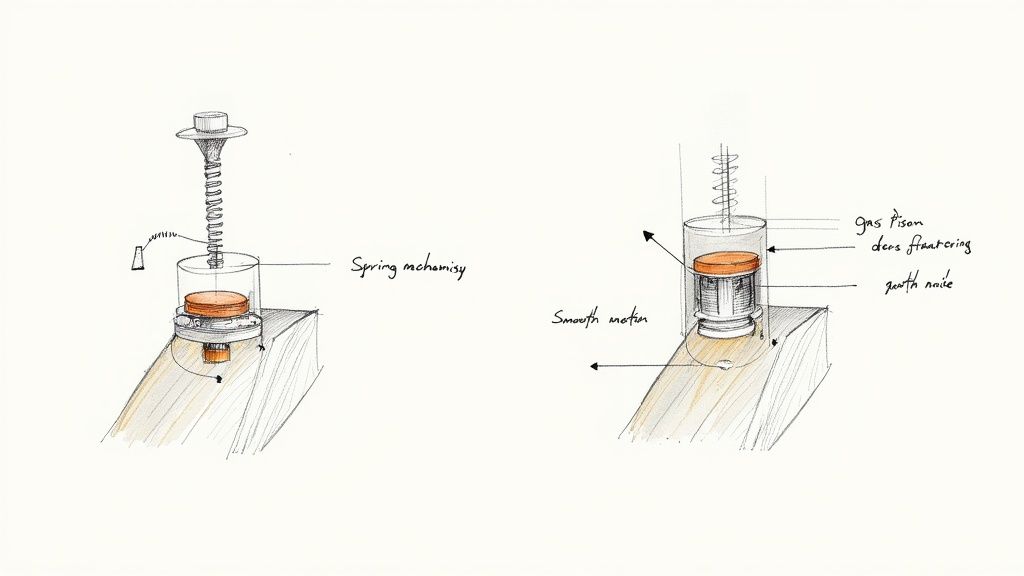
When you’re comparing a wall bed to a Murphy bed, the conversation will always circle back to the mechanism—it’s the engine that powers the whole system. The difference between a classic spring lift and a modern piston lift is probably the single most important factor in your decision. It affects daily use, safety, and your long-term satisfaction.
These two systems get the same job done, but they get there with totally different engineering, leading to a distinct feel for the user.
The traditional spring-lift mechanism is the original workhorse, found in many beds that stick to the classic Murphy design. It relies on a series of heavy-duty, coiled springs hidden inside the cabinet. These springs are carefully tensioned to perfectly counterbalance the weight of the bed and mattress, which is what makes it possible to lift a very heavy bed with manageable effort.
Think of it like an old-school garage door. The springs store energy when the bed is down and then release it to help you lift it back up. It’s a design that’s been trusted for decades because of its raw strength and durability.
A Deep Dive into the Spring Lift Mechanism
One of the main selling points of a spring system is its adjustability. You can actually add or remove individual springs to fine-tune the tension for a specific mattress weight. This is a huge plus if you think you might swap out your mattress down the road, as the system can be recalibrated to keep things balanced.
But that flexibility comes with a trade-off. Over many years, those springs can start to lose their tension—a process called “metal fatigue.” This means the bed might get a little harder to lift or won’t stay closed as securely, eventually needing a professional tweak to get it back to its original performance. The operation can also be a bit noisier, with the distinct creak and groan of springs stretching and compressing.
A Quick Look at Spring Systems:
- Durability: Made with heavy-gauge steel, these systems can last for decades if they’re properly maintained.
- Adjustability: You can fine-tune the tension to match different mattress weights by adding or removing springs.
- User Effort: They generally require a bit more muscle to operate than piston systems, especially if the tension isn’t perfectly set.
The Piston Lift Mechanism: A Modern Approach
In contrast, most modern wall beds use a gas piston lift mechanism, sometimes called a gas spring. It’s the same tech that lets the hatchback on an SUV open so smoothly and stay up on its own. Each piston is a cylinder filled with pressurized nitrogen gas and a little bit of oil.
When you pull the bed down, the gas gets compressed, storing energy. When it’s time to lift, that compressed gas expands, pushing the piston to give you a smooth, silent, and almost weightless lift. The motion is fluid and controlled the whole way, so there are no sudden jolts or loud noises.
This fluid motion is what defines modern wall bed design. The piston system makes sure the bed glides gently into place without ever slamming shut or needing a lot of force to open, making it incredibly user-friendly for people of all ages and strengths.
A big advantage of piston systems is their consistency and lack of maintenance. Unlike springs, they never need to be re-tensioned. They’re built to work reliably for their entire lifespan, which is usually thousands of cycles. To put that in perspective, a high-quality piston system is designed to last for well over a decade, even with daily use, without any drop in performance.
If you’re exploring different space-savers, you’ll see how this effortless operation stacks up against designs like Murphy cabinet and chest beds, which often use completely different folding mechanics.
The furniture market, which is seeing steady growth, really thrives on this kind of innovation. While single wall beds make up over 40% of the market segment, queen-size models are the most popular for balancing comfort and space. This has pushed manufacturers to perfect these easy-to-use mechanisms.
Which Mechanism is Right for You?
Choosing between springs and pistons really comes down to what you prioritize.
A spring mechanism might be a better fit if:
- You want the ability to make tiny adjustments to the tension yourself.
- You’re okay with the possibility of some maintenance down the line.
A piston mechanism is probably the better choice if:
- You want the quietest, smoothest, and most effortless operation available.
- You prefer a “set it and forget it” system that’s virtually maintenance-free.
- The bed will be used often or by people who would benefit from an easier lift.
For most people today, the quiet, graceful, and maintenance-free experience of a piston system makes it the clear winner. It aligns perfectly with the demand for functional furniture that’s as simple to use as it is beautiful.
Evaluating Installation and Structural Requirements
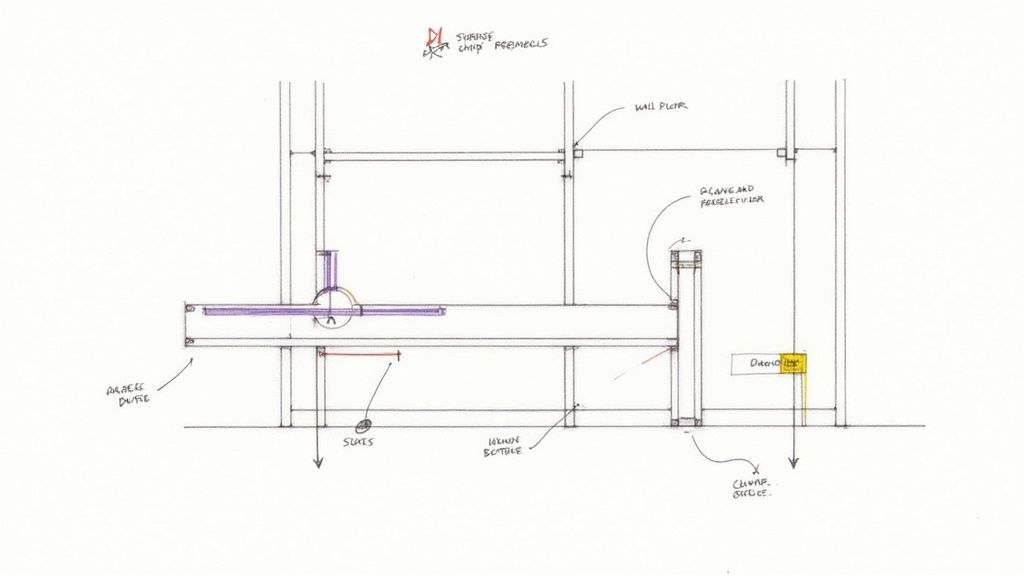
Beyond how the bed operates, the next make-or-break factor is installation. You need to understand that a wall bed isn’t just another piece of furniture you can move around. It’s a permanent fixture that becomes part of your home’s structure, and getting the installation right is absolutely non-negotiable for safety and proper function.
The entire system depends on a rock-solid connection to your wall’s framework. If it’s not anchored correctly, the weight and tension from the lifting mechanism could pull the whole unit right off the wall—a serious safety hazard. So before you even start shopping, you need a clear picture of your room’s construction.
Wall and Floor Integrity
First things first: take a good, hard look at your walls. The vast majority of modern wall beds are designed to be mounted directly to wall studs, which are the vertical wood or metal beams that form the skeleton of your home. You have to locate these studs and be sure they’re structurally sound.
It’s also crucial to check if your floor is perfectly level. An uneven floor can make the cabinet sit crooked, putting uneven stress on the frame and lifting mechanism. This can cause problems with how the bed operates and lead to premature wear and tear down the line.
Key Structural Checks:
- Wall Construction: What’s your wall made of? Drywall, plaster, or something else?
- Stud Type: Figure out if your studs are wood (most common) or metal. This changes the type of anchoring hardware you’ll need.
- Floor Level: Grab a level and make sure the spot where the cabinet will go is flat and stable.
Think of these checks as the foundation of your project. They’ll tell you if you can move forward confidently or if you need to bring in a professional for an assessment.
DIY vs. Professional Installation
Once you’ve confirmed your room is ready, you have to decide who’s doing the actual installation. While some panel-based wall bed kits are marketed for DIY assembly, they require a high degree of precision and a real comfort level with construction tasks. And if you’re looking at a fully integrated model with a sofa or desk, the complexity goes up significantly.
Sure, a DIY approach can save you some money upfront, but the risks are high. A small miscalculation in measurements or a failure to anchor the unit securely can have disastrous consequences.
Professional Insight: For most homeowners, we strongly recommend professional installation. Services like Futonland’s White-Glove Assembly take all the guesswork out of the equation. Our team ensures the bed is perfectly level, securely anchored to your studs, and functions flawlessly. That peace of mind is priceless.
Hiring pros also means they do the heavy lifting and make the delicate adjustments needed to perfectly balance the mechanism with your mattress. They have the experience to handle unexpected curveballs, like non-standard stud spacing or slightly uneven walls, ensuring a perfect fit every time.
Planning Your Space and Clearance
The final piece of the puzzle is measuring everything correctly—and then measuring it again. You need to account for the cabinet’s dimensions when it’s closed and the bed’s full projection when it’s open.
Start by measuring the height, width, and depth of the wall space. Then, measure from that wall out into the room to see how far the bed will extend when it’s lowered. Don’t forget to leave enough clearance to walk around the open bed comfortably. Pay attention to ceiling fans, light fixtures, and even baseboards that could get in the way.
For more ideas on picking the right size and style, our guide to different bed frames can offer some helpful insights. Taking the time for these detailed measurements ensures your new wall bed fits seamlessly into your space with no unwelcome surprises.
What About Cost, Customization, and Long-Term Value?
When you’re deciding between different types of wall beds, the conversation almost always lands on price. But the sticker price is only one part of the equation. Real value comes from understanding exactly what you’re paying for—from the raw materials and engineering down to the finish—and how those decisions impact the bed’s lifespan and how you’ll use it every day.
The cost of a wall bed can swing wildly, from basic DIY kits under a thousand dollars to high-end, custom-built systems that can easily top $10,000. This huge range comes down to a few key factors that don’t just affect the price tag, but also your long-term return on investment. Often, a higher upfront cost means better durability and a smoother experience for years.
What Drives the Price?
The biggest factor influencing cost is the material used for the cabinet and bed frame. Entry-level models often use materials like melamine or medium-density fiberboard (MDF). They’re budget-friendly, but they may not have the staying power of premium options. As you move up the ladder, you’ll find solid hardwoods like oak, maple, or cherry, which offer incredible strength and a classic look that can even add to your home’s value.
The lifting mechanism is another critical piece of the puzzle. While both spring and piston systems are reliable, you’ll find high-quality, German-engineered piston mechanisms in most premium wall beds. These systems are known for being whisper-quiet, incredibly smooth, and completely maintenance-free. They contribute to a higher initial cost but guarantee effortless function for decades.
Finally, customization and extra features play a huge role. A simple, standalone wall bed is going to be far more affordable than a multi-functional system that includes things like:
- An integrated sofa that folds away on its own
- A full-size desk that stays perfectly level when the bed comes down
- Built-in bookcases, wardrobes, or ambient LED lighting
These kinds of add-ons transform the unit from just a bed into a complete room solution, adding significant utility that’s reflected in the price.
Long-Term Value and Market Trends
Putting a high-quality wall bed in your home isn’t just a purchase; it’s a strategic move, especially in cities where every square foot counts. North America leads the market for wall beds, a trend fueled by urbanization and the rise of the multi-functional home office/guest room. In fact, the US wall bed market was valued at around $3.28 billion in 2024, with steady growth expected. You can learn more about the trends shaping the US wall bed market on custommarketinsights.com.
This demand points to a bigger idea: homeowners are realizing that smart, space-saving furniture is an investment that pays off.
A well-built wall bed made from quality materials can easily last 20 to 30 years, or even longer. By freeing up a room for two purposes—like a home office that doubles as a guest suite—it adds real, tangible functionality and can boost your property’s appeal to future buyers.
When you’re weighing the cost, think about the value of reclaiming an entire room. A bed that disappears into the wall gives you back all the square footage you’d normally lose to a traditional bed. Over the life of the furniture, that extra utility often more than makes up for the initial investment, especially when you compare it to the cost of moving to a bigger place.
Customization: Making It Your Own
Beyond pure function, customization is where a wall bed truly becomes a part of your home. The ability to pick specific finishes, hardware, and cabinet styles ensures the unit doesn’t just fit your space—it actually enhances your decor. This seamless integration is a huge part of long-term satisfaction.
Consider these options that affect both price and value:
- Finishes: Choices can range from standard laminates to custom-matched wood stains and paint colors.
- Hardware: Upgrading the handles and pulls can instantly elevate the look of the entire unit.
- Cabinet Style: You can go with anything from minimalist flat-panel designs to more traditional Shaker or raised-panel styles.
While these choices do add to the cost, they make sure the wall bed feels like a beautiful, intentional piece of furniture rather than just a utilitarian object. This level of personalization is what separates a basic model from a high-value, long-term investment.
Finding The Right Bed For Your Lifestyle
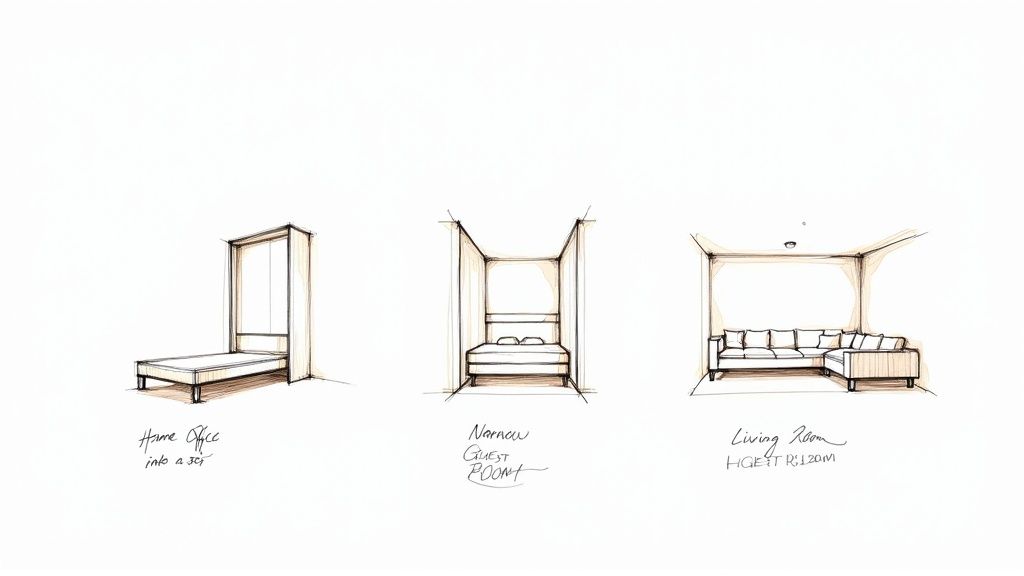
Knowing the mechanics and costs is one thing, but the real magic happens when you see how a wall bed fits into your life. The best choice isn’t about what’s technically superior; it’s about how you actually use your space. A setup that’s perfect for a studio apartment you live in every day might be complete overkill for a guest room that sees visitors twice a year.
Let’s step away from the specs and dive into some real-world situations. Once you match your needs to the right features, you’ll find a system that feels like it was designed just for you.
The Home Office and Guest Room Hybrid
This is easily one of the most common reasons people look for a wall bed today. You need a dedicated, clutter-free workspace from Monday to Friday, but you also want to offer guests a comfortable place to stay over the weekend. For a room that has to do double duty, a vertical wall bed with an integrated desk is an absolute game-changer.
The star of the show here is the pivoting desk. As you lower the bed, the desk surface stays perfectly level, so you don’t have to pack away your laptop, monitors, or papers. It takes the room from a productive office to a welcoming bedroom in less than a minute, without messing up your workflow.
The Narrow or Low-Ceiling Room
What do you do with that spare room that’s long and skinny, or an attic space with a sloped ceiling? A traditional vertical wall bed might not fit, or it could make the room feel cramped when it’s open. In these tricky spots, a horizontal wall bed is the perfect problem-solver.
Also known as a side-mount wall bed, a horizontal model opens lengthwise. This drastically cuts down on how far the bed projects into the room, leaving much more floor space clear for walking around. It’s a brilliant fix for awkward layouts where vertical height is a luxury, ensuring you can still have a comfy bed without sacrificing the room’s open feel.
By choosing a horizontal orientation, you’re prioritizing floor space. This is crucial in rooms where every inch matters, whether it’s a kid’s playroom or a home gym.
The Living Room or Studio Apartment
When you’re living in a studio or need to squeeze a bed into your main living area, you need furniture that works hard. The goal is to hide a bed in plain sight inside a piece of furniture that looks like it belongs there. For this, a wall bed with an integrated sofa is the top choice.
By day, it’s a stylish, comfortable sofa for lounging or having friends over. When it’s time for bed, you simply remove the cushions and fold the mattress down over the sofa’s base. It’s unbelievably efficient because you don’t have to move a single piece of furniture to make space. This design gives you two essential pieces of furniture in one footprint, effectively handing you back an entire room’s worth of space. Exploring creative small apartment layouts often shows just how indispensable these systems are for creating functional, comfortable homes.
The best modern systems easily compete with high-end convertible sofa beds, but with the added bonus of a true mattress. When you think about your daily routine and what you need from a room, it becomes clear which wall bed system will not just fit, but genuinely improve your lifestyle.
Your Decision Checklist From Futonland
Choosing between a modern wall bed and a traditional Murphy bed really comes down to what fits your home, your budget, and your day-to-day life. To make it easier, we’ve put together a straightforward checklist that cuts through the noise and focuses on what truly matters. Think of it as a simple framework to help you land on the perfect space-saving bed.
Answering these four questions will point you in the right direction, ensuring you find a solution you’ll be happy with for years to come.
Finalizing Your Choice
Before you pull the trigger, walk through these four key points:
- Mechanism and Ease of Use: Are you looking for the smooth, silent, and nearly effortless operation of a modern piston system? Or does the classic, manually adjusted tension of a spring mechanism appeal to you? For beds that will be used often, or by people of all ages, a piston lift is almost always the better, safer choice.
- Primary Function: What’s the main job for this bed? Is it for a guest room that gets used a few times a year, or is it for a home office that needs to transform into a bedroom every single night? Knowing this will help you decide if you need a simple, standalone bed or a more integrated system with a built-in desk or sofa.
- Installation Plan: Are you a seasoned DIYer ready to tackle a complex project, or would you rather have the peace of mind that comes with professional installation? For something this important, we strongly recommend professional assembly to guarantee safety and flawless operation.
- Budget and Long-Term Value: Are you shopping for a basic, entry-level model, or are you ready to invest in a quality piece of furniture that’s built to last for decades? The quality of the materials, the durability of the mechanism, and the available customizations all play into the bed’s true long-term value.
At Futonland, we focus on that long-term value. Our European-made wall bed systems are expertly engineered with premium piston-lift mechanisms, so you get a reliably smooth and safe operation every single time.
Our curated collection was designed to answer these questions directly. Whether you need a sophisticated system with an integrated sofa for your studio apartment or a simple, elegant wall bed for a spare room, we have a solution that fits.
And to take any installation stress off your shoulders, we offer White-Glove delivery and assembly. Our expert team will make sure your new wall bed is securely installed, perfectly balanced, and ready to go, giving you complete peace of mind. Let our specialists help you select the perfect finishes and mattress to complete your setup.
Ready to reclaim your space? Browse our collection of modern wall beds online or stop by a Futonland showroom to experience the quality and effortless function for yourself.
Got Questions About Wall Beds? We’ve Got Answers.
When you’re trying to choose between a wall bed and a Murphy bed, a lot of practical questions pop up. Getting those sorted out is key to feeling good about your decision. Here are the straight-up answers to the questions we hear most often from people looking to add a modern wall bed to their home.
Can I Use My Own Mattress?
This is probably the number one question we get, and the answer comes down to two things: thickness and weight. Most modern wall bed systems are built to handle a standard mattress up to 11 inches thick. If you go any thicker, you might find the bed won’t close up neatly inside the cabinet.
Just as critical is the mattress’s weight. The piston or spring mechanism that lifts the bed is carefully calibrated for a specific weight range. This is what makes it operate so smoothly and safely. If you use a mattress that’s too light or too heavy, it throws the whole system out of balance. It might be a struggle to lift, or it could even start to drift open on its own. Always double-check the manufacturer’s specs before you buy.
Are Wall Beds Safe for Kids and Pets?
Absolutely. Safety is a huge priority in modern wall bed design. High-quality systems are packed with features to prevent accidents and ensure everything is secure, making them a totally reliable choice for homes with kids and pets running around.
You’ll find key safety features like:
- Safety Locks: A lot of models include a lock that keeps the bed from being pulled down by accident.
- Counterbalance Systems: Those advanced piston mechanisms aren’t just for easy lifting. They make sure the bed lowers slowly and stays put, so it won’t ever slam down unexpectedly. It takes a real, intentional pull to get it moving.
- Secure Anchoring: This is the most important part. Proper installation means the cabinet is bolted securely to the studs in your wall. That’s what stops the whole unit from ever tipping over.
Do Wall Beds Really Have to Be Attached to the Wall?
Yes, and this one is completely non-negotiable. The stability and safety of a wall bed depend entirely on it being anchored to your home’s structural frame. The lifting mechanism is under a ton of tension, and without being bolted to the wall, that force could easily pull the whole cabinet forward.
Think of it this way: the connection to the wall studs is what counteracts the force from the lifting system and the weight of the bed itself. Trying to use a wall bed as a freestanding piece of furniture is extremely dangerous—it’s just not what they were designed for.
How Much Weight Can a Wall Bed Actually Hold?
Weight capacity can vary a bit between different models, but most high-quality wall beds are built like tanks. They can support just as much weight as a traditional platform bed. A well-built queen or king-size wall bed can typically hold between 800 to 1,000 pounds, which easily covers the mattress and anyone sleeping on it. Once the bed is down, it feels every bit as sturdy and reliable as a standard bed frame.
At Futonland, we give you all the product specs and expert advice you need to answer every question. Our White-Glove Assembly service guarantees your wall bed is installed perfectly for total safety and performance. Find the perfect space-saving solution for your home by visiting Futonland.com.