
The Ultimate Guide To Finding The Best Affordable Sofa Beds
Finding a great, affordable sofa bed isn’t about chasing the lowest price. It’s about finding that sweet spot where a durable frame, a comfortable mattress, and a reliable mechanism come together without the sticker shock. The trick is to focus on function and quality materials over flashy, fleeting trends. For most people, that magic number falls somewhere between $800 and $1,800.
Your Guide to Smart and Stylish Sofa Beds
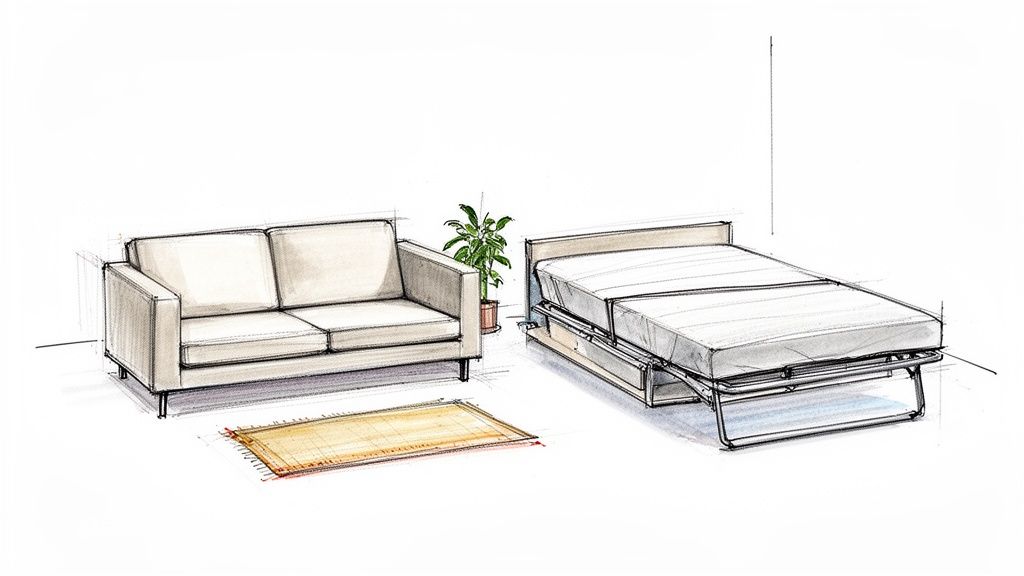
Welcome! You’re looking for a sofa bed that nails the balance between comfort, style, and your budget, and you’ve come to the right place. The search for furniture that does double duty can feel like a maze. You need something that looks sharp in your living room but also gives your guests a genuinely good night’s sleep—all without draining your bank account.
This guide is here to cut through the confusion and show you how to land a durable, comfy sleeper without overspending. We’re going to tackle the big question head-on: how do you get a high-quality piece that just works for your space and your wallet? Think of this as your personal roadmap to the world of convertible furniture, designed to help you buy with confidence.
What Makes a Great Affordable Sofa Bed
Getting the best value is about more than just a low price tag. It’s about knowing where your money makes the biggest impact. A truly fantastic affordable sofa bed shines in three key areas, and understanding them is the first step to making a smart purchase.
Let’s break down the crucial elements that separate a bargain from a bust:
- The Conversion Mechanism: This is the engine of your sofa bed. A smooth, effortless mechanism means you’ll actually use it. A clunky, frustrating one will just gather dust.
- Mattress Quality: Your guests’ comfort (or your own!) lives and dies by the mattress. We’ll get into the real differences between innerspring, foam, and hybrid options so you know what you’re sleeping on.
- Frame and Fabric Durability: A sturdy frame built from solid or engineered wood is the foundation for a long life. The right fabric ensures it can handle everything daily life throws at it.
A common mistake is falling for a sofa’s looks while forgetting it has a second, equally important job. A great sofa bed has to master both roles—sitting and sleeping—to be a real asset in your home.
By the end of this guide, you’ll have the know-how to judge these factors like a pro. Whether you’re outfitting a tiny apartment, a dedicated guest room, or a busy family room, our goal is to help you find a piece you’ll be happy with for years. Let’s get started on finding your perfect, practical, and affordable sofa bed.
Choosing the Right Sofa Bed Mechanism
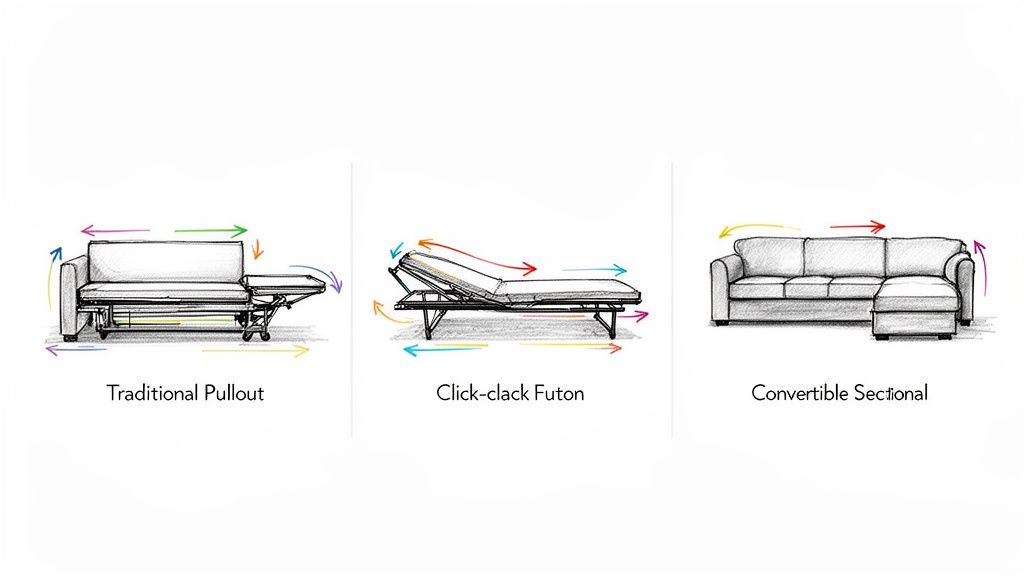
[Image demonstrating the conversion mechanisms of a traditional pull-out sofa, a click-clack futon, and a convertible sectional]
The heart of any great sofa bed isn’t just how it looks—it’s how it works. The mechanism is the engine that transforms your stylish seating into a comfortable bed, and understanding the differences is key. Think of it like picking a car: you wouldn’t choose a tiny sports car for a family camping trip.
The three most common types you’ll run into are the traditional pull-out, the simple click-clack futon, and the modern convertible sleeper. Gone are the days of clunky, back-breaking contraptions. Today’s designs are smoother and more user-friendly than ever before.
Let’s break down each system to see which one is the right fit for your home.
The Traditional Pull-Out: A Hidden Guest Room
The pull-out is the classic sofa bed most of us picture. Its design is ingenious: a complete, folded mattress and frame are tucked away right under the seat cushions. To convert it, you just pop off the cushions and unfold the bed frame outwards.
This mechanism is like having a hidden guest room that only appears when needed. Because the mattress is separate from the seating cushions, it often provides a sleep experience closer to that of a traditional bed.
It’s no surprise that the pull-out design has a 40.22% share of the US market. It’s a go-to for families who host guests or college students needing a quick-convert option. This reflects a global trend where over 52% of consumers choose sofa beds for their dual functionality, especially in cities where every square foot counts.
- Best For: Living rooms or dedicated guest rooms where comfort for overnight visitors is the top priority.
- Pros: Often accommodates thicker, more traditional mattress types and keeps the sleep surface separate from the daily wear and tear of sitting.
- Cons: The mechanism can be heavy, and you’ll need a good amount of clear floor space in front to pull it out all the way.
The Click-Clack Futon: The Versatile Transformer
The click-clack mechanism, most often found in futons, is all about simplicity and efficiency. Instead of a hidden mattress, the sofa’s backrest simply clicks down to lay flat, creating a single sleeping surface with the seat. The name comes from the distinct “click” sound it makes when locking into different positions.
Think of it as a versatile transformer. In seconds, it can switch from a sofa to a lounger to a bed, making it perfect for multi-purpose spaces like a home office or studio apartment. This design is also incredibly space-efficient because it doesn’t need extra clearance in front.
Because the same surface is used for both sitting and sleeping, you’ll want a durable mattress. Exploring different futon frames shows just how adaptable this simple mechanism can be, fitting everything from modern minimalist to classic wood styles.
The real beauty of the click-clack system is its straightforward design. Fewer moving parts often mean greater long-term durability and a more accessible price, making it a star player among the best affordable sofa beds.
The Modern Convertible Sleeper: The Ultimate Hub
Modern convertible sleepers, especially sectional sofas, are the next step in dual-purpose furniture. They often use sleek, European-style mechanisms that are surprisingly simple. Some feature a “drawer-style” system where a section pulls out from the base and pops up to meet the chaise, forming a large, flat bed.
These are the ultimate family hubs. A convertible sectional can be the main seating for a household and instantly become a spacious bed for movie nights or when guests stay over. Many even include hidden storage in the chaise—a lifesaver in smaller homes.
The design is often so seamless you’d never guess it doubles as a bed. This makes them a fantastic choice for anyone who wants guest-ready functionality without compromising on a clean, contemporary look.
Sofa Bed Mechanism Comparison
To make things even clearer, here’s a quick-glance table comparing the most common sofa bed types. Use it to help you decide which mechanism is right for your space and needs.
| Mechanism Type | Best For | Comfort Level (Typical) | Space Requirement | Ease of Use |
|---|---|---|---|---|
| Traditional Pull-Out | Frequent guest use; a more “real bed” feel. | Medium to High | High | Moderate |
| Click-Clack Futon | Small spaces, home offices, and budget-friendliness. | Low to Medium | Low | Very Easy |
| Convertible Sectional | Main living areas, family rooms, and maximizing utility. | Medium | Medium to High | Easy to Moderate |
Ultimately, the best mechanism is the one that solves your specific problem, whether that’s hosting the in-laws comfortably, giving your teen a spot for sleepovers, or simply making the most of a small apartment.
Finding the Most Comfortable Sofa Bed Mattress
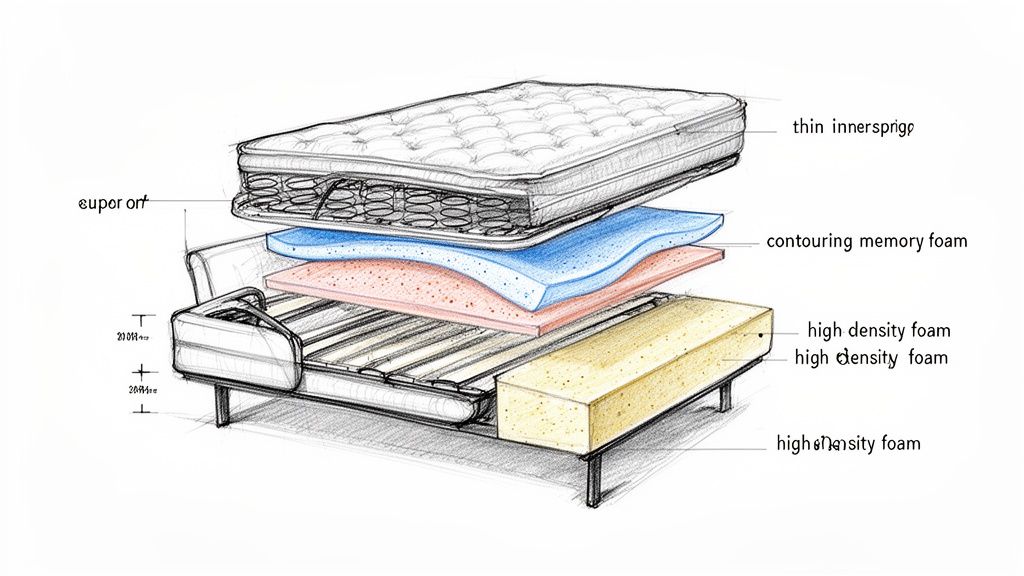
[Image displaying an exploded view of a sofa bed mattress revealing layers of high-density foam, memory foam, and pocketed innersprings]
While a smooth mechanism is the engine of a sofa bed, the mattress is where comfort truly lives or dies. It’s the single most important factor for a good night’s sleep. Think of it this way: the frame is the car’s body, but the mattress is the suspension—it’s what absorbs the bumps and makes the ride enjoyable.
In the world of affordable sofa beds, you’ll primarily run into three types of mattresses, each with its own personality and set of trade-offs. Getting to know them is the key to finding a sleeper your guests will actually look forward to using.
The Familiar Feel of Innerspring
Innerspring mattresses are the traditional choice, built with a network of steel coils. They offer that familiar, bouncy feel many people are used to from a standard bed. This can be a major plus for guests who prefer a more responsive surface rather than one that “sinks in.”
The biggest challenge with innerspring mattresses in affordable sofa beds is their thickness. To fold up inside the frame, they are often much thinner than a regular mattress, typically just 4 to 5 inches. This can sometimes lead to feeling the support bar underneath if the coil count is too low or the padding is minimal.
- Best for: Occasional guests who prefer a classic, firm sleep surface.
- Keep in mind: Look for models that specifically mention a higher coil count or thicker padding to avoid that dreaded “bar-in-the-back” feeling.
The Contouring Comfort of Memory Foam
Memory foam mattresses are the undisputed champions of pressure relief. Made from viscoelastic polyurethane, this material is engineered to soften and contour to your body in response to heat and pressure. The result is an almost weightless feeling that cradles joints and helps align the spine.
This type of mattress is a lifesaver for side sleepers, as it prevents sore hips and shoulders. The main trade-off? Some traditional memory foams can trap body heat, leading to a warmer night’s sleep. Thankfully, many newer models incorporate cooling gel infusions or open-cell structures to improve airflow. For a deeper dive, you can explore a wide variety of specialized futon mattresses that prioritize both support and breathability.
When choosing a foam mattress, density matters more than just thickness. A higher-density foam will provide better support and be far more durable over time, preventing the dreaded “sinking” feeling after just a few uses.
The Supportive Base of High-Density Foam
Not to be confused with memory foam, high-density polyurethane foam (often called HR or High-Resilience foam) provides a much firmer and more supportive base. It doesn’t have that slow-moving, body-hugging feel of memory foam. Instead, it offers a solid, stable surface that springs back into shape quickly.
This makes it an excellent choice for sofa bed mattresses because it provides robust support without needing to be overly thick. You’ll often find it in click-clack futons and modern convertible sofa beds where the mattress needs to double as a firm seating cushion. It resists sagging well and offers a consistent feel across the entire surface.
Mattress Thickness and the Power of a Topper
No matter which mattress type you choose, thickness plays a crucial role. In the affordable range, most mattresses will be between 3 and 6 inches thick. While a 6-inch foam mattress can be quite comfortable, a 3-inch innerspring model is likely best reserved for kids or very short stays.
But here’s the game-changing secret for any sofa bed owner: a mattress topper.
A simple 2 to 3-inch memory foam or plush fiberfill topper can dramatically upgrade the comfort of almost any sofa bed. It adds a luxurious layer of padding, smooths out any lumps or seams from the mattress below, and provides extra support. This one simple addition can turn a good sofa bed into a great one. It’s the most cost-effective way to ensure your guests sleep like a dream, and it can be easily rolled up and stored in a closet when not in use.
How to Select the Right Size and Materials
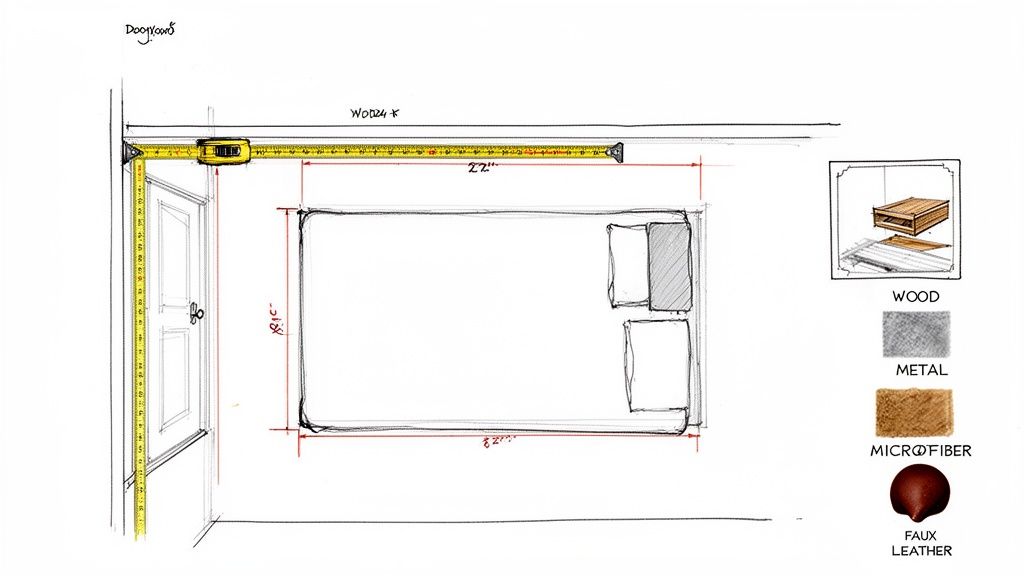
[Image demonstrating how to measure the fully extended open depth of a sofa bed in a living room layout]
A great sofa bed isn’t just about looks—it has to actually fit in your space and hold up to real life. Getting the size and materials right is like laying the foundation for a house. Do it correctly, and you’ll have a piece of furniture you can rely on for years. Get it wrong, and you’re in for a whole lot of frustration.
This all starts with one simple tool: a measuring tape. It’s the single most important step you can take to avoid that sinking feeling when you realize your new sofa won’t fit through the front door.
Mastering Your Room Measurements
Before you get attached to a particular style, you need to know exactly what your room can handle. This isn’t just about where the sofa will sit; it’s about the entire journey it takes to get there. A beautiful sofa bed stuck in the hallway is just a very expensive obstacle.
Make a quick checklist to cover all your bases:
-
Measure the Final Placement Area: Get the maximum width and depth for the spot you’ve picked out. Keep an eye out for things like wall outlets, windowsills, or radiators that could get in the way.
-
Measure the Fully Extended Dimensions: This is the mistake everyone makes. Look up the sofa bed’s “open” or “sleeper” dimensions and measure that exact footprint on your floor. Use some painter’s tape to mark the corners so you can see how much walking room you’ll have left.
-
Measure the Delivery Path: Check the width and height of every single doorway, hallway, and staircase the sofa needs to navigate. Don’t forget to account for tight corners or low-hanging light fixtures.
If you need a little more guidance, our comprehensive Futonland sizing charts have helpful visuals that make it much easier to plan things out.
Decoding Frame Materials for Durability
The frame is the skeleton of your sofa bed—it provides all the structural support. When you’re shopping for affordable options, you’ll typically run into three main materials, each with its own pros and cons. Knowing the difference helps you predict how well your investment will last.
- Solid Wood: Kiln-dried hardwood frames (think oak or maple) are the gold standard. They’re incredibly strong, resist warping, and are your best bet for a piece that will last a lifetime.
- Engineered Wood: This includes materials like plywood and particleboard. Don’t dismiss them outright—high-quality, multi-layered plywood can be surprisingly strong and stable, offering a great mix of durability and value.
- Metal: Metal frames are strong and lightweight, making them perfect for modern, minimalist designs. They provide sturdy support in a slim profile, but always check to make sure the joints are securely welded.
A well-built frame is a non-negotiable. Even the most gorgeous fabric can’t save a sofa bed with a wobbly, weak foundation. Always ask about the frame construction—it’s the clearest sign of how long it will last.
Choosing Upholstery That Fits Your Lifestyle
The upholstery is the outfit your sofa bed wears every day. It needs to be comfortable, look good, and handle everything from movie-night spills to energetic pets. Your lifestyle should be your number one guide here.
Common Fabric Choices and Their Strengths:
| Fabric Type | Best For | Key Benefits |
|---|---|---|
| Microfiber | Families with kids and pets due to its stain resistance and durability. | Extremely soft, easy to clean, and tightly woven to resist pet hair and claws. |
| Polyester Blends | High-traffic areas and budget-conscious buyers seeking versatility. | Resists wrinkling, fading, and abrasion. Available in a huge range of colors and textures. |
| Faux Leather | A modern aesthetic and anyone needing a wipe-clean surface. | Looks sleek, is liquid-resistant, and can be cleaned with a simple damp cloth. |
As you compare fabric sofa beds versus faux leather options, look for the “rub count,” which is a standard measure of durability. For regular home use, a rub count of 15,000 or higher is what you want. This ensures the material can handle daily sitting and lounging without looking worn out too quickly, keeping your affordable sofa bed looking great for years.
What to Expect at Every Price Point
Trying to navigate the world of affordable sofa beds can feel like a guessing game. What does “affordable” actually get you, and what kind of quality can you realistically expect for your money? The key to finding a piece that feels like a smart investment—not a regrettable compromise—is setting the right expectations from the start.
To make your search easier, let’s break the market down into three distinct price bands. Each tier strikes a different balance between materials, comfort, and longevity. Once you know what to look for, you can spot true value and pick the perfect sofa bed for your needs and budget.
Entry-Level: Under $500
This is the most budget-friendly category, and it’s a perfect fit for dorm rooms, first apartments, or a space where it will only see occasional use. At this price, you’ll mostly find simple, armless futons with click-clack mechanisms or basic convertible chairs.
- Frames: Expect to see frames made from metal or particleboard. They get the job done but aren’t built to withstand heavy, long-term use.
- Mattresses: The mattresses will be on the thinner side, usually just a few inches of high-density foam or simple cotton batting. They offer a firm surface that’s fine for a night or two but lack the contouring comfort you’d want for regular sleep.
- Design: Function definitely comes before form here. The designs are straightforward and compact—great for tight spaces—but your upholstery choices will be limited to basic polyester blends.
Key Takeaway: A sofa bed under $500 is a practical fix for the rare overnight guest. It solves an immediate need for extra sleeping space but isn’t designed to be a primary, long-lasting piece of furniture.
Mid-Range: $500 to $1200
This price range is the sweet spot for most people shopping for an affordable sofa bed. This is where you’ll see a major jump in quality, durability, and style, offering the best overall bang for your buck.
Here, you’ll start finding more traditional pull-out sofa beds with dedicated mattresses, along with higher-quality futons built on more substantial frames. The materials and construction are designed to handle more regular use, making them a solid choice for a guest room or family living area.
Frames in this category often use a mix of engineered wood and solid wood components at key stress points. You’ll also discover a much wider variety of mattress options, including thicker innerspring and memory foam models that deliver a far more comfortable night’s sleep.
Premium Affordable: Over $1200
Once you cross the $1200 threshold, you’re in a tier where quality and design really start to shine. These sofa beds are built for comfortable daily sitting and frequent sleeping, often feeling just as good as a traditional bed.
You can expect to find sturdy frames made from kiln-dried solid hardwoods, which ensures maximum stability and a long life. The mechanisms operate more smoothly, and the mattresses are often 6 inches or thicker, featuring premium materials like gel-infused memory foam or pocketed coils for superior support. Upholstery choices also expand to include more durable, high-performance fabrics like true leather.
This is also where you’ll find more thoughtful designs and features. Think stylish sectional sleepers with hidden storage or sleek, European-inspired convertible designs that blend right into your decor. These pieces are true dual-purpose investments meant to last for years.
The demand for high-value furniture is reshaping the industry. The economic segment of the US sleeper sofa market holds a massive 44.50% share, proving that budget-friendly options are a top priority for shoppers who still want quality. It’s also worth noting that sectional sleepers are the fastest-growing category, showing that families want versatile furniture that delivers both function and style.
How to Shop Smart and Care for Your Investment
Making a smart purchase is just the beginning. The real win is protecting that investment so it serves you well for years. A little know-how during the buying process and some simple maintenance down the road can turn a good deal into a lasting piece of furniture you’ll be proud of.
The first hurdle is often deciding where to shop. Buying online offers a massive selection and competitive prices, but you can’t exactly test it out through your screen. In-store shopping lets you sit on the sofa, feel the fabric, and test the mechanism yourself. The best approach? Do both. Research online to narrow your choices, then visit a showroom like Futonland to get a real feel for your favorite picks.
Customer reviews are gold, but you have to learn how to read between the lines. Don’t get hung up on a single glowing or scathing review. Instead, look for patterns. Are multiple people saying the mattress is surprisingly firm or that the pull-out mechanism is silky smooth? Those trends paint a much more reliable picture of how the product actually performs.
Protecting Your Purchase with Proper Care
Once your new sofa bed is home, a simple maintenance routine will keep it looking and functioning like new. It’s the easiest way to protect your investment and stop small issues from becoming big problems.
Start with the upholstery. Give it a quick vacuum once a week with a soft brush attachment. This gets rid of the dust and crumbs that can grind into the fabric and wear it down over time. If a spill happens, act fast—blot, don’t rub, with a clean, dry cloth to soak up as much as you can.
Here are a few essential tips to keep in your back pocket:
- Clean According to the Code: Always check the fabric tag for a cleaning code (W, S, W/S, or X). Using the wrong cleaner can cause permanent damage, so stick to what the code recommends.
- Rotate and Fluff Cushions: If your sofa bed has removable back or seat cushions, flip and rotate them every few months. It’s a simple trick to ensure everything wears evenly.
- Protect the Mattress: A waterproof mattress protector is a must-have, no exceptions. It’s your first line of defense against spills, stains, and allergens, and it will dramatically extend the life of the mattress.
A removable cover is another game-changer for easy maintenance. It lets you completely refresh the look or clean up after a major spill without a fuss. You can find a huge variety of stylish and durable futon covers to match any decor and add an extra layer of protection.
Understanding Warranties and Delivery
Finally, let’s talk about the practical details that people often overlook. Before you click “buy,” make sure you understand the warranty. A manufacturer’s warranty on affordable models usually covers defects in the frame and mechanism for a set period, often one year. Just remember, this won’t cover accidental damage from your cat or normal wear and tear from daily use.
Delivery is the other big one. Confirm if the service is just curbside drop-off or if they’ll bring it inside. For a heavy piece like a sofa bed, spending a little extra on “white glove” service—which includes assembly and removing all the packaging—can save you a massive headache. If you’re in the NY area, our New York City services make delivery and setup completely painless.
Answering Your Top Sofa Bed Questions
Even after diving into all the details, you might still have a few questions rolling around in your head. That’s completely normal—making a smart furniture purchase means getting all your ducks in a row. Here are some clear, straightforward answers to the questions we hear most often from shoppers just like you.
Can a Sofa Bed Be Used for Everyday Sleeping?
Yes, absolutely—but you have to pick the right one. Many modern sofa beds, especially in that sweet spot of the mid-to-premium affordable range, are built for the daily grind. The secret is all in the mattress. Look for models with a quality memory foam or pocketed coil mattress that’s at least 5-6 inches thick.
Here’s a pro tip: adding a good mattress topper can be a game-changer. It can easily turn a solid sofa bed into a comfortable, legitimate primary bed, which is perfect for studio apartments or tight living spaces.
What Is the Main Difference Between a Futon and a Sofa Bed?
The real difference comes down to how they’re built and how they work. It’s easiest to think of it this way:
- A sofa bed is basically a sofa with a separate, traditional mattress tucked away inside the frame. You pull the seat cushions off to unfold the bed from within.
- A futon is much simpler. It uses one single mattress that doubles as both the seat cushion and the sleeping surface. The frame itself is what moves, usually by clicking the back down until it’s flat.
In general, sofa beds will give you a sleep experience that feels much closer to a real bed. Futons, on the other hand, are simpler in design, often firmer, and usually a bit better for really tight spaces.
How Much Should I Spend on a Good Affordable Sofa Bed?
To get a sofa bed that’s truly comfortable and built to last, a realistic budget is somewhere between $800 and $1,800. In this price range, you’ll find well-built models with solid frames (think kiln-dried or engineered wood), dependable mechanisms, and the kind of higher-quality mattresses your guests will actually thank you for.
While you can find options under $500, they almost always cut corners on the frame and mattress comfort. They’re okay for very rare occasions, but investing a little more usually pays for itself in durability and a much better night’s sleep.
At Futonland, we’re experts at finding that perfect mix of style, comfort, and value. Our team is here to answer any other questions you have and help you find the best space-saving solution for your home. Come explore our collection today at https://futonland.com.