
Futon vs Couch: Choosing The Right Fit For Your Space
The real difference between a futon and a couch boils down to one simple thing: a futon is a convertible, dual-purpose piece designed for both sitting and sleeping, while a couch is a dedicated piece of furniture built just for lounging. Your choice hangs on whether you need space-saving versatility or specialized, plush comfort.
Futon vs Couch: At-A-Glance Comparison
Picking between a futon and a couch really sets the tone for your living space, shaping both how you use it and how it feels. This first look breaks down the core differences to give you a solid starting point. While they both offer a place to sit, their designs and intended uses couldn’t be more different.
A futon is the undisputed champion of saving space. Its main draw is the ability to transform from a sofa into a bed in seconds, making it a lifesaver for studio apartments, home offices, and guest rooms where every inch matters. This dual functionality is part of its DNA, typically featuring a separate frame and mattress.
On the other hand, a couch is engineered for one thing and one thing only: comfortable seating. The construction is more involved, usually with an integrated frame, spring systems, and layers of built-in cushioning. This singular focus generally creates a plusher, more supportive sitting experience for everyday use. But even the coziest traditional sofas can’t offer the built-in sleeping function of a futon.
Key Takeaway: The choice isn’t just about furniture; it’s about lifestyle. A futon supports a flexible, multi-use space, while a couch anchors a room dedicated to relaxation and social gathering.
To help you see exactly how they stack up, this quick comparison table lays it all out. Think of it as your cheat sheet for the futon vs. couch debate, helping you instantly see which one lines up with your needs.
Quick Comparison: Futon vs Traditional Couch
| Attribute | Futon | Couch |
|---|---|---|
| Primary Function | Dual-purpose sitting and sleeping | Dedicated seating and lounging |
| Price Range | Generally more affordable | Wider price range, often higher |
| Space Footprint | Smaller and more adaptable | Larger and fixed |
| Versatility | High, converts to a bed | Low, single-purpose seating |
| Typical Lifespan | 5-10 years (mattress is replaceable) | 7-15 years (integrated parts) |
| Mobility | Lighter and easier to move | Heavy and difficult to move |
These are the fundamentals. Now, with this groundwork in place, we can dive deeper into the specifics that will help you make the perfect choice for your home.
Comparing Comfort For Sitting And Sleeping
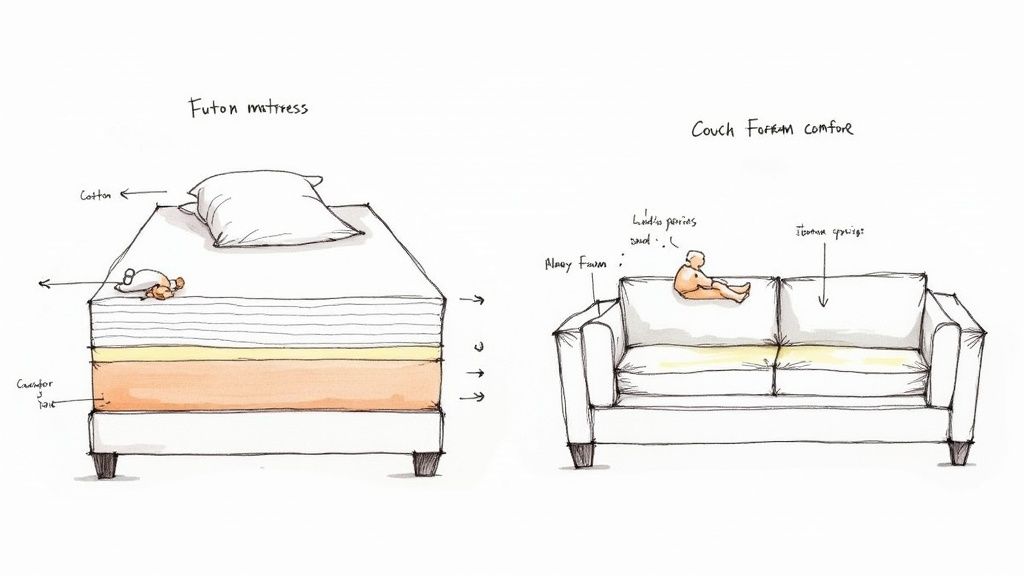
When it comes to the futon vs. couch debate, comfort is the bottom line. It’s where you feel the real-world impact of their different designs, affecting everything from how you lounge on a Tuesday night to how well your guests sleep over the weekend. While comfort is always personal, it really boils down to construction and materials.
A couch is built from the ground up specifically for sitting. Its comfort comes from a whole system working together: a solid frame, a suspension like sinuous springs, and cushions made of multiple layers. These cushions typically have a high-density foam core for support, topped with softer materials like down, fiberfill, or memory foam to create that plush, sink-in feeling. It’s a specialized design meant for deep, relaxed lounging.
A futon’s comfort, on the other hand, is all about the mattress. Since it has to pull double duty for both sitting and sleeping, the mattress is the main event. It’s a single, standalone unit engineered to fold and flex while still providing consistent, even support across the entire surface—something a couch’s separate cushions just can’t do.
The Anatomy Of Seating Comfort
The sitting experience on a couch usually feels softer and more forgiving. The springs absorb movement, and the deep cushions are made to envelop you in a seated position. It’s perfect for kicking back for a movie marathon or curling up with a good book.
But that very same plushness can sometimes work against you, lacking the firm support needed to prevent slouching during long sits. The seat depth can also be a double-edged sword; what feels luxurious to one person might be awkward for someone shorter or for more formal, upright conversations.
In contrast, a futon generally provides a firmer place to sit. Because the mattress has to work as a bed, it’s built to offer more uniform, edge-to-edge support. This firmness is actually a big plus for posture, encouraging a more upright seating position that many people find more comfortable for daily use. A quality futon frame also provides a solid foundation, so you don’t get that “sinking” feeling you find in some couches.
Situational Recommendation: If your top priority is a deep, sink-in seat for a dedicated media room, a classic couch is hard to beat. But for a multi-purpose living area where good posture support and a slightly firmer feel are important, a high-quality modern futon is an outstanding choice.
Decoding Sleeping Comfort
This is where the tables turn. A couch might be fine for a quick nap, but it’s rarely a good option for a full night of sleep. The gaps between the cushions, the uneven surfaces, and the narrow width make it a real compromise. Even traditional sleeper sofas, with their hidden pull-out beds, are notorious for their painfully thin mattresses and that dreaded support bar that always seems to land right in the middle of your back.
Here’s where the futon truly excels. Its entire design is built for sleeping. The single, unbroken mattress surface means no lumps, no gaps, and no awkward pressure points. Best of all, the level of sleeping comfort is entirely up to you—it’s directly tied to the mattress you pick, offering a level of personalization that a couch can’t even begin to approach.
If you want to give your guests a genuinely great night’s sleep, you’ll want to explore the different types of futon mattresses available. The options are huge and designed for different preferences:
- Innerspring & Coil Mattresses: These give you that bouncy, traditional mattress feel. They offer robust support and great air circulation, which helps keep you cool.
- Memory Foam Mattresses: Perfect for pressure relief, these mattresses contour to the body’s curves. They’re a favorite for side sleepers.
- Latex & Wool Mattresses: Often chosen for their natural, hypoallergenic properties, these materials provide firm but responsive support and are incredibly durable.
By choosing a premium, multi-layered futon mattress that’s 8-10 inches thick, you can create a sleeping surface that isn’t just “good enough”—it’s genuinely comfortable. It can easily rival, and often surpass, the comfort of a dedicated guest bed, making the futon a much more practical and welcoming solution for hosting friends and family.
Evaluating Functionality And Space Efficiency
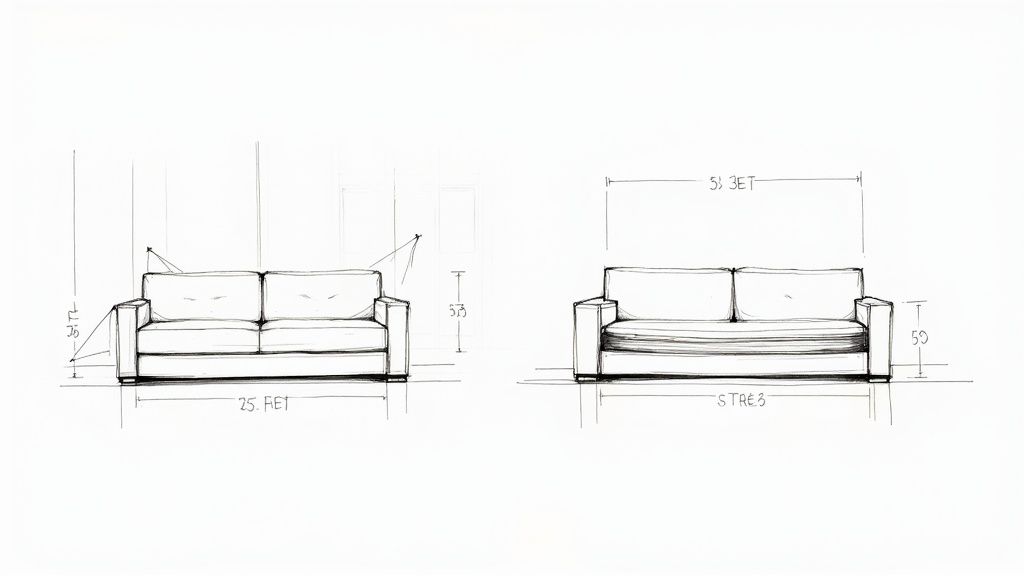
In modern homes where every square foot is precious, furniture needs to do more than just look good—it has to work for its place. When you put a futon and a couch head-to-head on functionality, the real difference is their entire approach to adaptability. A couch is a specialist, built to master the art of seating. A futon, on the other hand, is a generalist, designed to transform a room’s entire purpose in an instant.
The core function of a futon is its seamless shift from sofa to bed. It’s almost always a simple, one-person job, usually just a straightforward fold-down or drop-back motion. That quick changeover is a huge advantage for any dual-use space, like turning your home office into a guest room the moment you close your laptop.
A sleeper sofa is the couch’s answer to this, but it usually involves a clunky pull-out system. This is often a multi-step process: move the coffee table, heave out a heavy internal frame, and then dress a thin, built-in mattress. It hides its second job well, but the effort involved can make it a pain for frequent use.
The Art Of Conversion
Let’s get practical. Imagine an unexpected guest needs to stay the night.
- With a Futon: You just toss off the decorative pillows and fold the frame flat. The whole thing takes less than a minute. You have an immediate, comfortable place to sleep with zero fuss.
- With a Sleeper Sofa: First, you have to find a place for all the seat and back cushions. Then you pull out the heavy metal frame, unfold the mattress, and finally make the bed. It’s a much more disruptive and labor-intensive process.
This difference in ease of use is everything. The futon’s sheer simplicity encourages you to use its dual function, while the sleeper sofa’s cumbersome mechanism often means it stays a “just-in-case” feature that rarely gets used.
A futon’s entire design philosophy is built around making the transition between sitting and sleeping effortless. That focus on fluid functionality is what makes it a superior choice for rooms that have to adapt daily.
This growing appreciation for adaptable furniture is showing up in market trends. The global futon market was valued at USD 1.2 billion in 2024 and is projected to grow 6.5% annually, outpacing the broader sofa market. This points to a clear consumer shift toward multifunctional pieces, especially in space-conscious urban homes where over 52% of convertible furniture buyers say dual-use capability is their top priority.
Beyond The Bed: Advanced Functional Features
Modern designs have pushed both futons and couches to offer more than just a place to sit or sleep. Many now come with clever storage solutions that help squeeze every bit of utility out of a room.
A lot of futon frames are designed with large, built-in drawers right under the seat. This space is perfect for stashing bedding, pillows, or blankets, keeping everything you need for guests organized and right at hand. This kind of integrated storage is a game-changer for small apartments where closet space is at a premium.
Similarly, some couches—especially sectionals—offer hidden storage. A storage chaise is a popular feature where the end cushion lifts up to reveal a deep compartment, great for board games or throw blankets. It’s useful, but it’s also tied to a much larger piece of furniture.
When choosing, think about how the feature fits your life. A futon’s under-frame drawers directly support its main convertible function. A sectional’s storage chaise offers more general-purpose space. For help visualizing how different sizes and features will fit in your room, check out our guide on furniture sizing charts for detailed dimensions. The best choice is the one that makes your space work smarter, not just harder.
Analyzing Style And Design Impact
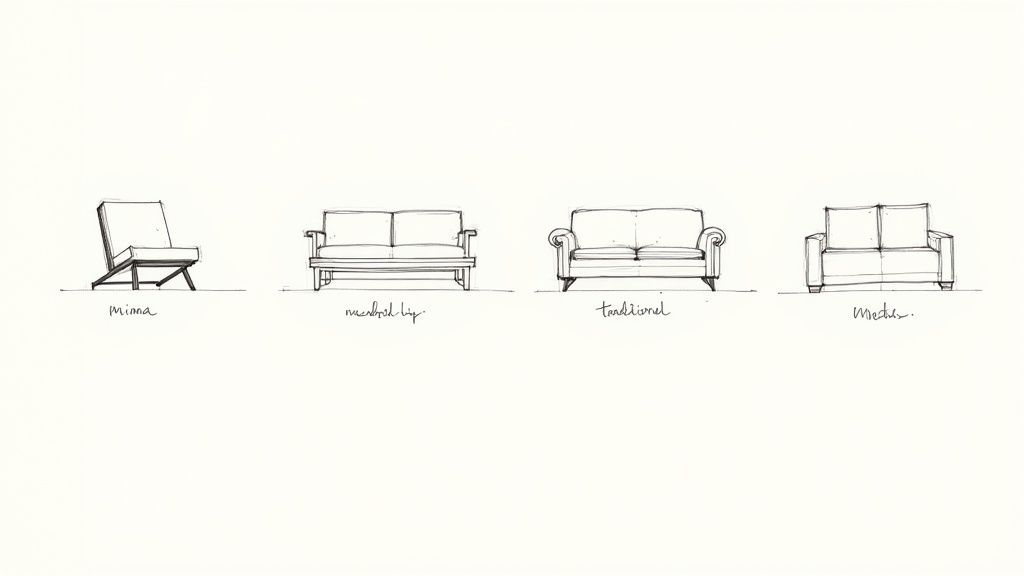
The right piece of furniture does more than fill a space; it sets the tone for the entire room. When you’re deciding between a futon and a couch, it’s easy to get stuck on outdated ideas, but modern design has completely changed the game for both. The real choice comes down to matching a piece’s visual language with your home’s unique character.
A futon’s look is defined by its structure. The separate frame and mattress create a distinct aesthetic that often emphasizes clean lines and honest materials. This makes modern futons a natural fit for some of today’s most popular decor styles.
The Futon: A Statement In Simplicity
Forget the basic metal grids of the past. Today’s futon frames are crafted with intention, offering a streamlined silhouette that can elevate a room’s design.
- Sleek Hardwood Frames: A solid wood frame, whether in a light oak or a deep walnut, brings warmth and an organic feel. This style pairs perfectly with Mid-Century Modern or Scandinavian decor, where craftsmanship and natural materials are the stars.
- Minimalist Metal Frames: Powder-coated metal frames in black, white, or gray offer an industrial edge. Their slender profiles create an illusion of more space, making them ideal for contemporary or minimalist interiors where less is more.
The visual weight of a futon is usually lighter than a traditional couch. You can often see the floor beneath the frame, which keeps it from feeling bulky—a huge plus in smaller rooms.
The modern futon isn’t just a functional item; it’s a design element that communicates efficiency and intentionality. Its form is a direct reflection of its function, creating an aesthetic that is both honest and stylish.
The Couch: An Expression Of Abundance
A couch, on the other hand, offers a nearly limitless stylistic vocabulary. Its integrated design allows for a huge range of shapes, sizes, and upholstery choices that can anchor a room with a strong sense of presence. More often than not, a couch is the centerpiece of a living room.
Just think about the classic silhouettes:
- Rolled-Arm Sofas: These evoke a sense of tradition and comfort, perfect for cozy, classic, or farmhouse-style living rooms.
- Tufted Chesterfield Sofas: With their deep button tufting and luxurious leather, they’re timeless statement pieces that feel right at home in a library or a sophisticated lounge.
- Modular Sectionals: These are the ultimate expression of modern comfort and flexibility. You can create a custom layout that suits your family’s lounging needs, and their bold, low-profile forms are ideal for large, open-plan living areas.
The design journey of convertible furniture reflects a massive market shift. Sofa beds, a category that often includes futons, are expected to command a market worth USD 17.15 billion in 2025, growing to USD 28.73 billion by 2034. This growth is fueled by their historic adaptability, from their origins in 13th-century Japan to their boom in Western homes post-WWII, where sales in the US alone jumped 300% between 1980 and 1990.
Making The Right Stylistic Choice
Ultimately, the best choice depends on the story you want your room to tell. If your style is clean, adaptable, and focused on maximizing light and space, a futon with a high-quality frame can be a chic and sophisticated option.
If you want a more permanent, plush anchor for your room—a piece that invites deep comfort and defines a dedicated relaxation zone—the endless stylistic options of a couch are hard to beat. To truly tie the room together, understanding how to select complementary accessories is key, like choosing the perfect area rug. Consider the visual weight, silhouette, and materials to make sure your selection perfectly complements your home’s character.
Understanding Cost, Durability, And Long-Term Value
Buying new furniture isn’t just about the initial price tag. It’s a bigger calculation that balances upfront cost with how the piece holds up over time. When you’re weighing a futon against a couch, this idea of long-term value becomes really clear, because their designs lead to totally different financial outcomes down the road.
At first glance, a futon usually seems like the more budget-friendly option. The final price, however, depends entirely on the quality of its two main parts: the frame and the mattress. You can find simple metal frames for a few hundred dollars, but solid hardwood frames, reflecting better craftsmanship and a longer lifespan, will cost more. The mattress choice plays an just as big a role in the total price.
A traditional couch, on the other hand, packages everything into one single price. A mid-range sofa might seem like a straightforward purchase, but its all-in-one design comes with hidden costs you’ll only discover years later.
The Advantage Of A Modular Design
The biggest difference in long-term value between a futon and a couch comes down to how they’re built. A futon’s modular design—its separate frame and mattress—is its secret weapon for durability and cost-effectiveness.
If the mattress starts to feel lumpy or worn out after a few years, you just replace it. You don’t have to throw out the entire piece of furniture, which dramatically extends the life of your original investment. In the same way, if you decide to redecorate, you can swap out the frame for a new look while keeping the mattress you already love. There’s a huge variety of futon frames available to match any style.
Think of a futon as a system, not just a single object. Because you can refresh it piece by piece, it adapts to your life for years, making it an incredibly smart and sustainable choice.
A couch is a closed system. If a spring snaps, a support beam cracks, or the cushions flatten into pancakes, you’re stuck. Professional repairs are often expensive and complicated, and sometimes, one broken part means the whole sofa is headed for the landfill. This forces you into a full, costly replacement.
Lifespan And Total Cost Of Ownership
When you look at the average lifespan of each, the difference becomes obvious. Consumer data shows that futons often last longer precisely because their parts are replaceable. A futon can last 8-10 years or more, while a typical couch lasts only 5-7 years. And when it’s time for a refresh, a new futon mattress costs about 25% less than buying a whole new couch.
This modularity also speaks to a growing desire for more sustainable living. Futons can use up to 40% less material over their extended lifecycle, a factor that matters to the 60% of consumers who now prioritize eco-friendly furniture.
Let’s put this into a real-world scenario:
- Scenario A: The Couch: You spend $1,500 on a nice couch. Six years later, the cushions are sagging and the fabric looks tired. Your only real move is to buy a new one. Your total cost over a decade is now $3,000.
- Scenario B: The Futon: You buy a quality futon and mattress for $1,000. After six years, the mattress has seen better days. You spend $400 on a new, upgraded mattress and put it on your original, still-sturdy frame. Your total cost is only $1,400, and your setup feels brand new.
The math doesn’t lie—the futon offers far better long-term value. Maintenance is easier, too. Most futon covers can be removed and thrown in the wash or replaced cheaply. For anyone focused on adaptability and a lower total cost of ownership, the futon is simply the smarter financial decision.
Common Questions About Choosing A Futon Or Couch
Even after weighing all the options, making that final call between a futon and a couch can feel like a huge commitment. To help clear up any last-minute questions, we’ve rounded up the ones we hear the most from people in your exact position. Here are some straight-up, practical answers to guide you to the perfect choice.
Is A Futon Comfortable Enough For Everyday Sitting?
Yes, a modern futon is absolutely comfortable enough for daily use, but there’s a catch: its comfort is completely dependent on the quality of its mattress and frame. The old idea of a futon being a paper-thin pad on a rickety frame is a thing of the past.
Today’s high-quality futons can easily go toe-to-toe with mid-range couches on comfort. The secret is investing in a substantial mattress, usually one that’s 8-10 inches thick. A well-made mattress using memory foam, latex, or an innerspring hybrid will give you all the support and cushion you need for daily lounging.
When you pair a great mattress with a solid hardwood frame, you get a firm yet inviting place to sit. A lot of people actually prefer this kind of support over the mushy, sinking feeling you get from some overly plush sofas. It encourages better posture and gives you a stable surface for reading or working.
Which Is A Better Investment: A High-End Futon Or A Mid-Range Couch?
When you look at long-term value and pure adaptability, a high-end futon is almost always the smarter financial move. The reason is its modular design, which gives it a massive advantage over a traditional couch.
Think about how furniture ages. With a high-end futon, if the mattress starts feeling a bit worn out after a few years, you just replace it. This costs a fraction of buying a whole new sofa. A quality futon frame, on the other hand, can last for decades, ready for a new mattress or even a new slipcover to match a different decor style.
A mid-range couch is a single, integrated unit. Once its built-in cushions start to sag, a spring pops, or the fabric rips, you’re usually looking at a complete replacement. Repairs are often expensive or not even an option, which means a much higher cost of ownership over its lifetime.
Situational Recommendation: If your top priority is a very specific, unchanging look for a formal living room, a mid-range couch might be the right fit. But if you value flexibility, lower lifetime costs, and the freedom to refresh your furniture without starting over, a high-end futon is the clear winner.
How Do I Choose The Right Futon Size For My Room?
Picking the right futon size means you have to measure your space for both of its forms—sofa and bed. It’s a critical step people often skip, and it’s the number one reason furniture ends up feeling cramped or out of place.
Just follow these simple steps for a perfect fit:
- Measure for the Sofa Position: First, measure the wall where you plan to put the futon in its upright sofa form. Jot down the width and depth, making sure to leave room for side tables or just walking around it.
- Measure for the Bed Position: This is the big one. Measure the total floor space the futon will need when it’s fully opened into a bed. This is its maximum footprint.
- Allow for Clearance: A good rule of thumb is to leave at least two feet of clear space around the futon when it’s open. This makes it easy to get in and out of bed and keeps the room from feeling blocked off.
Don’t forget to consider the frame style, too. Armless designs are fantastic for saving a few inches in tight spots. Bi-fold frames are the most common, while tri-fold frames save depth when closed but need more floor space when opened. Always double-check the manufacturer’s exact dimensions for both positions before you buy.
Can A Futon Work As The Main Sofa In A Living Room?
Absolutely. A modern, high-quality futon can easily be the stylish, functional centerpiece of your main living room. The trick is to look beyond the basic, entry-level models and choose a piece designed with real substance and aesthetics in mind.
To make a futon the star of your living room, focus on a few key elements. Start with a substantial frame made from materials like solid oak, walnut, or even a sleek powder-coated steel. A well-crafted frame has the visual weight and presence to anchor the entire room.
Next, pair that frame with a premium, upholstery-grade mattress and a cover that matches your decor. You can find covers in virtually any fabric, color, or pattern you can imagine, from rich velvets to durable linens. Style it just like you would a regular couch—add some decorative throw pillows, a cozy blanket, and an area rug to pull it all together. With that approach, you’ll have a sophisticated, inviting focal point that cleverly hides a comfortable guest bed in plain sight.
At Futonland, we specialize in helping you find the perfect multifunctional furniture for your space. Explore our wide selection of high-quality futons, sofa beds, and mattresses to discover a solution that combines style, comfort, and unbeatable long-term value. Visit us online at Futonland.com to find your perfect fit today.