
Replacement Mattress for a Pull-Out Couch: Sizing & Materials
If you’re searching for a replacement mattress pull out couch solution, you’re probably dealing with a sofa bed that has crossed the line from “not ideal” to “nobody wants to sleep on this.” The usual complaints are familiar. You feel the bars. The middle sags. The surface has lumps, dips, or a fold line that never smooths out.
That doesn’t mean you need a whole new sofa.
In most cases, replacing the mattress is the sensible fix. You keep the frame, keep the footprint, and restore the part that failed. For apartment living, guest rooms, home offices, and multi-use spaces, that’s often the fastest path back to a usable bed.
Your Pull-Out Couch Deserves a Better Mattress
A bad sleeper mattress makes the entire sofa feel worn out, even when the frame is still perfectly serviceable. People assume the whole unit is done because the sleeping experience is miserable. Usually, the problem is simpler. The mattress has compressed, lost support, or no longer folds cleanly inside the mechanism.
That’s why replacement mattresses matter so much in this category. More sofa beds in use over time means more owners eventually need a new mattress rather than a whole new piece of furniture.
For NYC apartments, that trade-off is even clearer. Replacing a sofa is disruptive. You have building access issues, stairwells, old elevators, narrow hallways, and the very real question of whether a new frame will even fit your room as well as the current one. A replacement mattress pull out couch upgrade avoids most of that.
Practical rule: If the frame opens and closes properly, the mattress is usually the part worth changing first.
Material choice matters, but fit matters more. A well-sized replacement in the right construction can make a pull-out usable again for guests, kids, or even regular sleeping. A poorly chosen one can create new problems fast.
If you’re comparing options beyond sleeper replacements, it helps to look at the broader range of futon mattresses too, especially when you’re trying to balance comfort, thickness, and apartment-friendly flexibility.
The Essential First Step: Measuring for a Perfect Fit
Most replacement mistakes happen before anyone clicks “buy.” They happen when someone measures the old mattress instead of the frame, assumes “queen sleeper” means the same thing across brands, or ignores how the mattress has to fold when the sofa closes.
Use the frame as your reference. The old mattress has already changed shape from use, compression, and repeated folding. It can be narrower, shorter, or thinner than what the mechanism was built to hold.
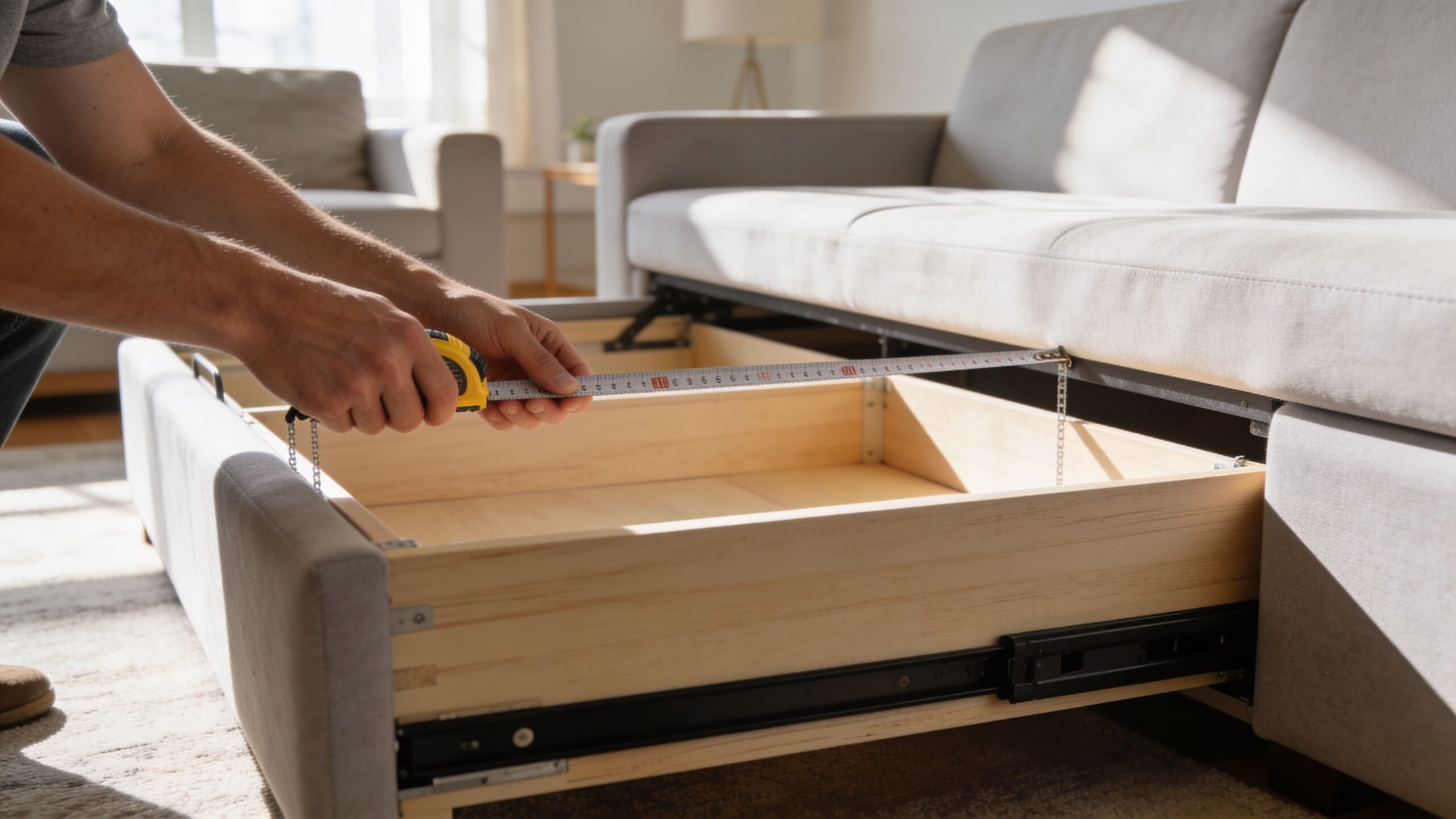
Measure the frame, not the old mattress
Open the pull-out fully and strip everything off. No sheets, no pad, no topper. Then measure the inside width of the frame from edge to edge and the inside length from head to foot.
Write those numbers down exactly. Don’t round because a close fit on a normal bed is fine, but a close fit on a folding sofa bed can jam the mechanism or push the mattress out of position every time you open it.
The next measurement is the one people skip.
Check folded clearance before you order
A sofa bed mattress doesn’t just have to fit flat. It has to fit folded inside the closed sofa. That’s why the folded profile matters as much as the open size.
Here’s the practical way to check it:
- Open the mechanism fully and remove the old mattress.
- Start closing the frame without a mattress so you can see how much space the mechanism leaves.
- Measure the available gap where the folded mattress needs to sit.
- Use that clearance as your thickness limit, not your guess based on the old mattress.
The most important fit rule is straightforward. Most pull-out mechanisms are built around a 4 to 5 inch mattress thickness. A mattress much thicker than that risks straining or damaging the folding mechanism, while one significantly thinner may not fold or seat properly in the frame — check the actual clearance you measured against the specific replacement mattress’s listed thickness before ordering.
If a thicker mattress only fits when you force the mechanism, it doesn’t fit.
That extra bit people try to “get away with” is often what causes hard closing, lifted seat cushions, stressed hinges, and a frame that starts operating badly.
Don’t trust the size label alone
“Twin,” “full,” and “queen” are starting points, not guarantees. Sleeper dimensions vary by manufacturer, and older frames can differ from current production. That’s especially common with older NYC apartment furniture, imported frames, and vintage pieces that were never built to today’s standard replacement assumptions.
A sizing reference helps, but it should support your frame measurements, not replace them. Use sizing charts as a quick comparison point, then match those numbers against the actual metal frame.
Choosing Your New Mattress: Materials and Construction
The right material for a replacement mattress pull out couch depends on how the bed gets used. An occasional guest setup can prioritize simplicity and storage. A sleeper used every week needs stronger support, better recovery at the fold points, and less chance of developing permanent soft spots.
Buyers often get distracted by showroom feel. A mattress can feel good for thirty seconds with a hand press and still perform poorly once it’s folded into a sofa day after day.
What folding use does to a mattress
A pull-out mattress works harder than a stationary mattress. It bends at the same zones, gets compressed under seat cushions, and has to recover after each use. That repeated articulation is what shortens lifespan compared to a mattress that only ever lies flat.
That doesn’t mean foam is a bad choice. It means you should match the material to the job.
Sofa Bed Mattress Material Comparison
| Material Type | Best For | Pros | Cons | Futonland Recommendation |
|---|---|---|---|---|
| Innerspring | Guest use, sleepers who like a traditional bed feel | Familiar bounce, good airflow, easier temperature neutrality | Coils can telegraph through thinner builds, folding stress can be hard on lower-quality units | Good when the sleeper dislikes foam and the frame has reliable support |
| Memory foam | Pressure relief, quieter sleep surface, couples | Conforms well, reduces motion transfer, no coil feel | Can sleep warmer, can feel slower to unfold, may stiffen in cold rooms | Good for guest rooms and occasional use if the foam is purpose-built for folding |
| Latex | Frequent use, responsive support, buyers focused on durability | Springy feel, quick rebound, strong support, doesn’t have the “stuck” feel of memory foam | Heavier, pricier, and not every frame handles its feel or folding behavior equally well | Worth considering when durability and responsiveness matter more than budget |
| Hybrid or layered construction | Mixed comfort preferences, higher-use sleepers | Balances support and comfort, often feels more stable than one-note constructions | Needs correct thickness and flexibility to work in the mechanism | Often the safest choice when the bed sees regular use |
What works best in real homes
Innerspring still makes sense for a lot of pull-outs. People who hate the feel of all-foam usually do better with it. It also tends to sleep less warm. The downside is simple. Cheap coils and repeated folding are a bad combination.
Memory foam solves some classic sleeper-sofa complaints. It reduces pressure points and softens the feel of a thin mattress. But in cooler rooms, it can be slower to relax and flatten after unfolding. In a drafty apartment or a room that stays cold, that’s noticeable.
Latex is worth prioritizing for anyone who wants the mattress to feel resilient rather than mushy. It rebounds quickly, supports well, and doesn’t have the delayed response of memory foam. For a pull-out that sees regular use, that responsiveness is a real advantage.
The best pull-out mattress isn’t the softest one. It’s the one that keeps its shape, folds cleanly, and still feels supportive after repeated use.
Match the mattress to the user, not the marketing
- For occasional guests: a straightforward foam or innerspring option usually does the job if the fit is exact and the cover is durable.
- For weekly use: look more carefully at resilience and recovery. A mattress that folds often needs better construction than a once-a-month guest bed.
- For frequent family use: prioritize durability over novelty. Kids, visiting relatives, and repeated opening cycles expose weak materials fast.
- For sensitive sleepers: if someone complains about pressure points or feeling stuck, material feel matters more than a generic “firm” or “plush” label.
Compare mattresses made for folding applications directly — not standard bedroom mattresses trimmed down to a similar thickness.
Placing Your Order: Standard, Custom, and Upgrades
Once your measurements are set, ordering is usually simple if your frame falls into a common size range. If it doesn’t, don’t improvise. That’s where many pull-out replacements go wrong.
A standard mattress in a non-standard frame may seem close enough on paper, but sleeper mechanisms are unforgiving. Too wide and the mattress bunches at the sides. Too long and the fold points shift out of alignment. Too loose and the mattress slides, drifts, and wears unevenly.
When standard sizes work
Many modern sleepers line up with common twin, full, or queen replacement sizes. If the frame measures cleanly into one of those and your thickness clearance is confirmed, a standard replacement is usually the fastest route.
This is also the stage where cover choices matter more than people think. If the sofa is in a family room, a rental, or a heavily used guest room, a tougher cover is often the smarter choice than a softer one. Spills, pet hair, friction from folding, and repeated handling wear the exterior before the core fully gives out.
When custom sizing is the only correct answer
Older sofa beds are where sizing gets tricky. NYC apartments have plenty of inherited furniture, vintage frames, imported sleepers, and one-off pieces that don’t match current replacement norms. In those cases, “close enough” is usually expensive.
If your frame is unusual, order to the frame you own. Don’t order to the category name. This is one place where custom cut-and-sew options make practical sense, especially when the alternative is forcing a standard mattress into a shape it was never made for.
Small upgrades that make a difference
- A sturdier cover if the sleeper lives in a high-traffic room
- A better edge finish if the mattress tends to rub against metal frame points
- A material upgrade if the sleeper is used more often than you first assumed
- Professional handling when the apartment layout makes delivery and swap-out difficult
Futonland is one specialist retailer that carries replacement sofa bed mattresses, custom sizing, and in-home delivery options suited to tight apartment access.
Installation and Fitment Tips for Your New Mattress
Installation is usually straightforward, but this is the point where you find out whether your measurements were accurate. A mattress that fits correctly should settle onto the frame evenly and let the mechanism close without a fight.
If the new mattress arrived compressed, give it time to open fully before judging the fit. Foam especially can look undersized or oddly shaped right out of the package.
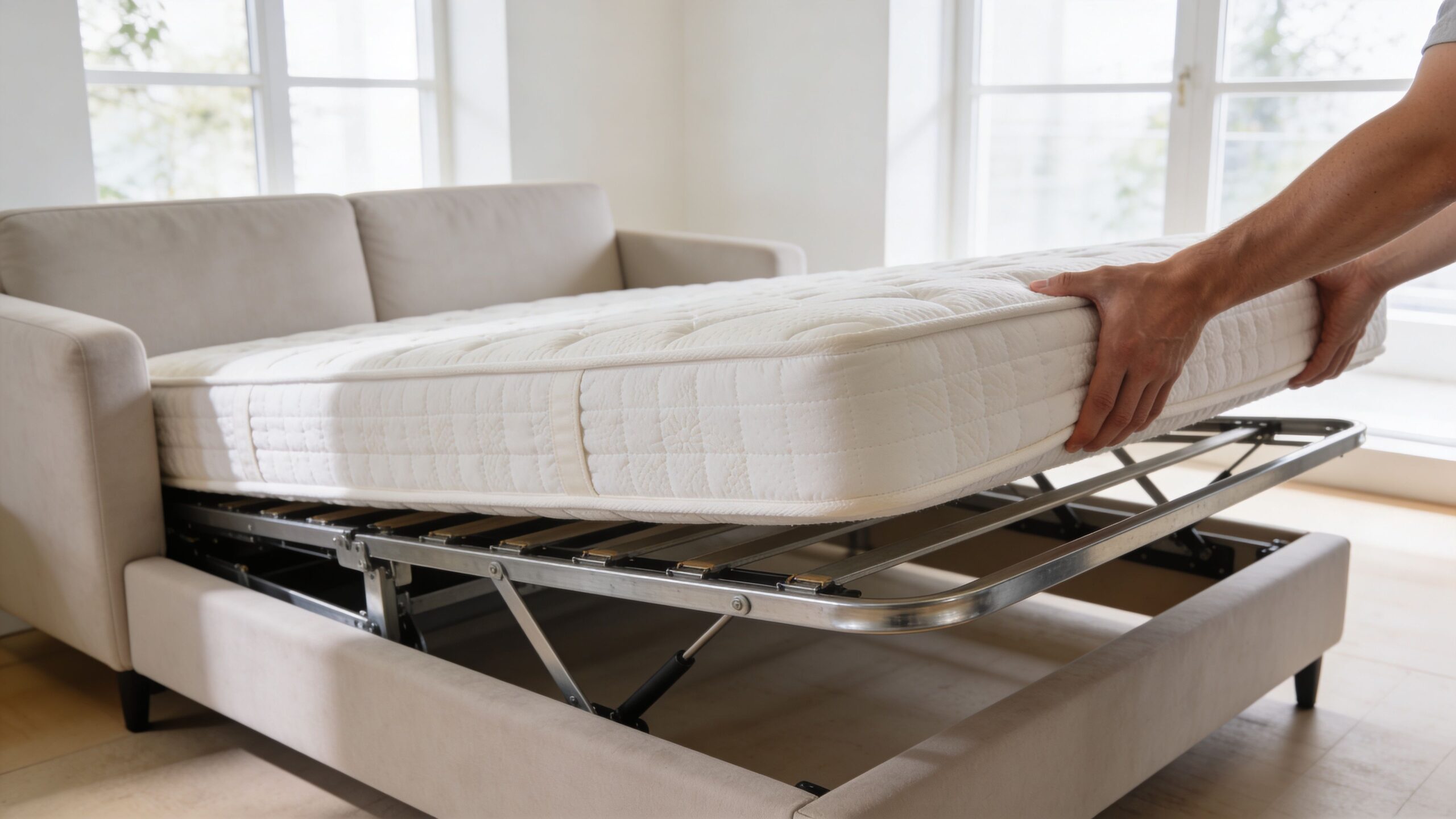
A clean installation sequence
- Open the pull-out completely so the frame is flat and stable.
- Center the mattress carefully on the support surface before attaching or tucking anything.
- Check all edges and corners to make sure nothing is caught on bars, hinges, or brackets.
- Fold the mechanism slowly the first time and pay attention to resistance points.
A little resistance can be normal. Hard resistance isn’t. If the frame feels like it needs extra force, stop and inspect the position of the mattress before trying again.
What usually causes a bad fit
- The mattress is off-center. Even a small shift can make one side bind while the other side looks fine.
- The cover is catching on hardware. This happens most often near corners and hinge points.
- The thickness is technically wrong for the frame. If everything is centered and the mechanism still strains, the folded profile is likely too bulky.
Close the sofa bed slowly the first few times. The mechanism will tell you very quickly whether the mattress belongs there.
If the mattress tends to slide or creep during use, accessories can help keep it positioned. A set of non-slip grip pads is a simple fix when the mattress shifts against the frame or support surface.
Care, Services, and Frequently Asked Questions
A pull-out mattress lasts longer when you treat it like a real sleep surface, not an accessory hidden inside a sofa. That means keeping it clean, rotating it periodically, and protecting it from the kind of stains and moisture that are hard to remove once they soak in.
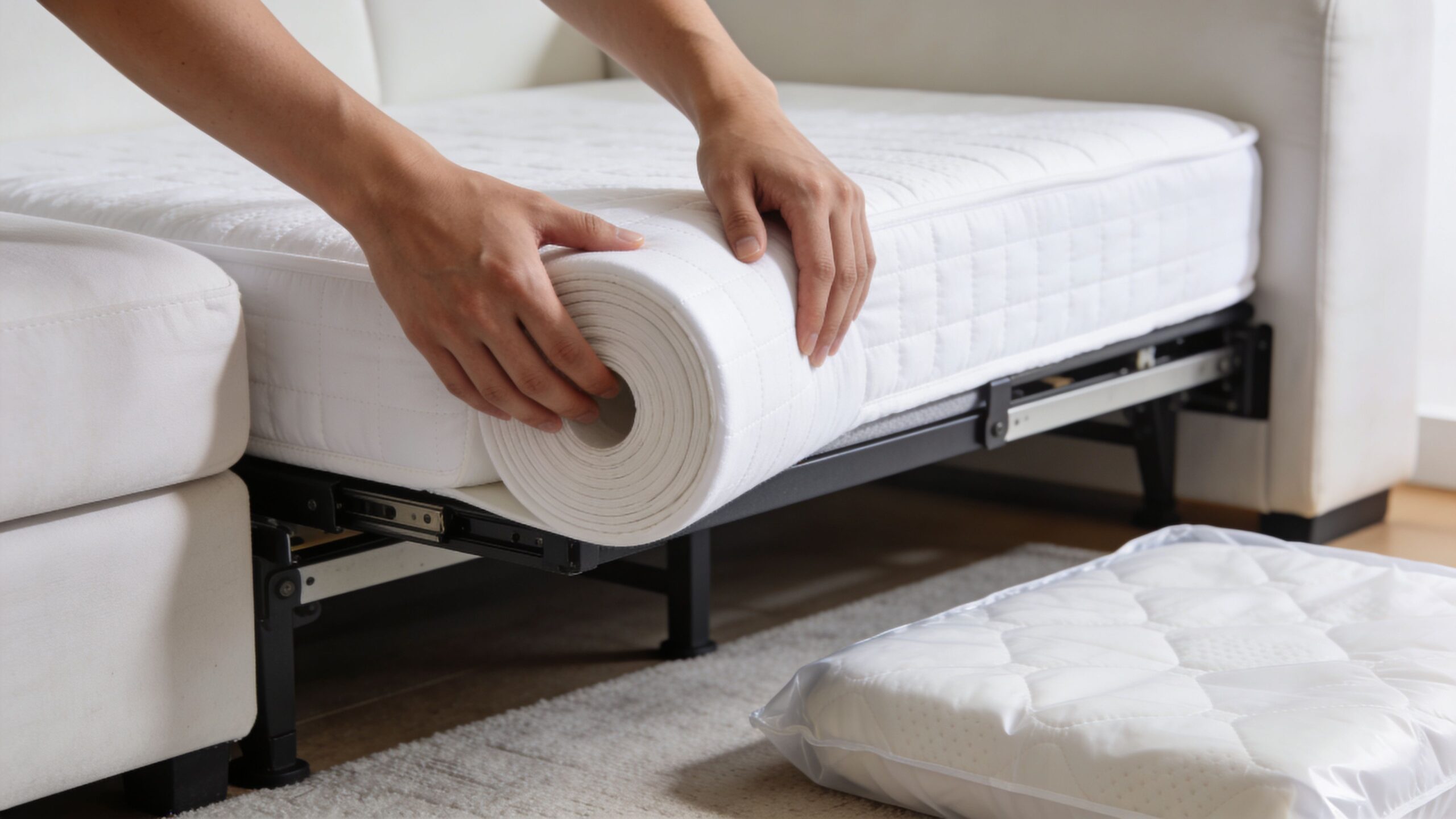
Care that actually helps
- Rotate the mattress periodically so one fold zone or sleeping side doesn’t take all the wear.
- Use a protector or cover if the bed sees guests, kids, or pet exposure.
- Store bedding separately if needed when extra bulk makes closing awkward.
- Watch for early fit changes such as bunching, dragging, or harder closing, which usually signal wear or slippage.
In NYC, service matters almost as much as the product. Carrying a replacement mattress through a walk-up, removing the old one, and setting the new one correctly on a sleeper frame is a hassle worth avoiding. White-glove delivery and old mattress disposal can make the swap much easier, especially when building rules and tight stairwells are part of the job.
Common questions
Can I replace just the mattress and keep the sofa?
Yes, if the mechanism and frame still operate correctly. That’s often the smartest fix when the sleeping surface has failed but the sofa itself is still structurally sound.
What if my sleeper sofa is older or oddly sized?
Measure the frame exactly and order to those dimensions. Vintage, antique, and custom frames often need a custom-cut replacement rather than a standard size.
Is thicker always better for comfort?
No. In a pull-out, thickness has to match the mechanism. More thickness can create folding problems, poor closure, and extra stress on the frame.
Which material feels most like a regular bed?
Usually innerspring or a well-balanced layered construction. Memory foam feels more contouring. Latex feels more responsive and buoyant.
How do I know the old mattress is beyond saving?
If it sags, stays compressed, folds poorly, feels uneven, or makes the frame uncomfortable even with bedding on top, replacement is usually the right move.
A good replacement mattress pull out couch purchase should solve the actual problem in one shot. Get the measurements right, respect the folding limits, choose materials based on real use, and the sofa you already own can become worth sleeping on again.