

Furniture with Hidden Bed: Murphy vs. Cabinet vs. Sleeper
A lot of New Yorkers are trying to make one room do the work of three. The living room becomes the office during the day. The office becomes the guest room at night. In a studio, the bedroom is everything.
That’s where furniture with a hidden bed earns its place — not as a gimmick, and not as a last resort. Done well, it gives you a room that looks finished and still sleeps like a real room.
The mistake most shoppers make is assuming all hidden beds solve the same problem. They don’t. Some are ideal for renters who can’t drill into a wall. Some are better for daily sleeping. Some look compact closed but need more clearance than expected. The right choice depends less on style than on lease rules, layout, and how often the bed will actually be used.
Your Extra Room Is Hiding in Plain Sight
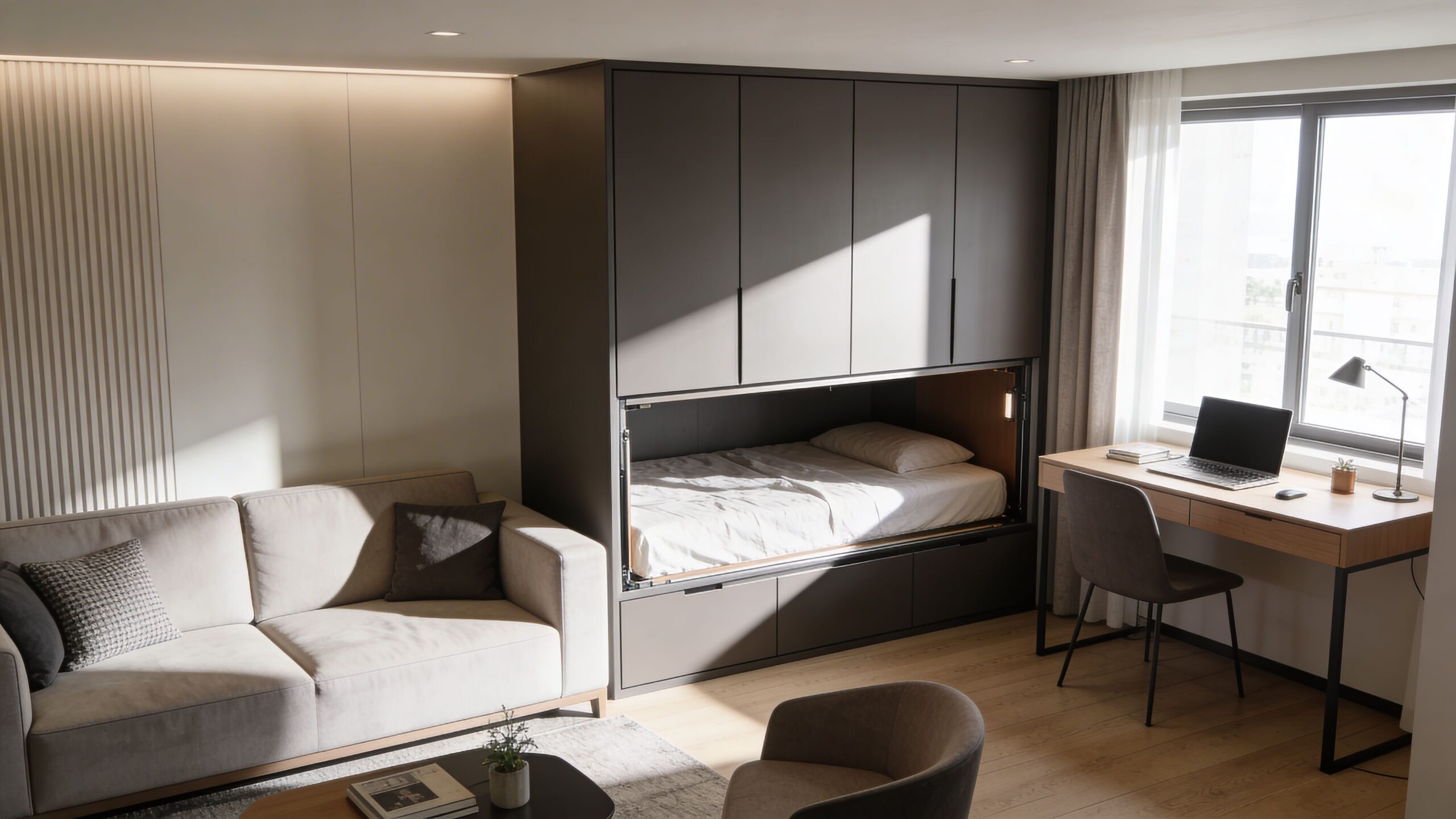
The classic NYC version of this problem is easy to recognize: a second bedroom on paper that’s actually an office, a workout corner, storage, and the only place a guest can sleep — or a studio where you don’t want to stare at your bed every hour you’re awake.
William Lawrence Murphy patented his “disappearing bed” in 1911 after inventing it in his own cramped San Francisco apartment. His company relocated to New York City in the 1920s, and the Murphy bed became a fixture of city living from there. The idea has lasted because city apartments still create the same pressure: floor space during the day, a sleeping surface at night, without every room announcing its bedtime function around the clock.
Tip: If a room has to change roles daily, choose furniture based on how it behaves when closed, not only how it looks when open.
What NYC shoppers are usually solving for
- Studio privacy: the room shouldn’t feel like a bedroom all day.
- Guest flexibility: occasional hosting, without a permanent bed taking over the room.
- Home office conversion: the room needs to work on weekdays and sleep on weekends.
- Lease limitations: renting means permanent installation may not be allowed.
Wall Beds, Cabinet Beds, and Sleepers: What’s the Difference?
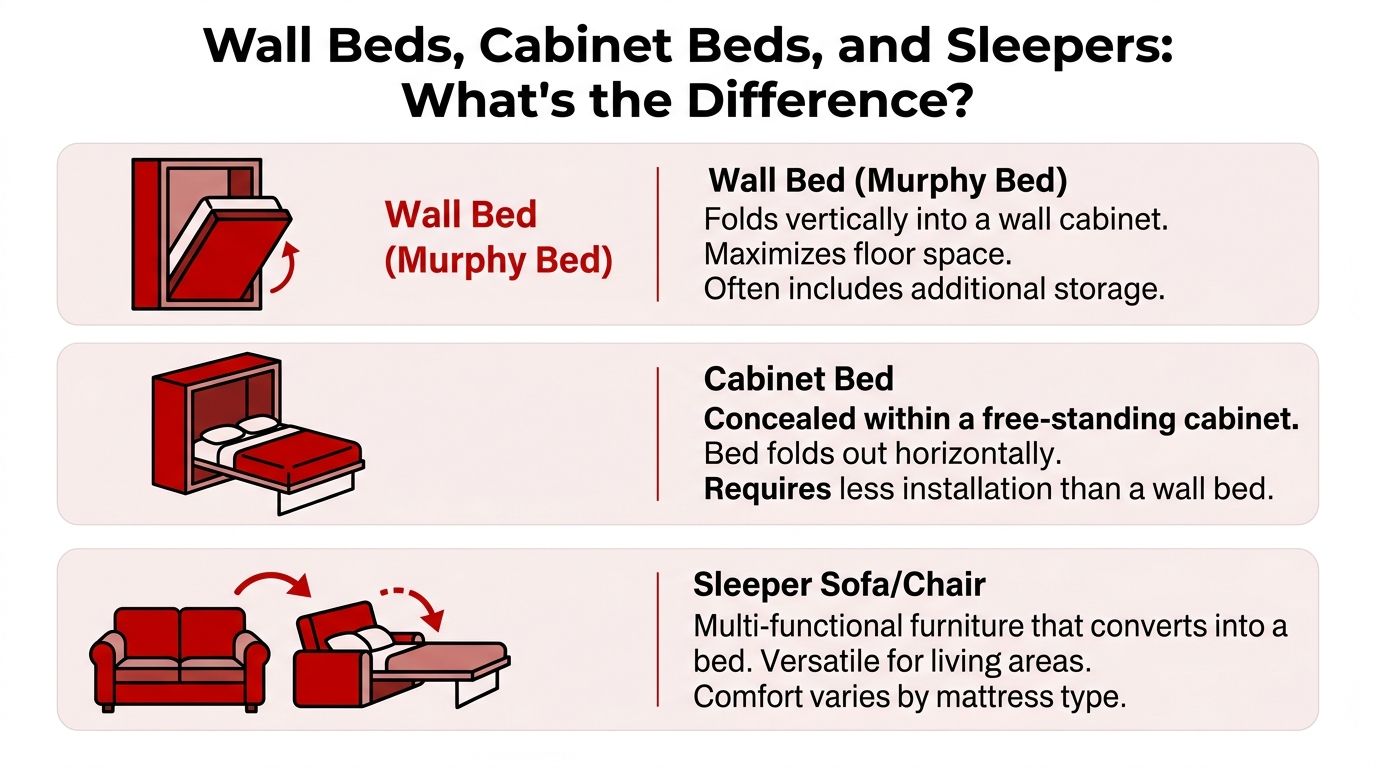
Murphy bed, wall bed, cabinet bed, chest bed, sleeper sofa — the terms overlap but aren’t interchangeable. The fastest way to choose is by installation, closed appearance, and how often the bed will be used.
Wall-mounted Murphy beds
The bed folds into a vertical or horizontal cabinet secured to the wall; some models add shelves, side storage, or a desk. For homeowners, or renters with written permission to install, a wall bed gives the cleanest built-in look and saves the most visual space since the bed disappears into a tall cabinet rather than sitting forward in the room.
Works well for: tight rooms needing open floor area by day, home offices that need a real bed at night, a more architectural look.
Doesn’t work as well for: strict no-drill leases, frequent movers, rooms with awkward wall conditions or baseboard obstacles.
Study the difference between the bed’s closed footprint and open footprint carefully — a wall bed can look minimal shut and still dominate circulation once opened. See the wall bed collection for common configurations.
Cabinet beds and chest beds
This category is often the smartest answer for renters. A cabinet or chest bed looks like a freestanding furniture piece — closed, it reads as a credenza or compact cabinet; open, the sleeping surface pulls out into the room. Because it doesn’t need wall mounting, it sidesteps lease compliance, patching, anchors, and building rules entirely.
The concept predates the Murphy bed by decades: Sarah E. Goode received a U.S. patent in 1885 for a folding cabinet bed that doubled as a writing desk, designed specifically for urban apartment renters combining two functions in one piece. That’s still the appeal today — cabinet beds make the room work harder without asking the apartment to change around them.
- Freestanding convenience: better for renters and frequent movers.
- More furniture-like appearance: useful in living rooms and guest rooms.
- Different floor use: these extend outward into the room when opened, so front clearance matters.
Key takeaway: If you can’t mount to the wall, start with cabinet beds and chest beds first.
Sleeper sofas and sleeper chairs
A sleeper sofa is hidden-bed furniture too, even if it’s not usually categorized that way — the sleeping surface is less visually obvious because the piece functions first as seating. It’s the best fit when the room is primarily a living room and only occasionally a bedroom.
| Type | Strongest use case | Main trade-off |
|---|---|---|
| Wall bed | Maximum daytime floor space | Requires installation |
| Cabinet or chest bed | Renters and no-drill spaces | Takes floor depth when opened |
| Sleeper sofa | Living room seating plus guest sleep | Sleeping comfort depends heavily on model and mattress design |
Quick filter: bedroom-only at night → wall bed. Lease limits installation → cabinet or chest bed. Room is mainly for sitting → sleeper sofa or sleeper chair.
Comfort and Durability: What Actually Matters
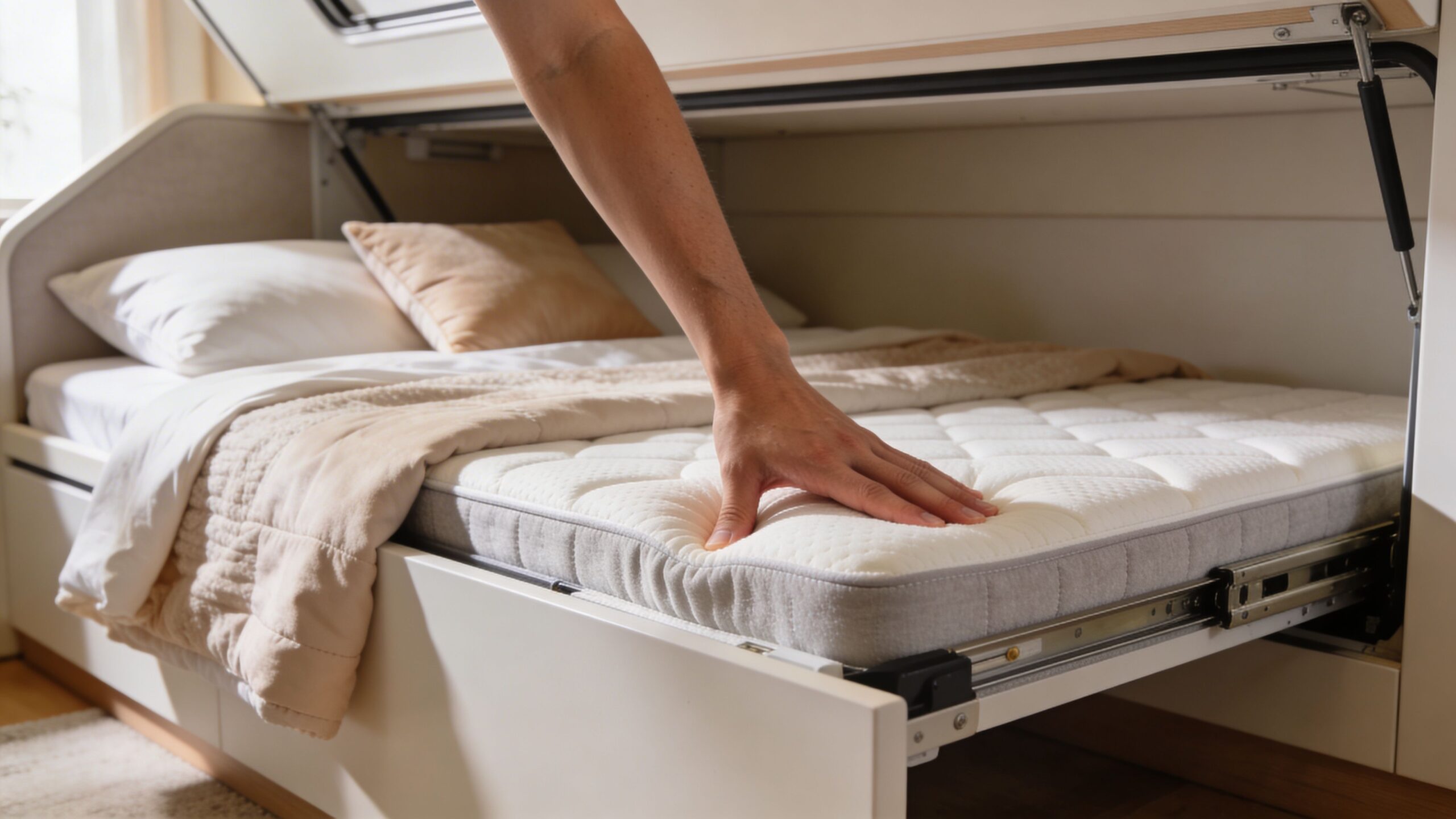
A hidden bed can look sharp in photos and still disappoint in use. Comfort comes down to two things shoppers often underweight: the mattress and the lift mechanism.
Start with the mattress, not the cabinet finish
Color, hardware, and silhouette matter, but sleep quality lives inside the unit. Higher-quality hidden bed frames use balancing systems like torsion springs or piston lifts and are built to accept a standard mattress rather than a thin proprietary pad — check the specific model’s rated mattress thickness and weight capacity before buying, since these vary a lot between units. Our Avalon Hidden Bed with Desk is one example with published specifications you can compare against. For mattress options generally, browse futon mattresses to see how construction affects comfort even when the frame is doing the space-saving work.
What a smooth mechanism feels like
Good lift hardware feels controlled, not jerky. When balanced properly, one person converts the bed without wrestling it down or straining to close it, and the movement stays predictable — which matters if the bed is used often or opened in a narrow room. Warning signs to watch for: the bed feels heavier than expected, the motion is uneven, you need to clear too much from the surrounding surface first, or the frame feels less secure at the end of travel.
Daily use changes the standard
An occasional guest bed tolerates more compromise than one used every night. For regular sleeping, pay close attention to support under the mattress, platform sturdiness, and how consistently the mechanism opens and closes.
Tip: Ask one blunt question before buying: “Would I be comfortable opening and closing this on a rushed weekday morning?”
Assembly affects comfort too
A well-designed bed can still feel off if assembly is uneven, the frame is out of square, or hardware isn’t tensioned correctly. Hidden-bed furniture has moving parts, alignment points, and safety components that are less forgiving than a basic side table or platform bed — professional assembly is worth prioritizing even if you’re generally handy.
Making It Fit Your Apartment
Small-space planning usually fails before the bed even arrives. People measure the wall, but not the room in motion — the width of the furniture, but not the path around it once it opens. That’s why hidden beds sometimes feel “too big” only after delivery. The issue is usually the clearance plan, not the unit itself.
Measure the room in two states
You need dimensions for the room closed and open — including the less obvious conflict points: nightstands, desks, radiators, closet swings, and the walkway still needed at the foot or side of the bed.
- Measure wall width: including baseboards, trim, and outlets.
- Measure depth when closed: confirm the furniture doesn’t choke circulation all day.
- Measure full projection when open: check whether the bed blocks doors, drawers, or work zones.
- Measure ceiling conditions: watch for soffits, low lights, and shelves.
- Measure your access path: hallways, stairwells, elevators, and building entry matter too, especially for delivery.
Confirm mattress and frame dimensions against Futonland’s sizing charts during planning.
Vertical or horizontal
A vertical wall bed makes sense with enough ceiling height and a preference for a smaller wall footprint. A horizontal wall bed works better with lower ceiling constraints, or where wall width is available but depth is tight — it also pairs more naturally with lower built-ins. Neither is automatically better; the room decides.
The renter workaround
No-drill leases narrow the shortlist immediately. If your building restricts wall mounting, freestanding cabinet beds are the cleaner answer — no permission issues, no wall damage, and still a guest-ready setup that looks intentional closed.
Plan around the room’s busiest hour
People often plan around bedtime, but in a small NYC apartment, daytime use usually matters more. A WFH office needs desk clearance and visual calm prioritized; a living room needs seating flow protected.
Tip: Plan around the hour when the room works hardest. That reveals which hidden-bed style will feel easy, not just possible.
Maintaining a Hidden Bed for Years of Use
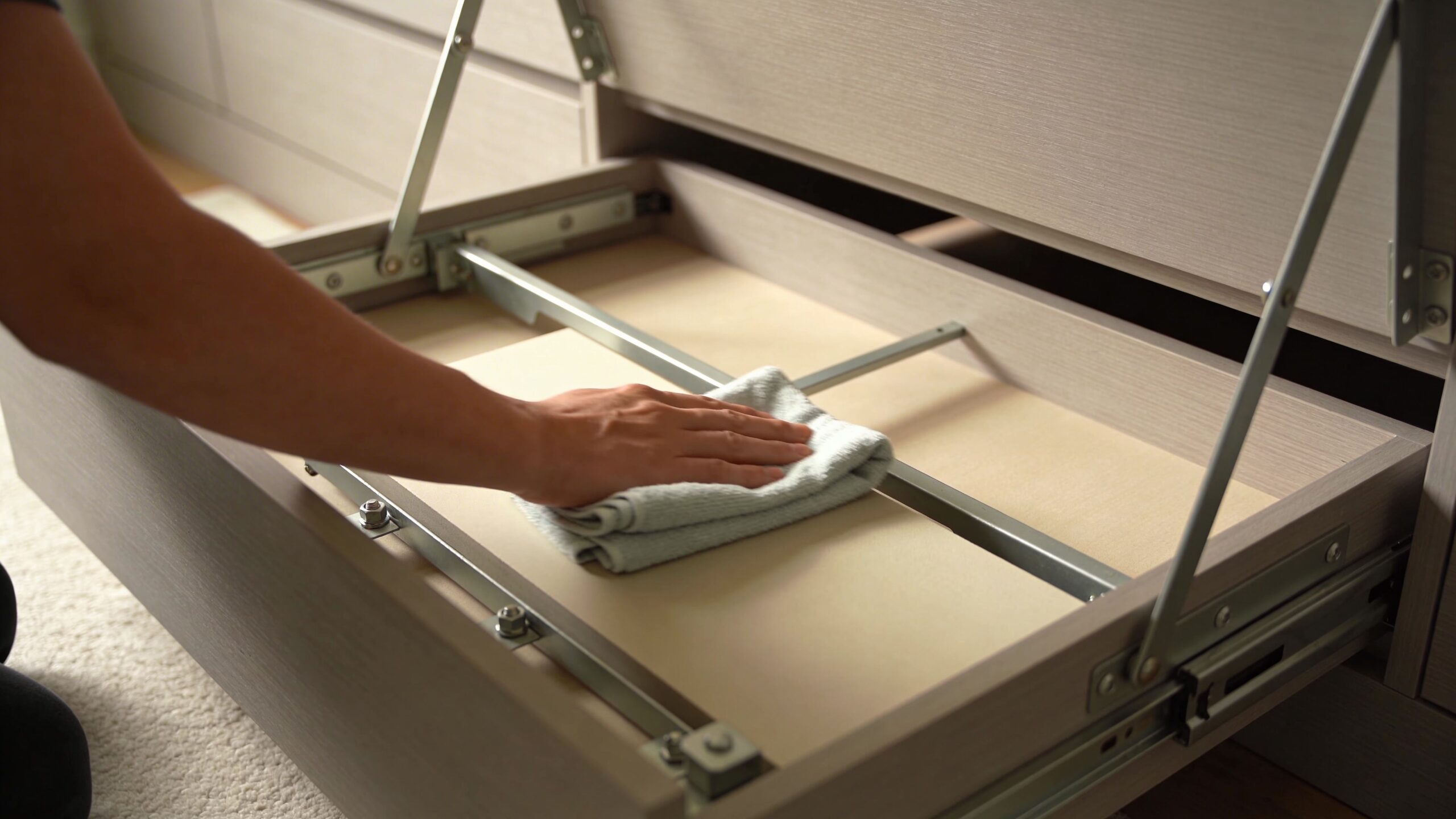
The more often a hidden bed changes form, the more attention it deserves — not a reason to avoid one, but a reason to treat it like a mechanical furniture piece rather than a static frame. That matters most in family homes, guest-heavy apartments, and any room where the bed sees frequent use. A guest bed opened a few times a month lives a very different life than one opened every morning and closed every evening.
A maintenance routine that pays off
Most problems start small — a loose fastener, a rougher-than-usual close, a slight shift in alignment. Catching those early is easier than waiting until the bed feels unstable.
- Check hardware regularly: tighten anything loose before movement creates more play.
- Keep tracks and pivot areas clear: dust and debris make moving parts work harder.
- Watch for changes in motion: resistance, noise, or uneven descent usually signals something needs attention.
- Protect the mattress and upholstery: covers and regular cleaning matter more in family spaces than people expect.
- Don’t overload surfaces improperly: desk-bed hybrids and cabinet tops still have operating limits.
Safety isn’t optional
In homes with children, or apartments where guests use the bed without much instruction, locking features and proper setup matter even more. A hidden bed should feel controlled at every point in its travel — if it doesn’t, stop using it until the hardware and installation are checked.
Key takeaway: White-glove assembly isn’t a luxury add-on for a hidden bed. It’s part of the safety system.
Choosing the Right Hidden Bed
Most shoppers don’t need more inspiration photos — they need help narrowing the options without an expensive mistake. In practice, hidden-bed buying comes down to matching one problem to one furniture type.
Lease says no drilling: start with freestanding cabinet beds and chest beds. They solve the hidden-sleeping problem without turning your wall into a project — useful for renters, frequent movers, or anyone who wants flexibility to rearrange later.
Room has to be an office most of the week: look at desk-integrated hidden beds and cleaner-profile wall beds, so the space reads as productive and uncluttered when the bed is put away.
Room is mainly for living: a sleeper sofa often makes more sense than a wall unit, especially when ample seating is essential and overnight guests are occasional.
Worried about comfort: don’t buy by silhouette alone — ask what mattress the unit takes, how the support platform is built, and whether it’s realistic for your intended use. Guest sleep and everyday sleep are different standards.
Worried about setup in a walk-up or tight building: delivery and assembly become part of the product, not a separate convenience. Hidden beds often move through narrow hallways, small elevators, and older buildings with little margin for error, and the final feel of the bed depends on proper installation and alignment.
To see options in person, compare mechanisms, and ask layout questions before ordering, visit a Futonland showroom in the Upper West Side, Greenpoint, or Newark. Futonland carries Murphy beds, cabinet beds, and wall beds, plus delivery and assembly service in NYC.
What works best long term
- Fits the lease as well as the room
- Matches the actual frequency of use
- Leaves enough circulation space when open
- Uses a mattress and mechanism suited to real sleep
- Is assembled correctly from day one
The wrong hidden bed makes a room feel more constrained because every conversion feels like effort. The right one gives the room back to you when you’re awake, and gives you or your guests a proper place to sleep when needed.