

Finding The Best Natural Latex Mattresses For Your Home
Thinking about a natural latex mattress? You’re not just buying a bed; you’re investing in better sleep and a healthier home. The “best” one isn’t a one-size-fits-all model. It’s about finding the perfect match for your sleep style, values, and space. For many people, that sweet spot is a mattress with customizable firmness, solid organic certifications, and a sturdy Dunlop latex core—a fantastic blend of support, purity, and long-term value.
Why Choose a Natural Latex Mattress
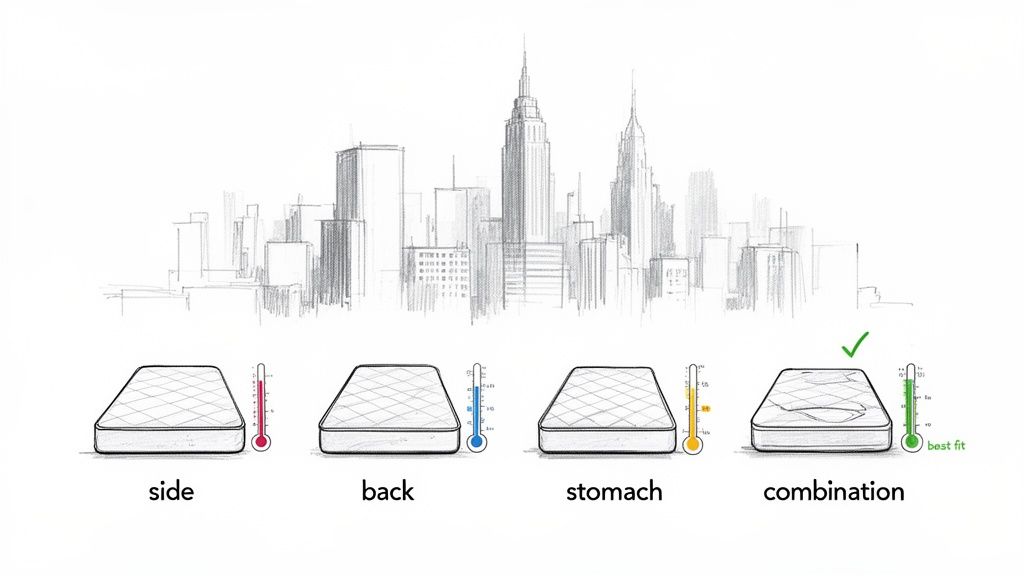
If you’re on the hunt for a mattress that delivers on comfort, durability, and sustainability, natural latex is in a class of its own. Unlike memory foam, which is a synthetic material made from petroleum byproducts, natural latex is harvested directly from the sap of rubber trees. This simple fact makes it a renewable resource and a much healthier choice to bring into your bedroom.
It’s no surprise that as more people look for sustainable, non-toxic products, latex mattresses have grown in popularity. The market for natural latex mattresses in North America is set to grow at a 5.1% CAGR, outpacing many traditional options. Shoppers are clearly voting for plant-based materials over synthetic foams.
Key Benefits of Natural Latex
Switching to natural latex comes with some pretty distinct advantages that lead to better nights and a cleaner living space.
- Exceptional Durability: A quality natural latex mattress can easily last 15 to 20 years. That’s often double the lifespan of a typical innerspring or memory foam bed.
- Superior Support and Comfort: Latex has a unique, buoyant feel. It contours to your body to relieve pressure points but doesn’t give you that “sinking” sensation common with memory foam. It supports you on the bed, not in it.
- Naturally Hypoallergenic: It’s inherently resistant to dust mites, mold, and mildew, which makes it a fantastic option if you struggle with allergies.
- Breathable and Cool: The open-cell structure of latex foam lets air flow freely, helping regulate your temperature so you don’t overheat during the night.
Natural vs. Organic: A Quick Comparison
While you’re shopping, you’ll see the terms “natural” and “organic” used a lot. They aren’t interchangeable, and knowing the difference helps you make the right call.
| Attribute | 100% Natural Latex | Certified Organic Latex |
|---|---|---|
| Source Material | Made entirely from rubber tree sap. No synthetic fillers allowed. | Made from rubber tree sap grown without pesticides or herbicides. |
| Verification | Verified by purity and material content tests. | Verified by rigorous third-party certifications like GOLS. |
| Best For | Shoppers who want a pure, plant-based mattress free of chemicals. | Eco-conscious shoppers who demand the absolute highest standard of purity. |
The main difference comes down to the farming and manufacturing process. All organic latex is natural, but not all natural latex has gone through the rigorous process to earn an organic certification.
Ultimately, whether you decide certified organic is a must-have or you’re happy with the inherent purity of 100% natural latex, you’re choosing a healthier sleep surface. Making a big purchase like this involves a lot of factors, so if you want to explore all your options, you can check out our comprehensive collection of mattresses.
Ready to see what’s out there? Explore our full collection of Futonland’s natural mattresses.
Dunlop vs Talalay: A Practical Comparison
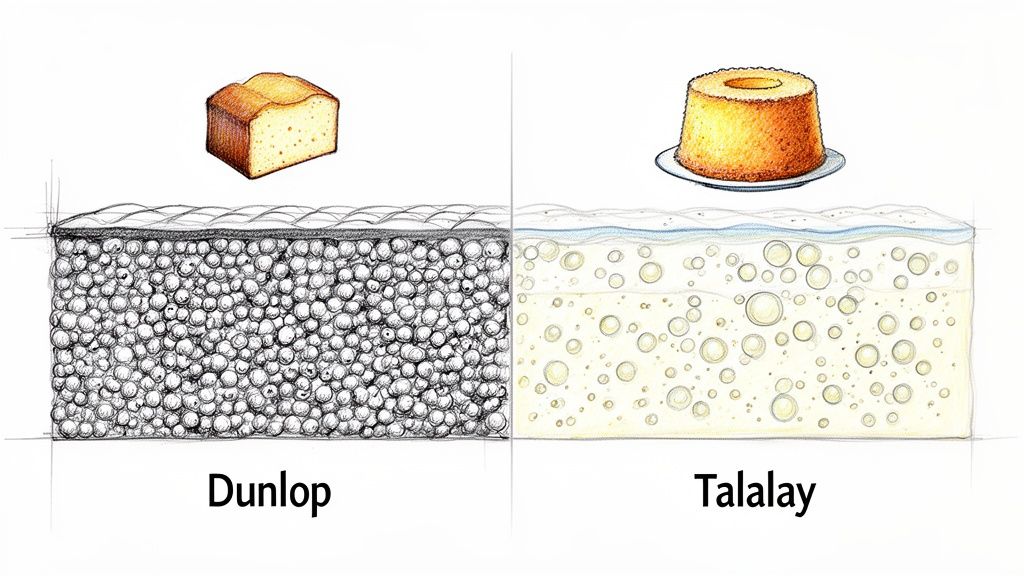
When you start looking at natural latex mattresses, you’ll quickly run into two names: Dunlop and Talalay. Both start as sap from the same rubber tree, but their journey from liquid to foam creates two completely different sleep experiences. Getting this difference isn’t just a technical detail—it’s the key to finding a mattress that actually fits your body and how you sleep.
Here’s a simple way to think about it: Dunlop is like a dense, supportive pound cake, while Talalay is more like a light, airy angel food cake. This little analogy really nails the core feel of each type and why they’re used for different jobs inside a mattress.
The Feel: A Tale of Two Textures
The real story behind Dunlop and Talalay is in how they’re made. Those manufacturing steps directly shape how dense, consistent, and springy the final foam feels.
The Dunlop process is the original method, trusted for nearly a century. Liquid latex is simply poured into a mold and baked in a vulcanization oven. As it bakes, natural sediment settles, which makes the finished foam a little firmer on the bottom than on the top. The result is a dense, highly supportive, and incredibly durable foam.
In contrast, the Talalay process throws in a couple of extra high-tech steps. The mold is only partially filled, then sealed and vacuum-expanded to spread the latex out. After that, it’s flash-frozen before being baked. This creates a much more consistent and open cell structure, yielding a foam that’s lighter, bouncier, and more uniform from top to bottom.
The most practical takeaway is this: Dunlop provides resilient, firm support, making it an ideal core material. Talalay offers buoyant, responsive cushioning, making it a premium choice for comfort layers that relieve pressure points.
Dunlop vs Talalay Latex At a Glance
| Attribute | Dunlop Latex | Talalay Latex |
|---|---|---|
| Feel | Dense & Supportive | Buoyant & Bouncy |
| Cell Structure | Irregular, denser at the bottom | Uniform & open |
| Best Use | Support Cores | Comfort Layers |
| Durability | Extremely High | Very High |
| Cost | More Affordable | More Premium |
| Ideal For | Back & Stomach Sleepers | Side Sleepers, pressure relief |
This table gives you a snapshot, but the best choice really depends on your personal needs.
Matching Latex Type to Your Sleep Position
There’s no single “better” latex—only the one that’s better for you. Your go-to sleeping position is the number one thing to consider when deciding between Dunlop, Talalay, or a mattress that smartly combines them.
For Side Sleepers
Side sleepers put a ton of pressure on their shoulders and hips, so they need a surface that gives way just enough to keep the spine straight.
- Talalay is often the winner here. Its buoyant, contouring nature cradles those pressure points perfectly without that slow-sinking feeling you get from memory foam. A top layer of soft or medium Talalay is a dream for side sleepers.
- Dunlop can still work. A softer Dunlop can provide enough pressure relief, but it will feel noticeably firmer and less “cushiony” than Talalay of the same ILD (firmness) rating.
For Back and Stomach Sleepers
These sleepers need the exact opposite: a firm, supportive surface to keep their hips from dipping and throwing their spine out of alignment.
- Dunlop is the clear favorite. Its dense structure offers the robust, unwavering support needed to maintain a neutral spine. A mattress built on a firm Dunlop core is a fantastic choice for back and stomach sleepers.
- Talalay can be used in firmer variations. A firm Talalay layer provides support, but its bouncier feel might not seem as stable as Dunlop, especially for stomach sleepers who need absolute stability.
The Power of Layering Both Types
Here’s the thing: many of the best natural latex mattresses don’t make you choose. They strategically layer both Dunlop and Talalay to harness the unique strengths of each material.
A popular and highly effective design uses a thick, firm Dunlop core as the foundational support system. This provides the durability and stability the mattress needs to perform for years. Then, one or more layers of softer Talalay latex are placed on top to deliver that immediate comfort and pressure relief.
This hybrid approach truly gives you the best of both worlds. You get the unyielding support your spine craves from the Dunlop base, combined with the luxurious, cloud-like cushioning that Talalay is famous for. This is why customizable mattresses, like those we offer at Futonland, are so effective—they let you fine-tune your comfort by layering different firmness levels, giving you ultimate control over your sleep.
Decoding GOLS, GOTS, and OEKO-TEX Certifications
When you’re shopping for a natural latex mattress, you’ll come across a few important acronyms: GOLS, GOTS, and OEKO-TEX. These aren’t just marketing buzzwords; they’re your guarantee that the mattress you’re buying is safe, clean, and responsibly made. Think of them as a team of independent experts, each verifying a different part of the mattress to give you the full picture.
GOLS checks the latex core, GOTS covers the fabrics like cotton and wool, and OEKO-TEX gives the final, finished product a thorough safety inspection. Understanding what each one means is key to making a choice you can feel good about.
GOLS: The Gold Standard for Organic Latex
The Global Organic Latex Standard (GOLS) is the big one for the latex foam itself. This certification is your proof that the latex comes from organically grown rubber trees, meaning the farm didn’t use any synthetic pesticides or herbicides.
To earn a GOLS seal, a mattress must contain at least 95% certified organic raw latex. This is a huge deal. It stops companies from mixing in cheap synthetic latex or other fillers while still calling their product “natural.” For anyone serious about eco-friendly living, this is the most important certification to look for.
GOTS: Certifying Organic Textiles
While GOLS is all about the latex, the Global Organic Textile Standard (GOTS) focuses on the fabrics. This certification applies to the materials you actually touch, like the organic cotton cover or any organic wool layers used for comfort and fire resistance.
GOTS ensures these fibers are not only farmed organically but also processed without nasty chemicals, bleaches, or dyes. The standard also includes strict social criteria based on the International Labour Organization, so you know the workers involved were treated fairly. When you see GOTS, you can be sure the fabrics are pure and ethically made. For a closer look, you can explore our full range of certified organic mattresses.
OEKO-TEX: Confirming Product Safety
Last but not least is the OEKO-TEX STANDARD 100 certification. This one is all about your health. While GOLS and GOTS look at the organic origins of the materials, OEKO-TEX tests the final product to make sure it’s free from a long list of harmful substances.
If a mattress has the OEKO-TEX STANDARD 100 label, it means every single component—from the latex and fabrics to the threads and zippers—has been tested and found to be free from harmful levels of over 100 substances known to be dangerous to human health.
This global shift toward non-toxic, sustainable products is making waves. The natural latex mattress market, valued at USD 2.5 billion in 2023, is expected to hit USD 4.5 billion by 2032. This impressive market growth shows that more and more people are prioritizing non-toxic materials for their homes.
Knowing what these certifications mean helps you cut through the noise and find a genuinely safe, clean, and sustainable mattress. They offer the peace of mind that you’re bringing a truly healthy product into your home.
Matching Firmness to Your Sleep Style
Picking the right firmness for a natural latex mattress goes way beyond just clicking “soft,” “medium,” or “firm.” It’s about finding that perfect balance where the mattress supports your body’s unique shape and sleeping habits. Latex foam has a buoyant, responsive feel that’s totally different from memory foam or innersprings, so getting the firmness right is key.
The ultimate goal is simple: achieve neutral spinal alignment. This just means your spine should keep its natural curve, no matter how you sleep. If a mattress is too soft, your hips will sink too far, creating a hammock effect that strains your lower back. Too firm, and you’ll get painful pressure points on your shoulders and hips, knocking your spine out of line.
Side Sleepers: Relief for Hips and Shoulders
Side sleeping is the most popular position, but it puts a lot of pressure on your hips and shoulders. To get the relief you need, the mattress surface has to be soft enough to let those areas sink in just a little, while the core stays firm enough to hold up the rest of your body.
A medium-soft to medium firmness is usually the sweet spot here. A top layer of softer Talalay latex works wonders, offering amazing pressure relief without that “stuck” feeling you sometimes get with memory foam.
Heavier side sleepers (over 200 lbs) might be better off with a medium-firm mattress that still has a softer top layer. This setup prevents them from sinking straight through to the firm support core, ensuring they get consistent support all night.
Back Sleepers: Support for Spinal Alignment
Back sleepers have it a bit easier when it comes to keeping their spine aligned, but they still need a mattress that supports the natural curve of their lower back. A surface that’s too soft won’t give that crucial support, and one that’s too hard will leave an awkward gap between your lower back and the mattress.
For most back sleepers, a medium-firm to firm natural latex mattress is the ideal choice. Dunlop latex, with its dense and supportive feel, is a fantastic core material for back sleepers. It provides the push-back needed to keep your hips from sagging and your spine perfectly aligned.
Stomach Sleepers: The Need for Firmness
Sleeping on your stomach is the toughest position on your spine. It tends to flatten your spine’s natural curve, which can lead to neck and back pain if your mattress isn’t firm enough. The main goal for stomach sleepers is to find a surface that stops their midsection from sinking at all.
A firm natural latex mattress is an absolute must. This level of support keeps the hips and abdomen right on top of the mattress, promoting a much healthier spinal position. A mattress with a firm Dunlop latex core is often the best bet, providing solid, unwavering support.
Finding the right firmness is a deeply personal journey that depends on body weight, sleeping position, and personal preference. The unique properties of latex allow for precise adjustments to meet these individual needs. To delve deeper into finding the ideal feel, explore our selection of conventional mattresses to compare different firmness options.
Combination Sleepers and Small Spaces
What if you toss and turn all night? Combination sleepers need a mattress that’s responsive enough to adapt to their movements instantly. The natural springiness of latex is perfect for this. A medium or medium-firm mattress usually offers the best of both worlds, giving enough cushion for side sleeping and enough support for your back or stomach.
The flexibility of latex also makes it a fantastic choice for modern, small-space furniture. Its resilience means it can bend and fold without losing its supportive qualities. It’s the top choice for:
- Adjustable Bases: Latex flexes easily with the base, providing consistent comfort in any position you choose.
- Futon Frames: Unlike a stiff innerspring, a futon mattress made of latex can be folded into a sofa daily without getting lumpy or breaking down.
- Sofa Beds: A latex mattress is a massive upgrade for any convertible sofa bed, giving guests a sleep experience that feels like a real bed.
This incredible versatility ensures that no matter your sleep style or living situation, a natural latex mattress can be configured to provide the perfect balance of comfort and support.
Why Latex Mattresses Excel in Small Spaces
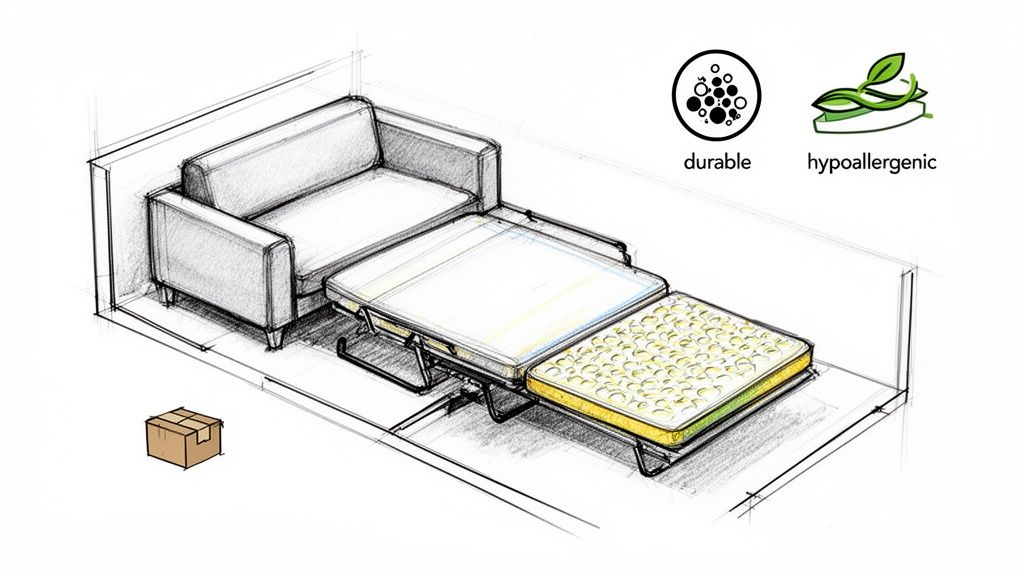
Living in a city apartment or a compact home demands that your furniture be more than just comfortable—it needs to be smart, durable, and versatile. For urban dwellers, a mattress isn’t just a place to sleep; it’s a big investment that has to work hard in a unique environment. This is where natural latex mattresses really shine, offering practical advantages that make them a superior choice for small-space living.
One of the most compelling benefits is their incredible longevity. A high-quality natural latex mattress is built to last 15 to 20 years, often double the lifespan of a typical memory foam or innerspring model. If you move frequently, this means your investment travels with you, providing consistent, reliable comfort without the hassle of replacement. It’s a buy-it-once, buy-it-right solution.
A Healthier Haven in the City
City living often comes with more dust, pollen, and other airborne irritants that inevitably find their way indoors. Natural latex offers a powerful defense against these common triggers, creating a cleaner, healthier sleep environment right where it matters most.
- Naturally Hypoallergenic: Latex is inherently resistant to dust mites, a primary cause of indoor allergies. This built-in protection helps keep your sleeping area fresh without any extra effort.
- Resistant to Mold and Mildew: The open-cell structure of latex foam promotes excellent airflow, which keeps moisture from building up. This breathability makes it extremely difficult for mold and mildew to grow—a huge plus in smaller spaces with limited ventilation.
This natural resistance means you can breathe easier without relying on chemical treatments or special covers, ensuring your bedroom remains a sanctuary for restorative sleep.
For urban residents, a mattress that actively contributes to better indoor air quality isn’t a luxury—it’s a necessity. The hypoallergenic and breathable nature of natural latex provides a tangible health benefit in compact living situations.
Unmatched Flexibility for Convertible Furniture
Perhaps the biggest advantage of natural latex in a small apartment is its remarkable flexibility and resilience. Unlike a stiff innerspring mattress that can’t bend or memory foam that breaks down under repeated folding, latex is born to flex. This makes it the undisputed champion for multi-functional furniture that saves precious floor space.
Convertible Sofas and Futons
A latex mattress transforms a standard futon or sofa bed from an “okay” guest option into a genuinely comfortable, everyday bed. It can be folded into a sofa position daily without developing lumps, creases, or weak spots. Its responsive support gives you the feel of a real mattress, not a temporary compromise.
Sleeper Chairs and Ottomans
For even smaller footprints, a latex mattress can be integrated into sleeper chairs or convertible ottomans. Its ability to compress and rebound perfectly means you can hide a high-quality bed in plain sight, ready to accommodate guests at a moment’s notice.
Murphy Beds and Wall Beds
The durability of latex also makes it ideal for vertical storage solutions. For those looking to maximize their living area, exploring the benefits of space-saving wall beds paired with a flexible latex mattress can be a game-changer. The mattress holds its shape and supportive qualities even when stored upright for long periods.
This unmatched adaptability ensures you don’t have to sacrifice sleep quality just to save square footage. With a natural latex mattress, your convertible furniture becomes a reliable, long-term sleep solution that delivers superior comfort without the bulk—the smartest choice for modern, urban living.
Your Natural Latex Mattress Questions Answered
Even with all the details, you might still have a few questions rolling around in your head. It’s completely normal. This section is here to clear up the most common queries we hear from shoppers, giving you straightforward answers so you can feel confident in your choice.
How Long Do Natural Latex Mattresses Last Compared to Memory Foam?
Natural latex mattresses are the marathon runners of the mattress world. With good care, they can easily provide consistent comfort and support for 15 to 20 years. That’s a huge leap from the typical 7 to 10-year lifespan you’d expect from most memory foam mattresses.
What’s the secret? It’s the natural resilience of rubber. Latex bounces back and resists sagging and body impressions over time, which makes it a much smarter long-term investment. This durability is especially critical for convertible furniture like futons, ensuring your sleep surface stays supportive for more than a decade.
Will a Natural Latex Mattress Sleep Hot?
This is a big concern for many, mostly because people lump latex in with other heat-trapping synthetic foams. The truth is, natural latex is one of the coolest materials you can sleep on. Its secret is an open-cell structure that allows air to flow freely.
This built-in breathability stops body heat from getting trapped, wicking away warmth and moisture all night long. Both Dunlop and Talalay latex are fantastic for temperature regulation, making them a top choice for hot sleepers who need a cool, dry rest.
A common myth is that all foam sleeps hot, but natural latex breaks this rule. Its plant-based, open-cell design actively works to keep you cool, unlike dense, synthetic memory foams that are known for retaining heat.
What Is the Difference Between Natural and Organic Latex?
These terms get used interchangeably, but they’re not quite the same. For anyone who’s eco-conscious, the distinction really matters.
- 100% Natural Latex means the foam comes entirely from rubber tree sap. No synthetic latex or weird fillers are mixed in.
- Organic Latex takes it a step further. To earn a certification like GOLS (Global Organic Latex Standard), the rubber trees must be grown without pesticides, and the entire manufacturing process has to meet strict environmental and social guidelines.
So, while all organic latex is 100% natural, not all natural latex is certified organic. If you’re looking for the absolute purest, most sustainably produced mattress possible, keep an eye out for that GOLS certification.
Do Natural Latex Mattresses Have an Odor?
When you first unpackage a new natural latex mattress, you might notice a faint, slightly sweet, or “earthy” scent. This is just the natural smell of the rubber itself—it’s completely harmless and non-toxic.
This is worlds away from the chemical “off-gassing” that comes with many synthetic memory foams, which can release volatile organic compounds (VOCs). If reducing indoor air pollution is a priority, you’ll love exploring our options for low VOC furniture. The natural aroma from latex usually disappears within a few hours or, at most, a couple of days, especially if the room is well-ventilated.
Choosing certified products gives you peace of mind that what you’re smelling is natural. Speaking of safety, you can learn more about finding mattresses without harmful chemicals by exploring our guide on no fire retardant chemicals mattresses. This ensures your entire sleep setup is as clean and healthy as possible.
At Futonland, we are dedicated to helping you find the perfect sleep solution that matches your lifestyle, values, and space. Explore our expertly curated collection of the best natural latex mattresses today. Visit us at https://futonland.com to find your ideal match.