Best Furniture for Small Living Rooms
The secret to a great small living room? It’s all about multifunctional sofas, accent tables, and vertical storage. These aren’t just trendy pieces; they’re smart solutions designed to maximize every last square inch. They offer dual-purpose functionality and have a smaller footprint, keeping your room from feeling cramped.
Your Guide to Furnishing a Small Living Room
Feeling like the walls are closing in on your small living room? You’re definitely not alone. It’s a common challenge, but one that smart design and the right furniture can absolutely solve. Think of this guide as your roadmap, helping you move past the frustration and create a space that feels both functional and surprisingly open. We’ll show you how a few key pieces can completely change your room’s entire vibe.
This isn’t about choosing between style and practicality—it’s about making them work together. By picking furniture that pulls double duty and planning a layout that feels natural to move through, you can have a living area that supports your lifestyle without any of the clutter. The key is to choose items that work harder for you.
Embracing Smart, Space-Saving Design
The demand for clever furniture is exploding. The global market for small-space furniture is expected to grow from USD 6,681 million in 2025 to a massive USD 12,151 million by 2035. This boom is driven by more and more of us living in cities, where designs like convertible sofas and compact tables are becoming essentials for modern life.
The real goal is to furnish your room in a way that opens it up, making it feel airy and intentional rather than just full. Every single piece should earn its keep, whether it’s providing seating, storage, or a flexible surface.
Getting into this mindset is a game-changer. Instead of seeing limitations, you can start seeing opportunities for creativity. We’ll walk you through everything, from getting your measurements right to the final design tricks that make all the difference.
By the end, you’ll have a clear plan for finding the perfect furniture for your small living room, creating a space that’s stylish and perfectly suited to your needs. Before we dive in, feel free to browse our complete collection of versatile living room furniture to get inspired.
Measure Twice, Buy Once to Plan Your Layout
Before you fall in love with a piece of furniture online, the most important work happens right in your living room with a tape measure. Seriously. Rushing this initial planning phase is the number one reason people end up with furniture that overwhelms a room or just plain doesn’t fit.
Think of it as creating a blueprint for success. This foundational step prevents the classic mistake of buying a beautiful sofa that blocks a doorway or a media console that makes a walkway feel like an obstacle course. It ensures every piece you choose will not only fit but also improve the room’s flow and function.
Create Your Room Blueprint
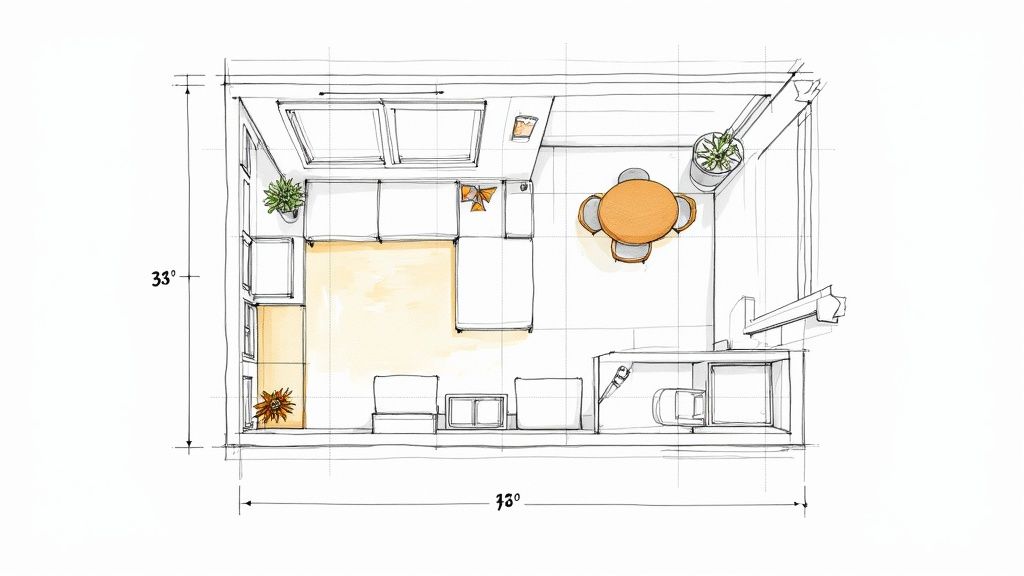
Start by sketching a simple bird’s-eye view of your room. It doesn’t need to be a masterpiece—grid paper is your best friend here, or you can use a simple app. The goal is just to get a visual reference of the space you’re actually working with.
Once you have the basic shape, it’s time to measure. And we mean everything.
- Wall-to-Wall Dimensions: Get the total length and width to know your maximum square footage.
- Doors and Windows: Note their width, height, and how much clearance they need to swing open. You don’t want a new chair trapping you in the room.
- Permanent Fixtures: Jot down the location and size of radiators, built-in shelves, or any architectural quirks that furniture will have to work around.
Getting these precise measurements is far better than guessing and hoping for the best. For extra guidance, our comprehensive sizing charts can help you match furniture dimensions to your available space.
Before you start browsing, fill out this quick checklist. It’ll save you a ton of headaches later.
Your Pre-Shopping Measurement Checklist
| Measurement Item | Why It’s Critical | Pro Tip |
|---|---|---|
| Room Dimensions (L x W) | Establishes the total available square footage for layout planning. | Don’t forget to measure ceiling height, especially for tall items like Murphy beds or shelving. |
| Doorways & Hallways (H x W) | Ensures your new furniture can physically get into the room. | Measure the narrowest point and account for any turns or tight corners on the delivery path. |
| Window Placement (H x W) | Affects furniture height and placement to avoid blocking natural light. | Note the distance from the floor to the bottom of the window sill. |
| Permanent Fixtures | Identifies unmovable obstacles like radiators, outlets, or fireplaces. | Take a photo of each wall to remember where outlets and light switches are located. |
Having these numbers on hand makes the entire shopping process smoother and ensures your final choice is a perfect fit.
Mapping Out Traffic and Zones
With your floor plan in hand, think about how you move through the room. Your “traffic flow” is just the natural path people take to get from the door to the sofa, or from the kitchen to the window. You’ll want to keep these paths at least 30 inches wide to avoid creating frustrating bottlenecks.
Next, think in “zones.” Even in a tiny space, you can create distinct areas for different activities, which makes the room feel much more organized and intentional.
Think about what your living room needs to do for you. Is it for watching movies, hosting friends, working from home, or all three? Defining these functions is the key to choosing furniture that actually serves your lifestyle.
For example, you could map out:
- A lounging zone anchored by your sofa bed and a coffee table.
- A reading nook with a comfy chair and a small side table.
- A flexible work area that can be tucked away after hours.
To see how different pieces might fit, an online home design planner can be a game-changer. These tools let you experiment with layouts risk-free, so you can visualize everything before you commit. Taking the time to map it all out turns a daunting task into a creative one, setting the stage for a perfectly furnished space.
The Power of Multifunctional Furniture
In a small living room, every single piece of furniture has to earn its keep. The real heroes of compact spaces are the items that can pull double or even triple duty—think of them as the Swiss Army knives in your design toolkit. These clever, hardworking pieces are your secret weapon for unlocking a home that’s functional, organized, and feels surprisingly spacious.
Multifunctional furniture isn’t just some passing trend; it’s a smart, strategic response to how we live today. As city apartments get cozier, the need for smart solutions is only getting bigger. The global furniture market is expected to grow by USD 157.8 billion between 2025-2029, and a lot of that is driven by minimalist designs perfect for small homes. Here in the US, demand for storage furniture is climbing at a 7.3% CAGR as people hunt for versatile options.
The Convertible Sofa: The Ultimate Space Saver
Without a doubt, the most powerful tool in your small-space arsenal is the convertible sofa. In one move, it can transform a daytime lounge into a comfortable guest room, getting rid of the need for a separate, space-hogging bed. But not all sofa beds are the same, and the right one for you really depends on your lifestyle.
Modern designs have come a long, long way from the clunky, uncomfortable pull-outs you might remember. Today’s options are built for both style and comfort, making sure your main seating looks great and your guest bed is actually worthy of a good night’s sleep. Exploring the different types of convertible sofa beds can open your eyes to innovative mechanisms you probably didn’t even know existed.
The best multifunctional furniture solves a problem you face every day. It’s not just about having a bed for the occasional guest; it’s about making your daily life easier, more organized, and less cluttered.
Take a look at these popular convertible options:
- Sleeper Sectionals with Storage: These are the heavyweights of multifunctionality. You get tons of seating, a pull-out bed, and a hidden chaise lounge perfect for stashing away blankets, pillows, and board games.
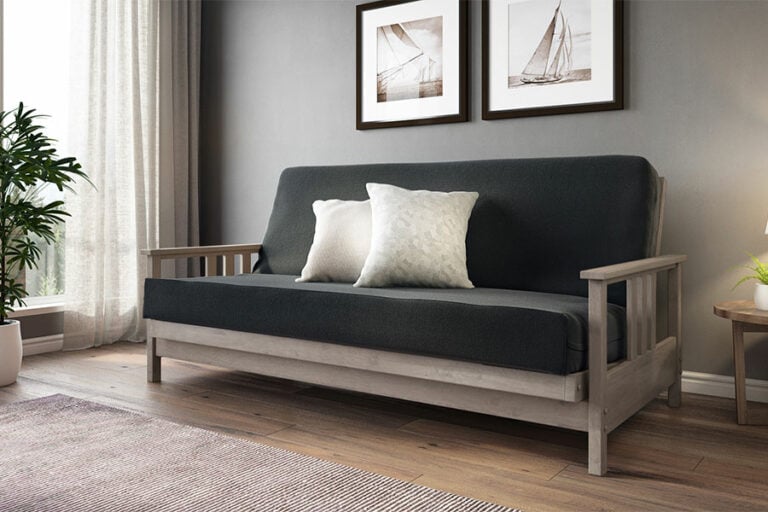
- Modern Futons: Sleek and minimalist, today’s futons feature high-quality mattresses and stylish frames. They convert with a simple click-clack mechanism, making them perfect for those tiny spaces where every last inch is precious.
- Murphy Cabinet Beds: This is a brilliant solution that hides a whole bed inside a handsome chest or cabinet. It works as a media console or credenza by day, then unfolds into a full guest bed at night, completely freeing up your floor space when you need it.
Beyond the Sofa: Smart Surfaces and Seating
While the sofa is usually the main event, other pieces can work just as hard to stretch your room’s potential. Start thinking about every item’s secondary purpose. A simple ottoman can be a footrest, extra seating for a party, and a secret storage bin all at once.
The key is to pick furniture that adapts to what you need in the moment. A lift-top coffee table is a perfect example. It’s a surface for your drinks and decor, but with one motion, it rises to become a comfortable dining table for two or a handy work-from-home desk. And that hidden compartment? Bonus space for clearing away clutter like remotes and magazines.
Choosing Your Hardworking Heroes
When you’re shopping for the best furniture for small living rooms, you have to judge each piece on its versatility. Ask yourself: how many different ways can I use this?
Here’s a quick checklist to guide your choices:
- Does it offer hidden storage? Keep an eye out for ottomans, benches, and coffee tables with concealed compartments.
- Can it transform its function? Convertible sofas, lift-top tables, and nesting side tables are prime examples of this.
- Is it visually lightweight? Pieces with raised legs, slim profiles, or see-through materials like glass or acrylic create an illusion of more space.
- Can it be moved easily? Lightweight armchairs or stools can be rearranged in a snap to accommodate guests or clear the floor for an activity.
By adopting this mindset, you’re no longer just filling a room—you’re strategically equipping it. Every choice becomes a chance to add function, cut down on clutter, and create a living space that feels open, inviting, and perfectly suited to your life.
Choosing Seating That Creates Space
Your sofa is the heart of your living room, but the wrong one can feel like a black hole, sucking up every last inch of available space. The real trick to designing a successful small living room is mastering the art of picking seating that feels expansive, not overwhelming. It all comes down to understanding scale and visual weight.
Think of it this way: a bulky, oversized sofa with thick arms that sits flat on the floor is a visual roadblock. Your eye just stops right at its edges. Now, picture a sofa with a slim profile, thin arms, and raised legs. Suddenly, you can see the floor underneath, which instantly creates a feeling of openness and makes the entire room feel lighter and larger.
Finding the Right Seating Configuration
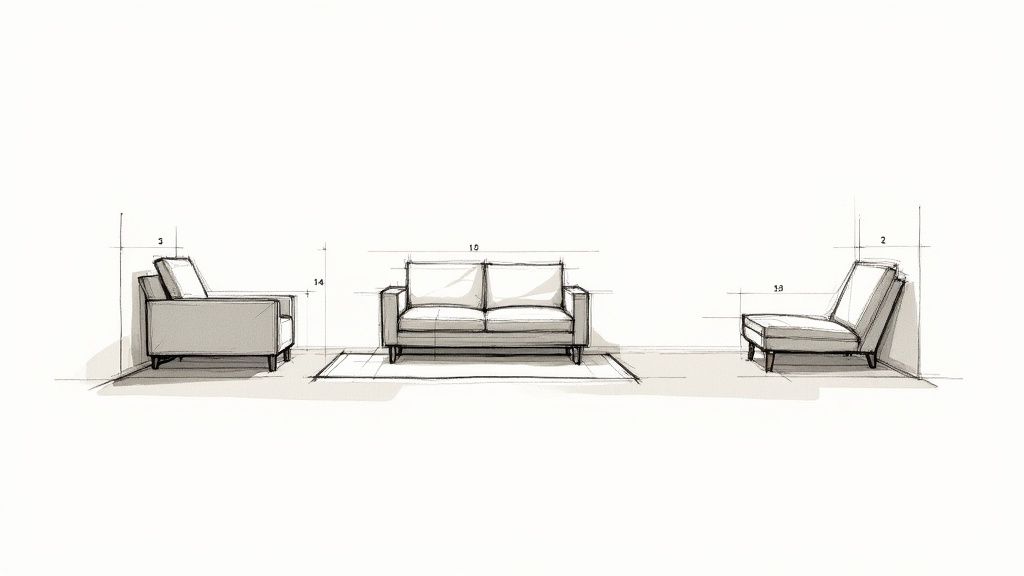
There’s no single “best” seating option out there—the right choice really depends on your room’s shape and how you actually live in it. Instead of automatically defaulting to a standard three-seater sofa, consider these smarter alternatives that give you flexible seating without all the bulk.
- Apartment-Sized Sectionals: These are designed specifically with smaller proportions in mind. They offer plenty of seating and can tuck neatly into a corner, making fantastic use of an area that often goes to waste.
- Loveseats and Accent Chairs: This classic combination is incredibly versatile. A stylish loveseat paired with one or two lightweight accent chairs gives you the same amount of seating as a much larger sofa but with way more flexibility to rearrange the room on a whim.
- Backless Sofas or Benches: When placed strategically, a backless sofa can act as a subtle room divider between your living and dining areas without putting up a visual wall.
The seating you choose is one of the biggest investments for your home. It’s no surprise that living room furniture makes up nearly half of all revenue in US furniture stores, with the market projected to hit USD 70.51 billion in 2025. For city dwellers, multifunctional pieces are a lifeline; sofa beds are seeing a 15% year-over-year growth in urban areas because they can save 25-40% of the space in a compact home.
Futon vs Sleeper Sofa Which Is Best for You
When you’re trying to find the best furniture for small living rooms, the futon versus sleeper sofa debate is a classic. Modern designs have definitely blurred the lines, but there are still some key differences. Let’s bust a few myths to help you decide.
The most important factor is being honest about its primary use. Is it going to be your main sofa for daily lounging, or will its main job be as an occasional guest bed? Your answer will point you in the right direction.
A sleeper sofa generally looks and feels like a traditional sofa because it has a separate mattress folded up inside its frame. This makes them a great pick for a primary seating option, though they can be heavy and take up quite a bit of space when opened. A futon, on the other hand, uses the same mattress for both sitting and sleeping, which typically makes it lighter, more affordable, and much quicker to convert.
Here’s a direct comparison to help you choose the right multifunctional seating for your small living room.
| Feature | Futon | Sleeper Sofa |
|---|---|---|
| Primary Function | Best for spaces where flexibility and frequent conversion are key. | Excellent as a primary, everyday sofa that doubles as a guest bed. |
| Mechanism | Simple click-clack or fold-down frame. Fast and easy to operate. | Involves removing cushions and pulling out a folded metal frame and mattress. |
| Footprint | Generally smaller and more compact, both as a sofa and a bed. | Often larger and heavier, requiring significant clear space in front to unfold. |
| Comfort | Comfort depends heavily on the quality of the futon mattress you choose. | Seating comfort is like a traditional sofa; sleeping comfort depends on the included mattress. |
Ultimately, both are fantastic solutions. If you focus on your daily needs and your room’s specific layout, you can confidently choose seating that is not just comfortable, but also a smart design element that makes your living room feel bigger and work harder.
Smart Storage and Surface Solutions
In a small living room, clutter is more than just a mess—it’s a space thief. Every little thing left out of place eats away at your square footage, making the room feel tight and chaotic. The secret to winning this battle isn’t just about tidying up. It’s about a complete strategy for storage and surfaces, turning every piece of furniture into a hard-working part of the solution.
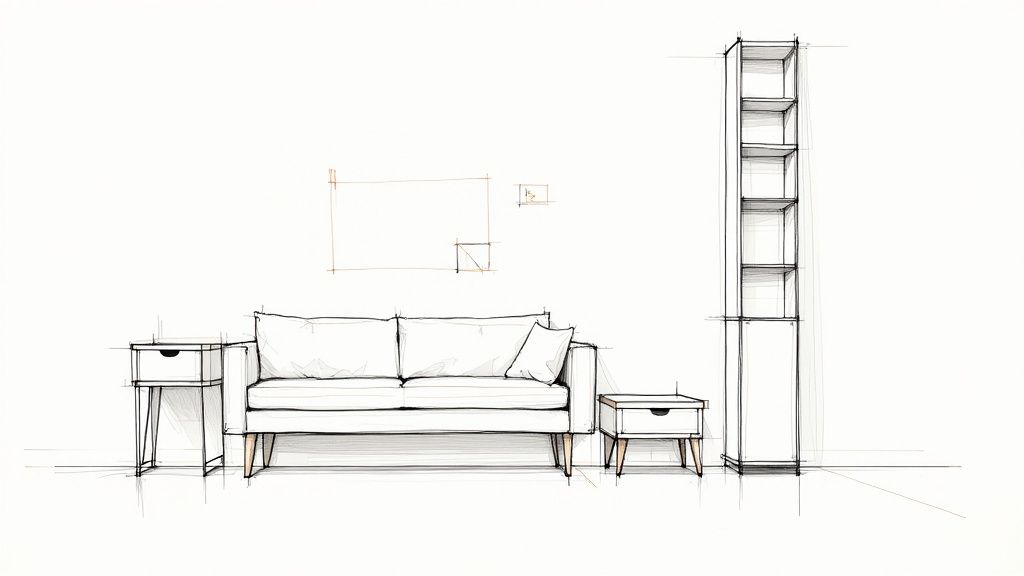
The most powerful move you can make is to think vertically. When you’re short on floor space, the only direction left to go is up. Tall, slender bookcases naturally draw the eye upward, which creates the illusion of higher ceilings while giving you a ton of storage without a big footprint. Wall-mounted shelves are just as brilliant for showing off decor or holding books, all while keeping that precious floor space clear.
Embrace Floating and Hidden Storage
Another game-changer is “floating” furniture. Think about a wall-mounted media console. It gives you all the room you need for your electronics and gadgets but seems to hover above the ground. This simple visual trick lets you see more of the floor, instantly making the space feel more open and airy. It’s a clever sleight of hand that works every time.
But don’t just look up—look within every piece. Many of the best furniture options for small living rooms have hidden talents.
The goal is to choose items that conceal clutter in plain sight. A well-designed piece should solve a storage problem without ever looking like a bulky storage unit.
Check out these clever, multi-purpose solutions:
- Coffee Tables with Drawers: A coffee table with built-in drawers or a lift-top mechanism offers a secret hiding spot for remotes, coasters, and magazines.
- Benches with Concealed Compartments: A stylish bench can pull double duty, offering extra seating while stashing away spare throw blankets or board games.
- Storage Ottomans: These are the true MVPs of multipurpose furniture. They work as a footrest, extra seating for guests, and a roomy container all at once. To see how these hardworking pieces can transform your space, explore the variety of modern storage ottomans available.
Choose Versatile and Adaptable Surfaces
Your surfaces need to be just as flexible as your storage. A single, heavy coffee table can feel like an immovable boulder in a tight layout. Instead, go for surfaces that can adapt to what you need at any given moment.
Nesting tables are a perfect example. They give you multiple surfaces when you have company, then tuck away neatly into a single footprint for everyday life. Another fantastic choice is a C-table, which is designed with a base that slides right under the edge of your sofa or chair. This gives you a handy spot for a laptop or a drink without taking up the space of a full side table. By picking furniture with hidden potential and adaptable designs, you’re not just decorating—you’re engineering a smarter, more functional living space.
Design Tricks to Make Your Room Look Bigger
Picking out the right furniture is a huge first step, but it’s only half the battle. Now it’s time to pull out a few proven design tricks to create the illusion of space, making your room feel bright, open, and way more inviting. These are the visual strategies that work hand-in-hand with your furniture choices to truly maximize every single square inch.
Your first and most powerful tool is color. A light, neutral color palette—think soft whites, gentle grays, and warm beiges—acts like a canvas, reflecting any available light and making the entire room feel more expansive. This doesn’t mean your space has to be boring! You can inject plenty of personality with strategic pops of color in your pillows, throws, or artwork.
This approach keeps the room from feeling closed-in while still letting your personal style shine through. The key is to use color to draw the eye to specific features without overwhelming the senses.
Layer Lighting to Eliminate Shadows
Lighting is one of the most effective ways to open up a room. A single, lonely overhead light can cast harsh shadows in the corners, making the space feel smaller and more cramped than it really is. The solution is to layer your lighting with multiple sources.
Think of lighting in three distinct layers:
- Ambient Light: This is your room’s main light source, like a stylish ceiling fixture or recessed lighting that provides general illumination.
- Task Light: These are focused lights for specific activities. Think of a floor lamp next to your sofa for reading or a small lamp on a side table.
- Accent Light: This type of lighting highlights cool architectural features or decor—like a picture light over a favorite piece of art—adding depth and visual interest.
By combining all three, you chase away the dark corners and create a warm, welcoming glow that makes the room feel much larger and more dynamic.
Use Mirrors, Curtains, and Rugs Strategically
Mirrors are a classic small-space trick for a reason—they work wonders. Placing a large mirror directly opposite a window is a brilliant move. It will bounce natural light all around the room and create a powerful illusion of depth. It’s almost like adding a whole new window.
The right decor can completely alter the perception of a room’s dimensions. Think of these elements as the finishing touches that pull your entire space-saving design together.
Your window treatments and rugs play a crucial role, too. Always hang your curtains high and wide by placing the rod several inches above and beyond the window frame. This simple trick makes your windows appear larger and your ceilings taller. Stick with lightweight, light-colored fabrics that let natural light filter through.
Finally, don’t fall into the common trap of using a rug that’s too small for the space. A tiny rug can make a room feel choppy and disjointed. Your area rug should be large enough that at least the front legs of your main furniture—like your sofa bed and chairs—are sitting comfortably on it. This grounds the seating area and makes it feel like one cohesive, expansive zone.
Still Have Questions? Let’s Clear Things Up.
Diving into the world of small-space furniture can feel a little overwhelming. You’ve got questions, and getting real, straightforward answers is the key to shopping with confidence. Here are a few of the most common dilemmas we help people solve every day.
If I Can Only Buy One Thing, What Should It Be?
Hands down, your best investment is a high-quality, multifunctional sofa. Think about it: a great convertible sofa, a compact sectional with hidden storage, or a modern futon does the heavy lifting for the entire room. It’s your main seating, a surprise guest bed, and a secret weapon against clutter, all rolled into one. Get this piece right, and it sets the perfect foundation for everything else.
Will a Dark Sofa Make My Small Room Feel Like a Cave?
Not at all! This is a common myth, but a dark sofa can actually be a sophisticated anchor piece, adding a sense of depth and character that you just can’t get with lighter colors.
The secret isn’t the color of the sofa, but the balance you create around it. A dark sofa won’t shrink a room if the other elements are working to create a feeling of openness.
Here’s how to pull it off: choose a model with a slim profile and raised legs—this keeps it from looking like a heavy block. Then, surround it with light-colored walls, a bright area rug, and plenty of layered lighting. The result is a chic, inviting space that feels perfectly balanced, not cramped.
How Do I Pick a Coffee Table That Doesn’t Eat Up the Whole Room?
The goal here is to find something that feels visually lightweight. You want to avoid anything that looks like a solid, heavy cube sitting in the middle of your floor plan.
These are always great choices:
- Glass or acrylic tops are fantastic because they create an illusion of openness—you can see right through them.
- Tables with thin metal legs are another smart move. They let you see more of the floor, which instantly makes the space feel larger.
- Round shapes are a small-space secret weapon. They’re easier to walk around and their soft edges improve the flow of traffic.
- Nesting tables offer the ultimate flexibility. Spread them out when you need more surface area, then tuck them neatly away when you don’t.
At Futonland, finding these smart, hardworking solutions is what we do best. Come explore our full collection of versatile furniture, all designed to squeeze the most style and function out of any space. Find your perfect fit at Futonland.com.