
Your Complete Guide To A Sectional With Pull Out Bed
A sectional with a pull out bed is one of those brilliant, multi-tasking pieces of furniture that just makes sense. It gives you all the generous seating of a sectional sofa but has a secret weapon tucked inside: a hidden, built-in mattress. This clever design lets you turn a living room into a guest room in just a few seconds, making it a perfect solution for maximizing your space without giving up an ounce of style or comfort.
The Smart Solution for Modern Living Spaces
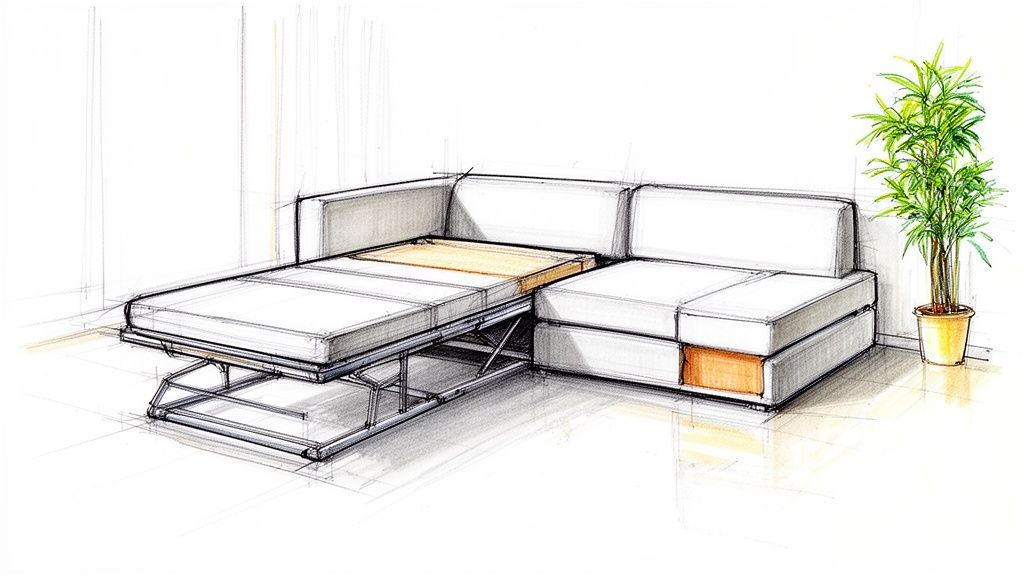
Let’s face it, in today’s homes, every square foot is precious. A sectional with a pull-out bed isn’t just another couch; it’s a strategic investment in pure versatility. By day, it’s the comfortable heart of your living room. By night, it effortlessly transforms into a welcoming bed for your overnight guests.
This adaptability has made it a cornerstone of modern interior design, especially for anyone living in a studio apartment, condo, or a house without a dedicated guest room. You really get the best of both worlds—plenty of seating for movie nights, and a genuinely comfortable sleeping space when family or friends decide to stay over.
Why This Piece is a Game-Changer
The demand for furniture that does more than one thing is definitely on the rise. We’re seeing a huge global shift toward practical pieces, with over 52% of consumers choosing sofa beds specifically for their space-saving benefits. This isn’t just a hunch; the global market for these versatile sofas is expected to hit a staggering USD 28.73 billion by 2034.
A sleeper sectional is the ultimate problem-solver. It addresses the need for abundant seating and occasional sleeping space in a single, stylish package, eliminating the classic dilemma of choosing one over the other.
Bringing a piece this functional into your home can totally change its dynamic. That’s why it’s so important to explore smart living room furniture layout ideas to make sure everything flows perfectly. Throughout this guide, we’ll dive into everything from the different mechanisms to long-term maintenance, giving you the confidence to choose the perfect sleeper sectional for your home.
Understanding Pull Out Mechanisms and Mattresses
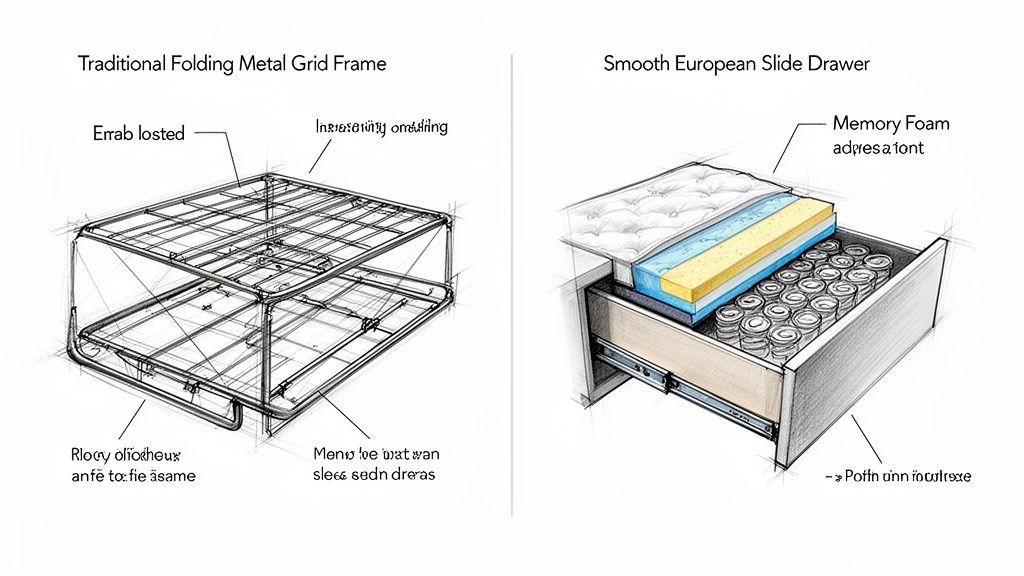
The real secret to a great sleeper sectional isn’t what you see—it’s what you don’t. Tucked away beneath the cushions is the mechanism, the engine that powers the transformation from sofa to bed. This piece of engineering is everything. It determines how easy the bed is to open, how comfortable the mattress feels, and how the whole thing holds up after years of use.
If you’ve ever wrestled with an old-school sleeper sofa, you know the classic design. It’s like unfolding a complicated map, requiring you to haul off every cushion before pulling out a grid of metal bars. While they work, these traditional frames can sometimes leave you feeling that support structure right through the mattress. Not exactly a recipe for a great night’s sleep.
Modern sectionals have come a long way. Many now feature slick European-style mechanisms that glide out smoothly like a drawer or use a clever pop-up design. The best part? Most of these newer systems let you leave the cushions in place, turning a multi-step chore into a quick, effortless transition.
Sleeper Sectional Mechanism Comparison
To really get a feel for what’s out there, let’s look at the most common systems side-by-side. Each one has its own set of trade-offs when it comes to convenience, comfort, and how you plan to use it.
| Mechanism Type | How It Works | Pros | Cons |
|---|---|---|---|
| Traditional Bi-Fold or Tri-Fold | A metal frame with a thin mattress unfolds from inside the sofa base. You typically remove the seat cushions first. | Widely available and often the most budget-friendly option. | Can feel flimsy, setup is a hassle, and the metal bars can be uncomfortable without a thick mattress. |
| Drawer or Slide-Out | A section pulls out from the bottom of the sofa like a drawer, creating a platform for a cushion or mattress. | Super easy to use, provides a solid and even sleeping surface with no bars. | May offer less “bounce” than a traditional bed; mattress thickness can be limited. |
| Pop-Up or Lift-Up | A section pulls out and then lifts up to become level with the chaise or seating area, creating one large, flat surface. | Incredibly fast and easy to operate. Creates a seamless and consistently firm sleeping area. | Can be more expensive and is often integrated into specific sectional configurations. |
Ultimately, the biggest leap forward in modern sleeper design isn’t just the mechanism itself, but the solid sleeping platform it creates. Shifting away from metal bars to a solid deck or slat system gives you a foundation that feels much more like a real bed.
Choosing the Right Mattress for Restful Nights
Of course, even the best mechanism is only half the story. The mattress is what truly makes or breaks the sleeping experience. Modern sleeper mattresses are designed to be flexible enough to fold away, but that doesn’t mean you have to sacrifice comfort anymore.
To see the full range of options, you can learn more about our extensive mattress options and find the perfect match for your needs.
Here are the main types you’ll come across:
- Innerspring: The old standby, built with a network of metal coils. They can be quite durable, but lower-quality versions sometimes feel too bouncy or let you feel the individual springs.
- Memory Foam: This is a game-changer for sleeper sofas. Memory foam contours to the body, relieving pressure points just like a high-end bed mattress. It’s a fantastic choice if the bed will be used frequently.
- High-Density Foam: If you prefer a firmer feel, this is the way to go. It’s incredibly resilient and holds its shape over time, offering a stable and supportive surface without the “sinking” sensation of some memory foams.
How to Measure Your Space for a Perfect Fit
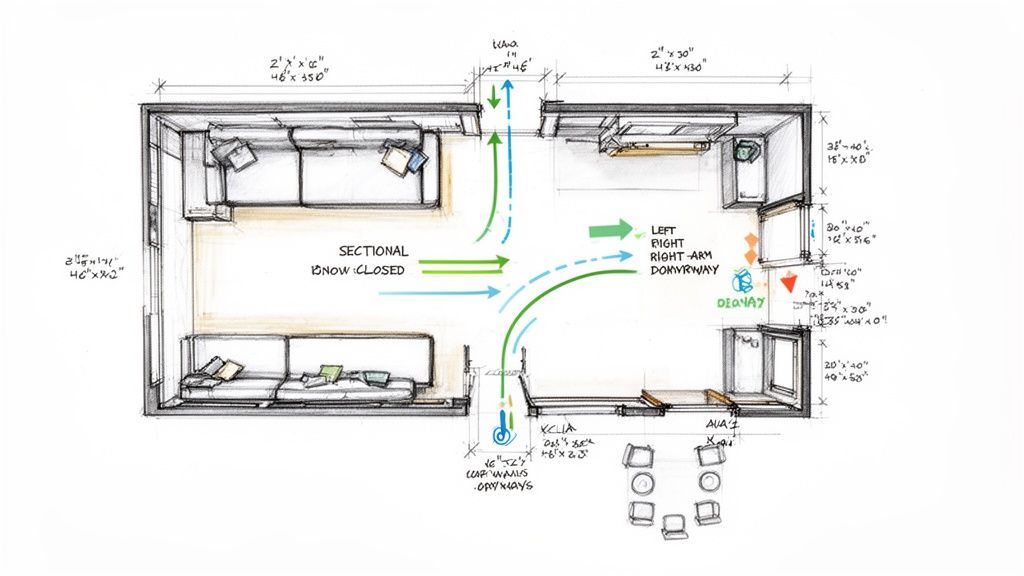
Here’s a rookie mistake we see all the time: a customer finds a sectional that fits their living room dimensions on paper, but they completely forget about the journey from the delivery truck to that final spot. A beautiful new sofa that can’t clear a tight hallway or pivot around a staircase is just a very expensive, very frustrating problem on your doorstep.
Think of it like planning a road trip. You wouldn’t just look at the final destination; you’d map out the entire route, including all the twists and turns. You have to do the same for your new sectional. That means measuring every doorway, hallway, and stairwell it needs to pass through. Getting this right from the start saves a world of headaches on delivery day.
Mapping Your Home for Delivery
Before you fall in love with a specific model, grab your tape measure and walk the entire delivery path, from the front door to the living room. Precision is everything here—even half an inch can be the difference between success and failure.
Follow these steps for a bulletproof plan:
- Doorway Dimensions: Measure the height and width of every single doorway on the path. Don’t just measure the frame; account for the door itself and any protruding doorstops or hinges that shrink the opening.
- Hallway and Staircase Width: Get the width of your hallways and stairs at their absolute narrowest points. Keep an eye out for sneaky obstacles like low-hanging light fixtures, handrails, or decorative molding.
- Crucial Turning Points: Those tight corners are where things get tricky. Look for sharp turns, especially at the bottom or top of stairs. You’ll want to measure the diagonal space here, because movers will often have to tilt and angle the furniture to squeeze it through.
Remember that a sectional with a pull out bed often arrives in multiple large pieces. Always compare your home’s measurements against the dimensions of each individual box, not just the fully assembled sofa.
Planning the Final Placement
[Image demonstrating how to measure the open depth and walking clearance around a fully extended sleeper sectional]
Once you’ve confirmed the sectional can actually get inside your home, it’s time to plan its final layout. This isn’t just about where the sofa sits, but also how it functions when the bed is pulled out. A great trick is to use painter’s tape to outline the sectional’s footprint directly on your floor. This gives you a real, tangible sense of how much space it will command.
Next, extend that tape outline to mark the full dimensions with the sleeper bed deployed. This is the step people always forget. You have to make sure there’s enough room to walk around the bed comfortably. As a rule of thumb, aim for at least 24-30 inches of clear walking space around the extended bed.
Another critical detail is getting the chaise orientation right. You’ll see terms like “left-arm facing” (LAF) or “right-arm facing” (RAF). This refers to the side the arm is on when you are facing the sectional, not sitting on it. Nailing this detail ensures the layout works with your room’s traffic flow instead of against it. For more detailed visuals, check out these helpful furniture sizing charts to get a better handle on standard dimensions.
And after you’ve done all your planning, keep in mind that getting the piece into your home is the final hurdle. If you’re in our local area, utilizing our New York City delivery and assembly services can take the stress out of moving heavy furniture.
Selecting an Upholstery for Style and Durability
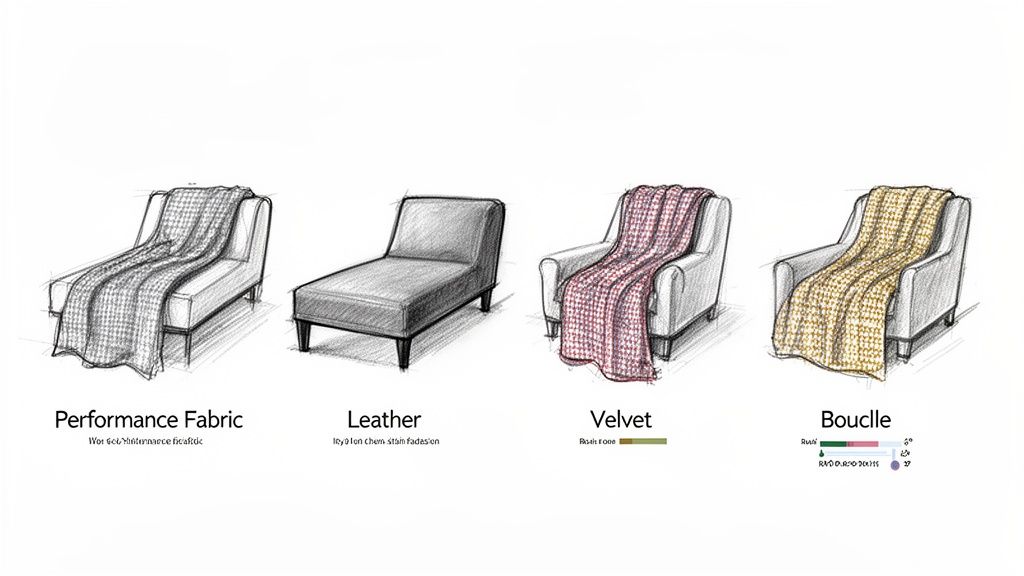
The fabric or leather you pick for your sectional is so much more than a style choice. It’s the piece’s first line of defense against, well, life. Think of it as the armor that protects your investment from spills, pets, and everyday wear and tear, all while defining its look and feel.
For any home with kids, pets, or just a lot of lively get-togethers, performance fabrics are an absolute must-see. These aren’t your grandma’s delicate textiles; they’re engineered from the fiber up to repel stains, moisture, and fading. Spills literally bead up on the surface instead of soaking in, turning a potential disaster into a quick cleanup.
This kind of practical innovation is exactly why the functional sofa market, which was valued at USD 12.5 billion in 2023, is booming. You can easily see this growing demand reflected in the wide variety of sectional sofas available today that don’t just look good but can also handle the realities of your lifestyle.
High-Traffic Heroes: Performance Fabrics and Leather
When durability is the name of the game, two materials consistently come out on top. Each brings its own unique blend of toughness and style to the table.
- Performance Fabrics: These modern marvels are often rated with a “double rub count”—a test that simulates years of use. A count of 15,000 is good for most homes, but if you’re outfitting a busy family room, look for fabrics rated at 30,000 or higher. That’s the sweet spot for serious durability.
- Leather: It’s a classic for a reason. Genuine leather sectional sofas are incredibly resilient and develop a beautiful, rich patina over time that tells a story. They are also a breeze to wipe clean, making them a fantastic choice for families. While pets’ claws can be a concern, many modern leathers are treated to resist scratches or make them easy to buff out.
Your choice of upholstery should be a direct reflection of how you live. A pristine, high-maintenance fabric might look stunning in a formal, rarely-used living room, but a family room demands a material that’s ready for anything.
Textural Choices: Velvet, Boucle, and More
If you want your sectional to be a real style statement, you have to think about texture. Materials like velvet and boucle don’t just feel good—they add visual depth and a cozy, tactile experience to your space.
Velvet gives you that plush, luxurious feel with a subtle sheen that plays beautifully with light. The best part? Modern performance velvets deliver all that classic elegance with surprising stain resistance, making them more practical than you might think.
Boucle, with its distinctive looped and nubby texture, instantly makes a room feel warmer and more inviting. It’s also great at hiding minor snags or wear, adding a layer of sophisticated comfort that’s built to last. To see some of these gorgeous textures in action, check out this collection of stylish fabric sectional sofas.
Sleeper Sectional vs. The Competition
When you need furniture that pulls double duty as a bed, a sectional with a pull-out isn’t your only play. To feel confident you’re making the right call, it helps to see how it stacks up against other popular sleepers, like traditional sofa beds, futons, and even Murphy beds. Each one shines in different situations, so the best choice really comes down to your space, your lifestyle, and what you value most.
Sectionals vs. Traditional Sleeper Sofas
The most direct comparison is the traditional pull-out couch. Think of it as the sleeper sectional’s smaller, more compact cousin. While both hide a mattress inside, the real difference-maker is seating. A standard sleeper sofa usually seats two or three people, making it a natural fit for smaller apartments or a dedicated guest room.
A sectional, on the other hand, is built for a crowd. With its L- or U-shape, it’s designed to comfortably seat four or more, making it the heart of a living room.
The market shows this split clearly. In 2024, standard pull-out sofa beds were the dominant force in the U.S. market, grabbing 40.22% of sales. But sleeper sectionals are the fast-growing challenger, valued at USD 704.35 million and projected to grow by an impressive 8.40%. It’s a clear sign that more and more people are looking for larger, more versatile furniture.
Sectionals vs. Futons
Futons take a completely different path to the sofa-bed concept. Their biggest strengths are simplicity and affordability. A futon is essentially just a mattress that folds over a frame, which means there are no complex internal mechanisms to deal with. This straightforward design makes them lightweight, easy to move, and friendly on the wallet.
But that simplicity comes with trade-offs. The futon mattress has to serve as both the seat cushion and the sleeping surface, which can cause it to wear out faster. While modern futons are far more comfortable than they used to be, a quality sectional with a dedicated foam mattress will almost always deliver a better night’s sleep.
Sectionals vs. Murphy Beds
Wall beds, or Murphy beds, are the ultimate space-savers. They fold right up into a wall or a cabinet, completely disappearing when you don’t need them and freeing up your entire floor. A Murphy bed can also hold a standard, thick mattress, offering sleeping comfort that’s often just as good as a traditional bed.
The major drawback? A Murphy bed offers zero seating when it’s put away. It is purely a bed that hides. A sectional with a pull out bed is the clear winner when you need to maximize both seating and sleeping in the same room. It gives you a full-size sofa for daily life—something a Murphy bed simply can’t offer. If you’re weighing all the different styles, our guide on convertible sofa beds can offer more helpful insights.
Sleeper Furniture Feature Showdown
Let’s break it down feature by feature to see how these options compare head-to-head.
| Feature | Sleeper Sectional | Traditional Sleeper Sofa | Futon | Murphy Bed |
|---|---|---|---|---|
| Seating Capacity | Excellent (4+ people) | Good (2-3 people) | Fair (2-3 people) | None |
| Sleeping Comfort | Good to Excellent | Good | Fair to Good | Excellent |
| Space Efficiency | Good (combines seating & bed) | Very Good (compact) | Very Good (lightweight) | Excellent (disappears) |
| Ease of Use | Good (pull-out mechanism) | Good (pull-out mechanism) | Excellent (simple fold) | Good (requires lifting) |
| Price Point | Mid to High | Mid-Range | Low to Mid | High (plus installation) |
| Primary Use | Daily living room seating | Guest rooms, smaller spaces | Budget-friendly, multi-use | Dedicated sleeping, max space |
So, what’s the verdict?
The best choice really boils down to your primary need. If you’re looking for maximum seating for family and friends, combined with a comfortable guest bed in one stylish package, the sleeper sectional is pretty tough to beat.
Essential Care and Maintenance Tips
A quality sectional with a pull-out bed is a serious investment in your home’s comfort and flexibility. To protect that investment, a little routine care will go a long way in keeping it looking and feeling brand new for years. Think of it as preventative medicine for your furniture.
A few minutes of upkeep each week can stop small issues from turning into major headaches. This ensures your sectional stays the comfortable, reliable centerpiece of your living room.
Upholstery and Cushion Care
The first line of defense is keeping the upholstery clean. For most fabrics, a weekly vacuum using a soft brush attachment is the key to getting rid of the dust and debris that can wear down the fibers over time. Don’t forget to rotate and fluff your seat and back cushions every week—this helps them wear evenly and keep their shape.
Spills happen. When they do, act fast! Gently blot the spot with a clean, dry cloth. Whatever you do, don’t rub, as that will just push the stain deeper into the fabric. Before you reach for any water or cleaning solutions, always check the manufacturer’s cleaning code, which is usually on a tag somewhere on the sofa.
- Code W: Safe for water-based cleaners.
- Code S: Use a solvent-based cleaner only. No water.
- Code W/S: You can use either water- or solvent-based options.
- Code X: Vacuum only. Keep all liquids away.
Mechanism Maintenance
The pull-out mechanism is the workhorse of your sleeper sectional. To keep it running smoothly, try to open and close it every few months, even if you don’t have guests over. This simple cycle keeps the moving parts from getting stiff and seizing up.
Is your frame squeaking? It’s a common complaint, but thankfully, it’s often an easy fix. A quick spray of silicone-based lubricant on the hinges and pivot points usually silences the noise and ensures a smooth, quiet transition from sofa to bed.
If the mechanism ever feels stuck, resist the urge to force it. The first step is to check for any obstructions—a tangled blanket or a lost toy is often the culprit. Gentle, steady pressure is always better than a hard yank, which can bend the frame and cause real damage.
Frequently Asked Questions
Even after you’ve narrowed down your choices, a few questions usually pop up. Getting those final details sorted is the last step before you can really feel great about your decision. Here are the most common things we hear from shoppers just like you.
Are Sectionals With Pull Out Beds Actually Comfortable for Sleeping?
Absolutely. The old horror stories of lumpy sleepers with a metal bar digging into your back are a thing of the past. Modern designs have completely changed the game, and today’s comfort really comes down to two things: the mattress and the support mechanism.
High-quality models now use supportive platforms, like solid decks or wooden slats, which get rid of those awful pressure points. When you pair that solid base with a premium mattress—think high-density foam or memory foam—the sleep experience is honestly as good as a regular bed. These mattresses are built specifically to contour to the body and give you consistent support, so your guests can get a truly restful night’s sleep. The days of sacrificing comfort for convenience are long gone.
How Much Space Do I Really Need for a Sleeper Sectional?
This is a big one, and there are two parts to the answer. First, you need enough room for the sectional when it’s just being a sofa. But just as important, you have to plan for its “open depth”—that’s the full length from the very back of the sofa all the way to the foot of the extended bed.
A classic mistake is only measuring for the sofa’s everyday footprint. Always, always map out the fully extended dimensions on your floor with painter’s tape to get a real feel for the space it will occupy. As a rule of thumb, you should leave at least 24 inches of clear walking space around the open bed so people can still move around the room easily.
Can I Put a Regular Mattress on a Sleeper Sectional Frame?
That’s a definite no, and for a really good reason. Mattresses made for a sectional with pull out bed are specially engineered to be thinner and much more flexible than a standard bed mattress. This unique design is what allows them to fold up neatly inside the sofa’s frame without getting ruined.
Trying to cram a regular mattress in there is a recipe for disaster. It’s far too thick and rigid, so it will stop the frame from closing properly and will almost certainly cause permanent damage to both the mattress and the sectional’s internal moving parts. It’s best to stick with mattresses made specifically for sleeper sofas.
Ready to find that perfect mix of style, comfort, and function for your home? Explore our handpicked collection of sleeper sectionals at Futonland and discover the ideal solution waiting for you. Shop our full range of sectional sofa beds today!