Queen Sleeper Sofa with Storage: 2026 Buyer’s Guide
Your guest is arriving, but your one-bedroom apartment has no guest room. The linens are stacked on a dining chair, pillows are taking over the closet, and the duvet has nowhere to go. A queen sleeper sofa with storage promises to solve all three problems, but only if the storage compartment, sleeping mechanism, and room clearance work together.
The appealing part is obvious. You get everyday seating, a queen-size bed for overnight guests, and a place to hide bedding or other small-space essentials. The less obvious part is that adding storage changes the sofa's structure, weight, access points, and sometimes its comfort. The right purchase isn't the sofa with the most features. It's the one that still works after you open the bed, reach the storage, and live with it every day.
What a Queen Sleeper Sofa With Storage Actually Does for Your Space
Your one-bedroom apartment needs seating, a guest bed, and somewhere to keep sheets. A queen sleeper sofa with storage combines those jobs in one frame. It works as a living-room sofa, opens to a queen sleeping surface, and holds bedding, pillows, or other items that might otherwise occupy a closet or corner.
A typical queen sleeper uses a 60 by 80 inch mattress. Closed sofa dimensions commonly run about 80 to 90 inches wide, 35 to 40 inches deep, and 30 to 38 inches high. These typical queen sofa dimensions show why this format suits apartments and rooms with more than one function.
The value is practical. A standard sofa bed gives you seating and a temporary bed, but you still need to store the sheets and duvet. A regular sleeper sofa hides its mattress inside the frame without necessarily providing a dedicated storage compartment. The queen sleeper sofa with storage addresses both problems in one piece.
The storage mechanism changes the furniture
Storage takes up real space inside the frame. A drawer, lift-up compartment, chaise cavity, or concealed arm section affects the sofa's support, the bed-opening process, and the reinforcement required around the frame.
Pull-out models deserve close inspection. Their folded mattress and metal mechanism occupy much of the sofa base, so storage may sit in a chaise or a separate compartment rather than directly under the mattress. Some designs place storage beneath the folded mattress. Others keep it independent. Independent access is the better choice if you need to retrieve bedding without taking apart the sofa.
A storage sofa buying guide recommends checking the compartment's actual dimensions instead of relying on the storage label. The space may fit bedding and pillows but not a bulky topper.
Practical rule: Choose the storage access you will use most often before choosing the upholstery color.
Why the queen size matters
A queen sleeper gives guests a familiar sleeping footprint without requiring a separate bed frame. In sofa form, it preserves a living-room layout instead of permanently dedicating the room to a bed.
The mattress size does not define the whole space requirement. The frame, opening path, storage access, and walking area decide whether the sofa feels efficient or obstructive. Section 4 covers the exact measurements and clearance plan.
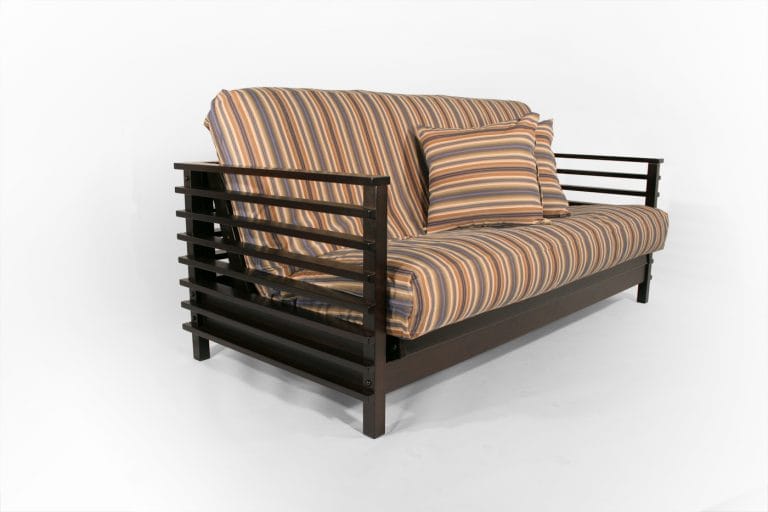
Futonland's convertible sofa bed collection provides a useful way to compare sofa-to-bed formats. Treat each model as its own setup, then verify the mechanism, storage location, and access points. Two sofas can both be called queen sleepers and behave very differently in a compact home.
Storage Types and How Each One Works Day to Day
Storage design matters more than the word “storage” on a product page. A compartment you can't open with the bed deployed, a drawer blocked by a rug, or a chaise lid pressed against a wall won't improve your room. The three configurations you'll encounter most often are front drawers, lift-storage chaise compartments, and small hidden compartments in the arms or back.
Compare access before capacity
| Storage Type | Best For | Clearance Needed | Main Downside |
|---|---|---|---|
| Under-seat drawers | Home offices and guest rooms where the sofa stays against a wall | Open floor space directly in front of the drawer | The drawer can conflict with rugs, tables, or the pulled-out bed |
| Lift-storage chaise | Studio dwellers storing bedding inside the sofa | Space beside and above the hinged lid | The chaise can complicate bed opening and room circulation |
| Hidden arm or back compartment | Remotes, throws, books, and small items | Access to the relevant arm or back section | The compartment offers limited capacity and can reduce usable seating width |
Under-seat drawers suit a room that regularly changes function. If your sofa sits in a home office, a drawer can hold sheets without requiring you to lift a cushion or move the sleeping mechanism. The trade-off is positional. The drawer needs a clear path in front of it, and that same area may be needed when you pull out the mattress.
A lift-storage chaise usually offers the most useful volume for bedding. It works well in a studio where the sofa itself must hold the guest linens. However, the hinge requires room for the lid to rise, and the chaise may sit directly beside the area where the sleeper opens. Check whether the storage remains accessible when the bed is extended.
Arm and back compartments are better for small objects than for a complete guest setup. They can keep remotes, chargers, blankets, or reading material close at hand, but they shouldn't be your main bedding solution. The structure used for storage can also reduce the open feel of the armrest or seating area.
The storage choice often picks the sofa, not the other way around.
If you're comparing standalone drawer units with sofa-integrated storage, Futonland's futon bed storage drawers can help clarify what front-access storage looks like in practice. For a queen sleeper, though, inspect the interaction between the drawer and the bed mechanism. A convenient compartment is valuable only when you can reach it without rearranging the room.
Mattress and Mechanism Options That Change the Sleep Experience
First-time buyers usually focus on the sofa cushions because that's what they test in a showroom. Guests sleep on a different system. The mechanism determines how the sofa becomes a bed, while the mattress determines whether the conversion feels like a practical guest solution or a compromise nobody wants to repeat.
Start with the opening method
A pull-out mechanism stores a folded mattress inside the sofa base. You pull the frame forward, lift or unfold the mattress, and create a separate sleep surface. This design often pairs with innerspring or foam mattresses, but the internal mattress deck leaves less room for lift-storage directly beneath it. Storage therefore tends to move into a chaise or another section of the sofa.
A click-clack or fold-flat mechanism lowers the sofa back until it meets the seat. It creates a flatter, simpler conversion and can leave useful space beneath the seat for drawers or other storage. The sleeping surface may include the seat and back cushions, so inspect the seam, support, and firmness before buying.
A futon-style folding frame uses a similar broad principle, with the frame and mattress folding between sofa and bed positions. It can work well for buyers who want straightforward conversion and accessible under-seat storage, but the sofa and mattress are more directly connected. The sitting feel may be firmer than a conventional upholstered sleeper.
Then judge the mattress, not the label
An innerspring mattress provides a familiar responsive feel and can support sleepers who dislike sinking into foam. Memory foam reduces spring movement and contours more closely to the body. Gel-infused foam is marketed toward sleepers who prefer a cooler-feeling foam surface, while hybrid pocket-coil layers combine individually responsive coils with foam comfort layers.
Thickness matters. A 5-inch mattress feels different from a 4-inch mattress, and that difference can matter to an adult guest sleeping more than one night. A thicker mattress may improve cushioning, but it also needs more folded space inside the sofa and can reduce the room available for storage or mechanism movement.
| Mechanism | Typical Mattress | Pairs With Storage Type | Comfort Level |
|---|---|---|---|
| Pull-out | Innerspring or memory foam | Chaise or separate compartment | Depends heavily on mattress construction |
| Click-clack | Integrated foam or cushion-based surface | Under-seat drawers | Often firmer and more uniform |
| Futon-style folding frame | Separate futon mattress | Under-seat or side storage | Varies with mattress thickness and support |
Don't assume a sofa that feels comfortable for sitting will feel comfortable for sleeping. Test the mattress in its open position when possible, and compare the listed mattress construction rather than relying on “queen sleeper” as a comfort guarantee. Futonland's futon mattress selection offers a useful reference point for understanding how different mattress materials affect the feel of a convertible frame.
Measuring Your Room and Planning Real Clearance
A queen sleeper sofa can fit neatly against a wall during the day and still consume most of the room when opened. The closed footprint tells only part of the story. Independent sleeper sofa guidance places many queen models at an open depth of about 89 to 92 inches, with roughly 90 inches from the wall commonly needed for full extension.
One queen sleeper may measure about 84 inches long when closed and roughly 90 inches deep when open. Another example has an exterior width of 82 inches and a 71.5 by 60 inch mattress. Compare both sets of dimensions on every product page. The frame determines whether the sofa fits, while the mattress dimensions determine how much usable sleeping space guests receive.
Take the tape measure beyond the wall
Measure the wall where the sofa will sit, then mark the open-bed rectangle on the floor with painter's tape. Walk around the taped area as if a guest were using the bed. If it blocks the route to the kitchen, bathroom, closet, or front door, the sofa is consuming the circulation space it was supposed to preserve.
Storage changes the layout. A drawer needs room to pull out, a chaise compartment needs room for its lid, and a lift-up seat needs clearance above the cushion. The storage location, opening mechanism, and bed extension must work together. A sofa that fits only when its storage stays closed is poorly planned for daily use.
Check these points before ordering:
- Wall-to-front distance: Allow for the full open depth, not just the sofa's closed depth.
- Side access: Some planning guidance recommends at least 24 inches of side access for comfortable use and 30 inches of clearance in front of nearby tables. Use the same guidance as a planning reference, then adjust for the room's actual traffic pattern.
- Lift-lid movement: A chaise compartment needs space beside and above the lid, not only an empty area in front.
- Delivery route: Measure doorframes, hallways, turns, stairwells, and elevator openings. A large frame must clear every turn, even if it arrives in multiple cartons.
- Ceiling and overhead fixtures: A raised sleeper frame or chaise lid can collide with low shelves, pendant lights, or wall-mounted décor.
| Measurement | Typical Range | Why It Matters |
|---|---|---|
| Closed width | About 80 to 90 inches | Determines wall fit and daily seating footprint |
| Closed depth | About 35 to 40 inches | Affects walking lanes and coffee-table placement |
| Open depth | About 89 to 92 inches | Determines whether the bed can fully deploy |
| Mattress size | 60 by 80 inches | Defines the guest sleeping surface |
| Side access | At least 24 inches recommended in some guidance | Helps guests enter, exit, and make the bed |
| Table clearance | About 30 inches in front of nearby tables | Prevents furniture from obstructing bed use |
Use Futonland's sizing charts while measuring, then confirm the exact product dimensions and delivery requirements with the retailer. In a studio, the open-bed outline should leave a usable route through the room. In a guest room, it should preserve access to closets and windows. In a multipurpose living area, make sure moving the coffee table does not block the storage compartment or create a second access problem.
Comfort, Durability, and Upholstery Choices That Last
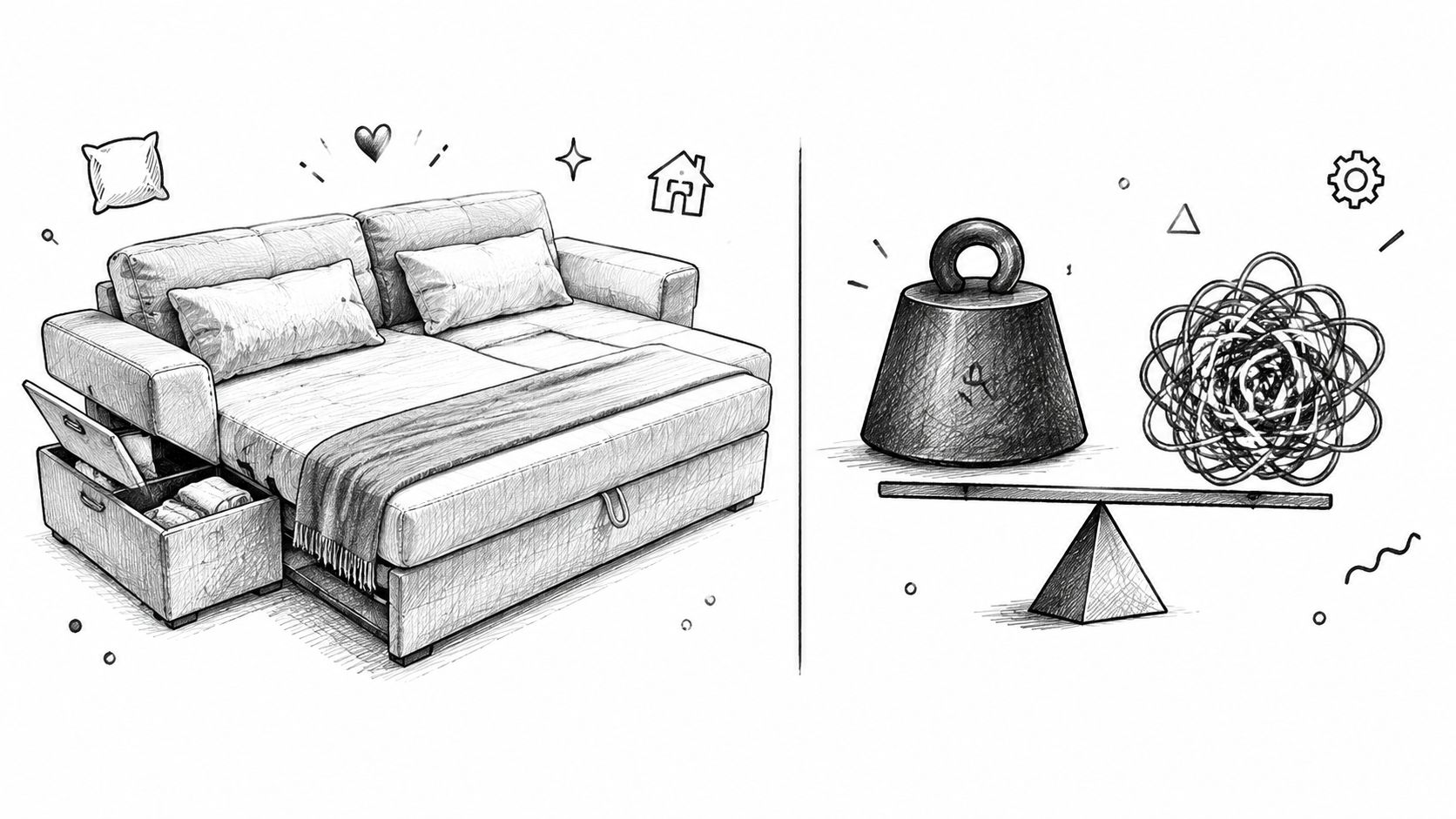
A sleeper sofa that works nightly needs more than a sturdy-looking silhouette. Judge five components separately: the frame, the sleeper mechanism, the mattress core, the seat cushions, and the upholstery. A weakness in any one of them can undermine the whole purchase.
Inspect the load-bearing parts
Hardwood frames generally provide a more substantial foundation than softwood frames, especially when the sofa carries a sleeper mechanism and storage compartment. Ask how the joints are connected and whether the frame feels rigid when you sit near the arm or edge.
For the seat platform, sinuous springs can offer resilient support in an upholstered sofa, while webbed platforms may feel more flexible and depend heavily on the webbing quality and tension. Neither label replaces hands-on testing. Sit in the center and near the front edge, then listen for movement as you shift your weight.
The mattress deserves separate scrutiny. Innerspring, memory foam, and hybrid constructions each create a different balance of responsiveness, pressure relief, and folded bulk. For regular guest use, choose the mattress before the decorative details. A removable topper can improve comfort, but you'll need a realistic place to store it.
Match upholstery to the household
Performance fabric is a sensible choice for children, pets, and frequent use because it's designed to handle more demanding cleaning routines. Leather wipes clean and develops a distinct patina, but scratches and surface marks remain visible. Microfiber resists some everyday spills and feels soft, while woven blends can provide more texture and visual warmth but may show pilling or snagging depending on the weave.
Ask about cleaning codes, removable covers, colorfastness, and replacement cover availability. If the sofa will sit in storage between moves or during a renovation, MG Self Storage's furniture care advice offers practical guidance on protecting upholstered pieces from moisture, dust, and pressure damage.
Cushion fill also changes daily comfort. High-resilience foam tends to hold its shape more consistently for everyday sitting, while fiber-wrapped cushions create a softer, more relaxed feel and may require regular plumping. A queen sleeper sofa with storage has enough moving parts already. Choose upholstery and cushions that fit your maintenance tolerance rather than buying a finish that only looks good on delivery day.
Pros, Cons, and Trade-Offs Worth Knowing Before You Buy
The strongest argument for a queen sleeper sofa with storage is simple. You get a usable queen bed without dedicating a room to it, and you get a place for guest bedding without adding a trunk or cabinet. In a studio or one-bedroom home, that consolidation can free up valuable floor area and reduce visual clutter.
The storage compartment can also make the guest routine faster. Sheets, pillows, and a duvet stay close to the bed rather than scattered across closets and shelves. A separate coffee table or storage chest may no longer be necessary, although the sofa still needs adequate clearance to open.
The quiet costs of combining features
The same structure that creates storage and sleeping capacity introduces compromises.
- Heavier delivery: Reinforced frames, chaise compartments, and sleeper hardware can make the sofa difficult to move through tight entrances.
- Firmer seating: Mechanisms and mattress decks can reduce the deep, soft sink that buyers expect from a conventional lounge sofa.
- Restricted access: Some designs require you to remove bedding or reposition cushions before reaching the storage compartment.
- Moving-part wear: Hinges, sliders, latches, and folding frames need more attention than a fixed sofa base.
- Reduced flexibility: A chaise may determine the room orientation, especially if it isn't reversible.
The key question is how often each function will be used. If guests sleep over regularly, prioritize the mattress and mechanism. If the sofa mostly serves as everyday seating, test the sitting posture for longer than a quick showroom visit. If storage is the main reason for buying, open the compartment repeatedly and check whether the lid, drawer, or chaise feels stable.
A feature only saves space if you can use it without fighting the furniture.
I recommend this category for buyers who need all three functions and have measured the open footprint. I don't recommend it for someone who has room for a dedicated guest bed or who wants the plushest possible everyday sofa. In those cases, separating the functions may provide better comfort and simpler maintenance.
Buying Checklist, Use-Case Match, and Service Questions Answered
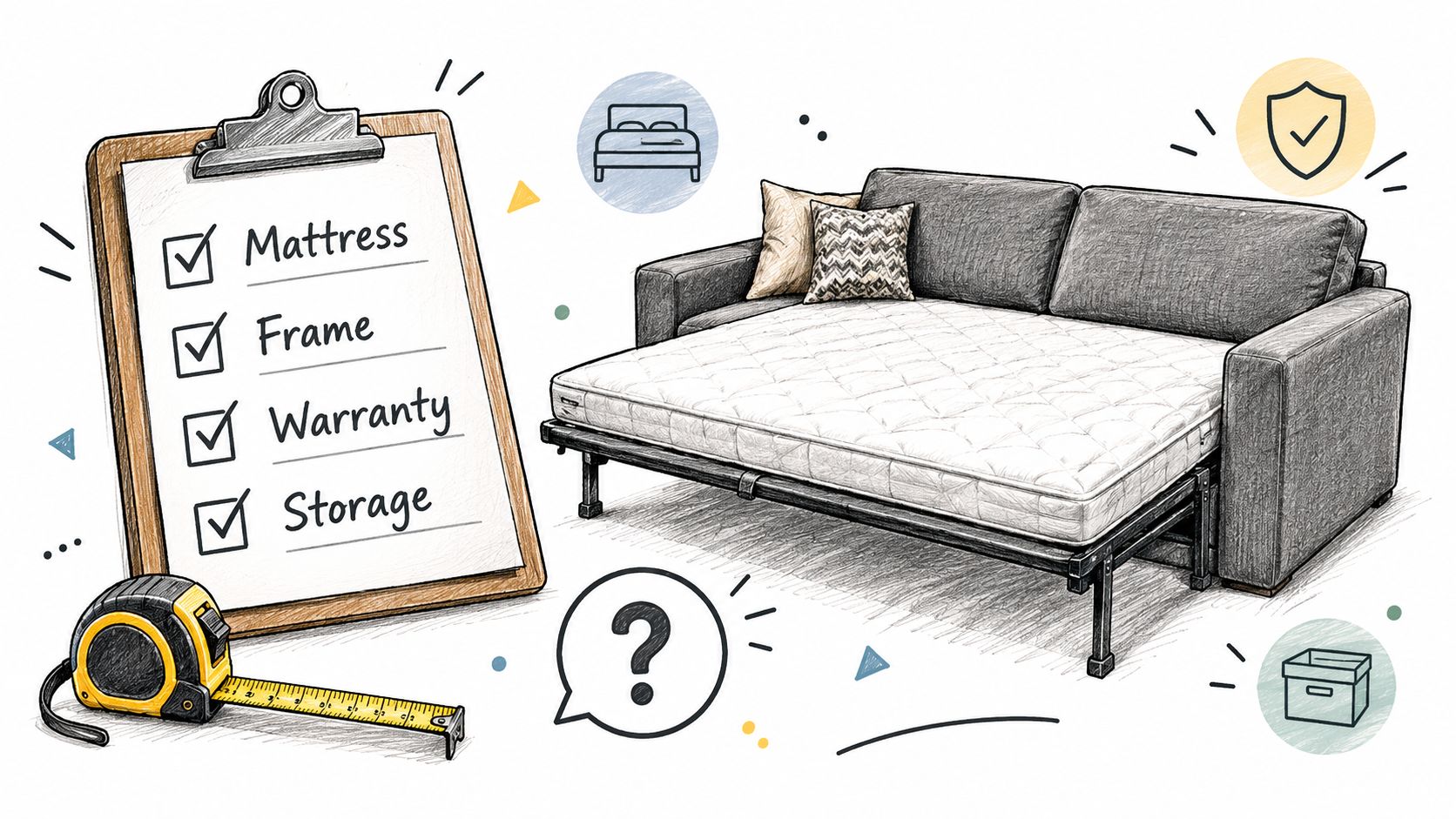
Bring a printed checklist to the showroom or keep one open while shopping online. Product photography rarely shows the awkward moment when the storage lid meets a wall or the bed blocks the only walking route.
Verify the product before paying
- Measure twice: Record closed width, depth, height, open depth, and every delivery opening.
- Test the mechanism: Open and close it without rushing. Watch for rubbing, catching, or excessive lifting force.
- Check storage access: Confirm whether bedding can be retrieved with the sofa closed, the bed open, or both.
- Judge the mattress: Identify the material, thickness, support layer, and whether a topper will be necessary.
- Inspect the frame: Ask about hardwood content, joints, platform support, and the mechanism warranty.
- Review the fabric: Check cleaning instructions, cover removability, pet resistance, and replacement options.
- Read service terms: Confirm delivery method, assembly, returns, damage reporting, and post-delivery mechanism support.
Match the configuration to your routine
A studio dweller who stores bedding inside the sofa should look first at a lift-storage chaise, provided the lid has room to operate. Someone using a home office as an occasional guest room may prefer front drawers because they offer direct access without disturbing the sofa structure.
Frequent hosts should spend more on the mattress and test the open bed before selecting decorative upgrades. A household with children or pets should prioritize a cleanable performance fabric and a mechanism that adults can operate smoothly. If you move often, avoid a design whose storage and sleeper components create an unusually difficult delivery route.
Ask the retailer direct questions
Ask whether the order ships in one piece or multiple cartons, whether delivery is threshold or white-glove, and whether assembly and debris removal are included. Confirm who handles a damaged carton, how bulky-furniture returns work, and whether return shipping or restocking conditions apply.
You should also ask what support is available if the sleeper mechanism needs adjustment after delivery. Futonland offers queen-size sleeper and storage configurations, along with delivery and setup services that vary by location and order, so confirm the exact service package before checkout rather than assuming every product receives the same treatment.

Measure the open bed area, test the storage access, and compare the mattress before you commit to a queen sleeper sofa with storage. If you're ready to narrow down models, contact Futonland's design team with your room dimensions, doorway measurements, preferred storage type, and guest-use needs so you can choose a configuration that fits your home in real life, not just on the product page.