

White Leather Sofa Set Buying Guide for Real Homes
You're standing in a showroom, running your hand across a white leather sofa set that looks impossibly clean. The cushions are perfectly aligned, the finish catches the light, and you can already see it against your living-room wall. Then real life arrives: sunlight reaches one cushion, a guest sits down in dark denim, and a coffee spill stays unnoticed longer than it should.
White leather isn't automatically impractical, but it is unforgiving. Leather grade, surface finish, frame quality, room exposure, and household habits matter more than the color alone. A protected top-grain set can remain polished with sensible care, while a poorly finished bonded piece may peel or discolor long before the frame gives out. This guide focuses on the decisions that determine whether your sofa still looks intentional after daily use.
Why a White Leather Sofa Set Looks Different Once You Live With It
A showroom hides the conditions that challenge white upholstery. The room is controlled, the lighting is flattering, and nobody has used the armrest with body lotion on their hands. At home, the sofa sits near a window, absorbs repeated contact at the headrest, and faces clothing dyes, dust, food, and changing temperatures.
The first mistake buyers make is treating white as a durability specification. It isn't. White describes the visible color, not the hide, protective coating, abrasion resistance, or cleaning requirements underneath it. Two sofas can look nearly identical at delivery and age in completely different ways because one uses a protected pigmented finish and the other exposes a more delicate surface.
What changes during the first weeks
A dark denim guest can leave transfer on a pale armrest. Body oils gradually darken the areas people touch most, especially headrests and outer arms. Direct sunlight can create uneven fading or yellowing, while heat dries the leather and increases the risk of cracking.
That doesn't mean you need to treat the sofa like museum furniture. It means you need to buy for the room you have. A low-use guest room has different requirements from a family room where people eat, nap, and climb across the cushions.
Practical rule: Choose the finish for your household first, then choose the shade of white.
Leather seating remains commercially significant rather than a fringe design choice. The global leather furniture market was valued at USD 11.45 billion in 2024 and is projected to reach USD 16.16 billion by 2032, with a projected 4.40% CAGR, while leather sofas represented the largest product share at 38.5% in 2024, according to Data Bridge Market Research's leather furniture market report. That context matters because a white leather sofa set belongs to the dominant sofa format within an established category.
The right question isn't whether white looks beautiful in a photograph. It does. The useful question is whether the set has the finish, construction, and maintenance profile to keep that appearance in your home.
Understanding Leather Grades and What They Mean for White
Leather grades describe how much of the original hide remains and how heavily the surface has been altered. They aren't a simple ladder where every higher label automatically suits every buyer. White makes the trade-offs more visible, so you should assess each grade by how it handles marks, oils, sunlight, and surface wear.
Full-grain preserves the most character
Full-grain leather retains the hide's natural surface. That gives it variation, breathability, and a distinctive feel, but it also leaves natural scars, grain changes, and future marks visible. On darker upholstery, those changes can read as patina. On white, they may look like uneven tone or accumulated wear.
Full-grain is the choice for a buyer who values natural material and accepts that the sofa will develop a history. It can be beautiful, but it isn't the safest recommendation for a bright, high-use family room where visual uniformity matters. For a clear explanation of the distinction between genuine leather terminology and full-grain leather, consult genuine vs full grain explained.
Top-grain leather has had the outer surface corrected or lightly finished. Manufacturers can create a more consistent appearance, which is a major advantage for white furniture. A protected or pigmented top-grain finish usually masks small variations and offers a more predictable surface than untreated natural leather.
Bonded and faux trade natural performance for price
Bonded leather combines leather fibers with a surface coating. It can deliver the visual effect of leather at a lower purchase cost, but stress points, seams, and frequently flexed areas are where problems usually appear. Once the coating begins to separate, the white surface makes the failure obvious.
Faux leather contains no animal hide and relies on a synthetic coating over a textile backing. It can be a sensible option for a rental, low-use room, or tightly controlled budget. Heat, repeated flexing, and poor ventilation can contribute to cracking or peeling, particularly when the product has a thin surface layer.
The strongest general recommendation for a white leather sofa set is protected top-grain leather with a disclosed finish. Full-grain works for design-conscious owners who want natural aging. Bonded and faux work when the budget or material preference takes priority, but you should buy them expecting a shorter cosmetic service life and checking the warranty carefully.
Comparing Full-Grain, Top-Grain, Bonded, and Faux Side by Side
The material label should help you decide, not impress you. Ask how the surface will feel on the first day, how it will respond to repeated contact, and what failure will look like when the sofa is white. A material that looks acceptable in a rarely used room may be a poor choice for a household sofa.
| Material | Origin & Feel | Durability on White | Stain & Aging Behavior | Typical Price Band | Best-Fit Household |
|---|---|---|---|---|---|
| Full-grain leather | Natural hide surface, varied and breathable | Strong material with visible marks and patina | Natural variation, scuffs, and tonal change remain visible | Premium | Low-to-moderate use, design-focused homes, owners who welcome patina |
| Top-grain leather | Corrected or finished natural hide, smoother and more uniform | Strong choice when protected or pigmented | Better visual consistency, with sheen and darkening at contact zones over time | Mid to premium | Everyday living rooms, apartments, guest-ready spaces |
| Bonded leather | Leather fibers under a coated surface, more uniform feel | Acceptable for lighter use, vulnerable at flex points | Coating can peel or separate at seams and high-stress areas | Budget to mid | Renters, low-use rooms, tightly managed budgets |
| Faux leather | Synthetic surface over textile backing | Practical for selected low- to moderate-use settings, but coating quality varies | Can crack, peel, or lose its finish under heat and repeated flexing | Budget to mid | Guest rooms, studios, households prioritizing animal-free materials |
Match the material to the room
For a small, sunlit apartment, protected top-grain is the safest leather choice. The finish gives you a more even white appearance, but you still need to manage window exposure and keep the sofa away from heat. Full-grain can work if you specifically want natural variation, though it will demand more tolerance for visible change.
For a high-traffic family room, choose protected top-grain or a well-specified faux or performance alternative. I wouldn't put unprotected full-grain white leather in the center of a room where children eat snacks and everyone uses the same headrest. The issue isn't only structural wear. It's cosmetic consistency.
For a guest-ready setup, bonded or faux may be reasonable when use is occasional and the budget is limited. That recommendation comes with one condition: inspect the coating, ask how the warranty treats peeling, and don't assume the word “leather” means the sofa contains a durable leather hide.
Abrasion testing also matters. North American upholstery guidance commonly uses the Wyzenbeek test, while ISO 17076-2:2011 evaluates upholstery leather with a Martindale apparatus and applies to semi-aniline, pigmented, and coated leathers, as explained by American Leather's upholstery rub-test resource. Ask the seller for the test method and rub or cycle threshold. A color name without a finish specification is incomplete product information.
Daily and Long-Term Care for a White Leather Set
White leather fails cosmetically before it fails structurally. Dust abrades the surface, ultraviolet exposure alters the tone, body oils darken contact zones, and aggressive cleaners strip or weaken finishes. A simple routine protects the appearance better than occasional panic cleaning.
Build a maintenance rhythm
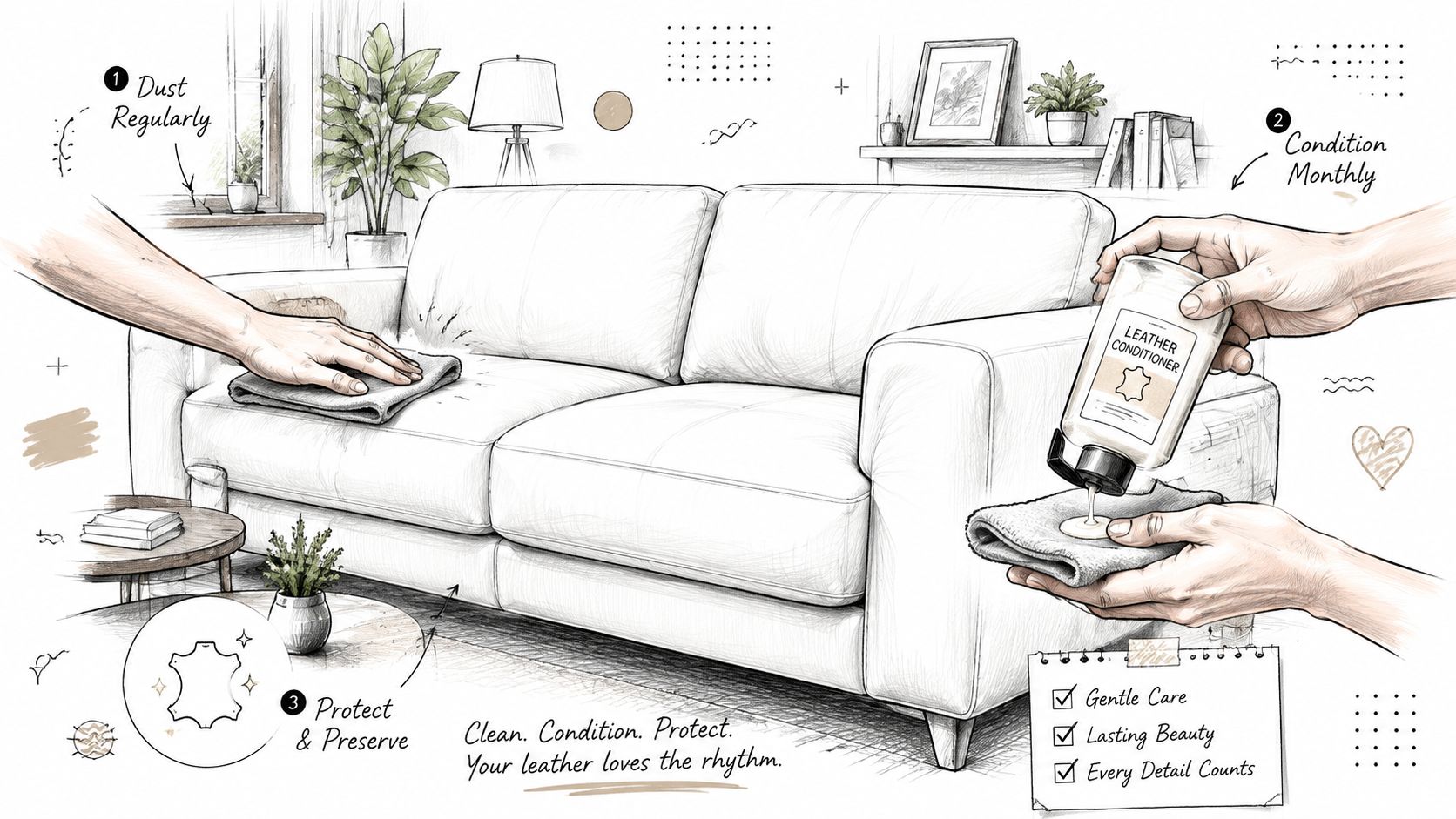
Weekly dusting should start with a dry microfiber cloth or a soft brush attachment. Remove grit from seams and beneath cushions before it gets ground into the surface by sitting. Don't scrub. White leather needs consistent, light contact rather than force.
Monthly conditioning should use a product approved for the specific finish. A pH-balanced leather conditioner may suit protected leather, while aniline and other less-protected finishes need more cautious product selection. Test anything unfamiliar in a hidden area first.
Biannual deep cleaning gives you a chance to inspect seams, contact zones, and areas exposed to light. Follow the manufacturer's instructions rather than applying a universal leather cream. The care guidance for many leather products recommends frequent dust removal, gentle damp wiping, immediate blotting, distance from heat, and avoidance of harsh household cleaners, as detailed in this manufacturer leather-care guide.
Deal with the three visible threats
- Sunlight: Keep the sofa out of direct sun where possible. Use curtains or blinds and avoid placing the brightest white cushion permanently in the window's path.
- Denim transfer: Raw or dark indigo denim can transfer pigment to pale leather. Pay attention to armrests and seat edges, where clothing makes repeated contact.
- Body oils: Headrests and arms collect oils faster than broad seat panels. Clean those zones gently before the discoloration becomes embedded.
For a fresh spill, blot with a clean white cloth. Don't rub, flood the leather with water, reach for a magic eraser, or use saddle soap, oils, bleach, or common household cleaners unless the manufacturer explicitly approves them. A protection plan also won't compensate for every appearance change, especially if its exclusions cover transfer dye, sunlight, or improper cleaning.
Even decorative choices affect the room around the sofa. If you want a subtle leather note elsewhere, read this guide to luxurious leather candles, but keep open flame, heat, and wax away from the upholstery.
Sizing and Layout Decisions for Small Spaces
A white sofa won't make a badly scaled room feel larger. In a small space, width, seat depth, arm thickness, and circulation determine whether the set feels airy or obstructive. Color can brighten the visual field, but it can't fix a sofa that blocks a doorway or overwhelms the walking path.
Apartment-scale sets should be measured at the outermost points, including arms and chaise sections. A sofa that technically fits the wall may still fail at delivery if the frame can't clear a hallway, stair turn, elevator, or narrow entry. Measure the route before you fall in love with the silhouette.
| Configuration | Typical Width | Best Room Size | Layout Note |
|---|---|---|---|
| Compact loveseat | Near 60 inches | Small living room, office, guest room | Leaves room for a chair or compact table |
| Apartment sofa | Around 72 inches | Studio or modest living room | Strong everyday choice when depth stays controlled |
| Apartment-scale set | Under 80 inches | Small apartment or multipurpose room | Confirm total width and arm profile |
| Modular sofa with removable chaise | Varies by arrangement | Flexible studio or narrow living area | Separate pieces can simplify delivery and reconfiguration |
| Convertible futon or sleeper | Varies by frame | Living-sleeping rooms and guest spaces | Provides seating and sleeping function in one footprint |
Leave a walking route of 30 to 36 inches where circulation matters, and keep the sofa away from direct baseboard heat. Those measurements and layout controls are especially important for white leather because cramped placement often forces the set close to windows or heating sources, increasing environmental stress.
A true apartment sofa is designed around compact proportions. A full-size sectional with smaller cushions is not automatically an apartment set. If the room serves as both living room and bedroom, a convertible may be the smarter purchase. Use Futonland's sizing charts to compare furniture dimensions against the room and access path before ordering.
My strongest small-space recommendation is a compact top-grain loveseat or modular set with a removable chaise. It gives you flexibility without forcing a large sectional into a narrow room. If you need overnight capacity, prioritize a well-built convertible over a decorative sofa that leaves the room unusable.
What Really Drives the Price of a White Leather Set
A white leather set costs more for reasons that have little to do with color alone. The price reflects the hide, frame, support system, cushions, finish, delivery, and assembly required to bring a large upholstered product into your home. Judge the construction before paying for a polished appearance.
| Cost Driver | Budget Impact | Why It Matters for White |
|---|---|---|
| Leather grade | Major | Natural hides and better surface selection cost more, while protected finishes improve consistency |
| Frame material | Moderate to major | Stable hardwood or quality engineered construction helps prevent distortion that makes seams and cushions look uneven |
| Suspension | Moderate to major | Springs or quality webbing influence support and reduce premature sagging |
| Cushion core | Moderate to major | High-resilience foam, coils, or blends determine comfort retention and shape |
| Surface finish | Moderate | Pigmented and coated finishes provide more uniform color and stain masking |
| Delivery and assembly | Variable | Modular sets may need in-home assembly, threshold service, or stair handling |
| Warranty terms | Indirect | Exclusions may leave transfer dye, UV damage, or finish changes outside coverage |
The frame matters because a flawless hide cannot rescue a sofa that twists or sags. Ask whether it uses kiln-dried hardwood, plywood, or softwood, and ask how the corners are joined. Then inspect the suspension. Eight-way hand-tied systems, sinuous springs, and webbing provide different support characteristics, while vague wording such as “durable construction” tells you very little.
White leather also makes finish quality more important. A protected, pigmented surface usually delivers more even color and better masking of everyday marks than a highly natural finish. That tradeoff can suit a family room, while a design-focused studio may value visible grain and accept more maintenance. Match the finish to how the room is used, not to a showroom sample.
What different budgets should prioritize
At $1,500, expect compromises. The likely choices may include bonded or faux leather, lighter construction, simpler suspension, or a smaller configuration. Spend carefully on fit and a clearly stated return policy instead of decorative details.
At $3,500, you may find a better balance of protected top-grain leather, sound frame construction, and more dependable cushion support. I'd direct everyday buyers who want a white leather sofa set without treating it as a disposable accent toward this range.
At $6,000, look for material transparency, stronger construction, better cushion engineering, and delivery support. Do not spend the entire amount on a prestigious hide while ignoring the frame or access plan. Explore Futonland's leather sofa sets to compare set formats, then evaluate every listing with the same construction checklist.
White-specific spending should go toward a suitable finish, reliable frame, and clear care support. Decorative tufting, oversized arms, and glossy accents come later.
Styling a White Leather Set Without Making It Feel Fragile
A white leather sofa set looks sterile when every nearby surface is smooth, pale, and reflective. The solution isn't to abandon white. Add texture, contrast, and warmer materials so the sofa reads as an intentional anchor rather than a showroom display.
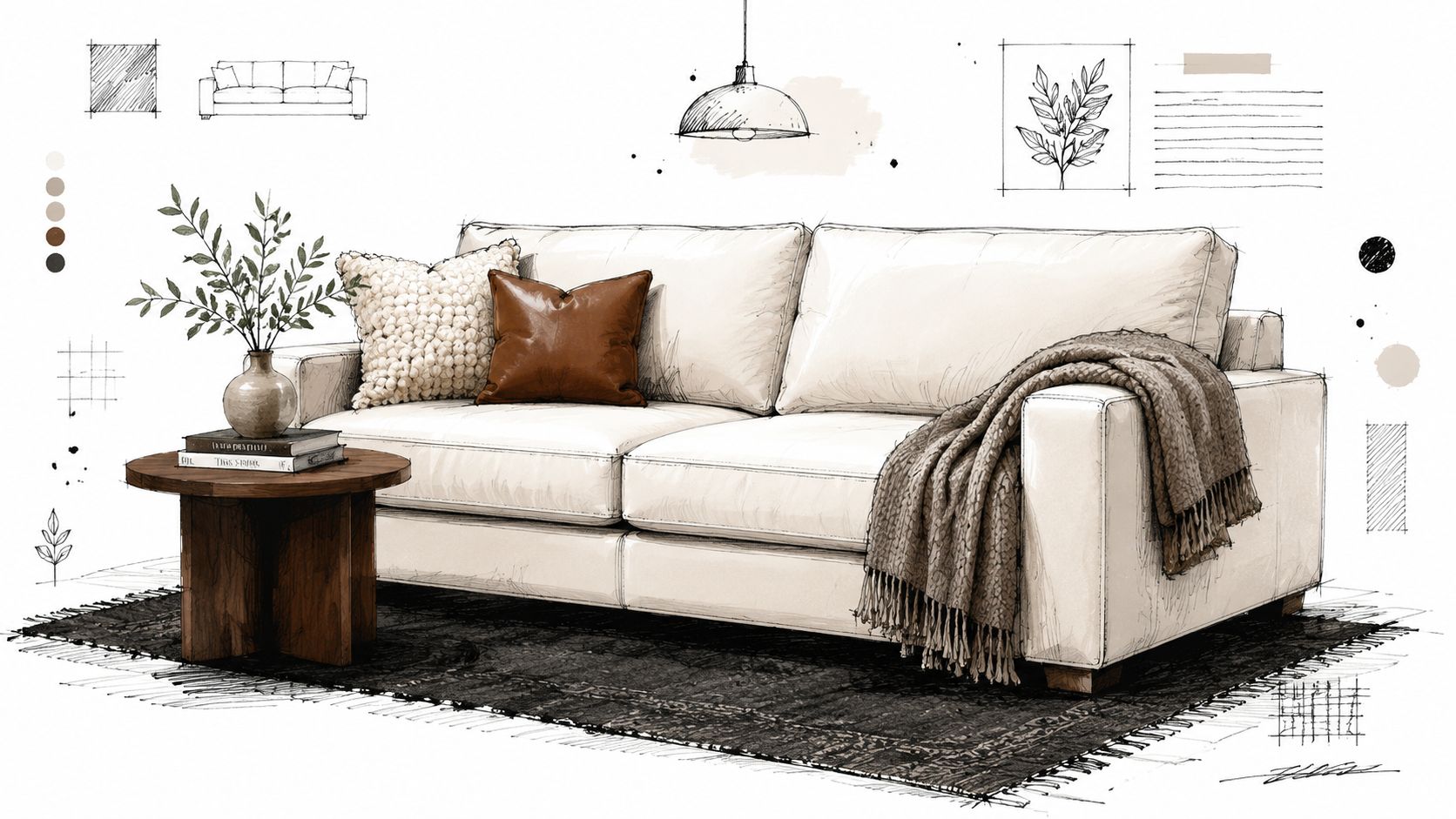
Start with the floor. A low-pile wool or jute rug gives the leather a grounded surface and breaks up glare. Walnut, natural oak, and blackened wood work especially well because their grain and darker tones create visual weight without competing with the sofa.
Use textiles to make the room feel lived in
Choose pillows in oatmeal, terracotta, sage, navy, or rust. Linen introduces a relaxed surface, boucle adds softness, and chunky knits make the seating feel usable rather than precious. Natural-fiber throws are better than shiny synthetics, which can exaggerate the leather's reflection.
Keep the arrangement edited. One large piece of wall art or a sculptural mirror can anchor the sofa more effectively than a crowded gallery wall. Matte black, unlacquered brass, and ceramic lighting also soften the polished quality of white upholstery.
Let contrast do the work
- Warm base: Pair ivory leather with walnut, oak, terracotta, and oatmeal for a calmer room.
- Graphic base: Use blackened wood, matte black lighting, and navy accents when you want sharper contrast.
- Earthy base: Add sage, jute, ceramic, and rust to prevent the set from feeling overly polished.
- Soft base: Layer linen, boucle, and wool if the room needs comfort without visual clutter.
Avoid plastic and glass-heavy furniture around a glossy white set. Those materials can multiply glare and make every surface feel hard. A rustic side table, woven basket, or ceramic lamp gives the room a more forgiving balance.
Rotate cushions when the construction allows it, and accept a little natural change. The goal isn't to preserve an untouched showroom image forever. The goal is a room that looks cared for, comfortable, and coherent. For supporting pieces, browse Futonland's home décor and accents with the same rule: choose texture and function before decoration.
Smart Alternatives and the Final Buying Checklist
White leather is a strong choice when you want a clean, easy-to-wipe surface and you can control sunlight and maintenance. It's a poor choice when the room is intensely sunlit, the sofa will face constant food and pet traffic, or you already know you won't follow finish-specific care instructions.
A small room may benefit more from a convertible futon or loveseat than a full set. A family with children or pets may get better long-term results from performance fabric or a durable faux surface. A guest room can justify a lower-cost bonded or faux option because the usage pattern is lighter.
| Alternative | Main Advantage | Main Trade-Off |
|---|---|---|
| White fabric sleeper sofa | Softer visual and tactile feel, with sleeping function | Spills and embedded soil can require more intensive cleaning |
| Faux leather set | Animal-free material and accessible pricing | Coating quality varies, with possible cracking or peeling |
| Convertible futon with washable covers | Flexible seating, sleeping capacity, and removable textiles | Less formal appearance than a tailored leather set |
| Ivory performance upholstery | Lived-in look with practical stain management | Won't have the same leather surface or visual authority |
| Protected top-grain white leather | Uniform, polished finish with easier surface maintenance | Requires sunlight control and regular care |

Use this pre-purchase checklist
- Confirm the leather type: Ask whether it's full-grain, top-grain, bonded, or faux.
- Confirm the finish: Find out whether the surface is aniline, semi-aniline, pigmented, or coated.
- Request abrasion information: Ask for the test method and stated rub or cycle threshold.
- Inspect the frame: Ask about hardwood, plywood, softwood, joinery, and corner reinforcement.
- Check suspension: Identify springs or webbing instead of accepting a general durability claim.
- Examine cushion construction: Ask about foam resilience, coils, or down blends.
- Test the exact white: Ivory and off-white can disguise wear better than a stark, glossy white.
- Measure delivery access: Check doors, hallways, stairs, elevators, and turning points.
- Read warranty exclusions: Look specifically for UV damage, dye transfer, peeling, and cleaning mistakes.
- Buy the correct cleaning kit: Use products approved for the actual finish, and test them discreetly.
The broader leather home-furnishing category also has substantial U.S. scale. It generated USD 3,300.4 million in 2022 and is projected to reach USD 4,769.3 million by 2030, with a projected 4.7% CAGR from 2023 to 2030, according to Deep Market Insights' leather furniture market report. Leather furniture was the largest revenue-generating type in that market in 2022 and is also identified as the fastest-growing type segment across the forecast period.
Choose the white leather sofa set only if its finish matches your home. If it doesn't, compare a washable-cover convertible or faux alternative at Futonland's faux leather sofa sets, then order the option that fits your room, routine, and cleaning tolerance rather than the one that merely wins in a showroom.
Before you buy, measure the room and delivery route, request the leather grade and finish in writing, inspect the warranty exclusions, and choose a care kit approved for that surface. If sunlight, pets, or frequent spills make white leather a poor match, select an ivory performance sofa, faux set, or convertible with washable covers today instead of paying to replace a beautiful but unsuitable sofa later.