

What to Look for When Buying a Sofa Bed: A Buyer’s Guide
You’re furnishing a one-bedroom apartment, and the guest is about to sleep in the living room. The sofa has to look good every day, open without a wrestling match, and give someone a usable place to sleep at night. That’s a demanding piece of furniture, and choosing it from a product photo or a low price tag is how buyers end up regretting the delivery.
A sofa bed is two products sharing one frame. Judge the sitting experience like a sofa, then judge the open position like a mattress and support system. The right choice depends on the mechanism, frame construction, mattress feel, upholstery, available clearance, and how often someone will sleep on it. This category has grown steadily in recent years as more buyers furnish smaller homes and need dual-use furniture that earns its floor space.
Why a Sofa Bed Deserves a Different Kind of Evaluation
A sofa bed must serve as seating by day and a sleep system by night. It has to open, fold, support a mattress, distribute sleeping weight, and return to a stable couch position without damaging the room or its mechanism. Those demands create trade-offs that upholstery photos and price tags rarely show.
Evaluate the two functions separately. For the sofa, check seat height, back support, arm stability, and whether the cushions recover after use. For the bed, inspect the mattress and its base. Look for an even sleep surface and consistent support, then lie down to check for bars, hinges, gaps, or frame pressure beneath your shoulders and hips.
Use the sofa and the bed as separate tests
The closed position deserves serious attention because the sofa will usually spend more time that way. Sit at the front edge, sit back fully, and confirm that your feet rest naturally on the floor. A sleek profile does not compensate for awkward seat depth that irritates you every day.
Test the open position with the same discipline. Remove the cushions, unfold the mechanism, and lie down. A quick showroom sit tells you little. Pressure points and uneven support become apparent after hours, not during a short demonstration.
Practical rule: Buy the sofa bed for the person who will use it most often, not for the occasional guest who claims to sleep anywhere.
Use frequency to set priorities. A sleeper used a few times a year can accept a simpler conversion and thinner sleep system if guests remain comfortable. Weekly use, nightly use, or primary-bed duty calls for dependable support, a carefully chosen mattress, and a mechanism you can operate without strain.
Compare convertible sofa beds as both couches and mattresses. Comparing conversion styles beforehand helps you understand what each design prioritizes — some favor compact folds, others favor sturdier mechanisms. Choose the combined piece only after it works for your room, your routine, and the person sleeping on it.
Conversion Mechanisms and How They Feel in Daily Use
The mechanism determines how the sofa bed behaves in your home. It affects the conversion effort, the space required in front of the sofa, the sleep surface, and how much wear the frame experiences over time.
Pull-out sleepers
A traditional pull-out uses a metal frame that folds inside the sofa and carries a separate mattress. It generally offers the most bed-like layout, especially when the mattress has a proper support core and the frame opens smoothly. The drawbacks are weight, more moving parts, and the need to remove seat cushions before opening many models.
Poorly designed pull-outs can create pressure points where metal bars sit beneath a thin mattress. They also need generous clearance in front of the sofa because the bed travels forward rather than just dropping into place. Test the action slowly. A good mechanism should feel controlled, not jerky, and shouldn’t scrape the floor.
Click-clack and futon-style designs
A click-clack sofa folds its back down to create a flat surface. Futon-style frames use a related principle, though frame geometry and mattress construction vary. These designs are usually straightforward to convert and work well in tight apartments because the motion is simple and visible.
Their compromise is the seat. The back and seat often share the sleeping surface, so the sofa may have a firmer, thinner profile than a traditional couch. You may also feel the frame or the division between sections if the mattress lacks enough cushioning. A well-made frame can still be excellent for occasional guests, particularly when daytime seating and compact dimensions matter most. Browse futon frames to compare the structural differences rather than judging only by silhouette.
Convertible and sofa-in-a-box designs
Modern convertible sofas often use folding cushions, hinged platforms, or compact engineered frames. They can be easier to handle than a heavy pull-out and may arrive in packages that are simpler to move through a building. Check the open footprint carefully, because a compact closed form can still require substantial floor space when extended.
| Mechanism | Ease of Daily Conversion | Sleep Surface Feel | Best For |
|---|---|---|---|
| Pull-out | More involved, often requires cushion removal | Closest to a conventional bed when well built | Frequent guests and regular sleeping |
| Click-clack | Usually quick and simple | Firmer, with more variation across sections | Tight rooms and occasional sleepers |
| Futon style | Straightforward, though frame quality varies | Depends heavily on mattress and support | Flexible seating with periodic overnight use |
| Convertible sofa | Often manageable for one person | Can be even and stable when properly engineered | Small homes needing repeated conversion |
The practical rule is simple. Frequent guests need a quality pull-out or convertible design. If the piece is mainly seating with occasional sleeping, a simpler fold-flat mechanism can be the smarter choice.
Mattress Quality, Thickness, and Real Sleep Comfort
A sofa bed can look excellent in the showroom and still sleep badly once opened in your apartment. Judge the mattress as part of a complete sleep system, not as extra padding beneath a couch. Check what supports the sleeper, how the mattress is built, and whether repeated folding will change its performance.
Start with a medium-firm feel as your baseline. Medium-firm surfaces are widely considered a safer default across sleep positions and body types than either extreme, though individual preference varies enough that lying on the actual sofa-bed mattress matters more than any general recommendation. Use medium-firm as your starting benchmark, then adjust for the sleeper’s body and usual bed preference.
Thickness is a mechanical decision
A sofa-bed mattress cannot be chosen by thickness alone. As a general guide, roughly 9 to 13 cm (about 3.5 to 5 inches) is a practical folding range for most mechanisms, with the thinner end of that suited to occasional use and 15 cm (about 6 inches) or more better suited to regular sleeping — though the exact limit depends entirely on the specific frame, so confirm it with the manufacturer rather than assuming. A mattress that is too thick, dense, or rigid can resist folding and place extra stress on seams and the metal structure.
Thicker construction can cushion shoulders and hips more effectively, but it can also raise the sofa seat and alter the closed profile. A thin pad maintains a lower couch posture, yet may leave sleepers feeling support bars or the platform below. Choose the thickest mattress the mechanism folds safely while keeping the open and closed geometry correct.
Read the foam and support details
Low-density foam can compress quickly, allowing the sleeper to feel the base. Higher-resilience foam usually spreads weight more evenly. Innerspring or hybrid construction can add structure, provided the springs, slats, or platform beneath them remain stable.
Check the areas that reveal poor support first:
- Shoulders and hips: pressure usually means inadequate cushioning or an overly firm surface.
- The middle of the mattress: a dip may point to weak support beneath the foam, not merely a soft comfort layer.
- The edge: collapse reduces usable sleeping space and makes getting up harder.
- The next morning: stiffness exposes uneven support that bedtime testing may miss.
Compare futon mattresses by construction and intended use. Lie down on the actual mattress before buying whenever possible, and test both the center and edge. A sofa bed earns its space only when it works convincingly as seating by day and a supportive bed at night.
Frame Construction, Joinery, and Weight Capacity
A sofa bed has to carry a sofa, a mechanism, and sleepers without developing movement between those roles. Evaluate the frame like a piece of furniture and a sleep system. Flex, twisting, or loose connections will eventually affect the way the mattress sits and the way the mechanism operates. In both sofa and bed positions, the frame should feel quiet, level, and planted.
For solid-wood designs, look for kiln-dried hardwoods such as oak, maple, or ash. Engineered hardwood and quality multi-ply birch plywood can also hold up well, especially around folding parts where consistent dimensions matter. Particleboard is worth being cautious about in a frequently used sleeper, particularly where it carries screws or hinges under repeated stress. Steel can last for years, but its gauge, welds, attachment points, and protective finish matter more than the word “metal” on a specification sheet.
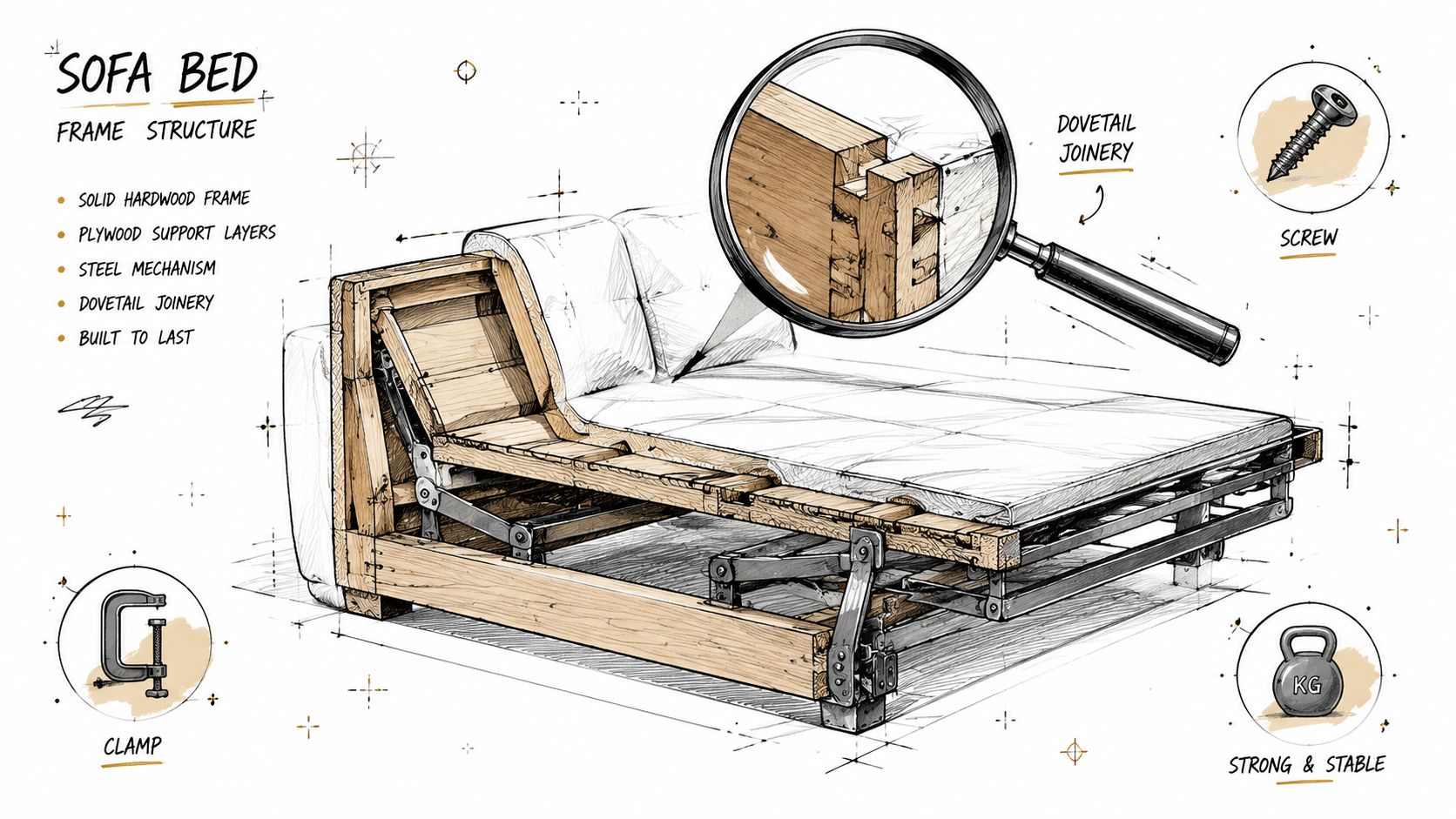
Inspect the joints, not just the material list
Mortise-and-tenon joints, reinforced corner blocks, dowels, and fitted metal brackets indicate a frame designed to resist racking. Staples alone do not provide that structure. Push on the arms, check whether the legs look undersized, and sit near the front edge to see whether the frame shifts.
Ask for the distributed weight capacity of the complete sleeper, not just the mattress size. A full or queen label says nothing about how much load the frame and mechanism can safely carry. Manufacturer weight-capacity labels should always be verified against the published spec sheet rather than inferred from the nominal bed size. The rating must match the people who will use the bed, including shared sleeping and regular guest use.
Test the frame in the showroom. Lift one front corner slightly, sit on the edge, open the bed, close it, and repeat the motion. Dramatic twisting, popping, grinding, or metal scraping signals loose tolerances or poor alignment. A well-made frame gives controlled resistance through your hands and stays aligned throughout the conversion.
Sizing, Clearance, and Small-Space Measurement Strategy
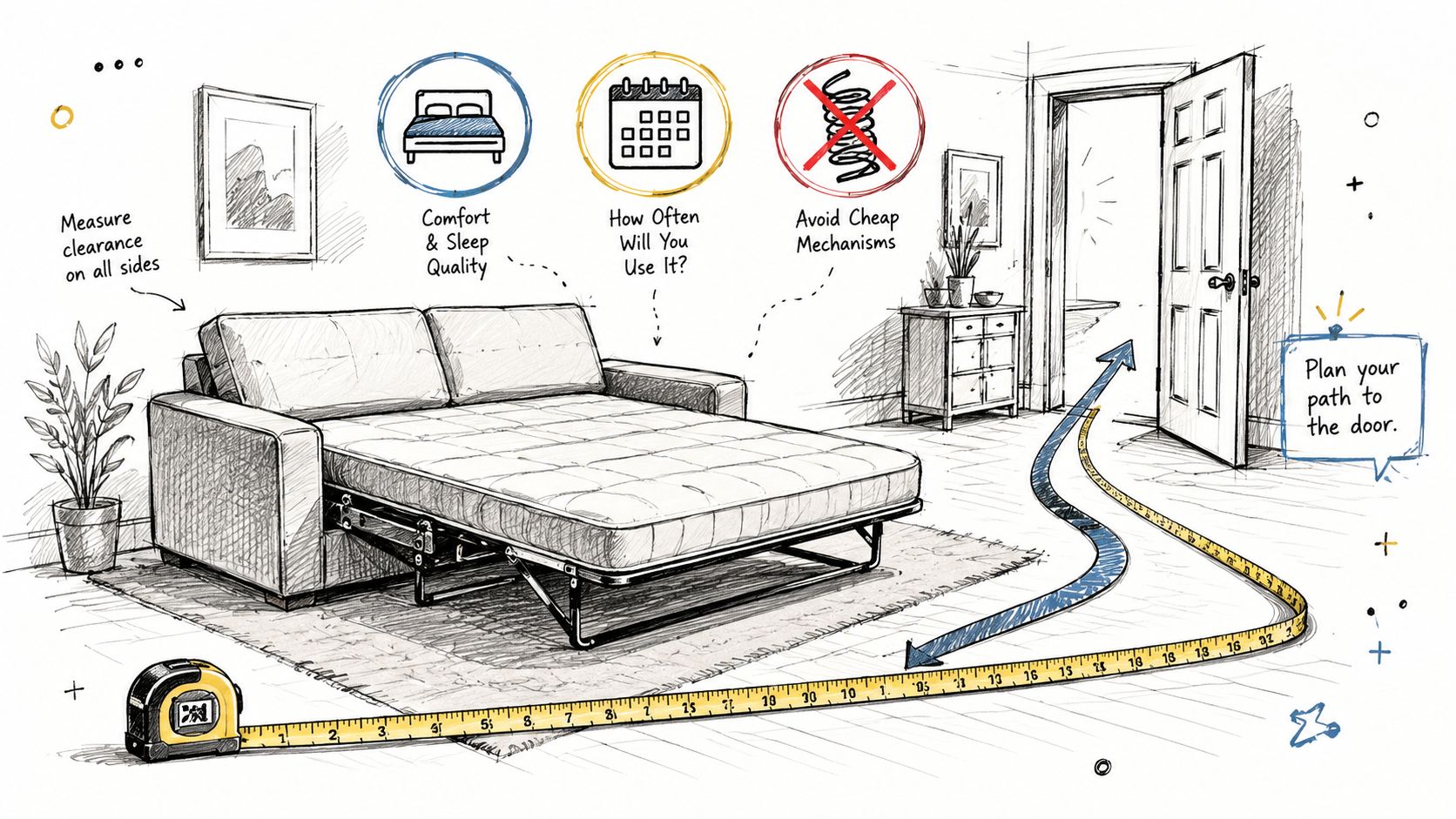
Bad measurements cause more sofa-bed returns than bad taste. A sleeper can fit against the wall and still fail once opened because the bed blocks the main walkway, traps a radiator, or leaves no room to reach the bathroom.
Measure the actual mattress footprint, not just the sofa’s advertised category. A nominal size can conceal a narrower interior, and a sofa under 70 inches wide may still use “queen” language by counting an unconventional sleeping area. Read the open dimensions, closed dimensions, arm width, and seat depth together.
| Configuration | Closed Depth (in) | Open Bed Size (in) | Min. Front Clearance (in) | Min. Doorway Width (in) |
|---|---|---|---|---|
| Twin sleeper | Verify product dimensions | 75 × 39 | Measure the complete open footprint | Measure the boxed item |
| Full sleeper | Verify product dimensions | 75 × 54 | Measure the complete open footprint | Measure the boxed item |
| Queen sleeper | Verify product dimensions | 80 × 60 | Measure the complete open footprint | Measure the boxed item |
The open depth is often roughly double the closed depth, but don’t plan from a rule of thumb when the room is tight. The mattress, arms, back cushions, and mechanism can all extend differently. A studio that works with a click-clack may become unusable with a deep pull-out.
Measure the route and the room
Use this sequence before placing an order:
- Measure the delivery route. Record the narrowest doorway, stairwell, elevator opening, hallway turn, and building entrance.
- Measure the room wall to wall. Mark windows, doors, closets, and furniture that can’t move.
- Mark the open bed footprint. Include the space needed to walk around it and operate the mechanism.
- Check the rug. Make sure the rug still sits safely under the arrangement without catching on moving parts.
- Protect heat and airflow. Keep the open and closed sofa clear of radiators, heating vents, and other fixed fixtures.
Use the product-specific sizing charts to compare nominal configurations, then outline the exact footprint with painter’s tape. Open the taped area, walk around it, and try the route you’ll take when changing sheets. That five-minute exercise catches layout problems before delivery does.
Upholstery, Cleanability, and Long-Term Durability
Fabric regrets usually arrive after the first spill, pet encounter, or month of daily sitting. Choose upholstery for the household you have, not the mood board you saved. A pale loose-weave linen may look perfect in a quiet room and become a maintenance project in a family living space.
Ask for the abrasion rating. As a general benchmark, at least 20,000 Martindale rubs is a reasonable minimum for domestic use, with 30,000 or more preferred for a main living-space piece that sees heavy daily traffic. A higher count isn’t a complete durability guarantee, but it gives you a useful comparison point when two fabrics look similar.
Polyester and microfiber usually offer practical stain resistance and easy upkeep. Performance blends can provide a more natural appearance while adding protection. Linen and cotton feel breathable and relaxed, but they may wrinkle, mark, or wear differently at the seams. Leather wipes clean and develops character, though scratches and surface treatments vary. Tighter weaves generally disguise mechanism seams and everyday abrasion better than loose, open textures.

Pair fabric with a care plan
Read the cleaning code before you fall for the color:
- W: water-based cleaning is permitted.
- S: use a solvent-based upholstery cleaner.
- W/S: either method may be suitable, following the manufacturer’s instructions.
- X: vacuuming or professional cleaning is generally the limit.
Removable cushion covers are valuable in a small home because you can’t easily hide a damaged sofa in another room. Ask whether the covers are machine washable, whether replacement covers are available, and whether the mechanism requires removing them during conversion.
Foam quality matters under the upholstery, too. As a general benchmark, foam density somewhere in the 1.8 to 2.5 lb/ft³ range performs well for residential seat cushions, with the higher end of that range (around 2.2 to 2.5 lb/ft³) better suited to heavy daily use. Higher-density foam resists permanent compression, so cushions are less likely to bottom out where people sit and where the fold places repeated stress.
Storage Extras, Delivery, Assembly, and Warranty
The small details determine whether a sofa bed works smoothly after the showroom excitement fades. Under-seat storage for sheets, blankets, and pillows can save a closet in a small apartment. A storage chaise or convertible ottoman may be more useful than built-in USB ports, especially if the primary problem is where to keep bedding.
Inspect every feature for interference. A storage compartment shouldn’t make the sofa awkward to open. Removable arm cushions should have secure fasteners. A USB port should be placed where a sleeper can reach it without creating a cable hazard. If an ottoman extends the sleep surface, check whether it locks into position or slides during use.
Treat delivery as part of the purchase
Get the packaged dimensions before paying. Measure the elevator, entry door, apartment door, hallway turns, and any tight stair landing. Ask whether delivery includes room placement, assembly, packaging removal, and debris removal. A sofa that fits the room but not the building isn’t a bargain.
Assembly ranges from white-glove placement to flat-pack construction requiring careful alignment. Don’t assume the floor model tells you what arrives at your door. Ask how many pieces come in the box, whether two people are required, and whether the mechanism needs adjustment after assembly.
| Feature | Pull-Out Sleeper | Click-Clack | Futon Style |
|---|---|---|---|
| Delivery concern | Heavy mechanism and larger package | Usually simpler frame profile | Frame and mattress may arrive separately |
| Assembly | May require substantial setup | Often limited, depending on design | Frame assembly and mattress placement are common |
| Packaging removal | Confirm with the delivery provider | Confirm with the delivery provider | Confirm whether separate boxes are removed |
| Warranty focus | Mechanism, frame, and mattress support | Hinges, frame, and locking positions | Frame joints, hinges, and mattress construction |
Warranty language deserves close reading. A frame warranty lasting 10 years or a lifetime can signal stronger manufacturer confidence, while only one year of coverage on the mattress mechanism deserves more questions. Confirm exactly what covers frame defects and mechanism failure, and what excludes fabric stains, misuse, normal mattress softening, or cushion compression. Request the certificate in writing before checkout.
For difficult building access, keep in mind that dimensions, access, stairs, and handling requirements all affect delivery complexity and cost — the same logistics logic that applies to moving any large, awkward item applies here.
The Buyer’s Decision Framework and Common Pitfalls
Use a fixed order of decisions. Start with primary use. If someone will sleep on the sofa bed regularly, prioritize mattress support and mechanism reliability. If it will host occasional guests, you may accept a simpler frame in exchange for better daytime proportions or storage.
Next, measure the room and the delivery path. Choose the mechanism only after you know the open footprint. Specify the mattress after deciding how often it will be used, then confirm the frame’s capacity and construction. Upholstery, storage, delivery service, and warranty come after those structural decisions, not before them.
The most avoidable mistakes
Buyers commonly choose a sofa bed because it matches the room, then discover that the seat is uncomfortable or the open bed blocks the only passage. Others skip the sit-test, ignore the sleep surface, or assume a category label tells them the true mattress size.
A few errors are especially avoidable:
- Buying the look first: a beautiful cover can’t correct poor pressure relief or a weak mechanism.
- Underestimating the open footprint: closed dimensions tell only half the story.
- Skipping the conversion test: if it feels awkward in the store, it won’t become easier at home.
- Choosing an underspecified mattress: a very thin, low-support sleep surface can expose the frame and create morning discomfort.
- Ignoring return terms: restocking, pickup, and bedding-related exclusions can change the actual cost of a poor fit.
- Treating the sofa bed as one product: you need a couch that holds up and a bed that supports a body.
Before buying, perform the final inspection in person:
- Convert it three times without rushing.
- Lie on the open mattress for at least two minutes.
- Sit on the edge and test for flex or instability.
- Look underneath for exposed staples, loose hardware, and unfinished contact points.
- Confirm the weight rating, warranty certificate, care code, and return policy.
- Photograph the delivery path and compare it with the packaged dimensions.
For a guided shortlist, share your room dimensions, doorway measurements, preferred sleeping size, and realistic sleep frequency with a furniture specialist. Futonland offers sofa beds, futons, mattresses, covers, and space-saving sleep furniture, with product specifications that can be compared by mechanism, dimensions, construction, storage, and capacity. Bring those details to a consultation, and choose the model that fits the actual apartment and the actual people using it, not just the showroom.
Send your room dimensions, delivery-path measurements, and how often the sofa bed will be used to a qualified furniture advisor before you order. Ask for a shortlist with the open footprint, mattress construction, frame rating, upholstery care code, delivery requirements, and written warranty included, then test the finalists in both sofa and bed positions before committing.