
What Is a Sleeper Sectional and How Does It Save Space
A sleeper sectional is a sectional sofa that includes a built-in bed (plus, in many models, hidden storage). It gives you the lounge-friendly seating of an L- or U-shaped sectional and the “guest room” function of a sleeper—without needing a separate bed to take up floor space.
Why Sleeper Sectionals Are a Big Deal for Small Homes
In a studio, one-bedroom, or multipurpose living room, furniture has to earn its footprint. A sleeper sectional helps you:
- Seat more people comfortably than a standard sleeper sofa, thanks to the chaise and corner layout.
- Host overnight guests without an air mattress taking over your room (or your closet).
- Reduce clutter when the chaise includes storage for blankets and pillows.
Sleeper Sectional vs Sleeper Sofa vs Regular Sectional
| Feature | Sleeper Sectional | Traditional Sleeper Sofa | Standard Sectional |
|---|---|---|---|
| Seats | High (great for groups) | Medium | High |
| Sleeps | Yes | Yes | No |
| Best for | One piece that does it all | Smaller rooms needing a guest bed | Seating-first living rooms |
Configurations and Storage Styles
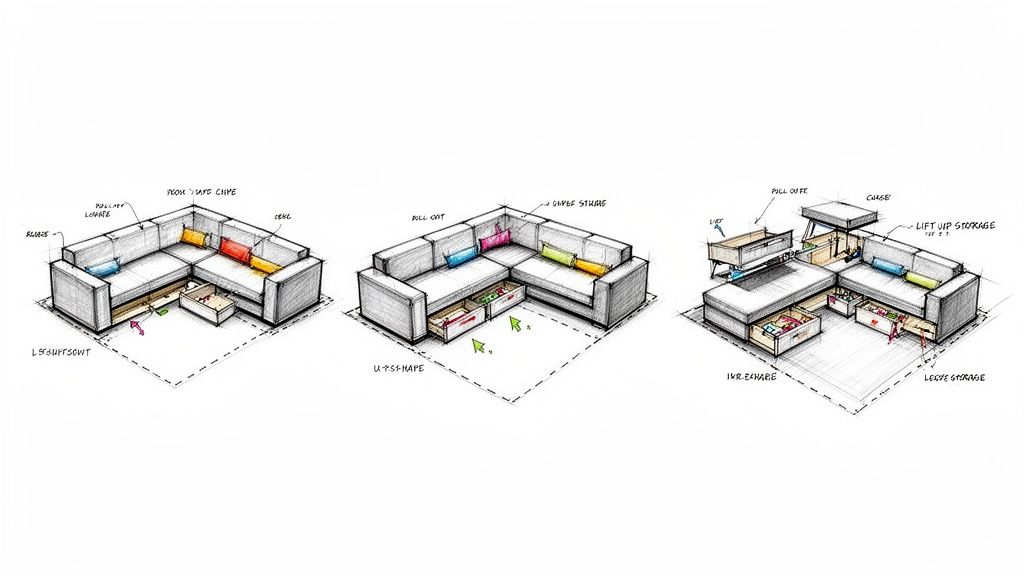
Choosing a sectional sleeper with storage is less like picking out a sofa and more like designing a custom solution for your living space. The right configuration doesn’t just maximize seating; it completely transforms the room’s flow and function. Before you fall in love with a particular style, take a minute to think about how you really live in your space.
Do you host big get-togethers, or is it mostly about cozy movie nights? Is your living room a wide-open loft or a snug, defined corner? Answering these questions is the first step toward finding the perfect shape for your home.
L-Shape vs. U-Shape Sectionals
The two most common layouts you’ll run into are the classic L-shape and the more sprawling U-shape. Each one serves a distinct purpose and is built for different types of rooms.
- L-Shape Sectionals: This is the undisputed champion of versatility. An L-shape is basically a main sofa with a chaise lounge tacked onto one end. It’s perfect for anchoring a corner, creating a soft barrier in an open-concept space, or just fitting neatly against a wall. Many models even come with a reversible chaise, letting you swap its position from left to right if you ever rearrange your room.
- U-Shape Sectionals: Think of the U-shape as the ultimate conversation pit. With two chaises or corner pieces flanking a central sofa, it creates an enclosed, inviting environment that’s a dream for large families and frequent entertainers. This setup definitely demands more floor space, but the payoff is an incredible amount of seating.
To get the most out of your furniture, it helps to think like a designer. Thinking strategically about your room’s layout can help you see your sectional not just as a piece of furniture, but as a core part of your home’s entire organizational system. Complementing it with functional decor and home accents ensures everything has its place.
Unlocking Hidden Storage Types
Once you’ve nailed down the shape, it’s time for the fun part: exploring the clever storage mechanisms that make these sectionals so incredibly practical. The storage isn’t just an afterthought; it’s an integrated feature designed to be seamless and spacious.
Pop-up ottomans can reveal generous bins for bedding, which is a major draw for many buyers.
The best storage solutions are the ones you don’t have to think about. They should be intuitive, accessible, and seamlessly integrated into the furniture’s design, making organization feel effortless rather than like a chore.
Let’s break down the most common types of storage you’ll find.
Lift-Up Chaise Storage
This is the most popular style, and for good reason. The entire seat and cushion of the chaise lounge lift up, usually with the help of a smooth hydraulic mechanism, revealing a massive, hidden compartment. It’s like having a secret trunk in your living room.
- Best For: Bulky items like comforters, extra pillows, and seasonal blankets that you don’t need every single day.
- How It Works: A gentle tug on a fabric tab is usually all it takes. Better models have hydraulic lifts that hold the top open for you, leaving both hands free to dig around. Cheaper versions might make you hold it open yourself.
Pull-Out Drawer Storage
While a bit less common, pull-out drawers are incredibly convenient. Instead of lifting a cushion, you simply slide a drawer out from the base of the sectional.
- Best For: Things you grab all the time, like remote controls, magazines, kids’ toys, or gaming controllers.
- How It Works: They glide out on metal tracks, just like a dresser drawer. The biggest advantage here is that you can get to your stuff without asking anyone to get up from their comfy spot.
Comparing Sectional Storage Types
Use this quick comparison to find the storage type that best matches your lifestyle and space requirements.
| Storage Type | Best For | Pros | Cons |
|---|---|---|---|
| Lift-Up Chaise | Bulky, less-used items (e.g., guest bedding, winter blankets) | Maximum capacity, hides clutter completely, easy to operate. | Requires clearing the chaise to open, not ideal for daily access. |
| Pull-Out Drawer | Frequently used items (e.g., remotes, toys, magazines) | Easy access without disturbing sitters, great for small items. | Less storage volume, can be visible from the side. |
Choosing the right combination of configuration and storage will transform your sectional from a simple piece of furniture into the hardworking centerpiece of your home. By matching the sectional’s layout to your room and its storage to your daily needs, you create a space that’s not just comfortable, but also remarkably organized.
Sleeper Sectional vs Other Sleeper Furniture
When you need furniture that pulls double duty as a bed, a sectional with a pull-out isn’t your only play. To feel confident you’re making the right call, it helps to see how it stacks up against other popular sleepers, like traditional sofa beds, futons, and even Murphy beds. Each one shines in different situations, so the best choice really comes down to your space, your lifestyle, and what you value most.
Sectionals vs. Traditional Sleeper Sofas
The most direct comparison is the traditional pull-out couch. Think of it as the sleeper sectional’s smaller, more compact cousin. While both hide a mattress inside, the real difference-maker is seating. A standard sleeper sofa usually seats two or three people, making it a natural fit for smaller apartments or a dedicated guest room.
A sectional, on the other hand, is built for a crowd. With its L- or U-shape, it’s designed to comfortably seat four or more, making it the heart of a living room.
Sectionals vs. Futons
Futons take a completely different path to the sofa-bed concept. Their biggest strengths are simplicity and affordability. A futon is essentially just a mattress that folds over a frame, which means there are no complex internal mechanisms to deal with. This straightforward design makes them lightweight, easy to move, and friendly on the wallet.
But that simplicity comes with trade-offs. The futon mattress has to serve as both the seat cushion and the sleeping surface, which can cause it to wear out faster. While modern futons are far more comfortable than they used to be, a quality sectional with a dedicated foam mattress will almost always deliver a better night’s sleep.
Sectionals vs. Murphy Beds
Wall beds, or Murphy beds, are the ultimate space-savers. They fold right up into a wall or a cabinet, completely disappearing when you don’t need them and freeing up your entire floor. A Murphy bed can also hold a standard, thick mattress, offering sleeping comfort that’s often just as good as a traditional bed.
The major drawback? A Murphy bed offers zero seating when it’s put away. It is purely a bed that hides. A sectional with a pull out bed is the clear winner when you need to maximize both seating and sleeping in the same room. It gives you a full-size sofa for daily life—something a Murphy bed simply can’t offer. If you’re weighing all the different styles, our guide on convertible sofa beds can offer more helpful insights.
Sleeper Furniture Feature Showdown
Let’s break it down feature by feature to see how these options compare head-to-head.
| Feature | Sleeper Sectional | Traditional Sleeper Sofa | Futon | Murphy Bed |
|---|---|---|---|---|
| Seating Capacity | Excellent (4+ people) | Good (2-3 people) | Fair (2-3 people) | None |
| Sleeping Comfort | Good to Excellent | Good | Fair to Good | Excellent |
| Space Efficiency | Good (combines seating & bed) | Very Good (compact) | Very Good (lightweight) | Excellent (disappears) |
| Ease of Use | Good (pull-out mechanism) | Good (pull-out mechanism) | Excellent (simple fold) | Good (requires lifting) |
| Price Point | Mid to High | Mid-Range | Low to Mid | High (plus installation) |
| Primary Use | Daily living room seating | Guest rooms, smaller spaces | Budget-friendly, multi-use | Dedicated sleeping, max space |
So, what’s the verdict?
The best choice really boils down to your primary need. If you’re looking for maximum seating for family and friends, combined with a comfortable guest bed in one stylish package, the sleeper sectional is pretty tough to beat.
How Sleeper Sectionals Convert: 3 Common Mechanisms
1) Pull-Out Bed (Classic Sleeper)
You remove the seat cushions and pull out a folded frame with a dedicated mattress.
- Best for: frequent guests and multi-night stays
- Watch for: needing open floor clearance in front of the sofa; heavier piece overall
2) Pop-Up Chaise (Easy + Space-Smart)
A platform hidden under the chaise lifts up to create a flat sleeping surface that meets the seat height.
- Best for: small apartments and quick setup
- Bonus: many models include chaise storage for bedding
3) Click-Down / Lay-Flat Back (Futon-Style)
The backrest drops down to form a sleeping surface using the sofa’s cushions.
- Best for: simplest conversion and smaller footprints
- Watch for: comfort depends heavily on cushion quality and support under the seat
If you’re comparing similar solutions, you can also browse convertible sofa beds to see other mechanisms and footprints.
What Makes a Sleeper Sectional Comfortable to Sleep On
Comfort comes down to the mattress (or cushion build), support underneath, and thickness. Here’s what to prioritize:
- Mattress type: Memory foam is great for pressure relief; high-density foam is supportive and durable; innerspring can feel bouncy and breathable but varies widely by quality.
- Mattress thickness: Aim for at least 4–5 inches if it’s a pull-out style. Thicker is usually better—within the limits of the fold-away design.
- Support deck: Slat-style or solid platform support typically feels firmer and more stable than “trampoline” webbing that can sag over time.
For upgrades (or replacements), you can explore mattresses and sleeper-compatible options depending on your model.
Choosing the Right Mattress for Restful Nights
Of course, even the best mechanism is only half the story. The mattress is what truly makes or breaks the sleeping experience. Modern sleeper mattresses are designed to be flexible enough to fold away, but that doesn’t mean you have to sacrifice comfort anymore.
To see the full range of options, you can learn more about our extensive mattress options and find the perfect match for your needs.
Here are the main types you’ll come across:
- Innerspring: The old standby, built with a network of metal coils. They can be quite durable, but lower-quality versions sometimes feel too bouncy or let you feel the individual springs.
- Memory Foam: This is a game-changer for sleeper sofas. Memory foam contours to the body, relieving pressure points just like a high-end bed mattress. It’s a fantastic choice if the bed will be used frequently.
- High-Density Foam: If you prefer a firmer feel, this is the way to go. It’s incredibly resilient and holds its shape over time, offering a stable and supportive surface without the “sinking” sensation of some memory foams.
Measure Twice: The Two Footprints You Must Plan For
Sleeper sectionals have two space requirements:
- Closed dimensions: the everyday sectional footprint (length x depth, plus chaise depth)
- Open clearance: the bed footprint when fully extended or popped up
A reliable trick is to mark the “open” bed size on your floor with painter’s tape. If it blocks a hallway, a closet, or the path to the bathroom, it’s not the right configuration—even if the sofa fits perfectly when closed.
Left-Hand Facing vs Right-Hand Facing (LAF vs RAF)
These labels describe where the chaise sits when you’re facing the sectional:
- LAF: chaise on your left
- RAF: chaise on your right
If you want a quick way to sanity-check sizing and layout, our sizing charts can help you compare footprints across styles.
Choosing Materials for Durability and Style
A sectional sleeper with storage is a serious investment. It needs to do more than just look good on day one—it has to stand up to real life, day in and day out. The materials you choose for the upholstery, frame, and cushions are the building blocks of its comfort, longevity, and overall style.
Think of it this way: the frame is the skeleton, the cushions are the muscle, and the upholstery is the skin. Each part is critical to how the sofa performs over time. Picking the right ones is a balancing act between your lifestyle, your aesthetic, and your budget. A home with kids and pets has completely different needs than a quiet, formal living room. This section will help you cut through the jargon and find a combination that’s built to last and perfect for your space.
Upholstery: The First Line of Defense
The fabric or leather you choose is the most visible part of your sectional and the one that takes the most direct abuse. It dictates the sofa’s feel, color, and how well it stands up to spills, stains, and fading.
- Performance Fabrics: These are the superheroes of the upholstery world. Made from tough materials like polyester, acrylic, or olefin, they’re specifically engineered to resist stains, moisture, and fading. They’re a fantastic choice for busy family rooms where spills are just a matter of time.
- Natural Fibers: Materials like cotton, linen, and wool have a wonderfully soft, breathable feel but are generally more prone to staining and wrinkling. They work best in lower-traffic areas unless they’ve been treated with a good stain-resistant finish.
- Leather: Timeless and tough, leather develops a beautiful character over time. It’s naturally resistant to spills and a breeze to wipe clean, which makes it another great option for families. Just be mindful that it can be prone to scratches from pets.
If durability and a huge variety of styles are your top priorities, browsing different fabric sectional sofas is a great way to see just how many textures and colors are available in modern performance materials.
The Frame: The Unseen Foundation
What’s under the hood is just as important as what’s on the outside. The frame is the structural heart of your sectional sleeper, and its quality directly impacts how long your sofa will last. A weak frame is a recipe for sagging, creaking, and a much shorter lifespan.
There are two main types of wood used for sofa frames:
- Solid Hardwood: Kiln-dried hardwoods like oak, maple, or ash are the gold standard. The kiln-drying process removes moisture to prevent the wood from warping or cracking over time, creating an incredibly strong and durable foundation.
- Engineered Wood: This category includes materials like plywood and particleboard. High-quality, multi-layered plywood can be very strong and stable, often hitting a sweet spot between durability and cost. Lower-quality particleboard, on the other hand, is far less durable and much more susceptible to damage.
When you’re shopping, keep an eye out for descriptions like “kiln-dried solid wood” or “high-grade engineered wood” to ensure you’re getting a quality piece.
A well-built frame provides the essential stability for both the seating and the sleeper mechanism. Investing in a quality frame ensures your sectional sleeper with storage remains a reliable centerpiece in your home for years, not just seasons.
Cushion Fillings: The Heart of Comfort
The final piece of the material puzzle is what’s inside the cushions. This determines everything about how your sectional feels, from firm and supportive to soft and sink-in. Just remember, the seating on a sectional sleeper is often firmer by design to properly support the mechanisms hidden underneath.
- High-Density Foam: This is the most common and reliable cushion filling. It provides a supportive, firm seat that holds its shape well over time. For the best quality and longevity, look for foam with a density rating of 1.8 pounds per cubic foot or higher.
- Down and Feathers: If you want a luxurious, sink-in feel, down-blend cushions are a popular choice. They are incredibly soft but do require regular fluffing to maintain their shape and keep them from clumping.
- Polyester Fiberfill: Often called “poly-fill,” this is a budget-friendly option that offers a soft initial feel. However, it tends to compress and flatten more quickly than foam or down, making it less ideal for a primary, everyday sofa.
Ultimately, the best material choices are the ones that align with your real-world needs. By understanding how the upholstery, frame, and cushion fill all work together, you can confidently pick a sectional sleeper with storage that isn’t just stylish, but truly engineered to endure.
Care and Maintenance Tips
A quality sectional with a pull-out bed is a serious investment in your home’s comfort and flexibility. To protect that investment, a little routine care will go a long way in keeping it looking and feeling brand new for years. Think of it as preventative medicine for your furniture.
A few minutes of upkeep each week can stop small issues from turning into major headaches. This ensures your sectional stays the comfortable, reliable centerpiece of your living room.
Upholstery and Cushion Care
The first line of defense is keeping the upholstery clean. For most fabrics, a weekly vacuum using a soft brush attachment is the key to getting rid of the dust and debris that can wear down the fibers over time. Don’t forget to rotate and fluff your seat and back cushions every week—this helps them wear evenly and keep their shape.
Spills happen. When they do, act fast! Gently blot the spot with a clean, dry cloth. Whatever you do, don’t rub, as that will just push the stain deeper into the fabric. Before you reach for any water or cleaning solutions, always check the manufacturer’s cleaning code, which is usually on a tag somewhere on the sofa.
- Code W: Safe for water-based cleaners.
- Code S: Use a solvent-based cleaner only. No water.
- Code W/S: You can use either water- or solvent-based options.
- Code X: Vacuum only. Keep all liquids away.
Mechanism Maintenance
The pull-out mechanism is the workhorse of your sleeper sectional. To keep it running smoothly, try to open and close it every few months, even if you don’t have guests over. This simple cycle keeps the moving parts from getting stiff and seizing up.
Is your frame squeaking? It’s a common complaint, but thankfully, it’s often an easy fix. A quick spray of silicone-based lubricant on the hinges and pivot points usually silences the noise and ensures a smooth, quiet transition from sofa to bed.
If the mechanism ever feels stuck, resist the urge to force it. The first step is to check for any obstructions—a tangled blanket or a lost toy is often the culprit. Gentle, steady pressure is always better than a hard yank, which can bend the frame and cause real damage.
Delivery Reality Check (Especially in Apartments)
Before ordering, measure the entire delivery path: building entry, elevator (or stairs), hallway turns, and your apartment door. If your space is tight, modular sectionals (shipped in smaller pieces) can be dramatically easier than one giant unit.
If you’d rather skip the stress, look for delivery options that include in-room placement and assembly—this matters more with sleeper mechanisms, since alignment and hardware tightness affect long-term performance.
Is a Sleeper Sectional Right for You?
A sleeper sectional is a strong choice if you want:
- Maximum seating without giving up guest-bed capability
- A cleaner living room (especially if the chaise has storage)
- A flexible layout for movie nights, visiting family, or a multipurpose home
If you rarely host overnight guests, you may get more day-to-day value from a standard sectional plus a compact guest solution. But if you host even a few times a year—or you live in a space where one room must do everything—this is one of the most efficient “one purchase, multiple problems solved” pieces you can buy.
To explore layouts and styles, browse sectional sofas and compare sleeper-ready configurations that match your room’s footprint and traffic flow.
Sleeper Sectional FAQs
Are Sectionals With Pull Out Beds Actually Comfortable for Sleeping?
Absolutely. The old horror stories of lumpy sleepers with a metal bar digging into your back are a thing of the past. Modern designs have completely changed the game, and today’s comfort really comes down to two things: the mattress and the support mechanism.
High-quality models now use supportive platforms, like solid decks or wooden slats, which get rid of those awful pressure points. When you pair that solid base with a premium mattress—think high-density foam or memory foam—the sleep experience is honestly as good as a regular bed. These mattresses are built specifically to contour to the body and give you consistent support, so your guests can get a truly restful night’s sleep. The days of sacrificing comfort for convenience are long gone.
How Much Space Do I Really Need for a Sleeper Sectional?
This is a big one, and there are two parts to the answer. First, you need enough room for the sectional when it’s just being a sofa. But just as important, you have to plan for its “open depth”—that’s the full length from the very back of the sofa all the way to the foot of the extended bed.
A classic mistake is only measuring for the sofa’s everyday footprint. Always, always map out the fully extended dimensions on your floor with painter’s tape to get a real feel for the space it will occupy. As a rule of thumb, you should leave at least 24 inches of clear walking space around the open bed so people can still move around the room easily.
Can I Put a Regular Mattress on a Sleeper Sectional Frame?
That’s a definite no, and for a really good reason. Mattresses made for a sectional with pull out bed are specially engineered to be thinner and much more flexible than a standard bed mattress. This unique design is what allows them to fold up neatly inside the sofa’s frame without getting ruined.
Trying to cram a regular mattress in there is a recipe for disaster. It’s far too thick and rigid, so it will stop the frame from closing properly and will almost certainly cause permanent damage to both the mattress and the sectional’s internal moving parts. It’s best to stick with mattresses made specifically for sleeper sofas.
Is the Storage Big Enough for All the Bedding?
It sure is. The storage compartments, especially the ones tucked inside a chaise lounge, are designed with bulky bedding in mind. You can typically fit a queen-size comforter, two standard pillows, and a set of sheets without a problem.
This keeps everything your guests need in one convenient spot, freeing up precious space in your linen closet for other things. It’s one of those small details that makes a huge difference.