

What Is a Murphy Bed An Expert Explainer
A Murphy bed, also called a wall bed or pull-down bed, is a bed hinged at one end so it can fold up into a wall-mounted cabinet when it isn’t in use. A spring or piston counterbalance mechanism does most of the lifting, so a full-size bed with a standard mattress can be raised or lowered by one person in seconds. Folded away, it looks like a cabinet or wall unit and frees up the floor space a traditional bed would take up all day.
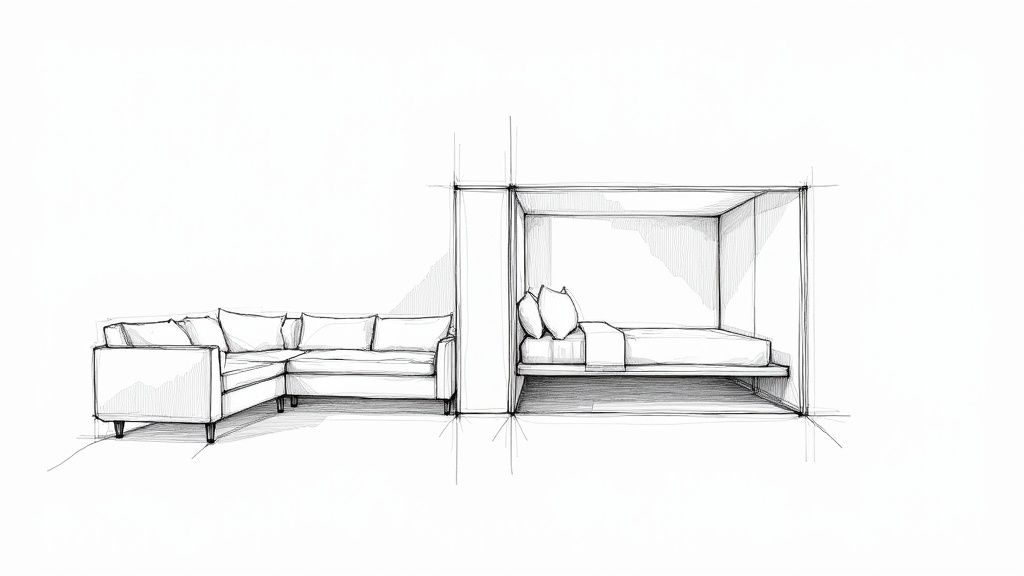
Murphy Bed at a Glance
- What it is: a real bed frame that folds into a wall cabinet.
- How it works: a spring or gas-piston mechanism counterbalances the weight of the frame and mattress.
- Mattress: a standard mattress, within the thickness and weight limits the manufacturer specifies. No box spring.
- Sizes: twin, full, and queen are the most common.
- Orientation: vertical (the head folds up) or horizontal (the long side folds up).
- Installation: must be securely anchored, usually into wall studs, following the manufacturer’s instructions.
Why People Choose a Murphy Bed
A Murphy bed lets one room do several jobs. The same space can be a home office during the day, a living room in the evening, and a bedroom at night, without keeping a bed on the floor full time. That makes wall beds a practical fit for studio apartments, guest rooms that double as offices, and small city homes where every square foot counts.
- Floor space: the largest piece of furniture in the room disappears when you don’t need it.
- Multifunctional rooms: one room can switch between living area, workspace, and bedroom.
- Real mattress comfort: unlike most sleeper sofas, a Murphy bed holds a standard mattress rather than a thin folding pad.
For a full look at the trade-offs, including cost and installation requirements, see our guide to Murphy bed pros and cons.
How Does a Murphy Bed Work?
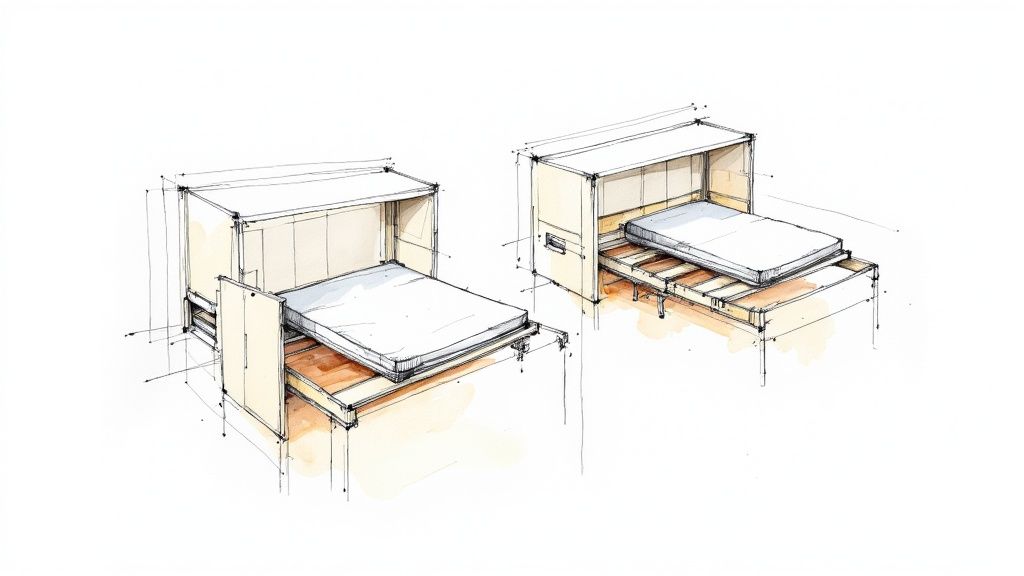
Lifting a bed and mattress against gravity sounds like hard work, but a Murphy bed doesn’t rely on strength. It relies on a counterbalance: a mechanism tuned to offset the weight of the frame and mattress, so the bed feels light and moves in a controlled way in both directions.
The Three Core Components
- The cabinet: the outer enclosure that anchors to the wall, hides the bed when it’s up, and holds the mechanism.
- The bed frame: the platform that holds the mattress, attached to the cabinet at a pivot point. Frames are typically steel, aluminum, or reinforced wood to keep the moving weight down.
- The lifting mechanism: the springs or pistons that counterbalance the bed so it lifts and lowers with little effort.
Spring vs. Piston Mechanisms
Spring systems are the traditional approach. Heavy-duty springs store tension as the bed is lowered and release it to help lift the bed back up, much like a garage door. Many spring systems can be adjusted to match the mattress weight.
Piston systems use gas-pressurized pistons, similar to the struts that hold up an SUV’s rear hatch. They give a smooth, quiet, controlled motion and are common in modern designs.
Both work on the same principle. What matters most is that the mechanism is matched to the bed size and mattress weight it was designed for.
Murphy Bed vs. Wall Bed: Is There a Difference?

In everyday use, “Murphy bed” and “wall bed” mean the same thing: a bed that folds into a wall-mounted cabinet. “Murphy bed” comes from the inventor’s name, while “wall bed” is the broader, more generic term many manufacturers use. The real differences between models are in the mechanism, orientation, and built-in features, not the name. Our wall bed vs. Murphy bed guide covers the distinctions in more detail.
Types of Murphy Beds
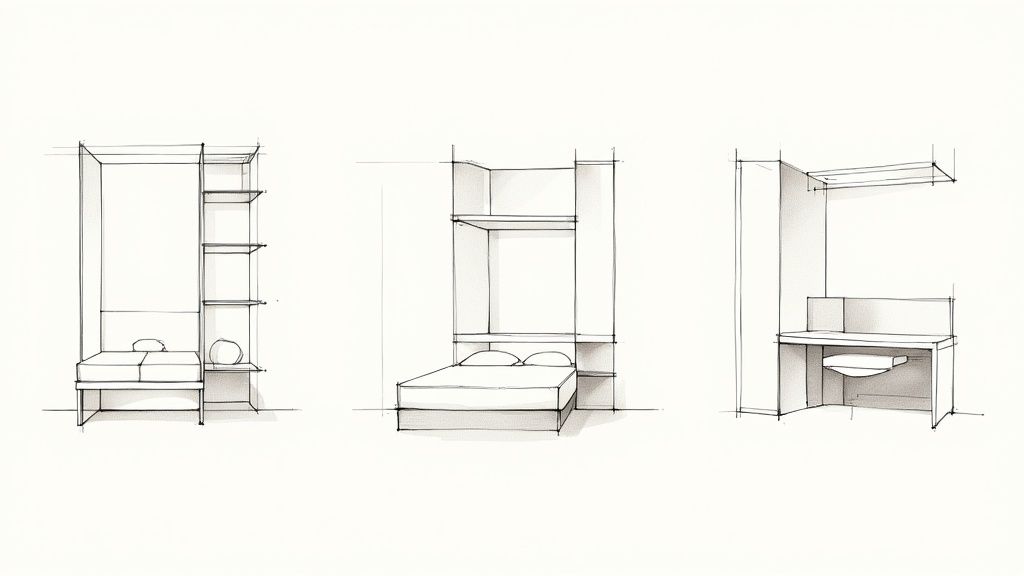
Vertical Murphy Beds
The classic design: the head of the bed folds up and the bed stands upright in the cabinet. Vertical beds use less wall width but need more ceiling height. A vertical queen typically needs close to an 8-foot ceiling, so check the cabinet height in the product specs. When open, the bed projects the full mattress length into the room.
Horizontal Murphy Beds
Also called side-tilt or side-mount wall beds, horizontal models fold up along the long side. They need more wall width but less height, which makes them the right choice for low ceilings, attics, basements, and rooms with bulkheads or windows above the bed wall. Because they open sideways, they project less into the room, which helps in narrow spaces.
Murphy Beds with Built-In Furniture
Many modern wall beds combine the bed with other furniture in one footprint:
- Murphy bed with desk: a work surface on the front of the cabinet that stays level as the bed comes down, so you don’t have to clear it first. The most popular choice for home office and guest room combinations.
- Murphy bed with sofa: a sofa attached to the cabinet front. The bed folds down over the sofa base once the cushions are moved, giving you daily seating and a real bed in the same space.
- Murphy bed with shelving or bookcases: side cabinets or shelves flanking the bed for storage and display.
| Style | Best For | Pros | Cons |
|---|---|---|---|
| Bed with desk | Home office and guest room | Dedicated workspace; desk items can often stay in place | Desk depth is limited; more complex mechanism |
| Bed with sofa | Living rooms and studio apartments | Daily seating plus a real bed; replaces a separate couch | Needs more floor depth; higher cost |
| Bed with shelving | Any room that needs storage | Adds vertical storage around the bed | Some shelves may be blocked when the bed is down |
Freestanding Cabinet and Chest Beds
If you can’t mount to a wall, freestanding Murphy cabinet and chest beds fold a mattress into a cabinet that sits on the floor like a dresser, with no wall anchoring required. They usually use a folding mattress rather than a standard one. See Murphy beds vs. cabinet beds for a side-by-side comparison.
Murphy Bed Sizes
Murphy beds are sized to standard mattresses, so a queen Murphy bed takes a standard queen mattress (60″ × 80″). The cabinet is larger than the mattress, so always check the cabinet’s closed dimensions and open projection.
| Size | Mattress (W × L) | Typical Use |
|---|---|---|
| Twin | 38″ × 75″ | Kids’ rooms, small offices, single guests |
| Full | 54″ × 75″ | Guest rooms and smaller studios |
| Queen | 60″ × 80″ | Primary beds, couples, most guest rooms |
Do Murphy Beds Need a Special Mattress?
Not a special type, but it does need to be the right one. The lift mechanism is balanced for a specific range of mattress thickness and weight. A mattress that’s too thick may keep the bed from closing, and one that’s too heavy or too light throws off the counterbalance, making the bed hard to lift or causing it to drift.
- Thickness: many systems accept mattresses up to roughly 10 to 12 inches, but some have lower limits. Check the spec.
- Weight: follow the manufacturer’s maximum mattress weight.
- Type: memory foam, latex, and hybrid mattresses work well because they hold their shape, stay put when the bed is vertical, and don’t need a box spring.
What to Know Before You Buy
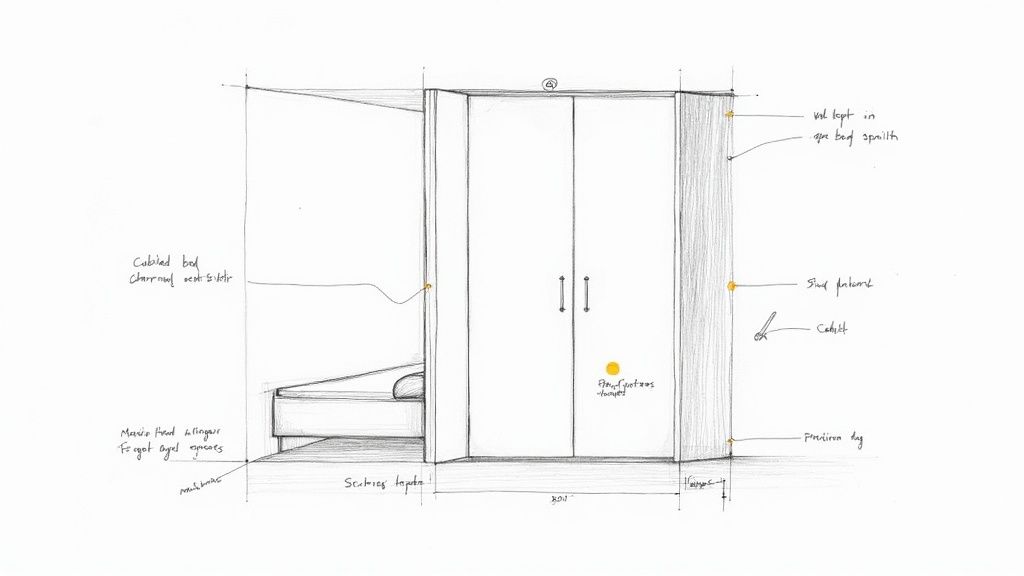
Measure the Room, Open and Closed
- Wall width and height: confirm the closed cabinet fits, including any side units.
- Ceiling height: critical for vertical beds.
- Projection: how far the open bed extends into the room. Mark the footprint on the floor with painter’s tape to check walking space and clearance from other furniture.
- Obstructions: baseboards, outlets, vents, windows, and light switches on the install wall.
Confirm the Wall Can Support It
A Murphy bed is a heavy unit with a large moving part, and its safety depends on proper anchoring. Most wall beds are secured into wall studs, never into drywall alone, and some designs also require floor anchoring. Use a stud finder, check what the wall is made of, and follow the manufacturer’s installation requirements exactly.
DIY vs. Professional Installation
DIY kits and hardware exist, but installation takes precision, the right tools, and at least two people to lift the cabinet sections. Poor installation can damage walls, void the warranty, or create a safety hazard. For most buyers, professional installation is the safer choice. It ensures the unit is level, anchored correctly, and balanced to the mattress.
What Affects the Price
Murphy bed prices vary widely. The biggest cost drivers are size (queen costs more than twin), orientation, mechanism quality, cabinet material (solid wood vs. engineered wood), built-in features like desks, sofas, or side storage, and installation. Mattress cost is usually separate. Browse current wall beds to compare configurations and prices.
Which Murphy Bed Fits Your Room?
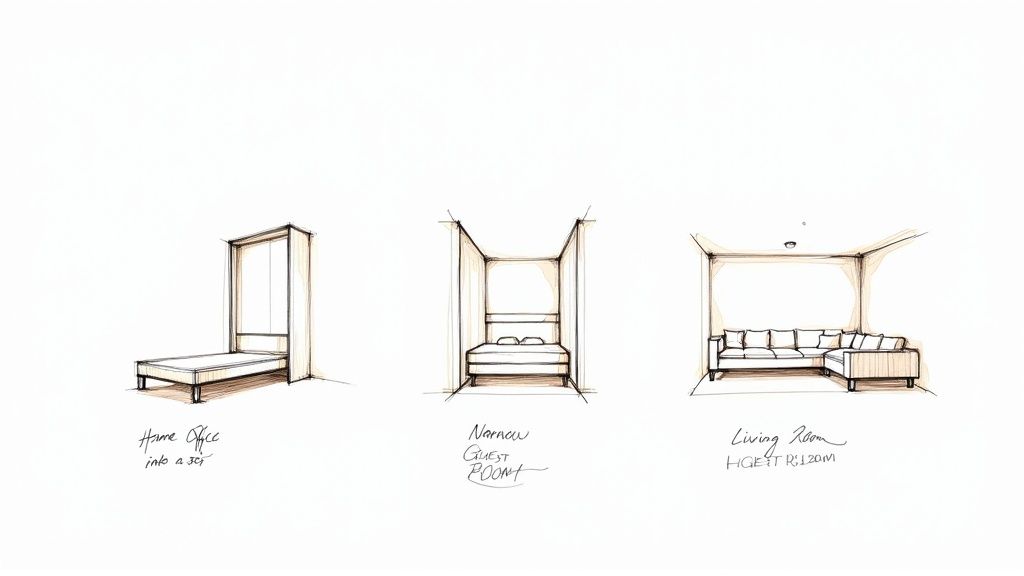
Home Office and Guest Room
A vertical wall bed with a built-in desk. The desk stays level as the bed lowers, so the room switches from office to bedroom without clearing the work surface.
Narrow or Low-Ceiling Room
A horizontal wall bed. It fits under lower or sloped ceilings and projects less into the room when open, leaving more floor space to move around.
Living Room or Studio Apartment
A wall bed with an integrated sofa. You get everyday seating and a real bed in one footprint, without moving furniture each night. If you’re weighing this against a sleeper, compare Murphy beds vs. sofa beds and browse convertible sofa beds.
No Wall Installation Possible
A freestanding cabinet bed, a wall-hugger futon frame, or another option from our list of space-saving Murphy bed alternatives.
Who Invented the Murphy Bed?
The Murphy bed is named after William Lawrence Murphy, who began working on hideaway beds while living in a one-room apartment in San Francisco in the late 1800s. According to family legend, he was courting an opera singer at a time when it was considered improper for a woman to visit a man’s bedroom. Folding his bed away into a closet turned the room into a respectable parlor. The couple married in 1900.
Fold-up beds existed before Murphy, but he introduced pivot and counterbalance designs and received a series of patents, including one for a “Disappearing Bed” in 1912. Demand grew in the following decades as cities expanded and apartments got smaller, and Murphy beds became common in city apartments, where they were marketed as a space-saving feature. Over time, “Murphy bed” became the everyday name for any fold-up wall bed.
Murphy Bed FAQ
Are Murphy beds comfortable?
Yes. A Murphy bed holds a standard mattress, so it can sleep as well as a regular bed, as long as the mattress is within the system’s thickness and weight limits. That’s the main comfort advantage over sleeper sofas and folding beds.
Are Murphy beds safe?
A quality Murphy bed that’s installed correctly is safe for everyday use. Modern counterbalance mechanisms control the bed’s movement, and many models include a latch or lock to hold the bed closed. Safety depends mostly on anchoring: the cabinet must be secured exactly as the manufacturer specifies. In homes with kids or pets, look for a locking mechanism and keep the bed closed when not in use.
Can you use a Murphy bed every day?
Yes. Murphy beds are designed for repeated daily use and work well as a primary bed in a studio or small apartment.
Can I use my own mattress on a Murphy bed?
Often, yes, if it matches the bed size and falls within the manufacturer’s thickness and weight limits. A box spring isn’t used.
How much weight can a Murphy bed hold?
Once the bed is down, it rests on legs or a support and works like a standard bed frame. Capacity varies by model and size, so check the manufacturer’s rated sleeper weight.
Do Murphy beds have to be attached to the wall?
Traditional Murphy beds do, usually into wall studs. If wall mounting isn’t possible, a freestanding cabinet bed is the alternative.
Why is it called a Murphy bed?
It’s named after its inventor, William Lawrence Murphy, who patented his pivoting, counterbalanced “Disappearing Bed” design in the early 1900s.
The Bottom Line
A Murphy bed gives you a real bed with a real mattress that disappears into a wall cabinet when you don’t need it, turning one room into several. The right model depends on your ceiling height, wall space, how often you’ll sleep on it, and what else the room needs to do. Explore Futonland’s wall bed collection to compare vertical, horizontal, desk, and sofa configurations.