

Space Saving Murphy Bed Alternatives for 2026
You’re probably looking at a room that needs to do two jobs at once. By day, it’s your office, living room, or kid space. At night, it has to become a real place to sleep. That’s when the classic Murphy bed usually enters the conversation.
Then the practical questions show up fast. Can you mount it to the wall? Will your landlord allow it? What happens when you move? Is it worth committing a whole wall to one piece of furniture?
Those are exactly the questions that make space saving murphy bed alternatives worth a serious look. In a New York apartment, or any compact home, a bed that saves space only helps if it also fits your lease, your budget, and your daily routine.
Why Look Beyond a Traditional Murphy Bed
Murphy beds have been around a long time for a reason. They work. They were invented in 1900, and they still solve the same basic problem: a bed takes over a room. In cities like New York, that problem hasn’t gone away. In fact, 33% of households live in apartments under 800 square feet, and alternatives like futons now hold 25% of the convertible bed market share, which says a lot about how buyers are prioritizing flexibility and daily usability (Inova Bed on Murphy beds and small-space demand).
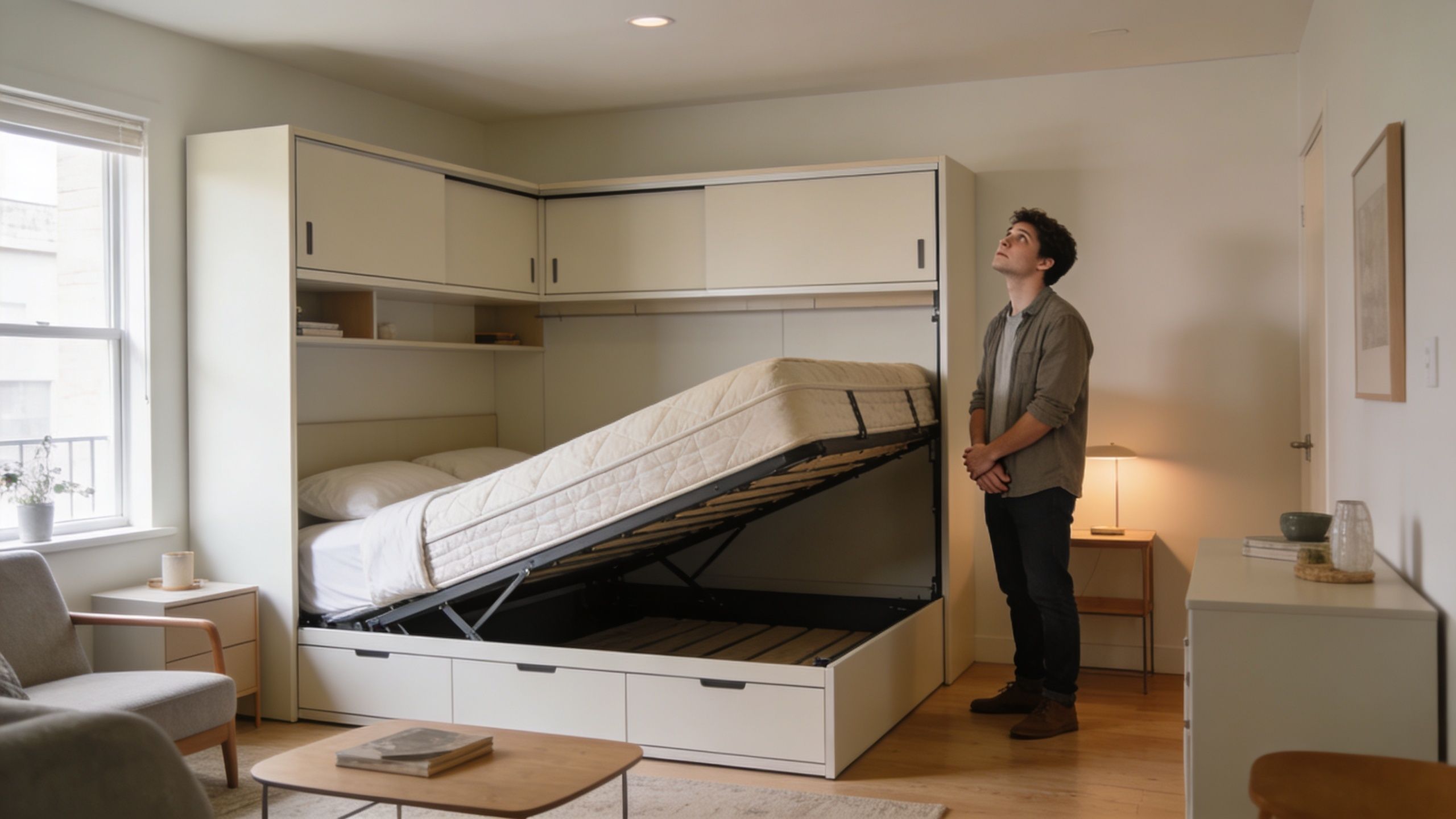
What’s changed is the buyer. A lot of people don’t want a permanent installation anymore. They want furniture they can move, reconfigure, or take to the next apartment without patching walls or reopening a conversation with a property manager.
What people usually want instead
Most shoppers aren't asking for a Murphy bed; they're asking for one of these outcomes:
- A bed that disappears enough so the room feels open again
- A renter-safe option that doesn’t need wall mounting
- Something comfortable enough for real sleep, not just emergency guests
- Furniture with a second job, like seating or storage
That leads people toward cabinet beds, chest beds, futons, sofa beds, storage sectionals, loft beds, and trundles. Each solves a slightly different version of the same problem.
The smartest small-space purchase usually isn’t the one that folds away most completely. It’s the one you’ll still like living with after the novelty wears off.
If you’re still comparing formats, it also helps to browse a broader mix of Suburban Furniture beds for small spaces. Seeing different categories side by side often makes the trade-offs clearer than looking at Murphy beds alone.
Where traditional Murphy beds fall short
A wall bed is strongest in one specific situation. You own the place, you’re staying put, and you want the bed off the floor every day. If any of those conditions changes, the disadvantages become hard to ignore.
The biggest one is commitment. A built-in wall bed can be excellent furniture, but it’s also a home project. Many shoppers don’t want a home project. They want a sleeping solution.
Wall-Mounted Murphy Bed vs Freestanding Cabinet Bed
The first decision isn’t about style. It’s about structure.
A wall-mounted Murphy bed is part bed, part installation. A freestanding cabinet bed is furniture. That difference affects delivery, assembly, portability, and what happens the next time you move.
| Feature | Wall-Mounted Murphy Bed | Freestanding Cabinet Bed |
|---|---|---|
| Installation | Mounts to a sturdy wall and cabinet structure | No wall alterations required |
| Portability | Difficult to move once installed | Portable and easier to relocate |
| Room impact | Fully clears bed footprint when closed | Stays as a furniture piece when closed |
| Best fit | Long-term homeowners or dedicated guest rooms | Renters, frequent movers, flexible rooms |
| Daily hassle | More involved setup and long-term mechanism upkeep | Simpler ownership, especially in apartments |
Installation and portability
A standard queen Murphy bed needs a sturdy wall and a cabinet unit. Its piston mechanisms are rated for 1,000 to 1,500 lift cycles, and the deployment effort is often 50 to 80 lbs. By contrast, freestanding alternatives such as cabinet beds or storage-based options avoid wall alterations altogether, and drawer-style access can require only 20 to 40 lbs of effort (Mattress Miracle on Murphy bed installation and access trade-offs).
That matters a lot in rentals. If you have plaster walls, limited stud placement, or a lease that restricts mounting, a wall bed can stop being practical before you even choose a finish.
A cabinet bed avoids that entire problem. It arrives as furniture, not as a fixture. That’s the difference many renters care about most.
Practical rule: If you expect to move before the furniture wears out, avoid making the bed part of the wall.
Cost isn’t just the sticker price
The frame price never tells the whole story with a mounted Murphy bed. You also have to think about delivery conditions, assembly complexity, and whether the room itself can support the installation cleanly.
Cabinet beds usually win on simplicity. You’re paying for a piece you can place, use, and later move. That doesn’t make them better for every room, but it does make them easier to live with.
Day-to-day usability
A wall-mounted Murphy bed does one thing exceptionally well. It gets the bed almost entirely out of the room. If your home office must feel like an office all day, that’s a real advantage.
A cabinet bed gives up some of that “invisible bed” effect, but it gives back flexibility. You can place it where a wall bed wouldn’t be practical. You can take it with you. You don’t need to redesign the room around a permanent installation.
Which one usually makes more sense
Choose the wall-mounted option when the room needs the bed hidden vertically and you’re comfortable treating the purchase like a built-in.
Choose the cabinet bed when your priorities are mobility, renter-friendliness, and avoiding wall work. For a lot of apartment shoppers, that’s the more realistic choice.
Sofa Beds, Sectionals, and Futons That Work Harder
Some alternatives don’t just store a bed. They earn their floor space all day.
That’s where modern futons, convertible sofa beds, and sleeper sectionals separate themselves from both Murphy beds and cabinet beds. They’re not trying to disappear completely. They’re trying to do more.
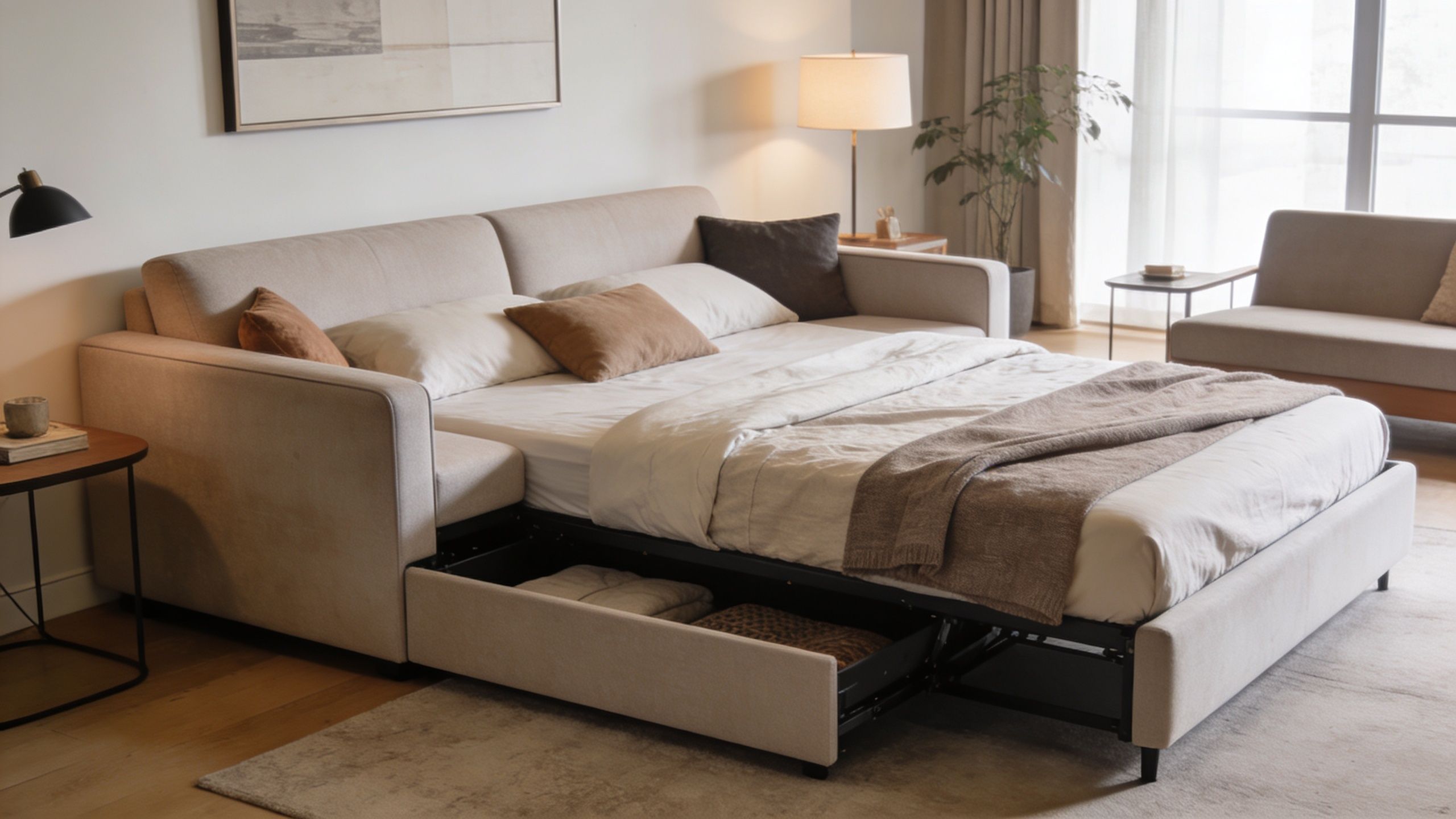
Futons for daily use
A lot of shoppers still picture a dorm-room futon. That’s outdated. A well-made futon is one of the most practical daily-use small-space pieces you can buy.
Futons account for 28% of the convertible furniture market, with frames supporting 500 to 900 pounds and quality mattresses lasting 7 to 12 years. That durability often exceeds the 5-year average lifespan of a typical sleeper sofa, and it matters in the 15 million studio and one-bedroom apartments across the U.S. (Contempo Space on futon durability and market share).
What I like about a good futon is the honesty of it. There’s no hidden thin mattress inside a sofa shell. The sleep surface is right there, which usually means better support and easier maintenance.
If you want to compare formats side by side, browse convertible sofa beds and pay attention to mattress design, not just silhouette.
Convertible sofa beds for guest-first rooms
A sofa bed makes sense when the room is primarily a living space. That includes a den, TV room, or home office that hosts overnight guests once in a while.
The strength here is appearance. Many sofa beds look more polished in a formal living room than a traditional futon frame. The trade-off is usually inside the seat. Built-in sleeper mattresses can be comfortable, but the comfort ceiling often depends on the mechanism and the mattress thickness the frame allows.
If the piece will be used for sleeping every night, judge it like a bed first and a sofa second.
That’s where brands with more thoughtful conversion systems, such as Innovation Living or Luonto, tend to stand out. The mechanism matters. So does how the seat cushions behave over time.
Sectional sleepers with storage
A sleeper sectional works well when you need seating, lounging, hidden storage, and occasional sleep capacity in one footprint. In family rooms, they can solve a lot of problems at once.
They’re especially useful when you need a spot for bedding. That sounds minor until you’re living in a small apartment and don’t have a linen closet. A chaise with storage can carry some of the burden a closet or dresser normally would.
What works and what doesn’t
Here’s the short version from a showroom perspective:
- Choose a futon if the piece will see regular sleep use and you care about mattress choice.
- Choose a sofa bed if the room’s first identity is a living room.
- Choose a sleeper sectional if storage is part of the problem, not just sleeping.
What usually doesn’t work is buying by appearance alone. A beautiful compact sofa that turns into a mediocre bed often disappoints faster than a simpler-looking piece with a better sleep surface.
Daybeds, Trundle Beds, and Loft Beds
Some space-saving solutions are excellent, but only in the right room. Daybeds, trundles, and loft beds fit that category. They’re not broad replacements for Murphy beds. They’re targeted tools.
Daybeds for home offices and dens
A daybed works best when you want a room to read like seating first. In a home office or den, that makes sense. Against a wall, a daybed looks intentional during the day and still gives you a proper place for an overnight guest.
The limitation is obvious. It doesn’t disappear. It always reads as part sofa, part bed. If you want the room to feel fully bed-free, this won’t do that.
Trundle beds for kids and extra guests
Trundle beds solve a different problem. They let one room sleep more people without permanently giving up more floor area.
Trundle beds can reclaim 50% to 70% of floor space by nesting the second bed underneath, but they usually rely on 6 to 8 inch mattresses, which can reduce comfort for adults. By comparison, chest beds such as the Night & Day Murphy Cube open from a 10 sq ft footprint into a queen bed and deliver 70% space savings, though the mechanisms may need checks after 600 to 800 cycles (Sleepopolis on trundles and chest bed trade-offs).
That tells you exactly where each option belongs. A trundle is great in a child’s room, for sleepovers, or in a guest setup where the second sleeper is occasional. It’s less satisfying for adults who need a substantial mattress night after night.
Loft beds for vertical thinking
Loft beds are one of the few options that create new usable space. They lift the bed so the room can hold something underneath, usually a desk, dresser, or lounge area.
Browse examples of bunk and loft beds if your room is more constrained by floor area than by ceiling height.
Loft beds save the most space on paper, but they only work if the user is comfortable climbing into bed every day.
That’s why lofts are strong for students, teens, and some studio setups, but weak for anyone who wants easy nighttime access. They’re a lifestyle choice as much as a furniture choice.
The simplest way to choose among them
Use this filter:
- Pick a daybed when the room needs to look like a sitting room.
- Pick a trundle when you need extra sleeping capacity without adding a second permanent bed.
- Pick a loft when vertical clearance is your biggest advantage.
If none of those sounds exactly right, a cabinet bed or futon usually ends up being the more balanced answer.
How to Choose Your Best Murphy Bed Alternative
People usually make this decision too quickly. They fall for the compact look, or for the idea of a room transforming, and skip the basics that determine whether the furniture will work.
For daily use in urban studios, durability matters more than novelty. Murphy bed hydraulics are often warrantied for around 5,000 cycles, or roughly 5 to 7 years of daily use, while quality convertible futon and sofa bed mechanisms are often rated for 10,000+ cycles. Independent tests also found that durable futon frames can outlast Murphy hydraulics by 20% to 30% in daily conversion scenarios (1StopBedrooms on durability for daily-use alternatives).
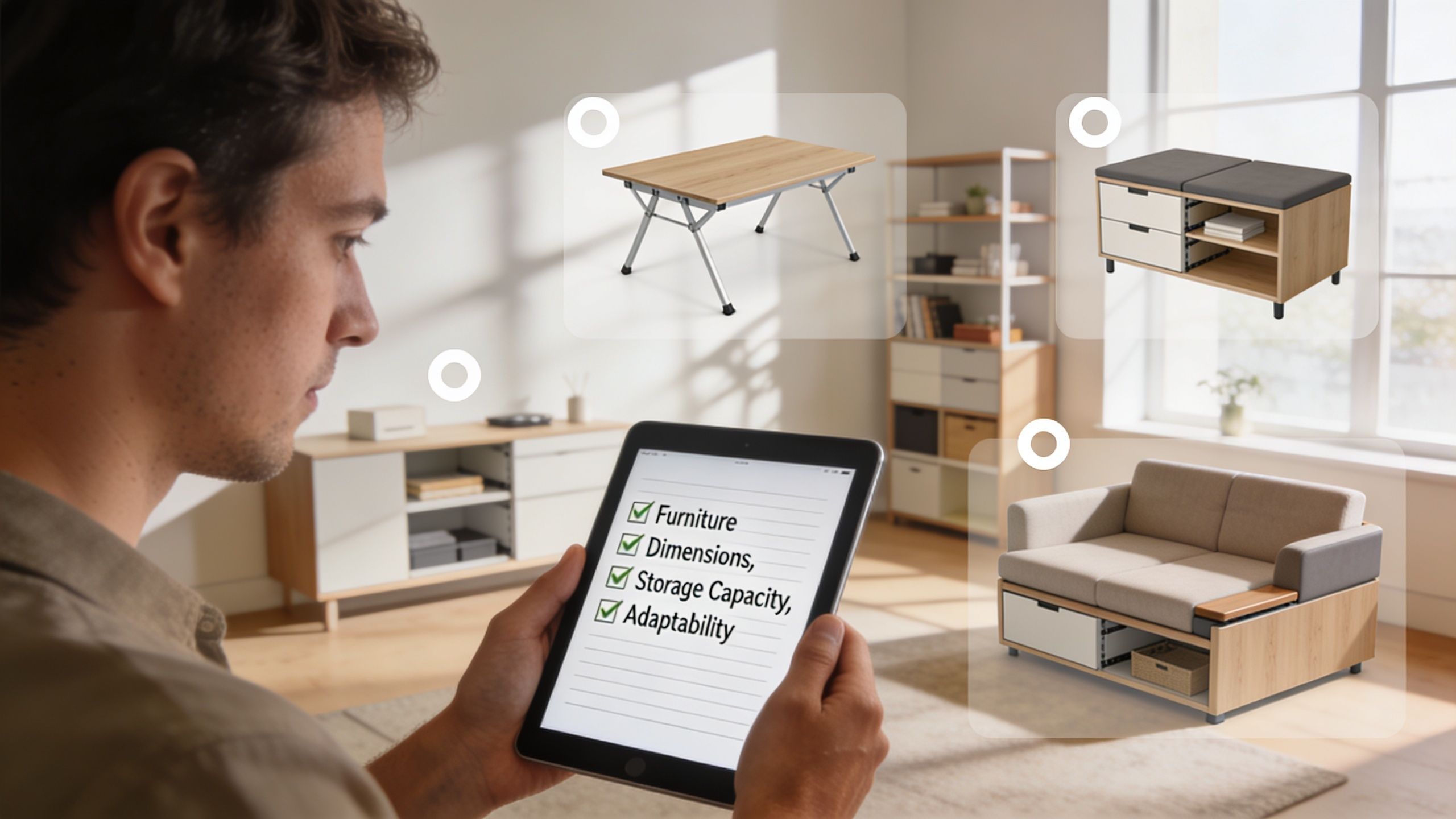
1. Measure the room like delivery depends on it
Because it does.
Don’t just measure where the furniture will sit. Measure:
- Floor clearance for opening the bed
- Doorways and hallways the piece has to pass through
- Ceiling conditions if you’re considering lofted or vertical-opening furniture
- Nearby furniture conflicts, including desks, radiators, and nightstands
Use a reliable bed and mattress sizing chart while planning. That saves people from the most common mistake in New York apartments, which is choosing a bed that fits the floor plan but can’t open comfortably once the rest of the room is furnished.
2. Decide if this is a nightly bed or a guest bed
This decision should drive almost everything else.
If it’s a nightly sleeper, prioritize mattress quality, ease of conversion, and long-term mechanism durability. Futons, cabinet beds with solid sleep surfaces, and some higher-grade sofa beds usually belong on that shortlist.
If it’s a guest bed, you can put more weight on how compact the piece feels when closed or how polished it looks as seating.
3. Be honest about your comfort non-negotiables
Some shoppers are fine with a thinner secondary mattress. Others aren’t. Some want a sofa look no matter what. Others care more about getting a flatter, more bed-like sleep surface.
Ask yourself:
- Do you sleep hot or need a specific mattress feel
- Will one person use it or two
- Do you want edge support or a softer lounge feel
- Will you tolerate a compromise in seating to get better sleep, or the reverse
Buy for the harder job. If the furniture has to sleep well and sit adequately, shop it as a bed. If it has to seat beautifully and only sleep occasionally, shop it as seating.
4. Budget for the whole decision
The wrong way to budget is to compare base prices only. The better way is to ask what you’re getting over time.
A freestanding bed alternative can carry long-term value because it moves with you, doesn’t require wall work, and often adapts more easily when the room changes function. A renter who relocates once or twice can get more practical value from portable furniture than from a built-in system that was perfect for one apartment and awkward in the next.
This is also where material quality matters. A stronger frame and a better mechanism usually pay you back in fewer frustrations, easier conversions, and better sleep.
Futonland's Picks for Every Room
Different rooms call for different answers. The mistake is trying to force one category into every layout.
For the compact studio apartment
In a studio, I’d usually steer people toward a modern futon or a compact convertible sofa that can handle regular sleep. You need seating every day, not just a hidden bed at night. A piece with a straightforward conversion and a mattress you can comfortably live with tends to outperform a more elaborate setup.
For shoppers comparing categories, Futonland futons are one example of the kind of format that makes sense in studios because they combine seating and sleep in one footprint.
For the welcoming family guest room
A freestanding cabinet bed is the strongest pick when the room only becomes a bedroom when company arrives. It keeps the room flexible, and it avoids the commitment of a wall installation.
A model like a chest bed earns its keep. You get a real bed when open, but you’re not redesigning the wall or treating the room like a permanent bedroom the rest of the year.
For the multi-functional home office
Home offices need restraint. Too much bed presence and the room stops feeling like a workspace.
A cabinet bed works well here if overnight guests are part of the plan. If the room also functions as a reading or video-call space, a daybed can work, but only if you’re comfortable with the room always signaling that a bed is present.
For kids, teens, or shared sleeping setups
Trundles and loft beds do their best work here. A trundle handles sleepovers and sibling overflow. A loft creates activity or study space underneath. These are highly effective, but they’re situation-specific. I wouldn’t default to them for a primary adult solution unless the room and user clearly support it.
The right choice usually comes from matching the furniture to the room’s real job, not from chasing the smallest footprint at any cost.
Common Questions About Convertible Beds
Can you use a regular mattress?
Sometimes. It depends on the frame. Cabinet beds, futons, sofa beds, trundles, and wall beds all have different mattress limits. Always check the frame’s compatibility before assuming your current mattress will work. Thickness and flexibility matter.
Is assembly difficult?
It varies a lot. Freestanding options are usually less disruptive than wall-mounted systems because there’s no anchoring step. If safety is a concern, especially in family homes, simpler mechanisms matter. Some folding bed mechanisms carry pinch-point risk, and the CPSC reports over 150 annual furniture tip-over or closing incidents, while many modern futon sofa beds use hinge-free flip systems that convert in under 30 seconds with virtually zero pinch risks according to UL safety certifications (Hidden Bed of Oregon on safety and conversion ease).
Are these comfortable enough for nightly sleeping?
Yes, some are. Not all are.
A well-built futon, a strong cabinet bed, or a thoughtfully designed convertible sofa can absolutely work for regular sleep. The key is buying the right category for the job, then matching it with the right mattress and bedding. Once you’ve chosen the furniture, practical upkeep helps too. If you’re rotating guest linens often, this guide on keeping sheets and towels soft is useful for maintaining comfort without overcomplicating laundry.
If you’re weighing wall-mounted Murphy beds against renter-friendly alternatives, the simplest rule is this: choose built-in only when you want permanence. For everyone else, portable options usually make more sense. Cabinet beds, futons, sofa beds, trundles, and lofts all solve the small-space problem differently. The right one depends on how you live, how often you move, and whether the furniture needs to function as a real bed, a real sofa, or both.