
Sofabed with Storage: The Ultimate Guide to Sofabed with Storage
At its core, a sofabed with storage is a multitasking master. It’s a comfortable sofa for daily lounging, a convenient guest bed for overnight visitors, and a clever storage unit all rolled into one. If you live in a small apartment, a studio, or a home where one room has to do double duty, this kind of furniture isn’t a nice-to-have — it’s a strategy.
The Secret Weapon for Clutter-Free Living
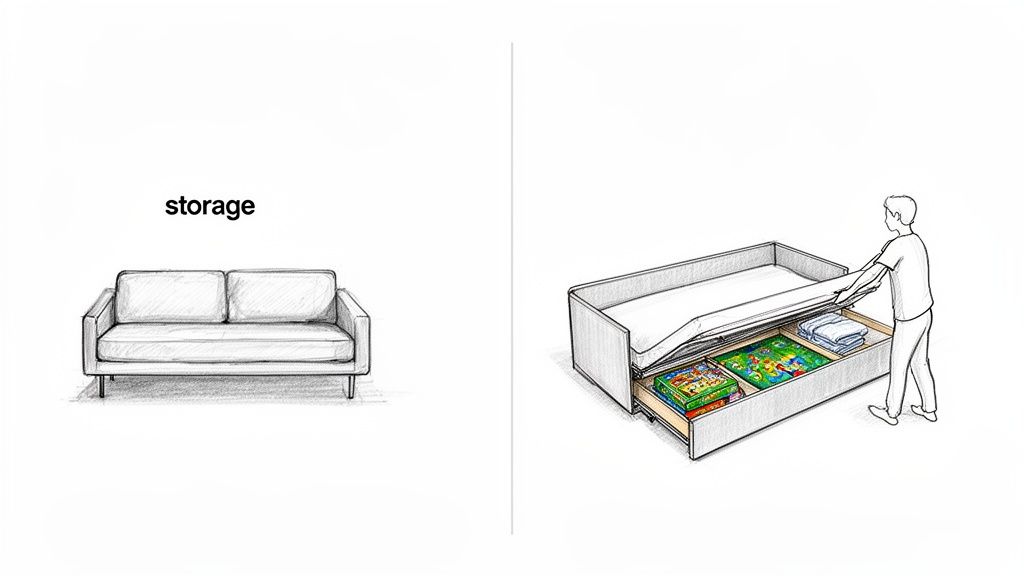
If you’ve ever stared at a room that feels both cramped and cluttered, you already understand the real problem: most furniture only does one job. A sofa sits. A bed sleeps. A dresser stores. In a small space, that “one job” mindset is exactly what makes a home feel overstuffed.
A sofabed with storage flips that script. It gives you:
- Daily seating that doesn’t feel like a compromise.
- A real sleeping surface you can rely on when someone stays over.
- Built-in hidden storage for bulky items that create visual clutter (blankets, pillows, linens, seasonal throws).
The biggest benefit is not just saving square footage — it’s saving mental bandwidth. When bedding and extras have a dedicated home inside the furniture, your space stays “guest-ready” without the frantic closet shuffle.
A sofabed with storage isn’t only about fitting more into a room. It’s about keeping the room usable, calm, and flexible — every day, not just when guests arrive.
If you’re trying to create a more functional living room setup, it also helps to think in “systems,” not single pieces. For example, pairing your sofabed with compact add-ons like ottomans can create extra seating, foot support, and even more hidden storage without taking over your room.
What Counts as a “Sofabed With Storage”?
Not every sleeper sofa includes storage, and not every storage sofa is a sleeper. A true sofabed with storage usually includes at least one of the following:
- Under-seat drawers built into the base.
- Lift-up storage inside a chaise (common on sleeper sectionals).
- Hidden compartments in arms, side panels, or the chaise frame.
- Integrated bedding storage specifically designed for sheets/blankets.
Some models store items while the bed is closed only. Others allow access even when it’s open. That detail matters more than people realize — especially if you plan to keep bedding inside permanently.
Why Storage Changes Everything in Small Homes
Storage is not just about where items go — it’s about what you can stop buying. When you add hidden storage to your main seating piece, you often eliminate the need for:
- An extra dresser in the living room or guest room.
- Bulky plastic bins under the bed.
- A second closet worth of bedding storage.
- “Temporary” piles of throws and pillows that become permanent clutter.
In real-life apartment layouts, the worst clutter isn’t books or décor — it’s bulky soft goods. Comforters, spare pillows, mattress toppers, and guest linens take up an absurd amount of space. A sofabed with storage creates a designated home for those items without adding a new piece of furniture.
Choosing the Right Storage Mechanism for Your Home
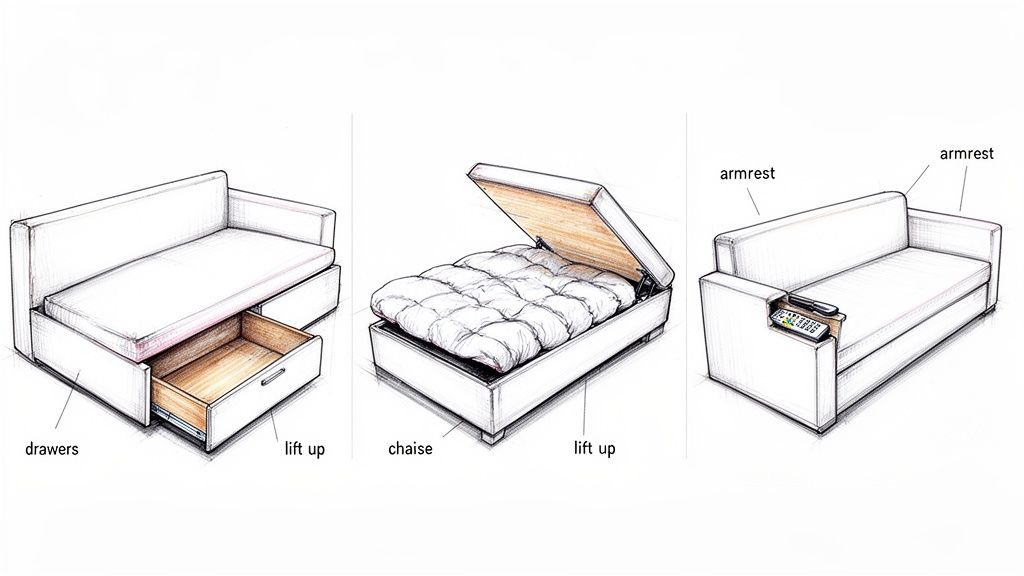
Here’s the key: the “best” storage type depends on what you’re storing and how often you need to access it. Treat storage like you’d treat a kitchen layout: everyday items should be easy to reach, and bulky seasonal items can live deeper.
1) Under-Seat Drawers for Easy, Frequent Access
Under-seat drawers act like a hidden dresser. They’re ideal when you want storage that’s:
- Fast (open a drawer, grab what you need).
- Organized (separate compartments instead of one big cavern).
- Accessible without lifting cushions or converting the bed.
Best for: sheet sets, folded blankets, guest towels, board games, kids’ toys, spare pillowcases.
Watch for: clearance. Drawers need space to pull out, so make sure they won’t slam into a coffee table or rug edge.
If you like this style of practicality, you’ll recognize the same concept in solutions like futon bed storage drawers, which are built for grab-and-go use.
2) Lift-Up Chaise Storage for Bulky Items
Lift-up chaise storage is the “hidden trunk” approach. You lift the chaise top and get a deep compartment. It’s perfect when you’re storing:
- Thick comforters and duvets
- Extra pillows
- Seasonal throws
- Mattress toppers
Best for: items you don’t need daily, but want available fast when guests arrive.
Watch for: access. You may need to clear the chaise surface to open it. If your chaise is always covered in pillows, plan accordingly.
If you’re storing bulky bedding, lift-up chaise storage is usually the most space-efficient option — it replaces an entire closet shelf in one move.
3) Hidden Compartments for Daily Clutter Control
These are the small details that keep a space feeling tidy:
- Arm storage for remotes, chargers, magazines.
- Side pockets for a book or tablet.
- Panel compartments in chaise bases or side rails.
Best for: the “little stuff” that creates visual mess.
Watch for: durability and hinges. Small compartments are only useful if they open smoothly and feel sturdy over time.
Quick Comparison of Storage Types
| Storage Type | Best For | Accessibility | Capacity |
|---|---|---|---|
| Under-Seat Drawers | Frequently used linens, blankets, games | High | Moderate |
| Lift-Up Chaise | Bulky seasonal bedding and pillows | Medium-Low | High |
| Hidden Compartments | Remotes, books, chargers, small items | High | Low |
Choosing the Sleeper Mechanism (This Determines Comfort)
The sleeper mechanism impacts:
- How easy it is to convert the sofa into a bed
- How much floor space you need when open
- What kind of mattress the sofabed can support
- How long the mechanism stays smooth (and quiet)
Pull-Out Sleeper (Classic Hidden Bed)
A traditional pull-out includes a folded bed frame and a dedicated mattress stored inside. It’s often the best choice if your guests stay for more than one night at a time.
Pros:
- Dedicated mattress (often more “bed-like” than cushion sleepers)
- Predictable sleeping surface
- Good option for frequent hosting
Cons:
- Needs clear floor space in front to open
- Heavier, more complex mechanics
- Comfort depends heavily on mattress quality
Click-Clack / Lay-Flat (Fast Conversion)
Backrest folds down to create a flat sleeping surface using the sofa’s cushions.
Pros:
- Fast conversion
- Usually lighter and simpler
- Great for tight spaces
Cons:
- Comfort depends entirely on cushion build
- Some sleepers feel the seam between sections
Pop-Up Chaise (Common on Sectionals With Storage)
The chaise section slides or lifts to create a larger bed surface, often paired with lift-up storage in the chaise. For many small homes, this is the best balance of ease, space, and practicality.
Pros:
- Smooth setup
- Often the best storage capacity
- Excellent for multi-use rooms
Cons:
- Requires room layout planning (LAF/RAF orientation matters)
- Not all pop-ups feel equally supportive
If you’re comparing styles, it helps to browse a range of designs in one place — convertible sofa beds make it easier to compare mechanisms side by side.
How Comfortable Is a Sofabed With Storage, Really?
The honest answer: it depends on the mattress system and support deck. Modern sofabeds can be genuinely comfortable — but the “good ones” share a few traits.
Mattress Types You’ll See
- Memory Foam: Pressure relief and a smoother feel (great for side sleepers). Look for higher-density foam so it doesn’t collapse quickly.
- High-Density Foam: More supportive, often preferred for daily use. Feels firmer and tends to hold shape well.
- Innerspring / Pocket Coil: Traditional bounce and airflow. Pocket coils generally feel more stable and supportive than old-school spring mats.
- Latex (or latex-like): Responsive, buoyant feel; tends to sleep cooler than many foams.
The Support Deck Under the Mattress
Two sofabeds can have the same mattress thickness, but feel totally different based on what’s underneath:
- Slats: Often firmer and more supportive (less sag over time if built well).
- Platform panels: Even support; can feel firmer; good for foam mattresses.
- Suspended decks (webbing/springs): Can feel cushier at first, but may soften with time.
Comfort isn’t only the mattress. The mattress + support deck + mechanism alignment is the real “sleep system.”
Daily Sleeping vs Occasional Guests
If you’ll sleep on it every night: prioritize mattress quality and support deck first, and storage second. You can live with less storage; you can’t live with bad sleep.
If it’s mainly a guest bed: a medium-feel mattress with a topper option is a safe, flexible choice.
How to Choose the Right Size Without Regret
Size decisions go wrong in two predictable ways:
- People only measure the sofa footprint (closed)… and forget the bed footprint (open).
- People forget the delivery path (doorways, elevators, stair turns).
Closed vs Open Footprint (Measure Both)
Before you buy, you need:
- Sofa width/depth when closed
- Bed length when open
- Clearance space for walking (aim for ~24 inches where possible)
A simple trick: mark both footprints on the floor with painter’s tape. You’ll instantly see whether the open bed blocks a walkway, closet, or door.
Don’t Ignore LAF vs RAF on Sectionals
If you’re buying a sectional sofabed with a storage chaise, Left-Hand Facing (LAF) vs Right-Hand Facing (RAF) is not a minor detail — it determines whether your room layout flows or feels blocked.
- LAF: chaise is on your left when you face the sofa
- RAF: chaise is on your right when you face the sofa
When in doubt, check diagrams on sizing charts and compare them to your floor plan.
Your Delivery Path Checklist (The Step People Skip)
A sofabed with storage is heavier than a typical sofa — because it has a mechanism and storage framing. Measure:
- Building entry door width
- Apartment door width
- Hallway width
- Stair width and landing turns
- Elevator interior dimensions and door opening (if applicable)
Then compare those measurements to the product’s packaged dimensions.
Why White-Glove Delivery Matters
For big, heavy sleeper pieces, white-glove delivery is often the difference between “delivery day” and “disaster day.” A true white-glove service typically includes:
- Carrying the piece into your home
- Placing it in the room
- Assembly and setup
- Packaging removal
In apartments — especially walk-ups and tight hallways — this is less about luxury and more about avoiding damage, stress, and a box sitting in your living room for a week.
Materials That Hold Up (Frame and Upholstery)
A sofabed with storage does more work than a standard sofa, so materials matter.
Frame Materials
- Solid hardwood: durable, stable, great for long-term use.
- Quality plywood: can be strong and stable when well-made.
- Metal frames: strong and often used in modern designs; can be excellent for mechanisms.
What to be cautious about: low-grade engineered wood where stress points are high (mechanisms, hinge areas, drawer supports).
Upholstery That Matches Real Life
If you have kids/pets: performance fabrics, microfiber, tightly woven blends, stain-resistant options.
If you want a softer lounge feel: durable woven fabrics with good rub ratings, textured upholstery that hides wear.
If you want a refined look: linen blends (beautiful but higher-maintenance), leather (durable but needs conditioning).
If you can choose one upgrade for longevity, choose upholstery that’s easy to maintain. The easier it is to clean, the longer it stays looking “new.”
How to Use the Storage Like a Pro (So It Doesn’t Become a Junk Drawer)
Hidden storage is powerful — until it turns into a black hole. A simple system keeps it useful:
What to Store Where
- Drawers: sheets, pillowcases, spare throws, kids items, games.
- Chaise compartment: comforters, extra pillows, mattress topper, seasonal textiles.
- Small compartments: chargers, remotes, reading glasses, small items that clutter surfaces.
Two Smart Add-Ons
- Soft zip bags for sheet sets (keeps them tidy and easy to grab).
- Low-profile fabric bins inside chaise storage (prevents everything from becoming a pile).
Keeping Your Sofabed With Storage in Great Shape
These pieces can last a long time with basic upkeep.
Weekly
- Vacuum with a soft brush attachment.
- Quickly check for crumbs near mechanisms/drawers.
Monthly
- Open and close the bed mechanism once or twice to keep movement smooth.
- Check for loose bolts/screws (especially if it’s used as a bed often).
Every 3–6 Months
- Rotate loose cushions if applicable.
- Air out the sleeping surface (especially if stored closed most of the time).
- If you keep bedding inside storage, shake it out occasionally to avoid trapped humidity.
If you want extra protection for the sleep surface, a thin barrier protector can help keep things fresh without changing the feel too much.
Buying Checklist (Use This Before You Click “Buy”)
- Storage type: drawers, lift-up chaise, compartments — what fits your habits?
- Mechanism type: pull-out, click-clack, pop-up chaise — what fits your space?
- Mattress quality: thickness, material, and support deck.
- Room fit: closed and open footprints measured (tape on floor).
- Delivery path: doors, halls, stairs, elevator measured.
- Upholstery choice: realistic for pets/kids/traffic level.
- Plan for bedding: what exactly will you store, and how will you organize it?
Your Sofabed With Storage Questions Answered
Are sofabeds with storage comfortable enough for daily sleeping?
Yes — if you choose one built for it. Prioritize a supportive sleep surface (high-density foam, quality memory foam, or a well-built pocket coil option) and a solid support deck. If it’s a daily bed, don’t buy based on looks alone — mattress quality should be the deciding factor.
How much storage do you actually get?
It varies wildly. Lift-up chaise storage usually holds the most bulky volume. Drawer systems typically hold less total volume but stay more organized and are easier to access. Always check product specs for interior storage dimensions when available.
Do storage drawers require extra clearance?
Yes. If the sofa sits close to a coffee table, radiator, or wall, drawers may be hard to use. If your room is tight, a lift-up chaise may be more practical than pull-out drawers.
What size is best for a studio apartment?
It depends on your layout, but many studios do best with a compact full-size sleeping surface (or a sectional that creates a wide lounge sleep area). The “best” size is the one that still allows walking space when open — tape it out before you decide.
Is white-glove delivery worth it?
For heavy sleeper pieces — especially in apartments — it’s often worth it simply to avoid damage, assembly headaches, and delivery failures due to tight stair turns.
Ready to find the perfect blend of style, comfort, and functionality? At Futonland, we’ve been helping people make the most of their space since 1995. Explore our collection of sofabeds with storage and find the ideal solution for your home.