

Murphy Bed Pros and Cons A NYC Guide
If you're reading up on murphy bed pros and cons, you're probably trying to solve a very New York problem. One room has to do too much. It has to be your bedroom at night, your office by day, and still feel presentable when someone drops by.
That tension appears in our showrooms all the time. A customer wants a proper bed for guests, but doesn't want to stare at it all day. Another needs a primary sleep setup in a studio and can't afford to give half the room to a permanent frame. Then the practical questions arrive. Can the wall handle it? Will the lease allow it? Is a cabinet bed smarter? Is a futon the more realistic choice?
A Murphy bed can be the right answer. It can also be unsuitable if your building rules, budget, or mattress expectations don't match the product. The useful way to shop this category isn't to ask whether Murphy beds are good or bad. It's to ask which version fits how you live.
The NYC Space Dilemma Is a Murphy Bed the Answer
Many NYC apartments force a compromise before you've even unpacked. The spare room isn't really a spare room. It's a desk, a Peloton corner, a Zoom background, a place to store winter coats, and maybe, if you're lucky, a guest room.

In practice, that leads to one of three setups. A regular bed dominates the room. A sofa bed handles occasional guests but leaves them with a compromise sleep surface. Or the room stays open and guests get an air mattress, which solves nothing long term.
What shoppers are usually trying to fix
Many aren't chasing novelty. They're trying to reclaim daily function.
- A studio resident wants a proper bed without making the whole apartment feel like a bedroom.
- A renter with a home office needs the room to work five or six days a week, but still host family.
- A homeowner wants a polished guest setup that doesn't leave a bed open year-round.
That's where Murphy beds enter the conversation. They promise a proper mattress, a cleaner footprint, and a room that can switch roles without much effort.
The catch in New York
The hard part isn't understanding the appeal. It's sorting through the constraints.
A wall-mounted bed may be perfect for an owner and impossible for a renter. A cabinet bed may solve the drilling issue but change the furniture layout. A futon may cost less upfront but won't give you the same feel as sleeping on a conventional mattress.
In NYC, the right sleep solution isn't just about comfort. It's about lease terms, wall conditions, room flow, and how often you'll use it.
If you're comparing options in person, it helps to test the mechanisms instead of judging from photos. A setup like this is easier to evaluate in a showroom than on a product page, especially if you want to compare opening motion, cabinet depth, and finishes across multiple styles at different NYC store locations.
The Core Benefit The Magic of Reclaimed Floor Space
The biggest advantage of a Murphy bed isn't subtle. It gives floor space back every single day.
A folded queen Murphy bed occupies roughly 9 square feet when closed, compared with 33 square feet for a standard queen when open, which means a 24 square foot daily gain, or more than a quarter of a typical 100 square foot bedroom according to the Murphy bed guide from Mattress Miracle. That same source notes that wall-mounted models need only 16 to 21 inches of depth when closed.
Why that matters in a real apartment
On paper, 24 square feet may not sound dramatic. In a small room, it changes the way the room works.
That reclaimed area can become:
- A work zone with a desk and chair that don't feel wedged beside a permanent bed
- A circulation path so you can move around the room without side-stepping furniture
- An open-use area for stretching, reading, folding laundry, or making the room feel less crowded
A traditional bed asks the room to serve sleep first and everything else second. A Murphy bed flips that equation. During the day, the room can function like an office, den, or living space. At night, it returns to bedroom duty.
The psychological effect is real too
Space savings isn't only about measurement. It's about visual relief.
When the bed is stored vertically, the room feels tidier because the largest object in the room is no longer spread across the floor. That matters in apartments where the living area is always in view. One large bed frame can make a compact room feel finished before you've added the rest of the furniture. A folded wall bed creates breathing room.
Practical rule: If your room needs to perform more than one job every day, floor recovery matters more than almost any decorative upgrade.
This is the strongest argument in favor of Murphy beds. Even people who are still unsure about installation or price respond to the same basic reality. If one piece of furniture gives you back meaningful square footage every day, it changes how usable the room feels.
Wall-Mounted Murphy Beds The Permanent Solution
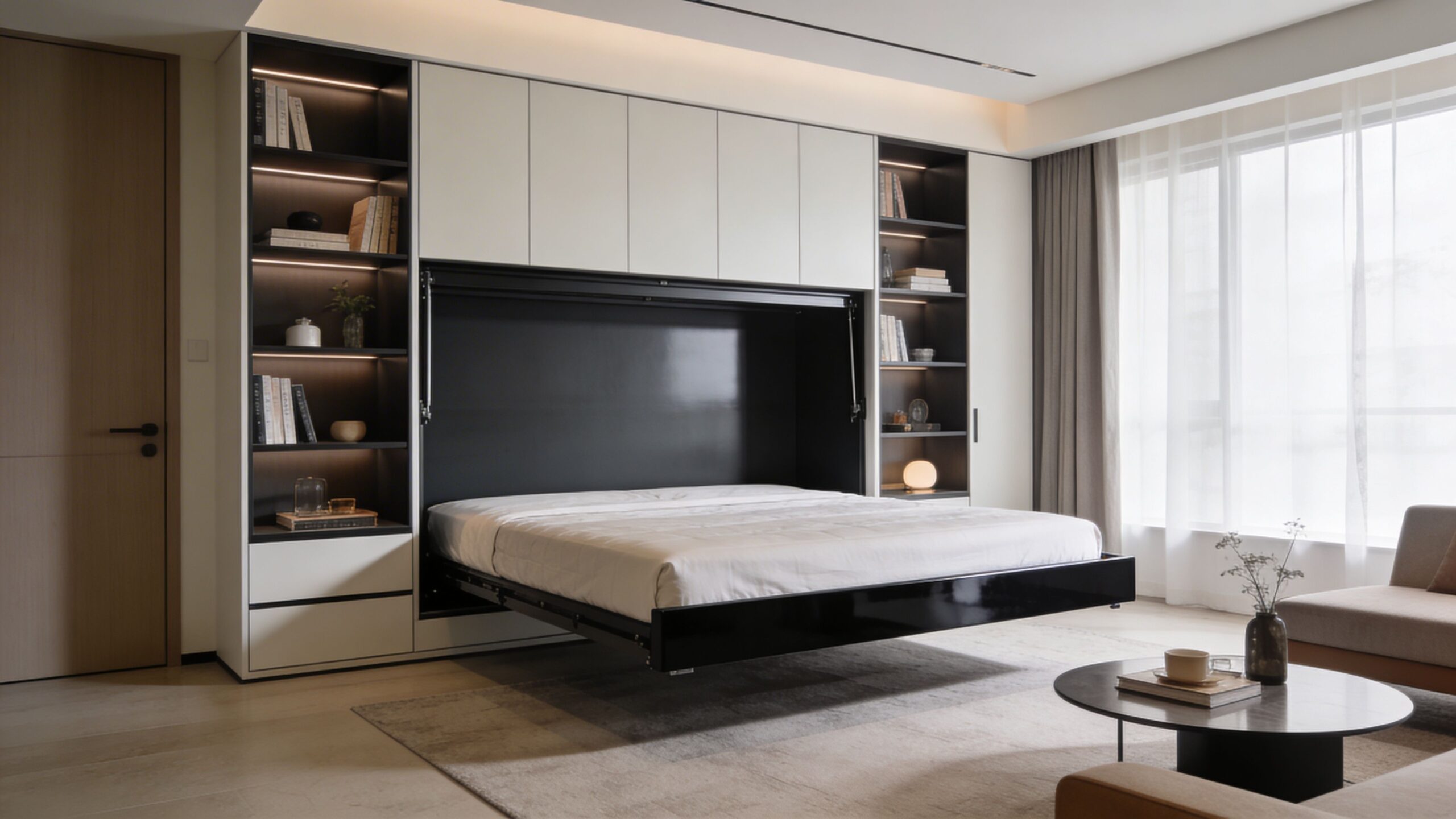
The classic Murphy bed remains the benchmark for people who want a built-in look and use the bed often. This is the format most shoppers picture first. A vertical bed folds into a wall unit or cabinet face, then lowers into place when needed.
Why owners often prefer them
A wall-mounted bed tends to feel more architectural than temporary. It can read like part of the room instead of an add-on piece.
That matters if you're furnishing a home office, a guest room, or a studio where visual order counts. The cabinetry can look intentional, and the bed can disappear into the design more neatly than many alternative sleep systems.
There's also a long history behind the category. The first patented Murphy bed was invented in 1916 to address space constraints in San Francisco apartments, and modern versions still follow that same central idea according to More Space Place Austin's overview of Murphy bed pros and cons.
The practical advantages
Wall-mounted models appeal to buyers who want permanence and repeat use.
- A more integrated look because the bed is designed to live in one fixed location
- Strong daily usability when the mechanism and frame are well made
- Long service life since quality all-wood construction and durable mechanisms can last for generations, as noted in the same source above
- Good fit for dedicated planning when you're designing a room around one clear layout
If you're shopping this category, browsing actual wall beds helps clarify the difference between a simple bed cabinet and a more built-in style.
Specific Cons for NYC renters
Murphy bed research becomes too glossy. Wall-mounted beds aren't difficult because the concept is flawed. They're difficult because city housing adds restrictions.
A proper installation means wall attachment. For many renters, that's the sticking point. Landlords and building managers often don't want tenants drilling into walls. Even when the lease isn't explicit, many shoppers don't want the risk, the patching, or the approval process.
Then there's fit.
The same source notes that many modern vertical models require ceiling heights of 84 to 90 inches and 84 to 96 inches of open floor clearance. In some apartments that's easy. In others, radiators, ceiling fixtures, tight walkways, or nearby furniture make the opening path less forgiving than people expect.
If you're renting, don't fall in love with the idea before you confirm the wall, the clearance, and the lease.
Cost and commitment
Wall-mounted Murphy beds also ask for a bigger upfront commitment. The source above states that pricing starts above $1,500. That doesn't automatically make them overpriced. It means you're buying more than a bed frame. You're buying cabinetry, hardware, a lift system, and often installation planning.
For owners, that can be worth it. For someone who may move next year, it can feel heavy. Not just physically, but strategically. A wall-mounted unit is a commitment to this apartment, this wall, and this layout.
That's why this category often makes the most sense for:
- Owners furnishing a long-term home
- Renters with clear building approval
- Anyone creating a polished multi-use room and willing to install properly
The No-Install Alternative Meet the Cabinet Bed
Many NYC shoppers reach the wall-mounting question and stop there. They like the idea of a Murphy bed, then realize they can't drill, don't want to drill, or know they're moving again. The cabinet bed becomes the smarter answer in such cases.
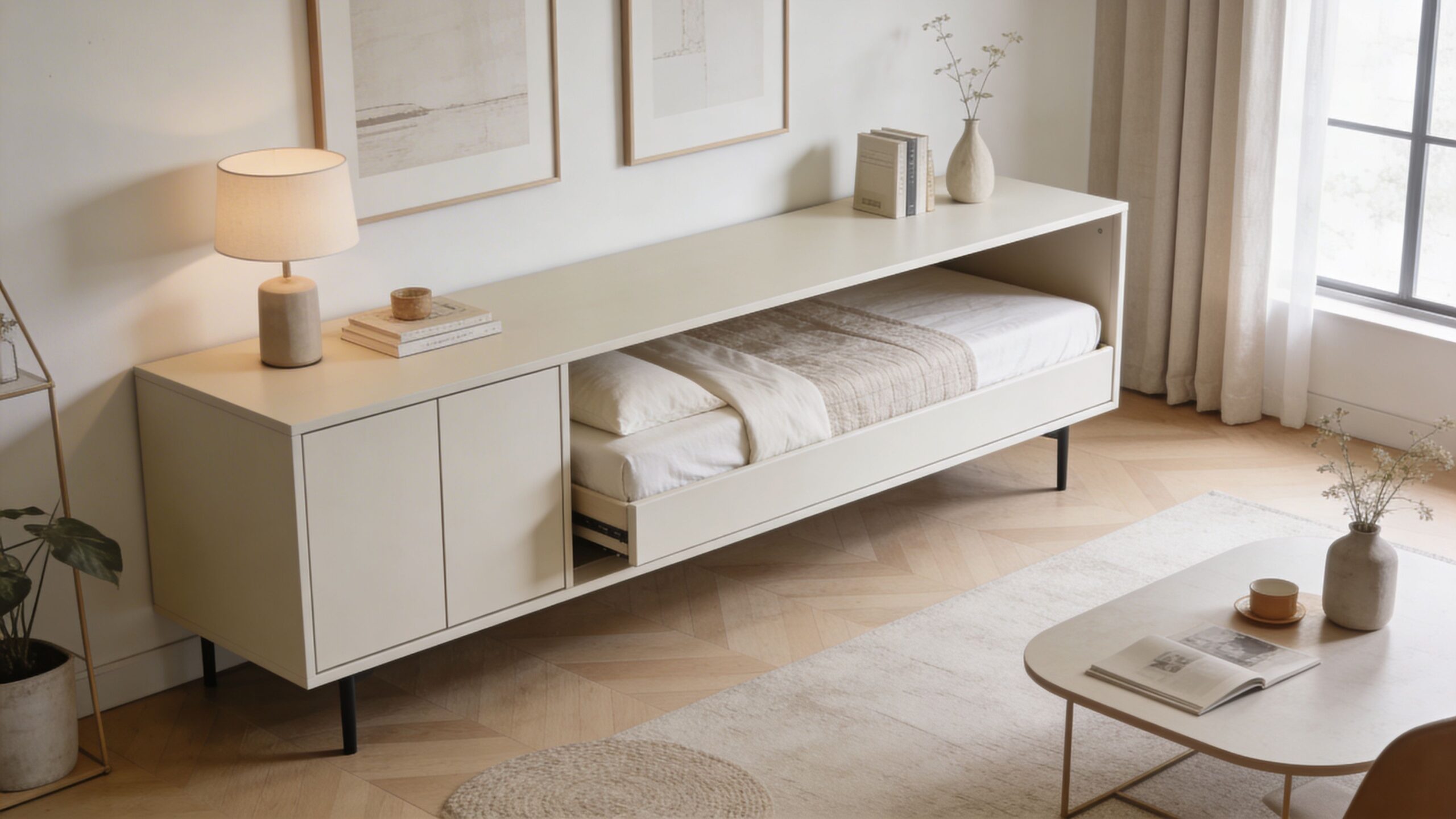
A cabinet bed is a freestanding piece that looks more like a credenza or storage cabinet when closed. Instead of folding vertically into a wall, it opens outward from its own cabinet structure. For many renters, that's the difference between "not possible" and "workable."
Why cabinet beds deserve more attention
Cabinet beds are often treated like a backup plan. In city apartments, they should be treated as a first-choice category for the right customer.
They solve a specific problem that traditional Murphy beds don't solve well: how to gain flexible sleeping space without attaching furniture to the wall.
That changes the buying equation in a few important ways.
- No wall mounting means you don't have to negotiate with a landlord or building super.
- Better portability means the bed can move with you when your apartment changes.
- Cleaner exit strategy means you aren't leaving behind hardware or repair work.
- Proper furniture presence means the closed piece can still look intentional in a living room, office, or guest room.
Who usually benefits most
Cabinet beds make the most sense for people whose housing situation is flexible, uncertain, or constrained.
A renter in Brooklyn who expects to move within a year. A couple converting a den into occasional guest space. A small apartment household that wants a proper sleep surface available on demand, but doesn't want a daily visual reminder that the room is also a bedroom.
That doesn't make cabinet beds "less than" wall beds. It makes them better aligned with how many New Yorkers live.
A cabinet bed isn't a compromise when installation is the wrong fit. It's a different category built for mobility and fewer permissions.
What to look at before you buy
Cabinet beds still need planning. You want to think about room layout, the path of the bed when opened, and whether the closed cabinet works with the rest of the furniture.
Seeing one in person matters because shoppers underestimate two things. First, how furniture-like the cabinet appears when closed. Second, how different opening motions feel from one design to another.
If you're comparing formats, murphy cabinet and chest beds are worth viewing alongside wall beds rather than after them. That's the right sequence for renters. Start with what's allowed in your apartment, then decide which mechanism and footprint you prefer.
Key Decision Factors Mattress Cost and Durability
Once you've settled the installation question, the buying decision gets more technical. Many mistakes happen at this stage. A Murphy bed can look perfect online and still be wrong for your room, your mattress expectations, or your budget.
Mattress fit affects comfort and function
The good news is that Murphy beds and cabinet beds can use a proper mattress. That's a major advantage over many sofa beds, which often ask guests to sleep on a thinner, more compromised surface.
The limitation is compatibility. According to Lori Beds' guide to the practical benefits of a Murphy bed, high-end models can support full-size standard mattresses up to 110 lbs, but mattresses thicker than 12 inches can cause improper closure and strain the mechanism. The same source says 6 to 10 inch foam mattresses are ideal for fit and support.
That means the plush pillow-top you love in a conventional bed may not be the right choice here. Murphy systems reward restraint. A mattress that is too thick, too heavy, or too soft for vertical storage can work against the mechanism.
If you're still sorting through comfort preferences, a broader guide on choosing a mattress can help you think through firmness and material before pairing one with a space-saving frame.
Don't choose the bed first and assume any mattress will work. In this category, bed and mattress have to be matched as a system.
For shoppers comparing options in one place, mattresses sized and spec'd for convertible sleep furniture are easier to evaluate when you already know your frame type.
Cost is higher but the comparison should be fair
Murphy beds often cost more upfront than a futon or a simple sofa bed. That's true, and it shouldn't be glossed over.
The fair comparison, though, isn't just sticker price. You're comparing different categories of furniture with different purposes. A quality Murphy or cabinet bed is often trying to deliver two things at once: meaningful space recovery and a more conventional sleep surface.
If the bed will be used often, or if the room has to switch functions constantly, that added cost may make practical sense. If you only host overnight guests a few times a year, a simpler product may still be the better buy.
Durability depends on materials and mechanism
The same Lori Beds source notes that high-end models are rated for 10,000+ lift cycles. That tells you what to pay attention to. Not marketing language. Construction quality.
What tends to hold up better:
- All-wood construction instead of low-grade particleboard
- Well-matched lift systems that don't fight the mattress weight
- A mattress within the intended thickness range
- Careful assembly so the hardware works as designed
What tends to disappoint:
- Buying by looks alone
- Using the wrong mattress because it's already in the house
- Treating a frequent-use bed like a decorative spare
- Choosing the cheapest version of a mechanism-heavy product
Sleep Solution Snapshot
| Feature | Wall-Mounted Bed | Cabinet Bed | Sofa Bed / Futon |
|---|---|---|---|
| Best fit | Owners or approved renters planning a long-term layout | Renters and movers who want no wall attachment | Budget-minded shoppers or occasional guest use |
| Installation | More involved, often with wall attachment | No wall mounting required | Generally simpler than a Murphy-style system |
| Sleep surface | Can use a proper compatible mattress | Can use a proper compatible mattress | Varies widely by model |
| Room impact when closed | Clean, built-in look | Furniture-like cabinet presence | Seating stays visible full time |
| Main trade-off | Cost, installation, permanence | Footprint and furniture placement | Comfort can vary more depending on model |
Making the Right Choice for Your NYC Space
The right answer becomes obvious when you stop asking which product is most impressive and start asking which one fits the room, the building, and the way you'll use it.
For a studio that needs a primary bed
If this is your main bed and the apartment has to feel open during the day, a Murphy-style solution makes sense only if the daily transformation is worth the investment. Owners often lean toward a wall-mounted setup because it feels integrated. Renters need to think more defensively.
If drilling is off the table, go straight to a cabinet bed. It solves the permission problem without forcing you into a sofa bed.
For a home office that hosts guests
This is one of the best use cases for the category. The room works as an office most of the time, and a foldaway bed keeps it from feeling like a part-time bedroom.
A wall bed works well if the room is stable and you want a built-in appearance. A cabinet bed works well if the room may be rearranged or if you don't want installation.
For a homeowner building a multi-purpose room
Here, wall-mounted models shine. If you're staying put, have the right ceiling and floor clearance, and want the room to read as finished millwork instead of flexible furniture, the permanence becomes a benefit instead of a drawback.
The bed stops feeling like a workaround and starts feeling like part of the architecture.
When a sofa bed or futon is still the better call
Not every shopper should buy a Murphy bed. If budget is the top constraint, or if the bed will only be used occasionally, a sofa bed or futon may still be the more sensible move.
If you want another angle on that comparison, this breakdown of Murphy bed vs. sofa bed is a useful companion read because it frames the decision around space use and sleep expectations rather than novelty.
The best small-space purchase is the one you'll keep using without resenting the setup, the cost, or the daily routine.
A Murphy bed is a tactile purchase. So is a cabinet bed. You learn a lot by opening the mechanism yourself, checking how the bed clears the room, and seeing whether the closed piece suits your space. That's why this category is worth viewing in person before you decide.
If you're weighing murphy bed pros and cons in a NYC apartment, start with the hard realities first. Are you renting or owning? Can you mount to the wall? Will the room need to transform every day, or only when guests visit? Once those answers are clear, the product choice gets much easier.