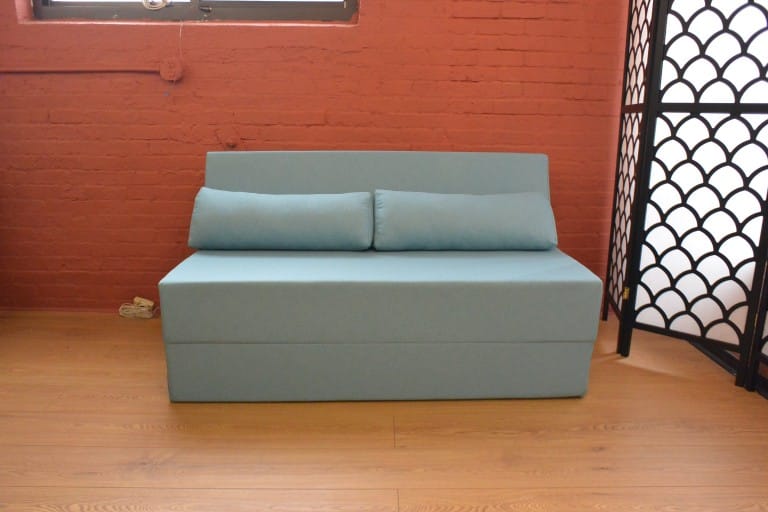

Modern Sofa Futon Guide: Frames, Comfort & Sizing
A lot of people start in the same place. They need a place for guests to sleep, or they need one room to do double duty, but they don’t want a bulky pull-out sofa or a futon that makes the room feel like a dorm.
That’s exactly why the modern sofa futon matters. Done well, it gives you a bed when you need one, and it still looks like intentional furniture when you don’t.
The Sofa That Does More And Looks Better Doing It
The old futon stereotype is easy to picture: a chunky wood frame, a thick mattress folded in half, a look that says “temporary.” That version still exists, and in the right room it works fine. It’s not what most style-conscious apartment shoppers are looking for now.
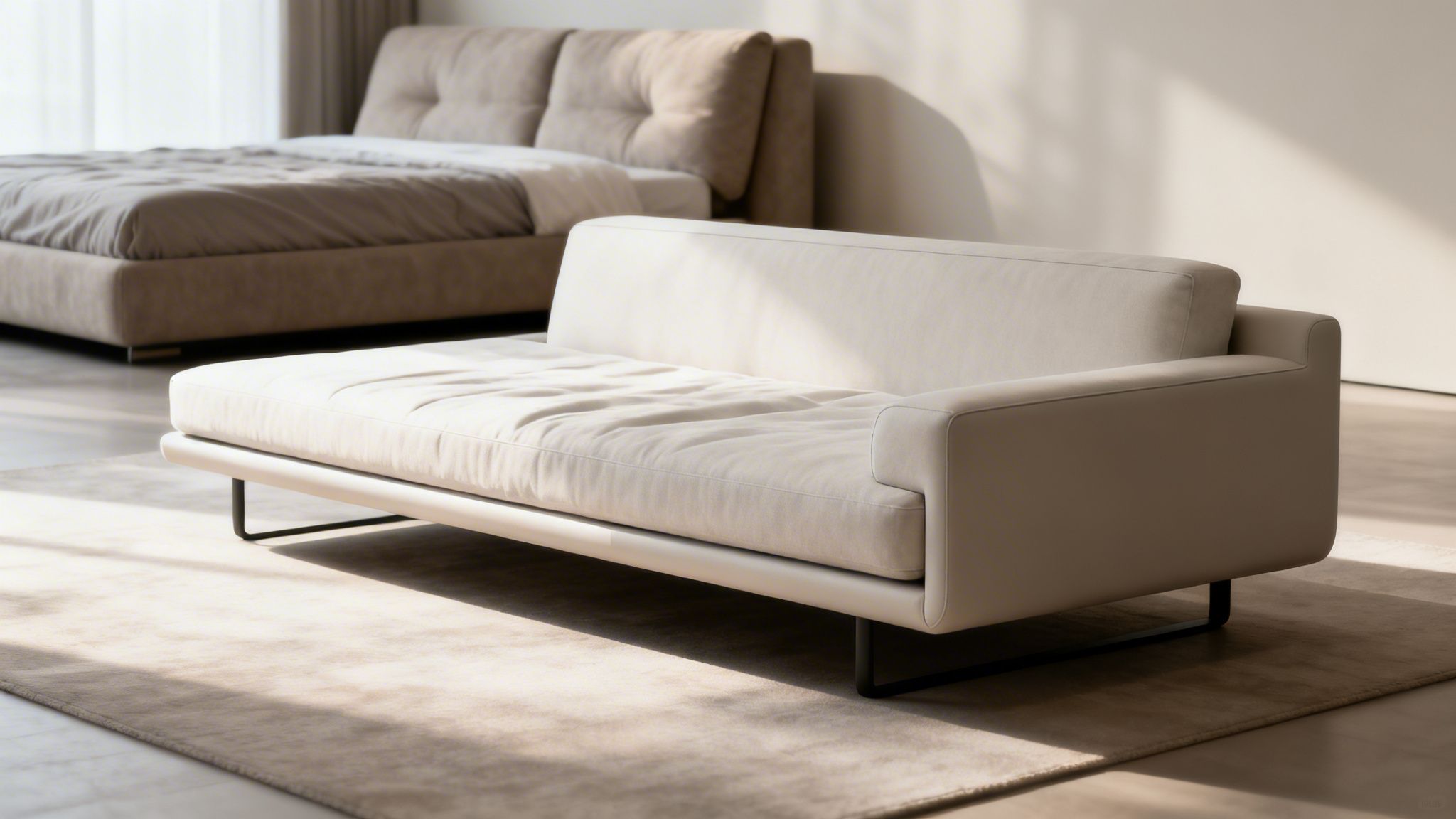
A modern sofa futon is a sofa first in how it presents itself. Cleaner lines, a lower profile, integrated upholstery that reads as one object instead of a frame plus a mattress. Replace an oversized pull-out or an older wood futon with a modern convertible and the room usually feels lighter right away — the furniture stops announcing its backup-bed function.
A good modern futon should not look like a compromise. It should look like the piece you wanted for the room anyway.
That’s the real shift in the category. Better models aren’t hiding function inside a traditional sofa silhouette — they’re designed from the start to work in both modes. For a studio, guest room, home office, or small living room, that’s often the smartest furniture decision available.
What Makes a Sofa Futon “Modern”
“Modern” gets used loosely in furniture. In the futon category it points to a few specific, visible markers. Missing them usually means the piece reads as more traditional, more casual, or more temporary.
Low profile and lighter visual weight
Height and mass are the first things people notice. A modern sofa futon typically sits lower than a conventional pull-out, which keeps sightlines open in a small room and makes the space feel less crowded.
It’s not only dimensions — it’s visual weight. Thin arms, exposed legs, and a shallower frame read as “easier” in a room even before the bed function comes into play. A traditional wood-frame futon shows its arms, slats, and separate mattress immediately; some buyers like that honesty, others read it as casual furniture.
Integrated upholstery instead of a separate mattress look
Most modern futons use fabric, faux leather, or leather-like finishes so the sofa reads as complete when closed — not a loose mattress sitting inside a frame, but a finished sofa with tighter shaping and a more deliberate silhouette.
That range is why a charcoal woven fabric futon suits a Scandinavian room while a warmer taupe or camel cover moves the same piece toward Japandi or soft contemporary. Traditional wood futons are more visually limited — even with a good mattress, the room still reads the mattress as a mattress.
Cleaner mechanisms and less visible engineering
A modern sofa futon should convert without a lot of exposed hardware or wrestling. That matters for use, not just looks: if conversion feels awkward or noisy, owners stop using the bed function. A smooth, one-motion conversion is what actually gets used.
| Feature | Modern sofa futon | Traditional wood-frame futon |
|---|---|---|
| Overall look | Upholstered, integrated, furniture-first | Frame-and-mattress, more casual |
| Room presence | Low, cleaner, lighter | More visible structure |
| Upholstery choices | Broad range of fabrics and faux leathers | More dependent on mattress cover |
| Mechanism visibility | Usually minimized | Often more obvious |
| Best fit | Contemporary living rooms, studios, offices | Guest rooms, casual spaces, classic futon setups |
Frame Materials and Mechanisms
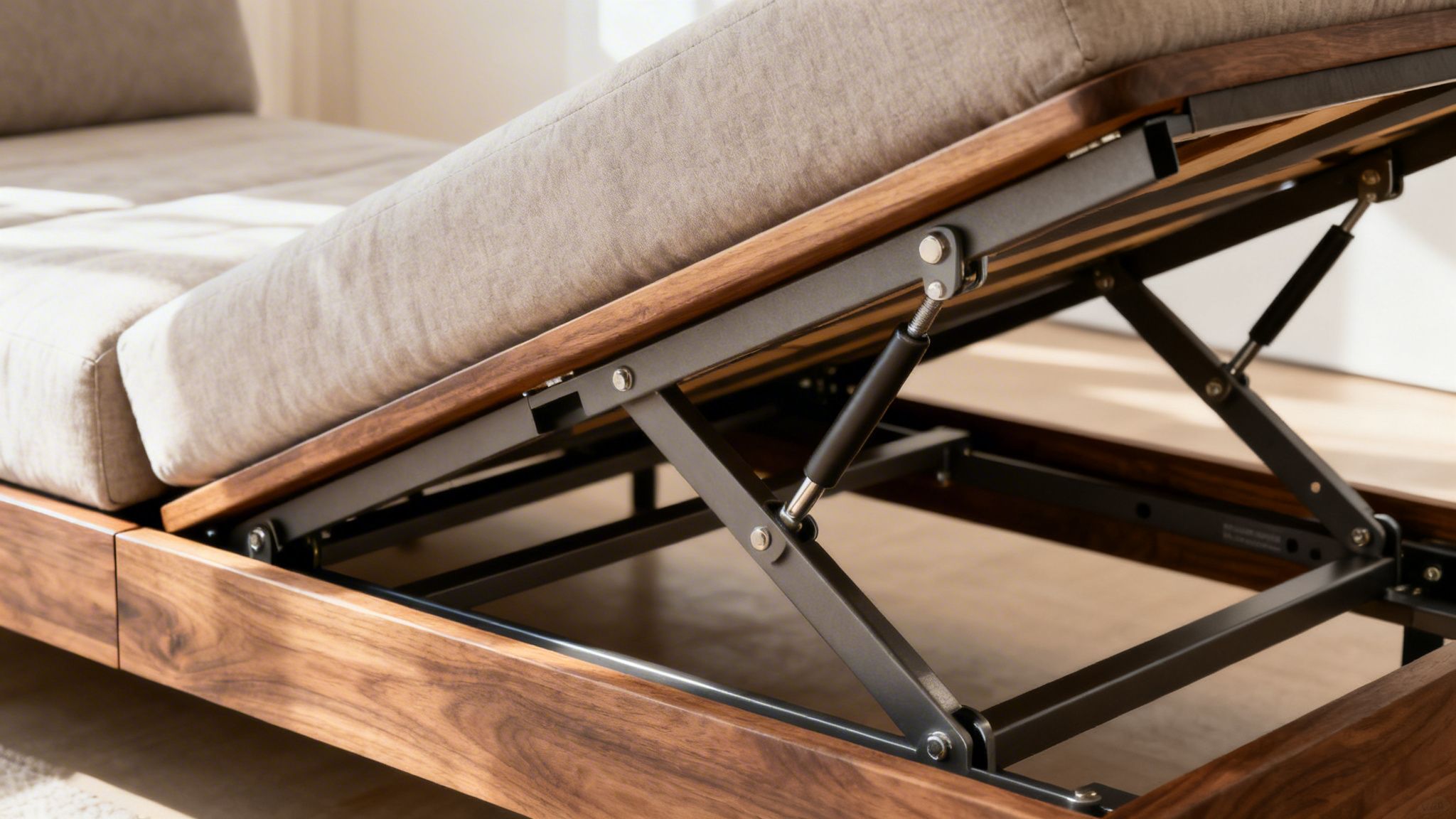
Good upholstery catches the eye, but the frame determines whether the piece feels solid, converts smoothly, and still looks like real furniture after years of use.
Metal frames for cleaner contemporary rooms
Metal frames make the strongest case in interiors with clean lines — simple millwork, neutral walls, sharper silhouettes. Powder-coated steel keeps the profile crisp and reads more like a designed sofa than a spare bed against the wall. A well-made metal frame also tends to track more smoothly with less rubbing at the joints, which matters if the bed function gets used often. Metal reads cooler and more architectural, so it benefits from softer upholstery or a warmer wood accent elsewhere in the room.
Wood frames for warmth and a settled look
Wood adds texture and softens hard edges, fitting naturally into Scandi and Japandi rooms built around calm rather than contrast. Not every wood futon looks current, though — clean arm lines, moderate exposed wood, and a lower stance keep the piece modern, while thick slats and heavy mission-style detailing push it back toward the dated futon look many shoppers are trying to avoid. Compare options in Futonland’s modern futon frames collection.
Click-clack versus bifold
Click-clack mechanisms suit buyers who want the most sofa-like appearance day to day — the back releases and folds flat in one motion, with a precise, finished look that matters in a formal living room or office.
Bifold designs separate the frame from the mattress, which adds flexibility later: the mattress can be replaced independently if comfort needs change, without replacing the whole piece. Bifold is generally the better fit for studios and guest rooms doing real overnight duty, and tends to be easier to service since the mattress isn’t built into the mechanism.
A note on wall-hugger layouts
Wall-hugger frames use space more efficiently behind the sofa, letting the piece sit closer to the wall without making conversion awkward — useful in narrow rooms where every few inches matter. Measure the footprint in sofa mode first; a futon that saves space every day beats one that only looks efficient when opened.
Mattresses and Cushions: The Comfort Equation
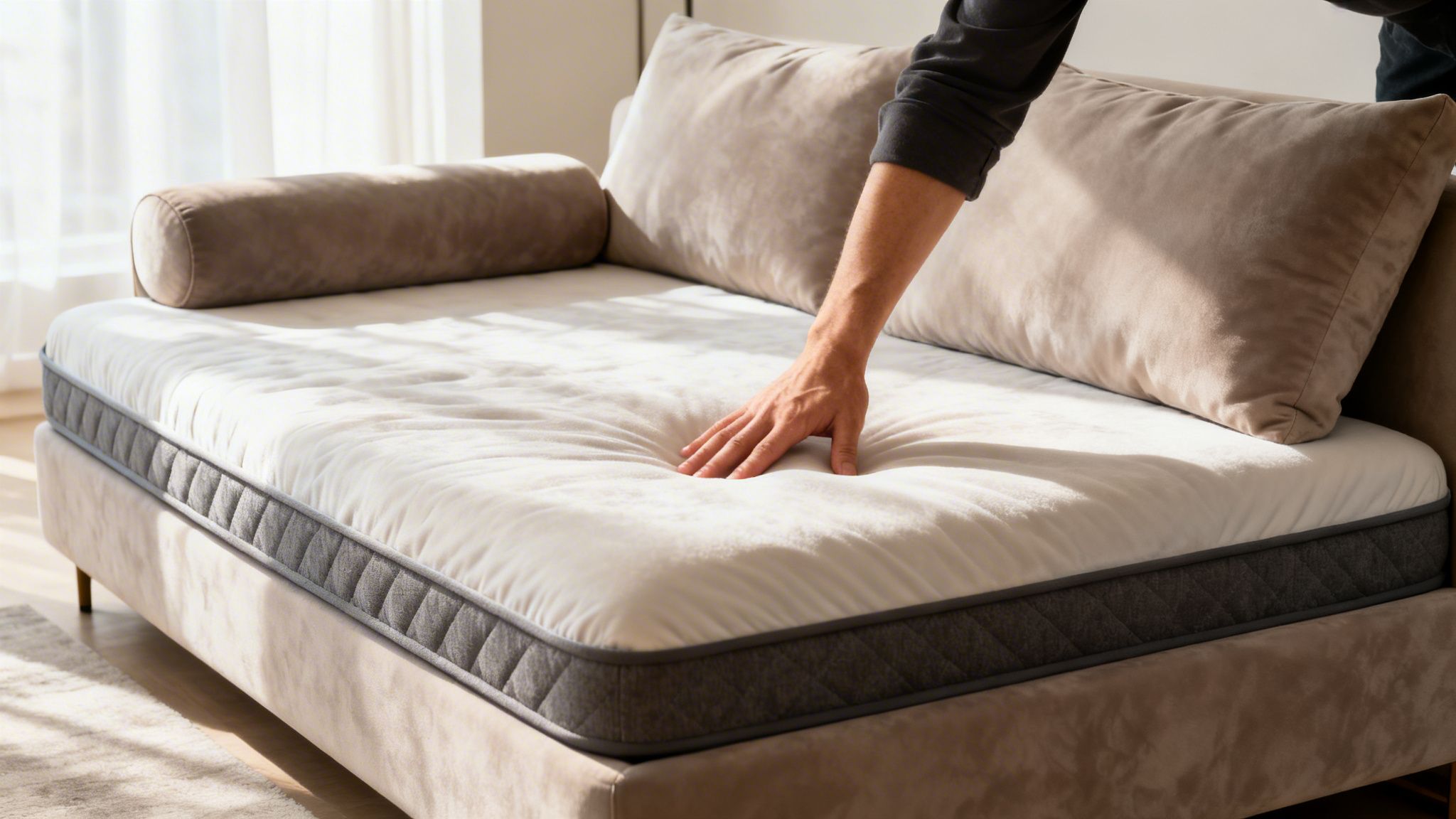
A lot of buyers carry old expectations into this category — thin, lumpy sleep surfaces and upright seating that feels temporary. That’s outdated if the construction is chosen carefully.
Integrated cushions versus separate futon mattresses
An integrated convertible sofa bed uses built-in seat and back cushions that flatten or unfold into a bed surface, giving a more refined sofa appearance — a strong fit for living rooms where daily look matters most.
A separate futon mattress on a frame gives more freedom to tune comfort independently — denser foam, innerspring, or a hybrid build, depending on whether the futon serves occasional guests or acts as a daily bed. The construction matters more than the label.
What holds up and what doesn’t
Denser core materials hold shape better under repeated daily folding and sitting. Lower-grade foam is where problems start — sagging, uneven folding, and edge collapse over time. Upholstery durability matters too: fabric that pills, stretches, or abrades quickly makes a sofa feel tired even when the core support is still fine.
For everyday use, buy for cushion density first and surface fabric second. People often reverse that order and regret it.
A simple buying filter
Start with use pattern. Daily bed use needs a more serious sleep surface than guest-only use.
Check core construction. High-density foam, innerspring, or hybrid builds generally outlast entry-level foam-only fills.
Weigh seat feel against sleep feel. Some mattresses sleep well but sit too stiffly; others lounge well but feel less supportive overnight.
Consider serviceability. A separate mattress is easier to replace or upgrade later. Compare options in futon mattresses.
Sizing and Space Planning
A common mistake: the futon looks clean and perfectly scaled in showroom mode, then once it’s open it cuts off the closet, crowds the coffee table, or blocks the path to the window. That’s usually a planning problem, not a product problem.
Measure the room in both working positions. Sofa mode tells you how the piece sits day to day; bed mode tells you whether the room still functions at night. Check wall width, closed depth, and open depth, and look at what surrounds it — swing doors, radiators, desks, side tables, and the actual walking path through the room.
Use Futonland’s sizing charts for frame and mattress dimensions, then confirm those numbers against your own floor plan — a size that looks right on paper can behave differently in a real studio.
Frame-to-mattress fit matters as much as room fit. A mattress that’s too tight can bind when the frame converts; one that’s too loose shifts, wears unevenly, and makes the whole piece feel less refined.
- Measure the wall first. Confirm the actual width where the futon will sit, not just the room’s widest span.
- Tape out the open bed on the floor. Painter’s tape gives a fast, accurate read on clearance.
- Protect the traffic path. Make sure someone can still move through the room when the futon is flat.
- Verify frame compatibility. On a bifold frame, back width is one of the key measurements for mattress fit.
- Check nearby furniture. Coffee tables, consoles, and nightstands often cause more trouble than the wall itself.
For many studios, a full mattress hits the best balance between seating scale and sleep space. A queen earns its footprint when two adults use it often and the room has clearance to support it comfortably — bigger isn’t automatically better.
Modern Futon vs. Sofa Bed
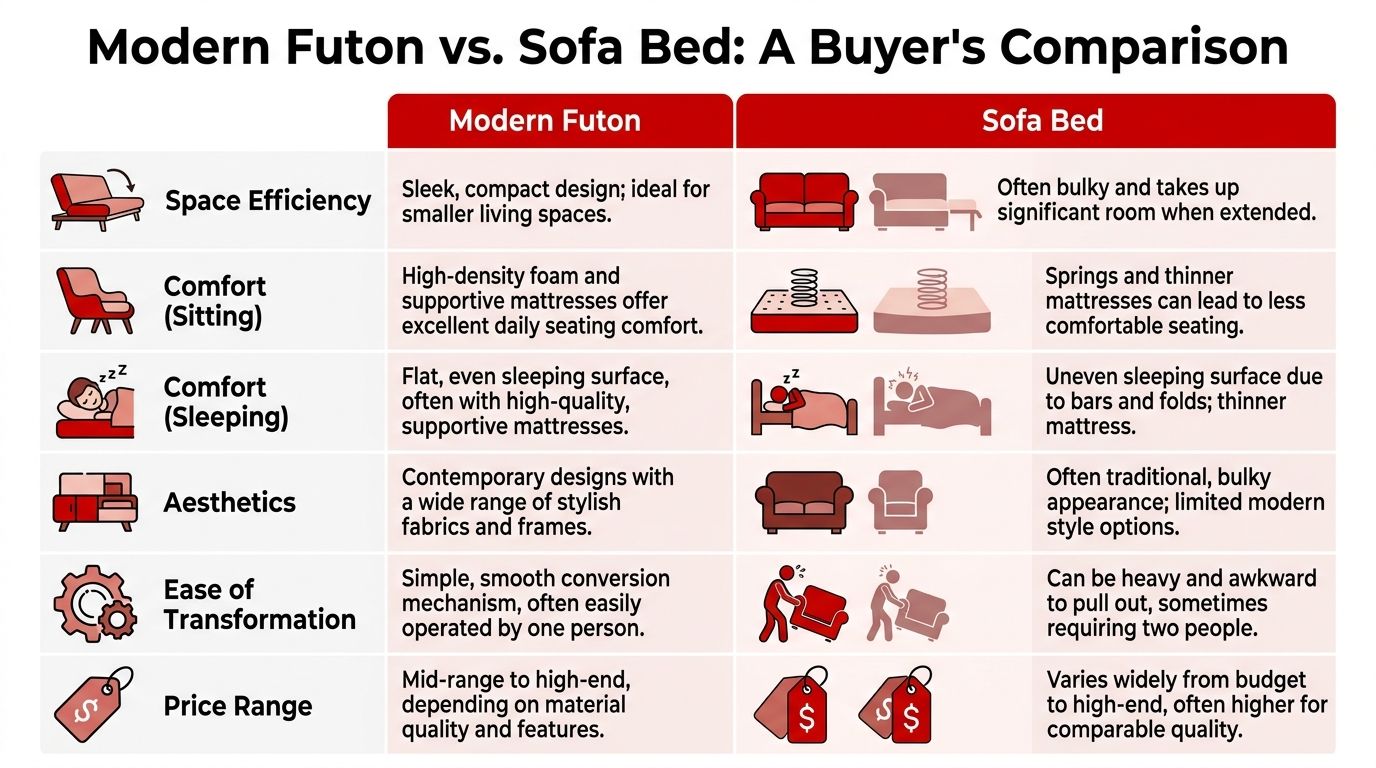
The most common comparison isn’t futon versus bed — it’s modern sofa futon versus traditional pull-out sofa bed, and that decision shapes both the room and the daily experience of using the piece.
Where the modern futon usually wins
A modern futon tends to feel lighter in the room — lower profile, less bulk, fewer signals that a mattress is hidden inside a heavy shell. In smaller living rooms that visual difference is immediate. It’s also typically simpler to operate: a pull-out means removing cushions and pulling a hidden bed frame forward through a nested mattress, while a futon’s conversion is usually more direct.
That doesn’t mean every futon beats every sofa bed. A high-quality sleeper sofa can still be the right call for someone who strongly prefers a conventional sofa feel and uses the bed rarely. For frequent conversion in compact rooms, the modern futon usually wins on practicality.
| Feature | Modern sofa futon | Traditional sofa bed |
|---|---|---|
| Visual bulk | Lower, cleaner profile | Heavier, more built-out look |
| Conversion | Usually one clear motion | More steps, more lifting |
| Small-room fit | Better for studios and offices | Can dominate compact rooms |
| Bed surface | Flat and direct | Can feel more layered mechanically |
| Style range | Strong in modern interiors | Often more traditional in appearance |
Who should choose which
Choose a modern futon if you live small (studios, guest rooms, home offices benefit most from the lighter footprint), convert often (a simple mechanism matters with regular use), or care most about how the room looks day to day.
Choose a traditional sofa bed if you want a more conventional sofa silhouette, the bed function is occasional, or the room has enough space to absorb the extra bulk.
For a side-by-side comparison, convertible sofa beds sit right between classic futons and full pull-outs.
Styling and Maintaining a Modern Sofa Futon
Styling it to read as furniture first
For Scandinavian rooms, keep the palette light and quiet — a soft gray or cream futon with pale wood, a low rug, and a few texture-driven pillows rather than bright contrast. For Japandi, use warmer neutrals, natural wood tones, and fewer accessories — a low-profile frame and matte upholstery do more than a pile of decorative cushions. For mid-century-adjacent rooms, slightly richer upholstery and cleaner geometry — tapered legs, walnut tones — help the piece feel anchored.
The common mistake is over-styling. If the futon already has a strong shape, let it carry the room.
Maintenance that matters
Durability concerns are real, especially with kids, pets, frequent guests, or constant conversion — sagging and fabric fatigue over time are the most common complaints in this category. A few habits extend the life of the piece:
- Vacuum fabric regularly. Dust and grit shorten upholstery life.
- Rotate or reposition usage when possible. Repeated pressure in one favorite seat spot shows up fast.
- Tighten hardware periodically, especially on wood frames that see frequent conversion.
- Address spills immediately. Faux leather is easier to wipe clean; woven fabric feels softer but needs quicker attention.
A retailer offering replacement or custom cut-and-sew covers is worth prioritizing — it lets you refresh the piece if the frame is still solid but the fabric or your room has changed.
Finding Your Fit
A modern sofa futon works best judged as real furniture, not a backup bed in a sofa disguise. The right one suits the room when closed, converts without drama, and supports how you actually use it.
The buying checklist: silhouette first, then mechanism, then cushion or mattress construction, then upholstery practicality, then exact size in both sofa and bed mode.
Some shoppers want the cleaner look of an upholstered convertible; others prefer the flexibility of a bifold frame with a separate mattress. Both work well when the construction and scale are right. Futonland carries both categories — modern convertibles from brands like Innovation Living, wall-hugging options from Strata, and matching mattresses and covers — for side-by-side comparison, since modern futons now range from minimalist apartment sofas to serious everyday sleep solutions.
Choose the piece that fits your room, your routine, and your tolerance for compromise. Browse modern sofa futons to start comparing.