


King Size Bed with Posts: A Practical Buyer’s Guide
You’ve found the bed you want. The tall posts look dramatic, the finish works with your nightstands, and the mattress is already chosen. Then the tape measure comes out, and the problem appears: the mattress fits, but the room may not.
A king size bed with posts is a room-planning decision before it’s a decorating decision. The mattress has a standardized footprint, while the frame determines how much space you lose around it, how high the structure rises, whether the posts obstruct furniture, and whether you can move it through the building. Regret with posted beds usually comes from ignoring those practical details until after delivery.
Why a King Size Bed with Posts Is a Room-Planning Question First
The mattress is the easy part. A standard U.S. king measures 76 inches wide by 80 inches long — 6,080 square inches of sleeping surface — and it’s also the largest standard mass-retail bed size in the U.S. market. The frame is where the decision becomes complicated.
Four posts, side rails, a headboard, footboard, canopy rails, and decorative trim all extend beyond that mattress rectangle. The frame can push nightstands outward, narrow the walking lanes, block a dresser drawer, or make a reading chair impossible to place. A platform king may feel tidy against a wall. A posted king behaves more like a small architectural installation.
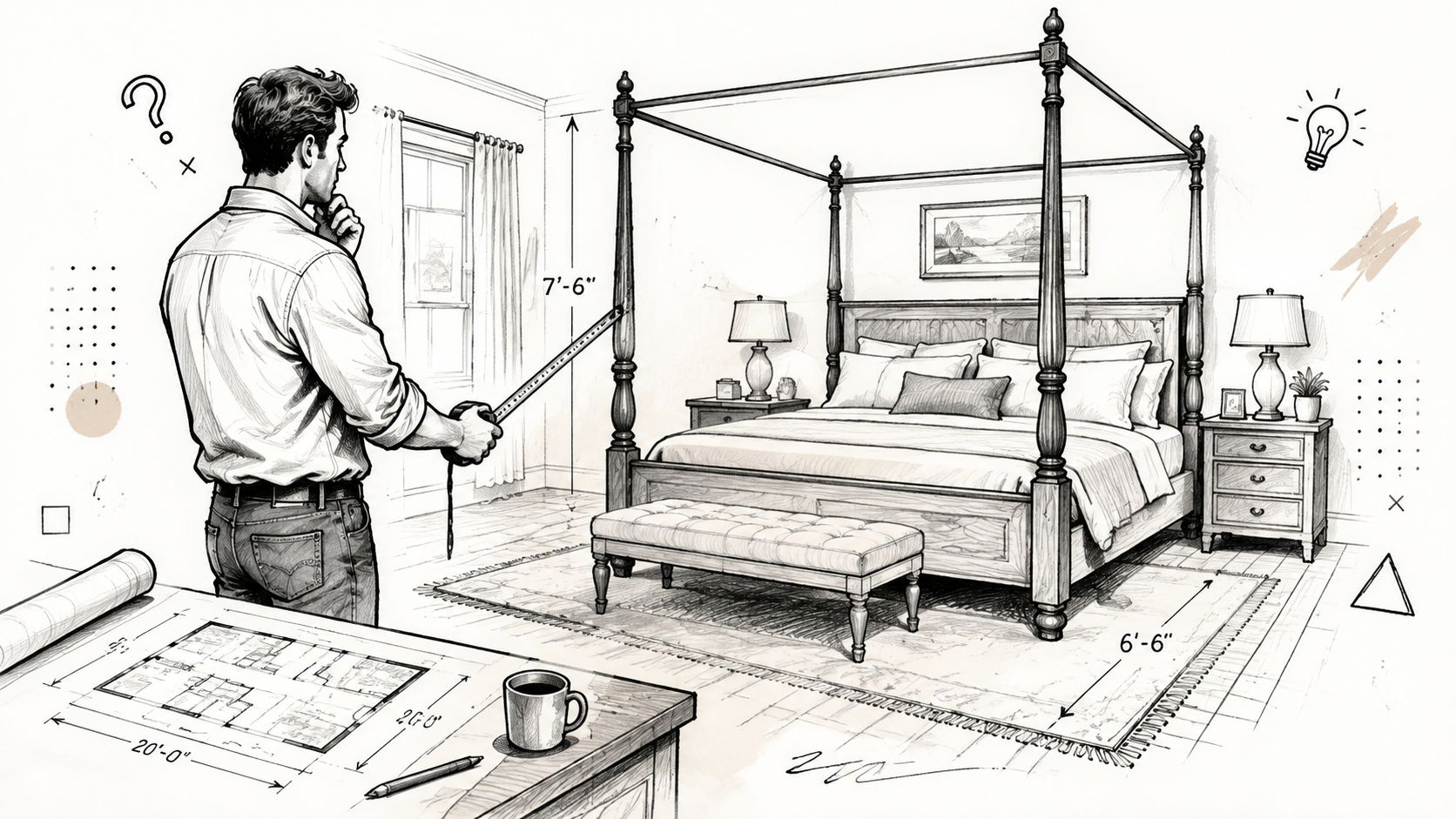
Measure the room in the right order
Start with the mattress, then measure the exterior frame, then map movement. Don’t begin with the headboard height or stain color.
- Mark the mattress rectangle. Use painter’s tape for the full king sleeping area.
- Add the frame footprint. Measure from the outside edge of one post or rail to the opposite edge.
- Add clearance for daily use. Check both sides, the foot of the bed, closet doors, dresser drawers, and the bedroom entrance.
- Measure vertically. Ceiling height, fan blades, light fixtures, crown molding, and sloped sections all matter.
- Mark the posts separately. A post that lands in a walking lane will annoy you every morning, regardless of how beautiful it looks.
Practical rule: Treat the post frame as architecture. If the room only works when every piece sits within an inch of its ideal position, the bed is too large for the room.
The right question isn’t “Will a king mattress fit?” It’s “Will the room still function after the frame, clearance, and traffic paths are included?” The following measurements answer that before you commit.
King Mattress and Post-Frame Dimensions You Need to Know
Lock down the measurements before choosing a finish. The standard U.S. king is 76 by 80 inches, and this specific footprint became the commercial standard sometime in the mid-20th century as major mattress makers converged on a common king size. That history explains why posted beds can combine older four-poster styling with a relatively modern standardized mattress size.
Frame dimensions vary a lot by manufacturer and model. As rough reference points, a king four-poster frame commonly runs somewhere around 78 to 80 inches wide by 83 to 85 inches long on the exterior, with overall post height often landing near 80 inches and some canopy versions reaching a bit higher. Treat these only as a starting mental picture — the exact exterior size, post height, rail height, and under-bed clearance always need to come from the specific manufacturer’s cut sheet, not a category average.
Use the Futonland sizing charts to organize the basic mattress measurements before comparing frame specs against them.
| Component | Standard Range | Notes |
|---|---|---|
| King mattress | 76 by 80 inches | Standard U.S. king sleeping surface |
| King sleeping surface | 6,080 square inches | Mattress area before frame additions |
| Four-poster exterior | Roughly 78–80 by 83–85 inches | Actual frame varies significantly by design — verify with manufacturer |
| Overall frame height | Often near 80 inches | Some canopy versions run taller |
| Compact post-bed floor area | Often 45+ square feet | The frame can feel larger than a platform bed |
| Slat-to-floor and under-bed clearance | Varies widely by model | Always confirm the exact figure for your chosen frame |
Read the frame specification, not the product photo
The posts add visual height and footprint without changing the mattress area much. That makes the frame’s outside dimensions, rail position, and ceiling relationship more important than the mattress label.
A frame can look like a standard king online yet leave less usable space beside the mattress because the corner posts force nightstands outward. Before ordering, request the exterior width, exterior length, post height, rail height, slat height, and under-bed clearance in writing.
Four-Poster, Canopy, and Sleigh-with-Posts Styles Compared
These three styles create very different rooms. A four-poster bed uses four visible corner posts with open rails or optional upper connections. It feels structured and substantial without necessarily enclosing the sleeper. A canopy bed connects the posts overhead, with fabric, wood, or a bare frame creating a stronger visual boundary.
A sleigh-with-posts keeps the curved or scrolled character of a traditional sleigh bed while using shorter decorative posts. It’s the better choice when you want formality without putting a tall architectural frame near the ceiling.
Compare broader categories through Futonland’s canopy and poster beds selection.
| Style | Ceiling Clearance | Drapery Needed | Best Room Size |
|---|---|---|---|
| Four-poster | Open upper structure, commonly near 80 inches overall | No | Medium to large bedroom |
| Canopy | At least 8-foot ceilings without drapes, 9-foot ceilings with fabric | Optional without fabric, expected with a full canopy | Larger bedroom with clear overhead space |
| Sleigh-with-posts | Shorter decorative posts, often suited to modest ceiling conditions | No | Medium bedroom with a traditional furniture plan |
Four-poster beds keep the ceiling open
Choose a four-poster when you want vertical emphasis but don’t want fabric overhead. Bare posts can look clean and modern, especially with straight rails and a restrained wood finish. They also preserve more visual openness than a draped canopy.
The catch is corner management. The posts become fixed obstacles, so a narrow nightstand may no longer sit where you expect, and the foot posts can interfere with a bench or walking route.
Canopies create a room within the room
A canopy gives the strongest sense of enclosure. Fabric can add privacy and softness, but it also introduces cleaning, lighting, and ceiling concerns. A frame-only canopy avoids the weight of drapery and gives you the structure without fully closing the sleep zone.
Pick this style only when the room has enough vertical breathing space. A canopy that nearly touches the ceiling makes the bedroom feel compressed rather than grand.
Sleigh posts are the conservative choice
Sleigh-with-post designs suit buyers who like traditional furniture but don’t want an eight-foot visual statement. The curved headboard and footboard carry most of the style, while the shorter posts provide detail rather than architecture.
As a simple rule: choose four-poster for open drama, canopy for enclosure, and sleigh-with-posts when you want formal character with fewer ceiling complications.
Mattress Compatibility, Slats, and Box-Spring Decisions
A shopper once chose a king posted bed, then discovered the mattress sat too high for the headboard and the frame offered no clear foundation guidance. The problem was not the king size. It was the support system. Before you compare finishes, trace how weight moves through the slats, center rail, side rails, and corner joints.
Support specifications — load rating, slat clearance, rail height, under-bed clearance — vary widely between individual frames, even within the same general style. Get the exact numbers in writing for the specific model you’re buying rather than assuming one four-poster’s specs apply to another.
Choose the support system before the mattress height
Ask for the maximum slat gap, confirm whether a center support rail is included, and check whether the manufacturer permits a foundation. A traditional box spring does not belong in every posted frame.
| Support Type | Best For | Slat Gap Limit | Box-Spring Needed? |
|---|---|---|---|
| Platform slats | Foam, latex, and many hybrids | Use the mattress maker’s stated limit | Usually no |
| Bunkie board over slats | Mattresses needing a flatter base | The board reduces direct gap concerns | No, unless specified |
| Traditional box spring | Mattresses designed for foundation height | Rails must support the foundation securely | Yes |
| Foundation on center-supported rails | Buyers needing added height | Confirm rail and center-support compatibility | Often |
A low slat platform keeps the mattress profile lower and can make the frame feel steadier. A box spring raises the sleep surface, which may leave a tall pillow-top looking awkward against the headboard or footboard. Measure the mattress and foundation together. If you are pairing the frame with a new foundation, compare its height with the frame’s rail and slat measurements before ordering.
Check the frame’s load path
The stated load rating applies to a complete, correctly assembled bed, not to the posts alone. It must cover sleepers, mattress, foundation, and normal movement. Ask whether the capacity is distributed across the full frame and whether the center rail reaches the floor.
Review the hardware list before purchase. Tall posts need rigid corner joints and well-supported side rails. If the specifications omit slat support, center support, or maximum load, keep shopping. Use the king bed frame options at Futonland to compare frame construction and compatibility before choosing a model.
Room Size, Ceiling Clearance, and Layout Rules
Room size determines whether the bed feels intentional or intrusive. Room-planning guidance commonly recommends a bedroom at least 11 by 14 feet for a king mattress, since the mattress itself is about 6 feet 4 inches wide by 6 feet 8 inches long before adding the frame and clearance.
That recommendation is a starting point, not permission to ignore the frame. A king four-poster can occupy well over 45 square feet of floor area once you account for the full exterior dimensions, and the posts and rails then push the usable circulation area farther outward still.
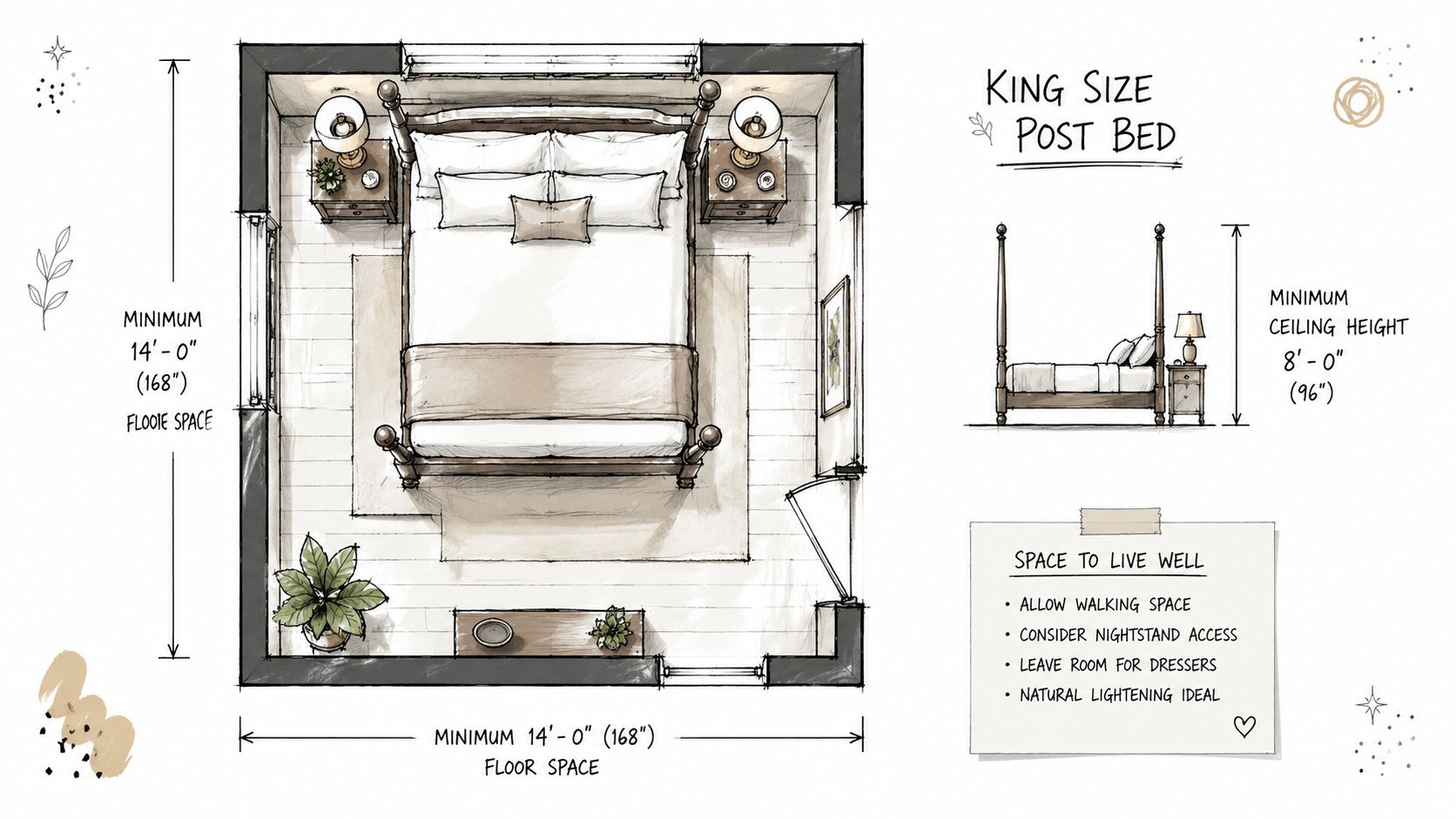
Use the ceiling as a hard limit
As a general guide, budget at least 8-foot ceilings without drapes and 9-foot ceilings with fabric for tall canopy-ready frames, with room dimensions often starting around 12 by 12 feet or larger for a canopy specifically. Don’t measure only at the center of the room. Check the lowest point near crown molding, ceiling fans, beams, and sloped sections.
An open four-poster can work under a standard ceiling if the posts don’t collide with fixtures. A fabric canopy needs more breathing room because the added visual and physical layer lowers the room’s perceived ceiling.
Protect the traffic paths
Place the headboard on the most stable wall, away from a window if the furniture blocks daylight, curtains, or access. Keep the foot posts out of the bedroom door swing, closet opening, and the route to the bathroom.
Use painter’s tape to outline the exterior frame and furniture. Open every dresser drawer, swing the door fully, and stand where you’ll walk at night. If a post occupies that path, no styling adjustment will solve the problem.
When Posts Are Worth It and When They Are Not
Posts earn their space when the bedroom can support them. They work especially well in a room with 9-foot ceilings or higher, a generous footprint, and a clear focal wall. They give you architectural presence without built-in millwork, and a bare frame can look finished without drapes.
A homeowner who expects to keep the bed in place for years gets more value from the visual commitment than a renter who moves frequently. Tall frames are heavier, more awkward through stairwells and elevators, and more vulnerable to loose joints after repeated disassembly. In a studio or shared apartment, the same square footage may need to hold a desk, dining table, storage, and seating. A king post bed usually loses that argument.
The room should pass four tests
Ask yourself these questions before you place an order:
- Can the ceiling handle the structure? Measure the lowest ceiling point, not the room’s advertised height.
- Can you walk around the bed comfortably? Include the outside edges of the posts, not just the mattress.
- Will the room still hold its other furniture? Test dresser drawers, closet doors, a chair, and work surfaces.
- Will you keep the bed in one location? If moving is likely, choose a simpler, lower frame.
Small bedrooms under 120 square feet are particularly difficult candidates for a king post bed, because the furniture competes with circulation and storage. That’s a useful rule of thumb, but the final test is always the taped layout in your own room.
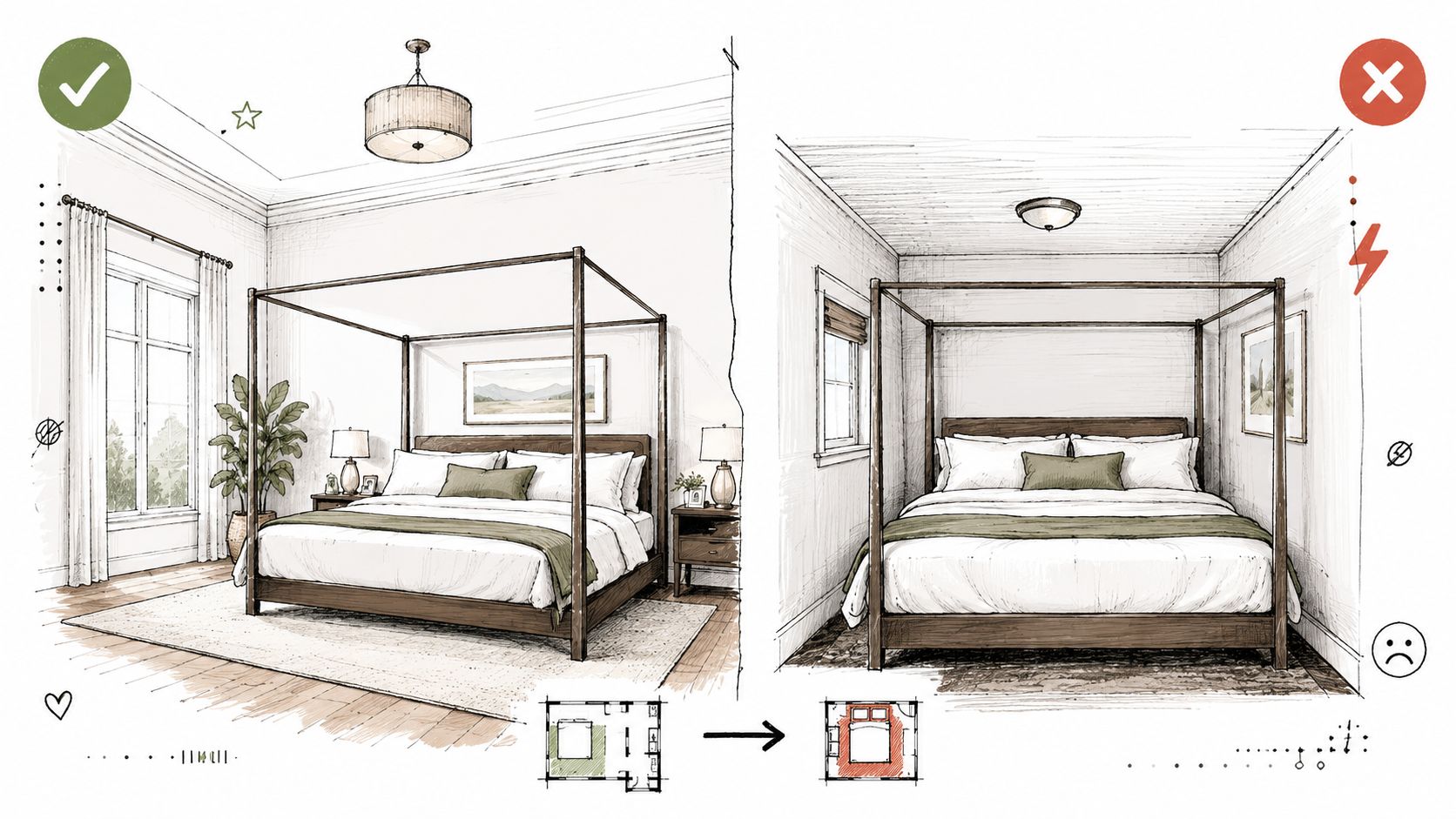
The verdict is straightforward. Buy the posts when the room has enough height and circulation to make them look deliberate. If the bed forces every other piece against a wall, choose a low-profile king and put the drama into the headboard, lighting, or wall treatment instead.
Assembly, Stability, and Long-Term Care
A king post bed is not a casual flat-pack purchase. The long components ship awkwardly, the corner joints carry substantial force, and small assembly errors become wobble or squeaks once the mattress and sleepers load the frame.
Plan the route before delivery. Measure stair turns, elevator openings, hallway corners, and the bedroom door. Clear the room, protect the floor, and stage the parts where you can identify each rail without leaning a long post against a wall.

Build for quiet stability
Use two adults, a level, the supplied hardware, and a properly sized ratchet or wrench. Sort bolts and washers into shallow trays by assembly step. Don’t tighten one corner fully while the opposite corner is still loose. Assemble the frame loosely, square the rails, confirm the slats sit evenly, then tighten the connections in a balanced sequence.
After the bed carries normal use, inspect the joints again. Wood and fasteners can settle under load, so a previously snug connection may need attention. If the bed squeaks, identify the joint rather than spraying lubricant everywhere. Check corner bolts, center supports, slat contact points, and footplates in that order.
A quiet posted bed usually comes from square assembly and tight joinery, not from hiding the noise after it starts.
Place felt pads under each footplate when the frame sits on hardwood. Confirm that the posts stand flat and that the side rails contact their supports evenly. A post that rocks on the floor can transfer movement through the entire frame.
Care depends on the finish
Dust solid wood with a microfiber cloth. Use the manufacturer’s recommended conditioner for the specific finish, and keep moisture away from joints and unfinished edges. Avoid pushing the bed tightly against an exterior wall if the room experiences major humidity changes.
For upholstered posts, use a brush attachment on the vacuum and spot-clean only with a product compatible with the fabric code. Don’t soak the upholstery. Fabric canopy rails also need regular dusting, especially if the bed sits beneath a ceiling fan.
Buying Checklist for Delivery, Returns, and Bundles
Get the practical terms in writing before paying. A posted king bed carries more delivery risk than a low platform frame because its packages are longer, the components heavier, and damage to one post or rail can stop the entire assembly.
Start with the room and mattress fit. Confirm that the inner well accepts a standard 76-by-80-inch king mattress, and ask whether the rails reduce usable sleeping width. An advertised king size does not guarantee generous interior clearance.
Ask the retailer these questions
- What are the exact exterior dimensions? Request width, length, post height, rail height, and canopy height.
- What are the package dimensions and boxed weights? Check stair turns, elevator clearance, hallway corners, and door openings.
- What does delivery include? Confirm whether the service is curbside, room-of-choice, assembly, or packaging removal.
- What happens if the frame arrives damaged? Photograph every box before signing and record damage on the delivery paperwork.
- What is the return policy after opening? Oversized furniture may have restricted returns or freight charges.
- Can you order replacement hardware? Ask for the hardware list and the process for replacing missing or damaged bolts.
- What does the warranty cover? Look for coverage of slat failure, post cracking, finish peeling, and joint defects.
- Does the mattress need a foundation? Confirm whether the frame accepts platform slats, a Bunkie board, or a box spring.
The package count matters. A missing box can leave you with an unusable bed, so keep the cartons, hardware bags, assembly instructions, labels, and delivery photographs until the frame is assembled and inspected.
The one question buyers skip most often is whether the boxed components can reach the bedroom. Measure the building entrance, elevator, stair landings, hallway turns, and apartment door before delivery is scheduled.
Decide on the foundation and service together
If you’re pairing the frame with a new box spring, compare its required height with your mattress profile. A new box spring may raise the mattress beyond the proportions intended by the headboard and footboard. Ask the retailer to confirm the complete assembled height, not only the mattress height.
Bundle delivery when it simplifies coordination. One shipment can reduce scheduling work, but it cannot fix a frame that fails the room test. In New York, Futonland offers platform and canopy bed options alongside mattresses and bedroom furniture, allowing you to compare foundation requirements within the same purchasing process.
Before checkout, send the retailer your room measurements, ceiling height, mattress dimensions, stair or elevator constraints, and preferred delivery level. A good advisor will confirm the fit or recommend a smaller visual profile. That answer is more valuable than discovering the problem after an oversized frame reaches your apartment.
Measure the room, tape the frame footprint, verify the ceiling, and request the complete specification sheet before buying a king size bed with posts. If the layout works, choose the style that suits your ceiling and daily traffic. If it fails, bring your dimensions and mattress details to a furniture advisor and choose a king frame that fits the space.


