
Futon Mattress Buying Guide: Fill, Size & Frame Match
A lot of people start shopping for a futon mattress after one bad night on the wrong one.
They bought a thin, bargain mattress because it looked tidy on the frame. It folded easily, fit the room, and worked fine for sitting. Then a guest stayed over, or they tried sleeping on it themselves for a week, and every weak point showed up fast. You feel the bars. The surface flattens. The mattress looks decent as a sofa and performs poorly as a bed.
That’s the mistake this futon mattress buying guide is meant to help you avoid.
A futon mattress is always a compromise between seating, sleeping, folding, and fitting the room. The right choice depends less on hype and more on honest priorities. Is this for a studio where the futon gets opened every night? A guest room that mostly needs clean lines? A family room that has to handle kids, spills, and occasional visitors? Those are different jobs, and they need different mattresses.
The Definitive Guide to Your Perfect Futon Mattress
Cheap futon mattresses fail in predictable ways. They’re too thin for sleep, too soft in the wrong places, or too loosely built to hold their shape after repeated folding. Buyers think the problem is “futons are uncomfortable.” The underlying issue is a mattress that didn’t match how the futon would actually be used.
A better approach starts with four decisions.
- Define the primary job. Is this mainly a sofa, mainly a bed, or a true split-use piece?
- Choose the right fill. Cotton, foam, innerspring, memory foam, latex, and natural builds all behave differently when folded and used over time.
- Match thickness to function. The dual-use dilemma lives here. Too thick can look bulky and awkward as a sofa. Too thin can sleep like a pad.
- Check the frame before buying. A good mattress on the wrong frame can still feel bad.
That’s why broad advice like “get the thickest one you can afford” backfires. Thickness alone doesn’t solve support, foldability, or appearance.
Practical rule: Buy for the way the mattress will be used most often, not for the rare moment you hope it might handle.
That single mindset prevents most expensive mistakes. It also makes the rest of the decision much simpler.
The First and Most Important Question: Your Futon’s Primary Job

Before comparing materials, answer one fundamental question: what is this futon’s primary job?
Wanting one mattress that looks sharp as a sofa, folds easily, and sleeps like a bed every night is a common request — and it’s where expensive mistakes start. A futon mattress always has a primary role, even in a dual-use room. The job it does most often should drive the choice, because the features that help sofa performance aren’t always the ones that help sleep performance. A mattress that folds cleanly and maintains a neat sofa shape may give up some depth and pressure relief. A mattress built for nightly sleep feels better in bed, but can look bulkier on the frame and take more effort to open and close.
That’s the dual-use dilemma. The way to solve it is simple: decide which job has to be better.
Start with the practical use pattern
Use the room, not the marketing, to make the call.
If the futon is sofa-first, prioritize:
- A cleaner profile: the mattress should sit neatly on the frame and keep its shape while upright.
- Easier conversion: lighter, more flexible builds are less awkward to fold.
- Stable seat support: structure that keeps people from sinking into a slouch.
If the futon is bed-first, prioritize:
- Sleep support: enough substance to keep you from feeling bars, slats, or pressure points.
- Surface comfort: side sleepers and couples notice thin or overly firm builds quickly.
- Longer wear under repeated use: nightly sleeping exposes weak construction much faster than occasional guest use.
A true split-use futon still needs a winner. If it will be a couch five days a week and a bed twice a month, buy sofa-first. If you live on it in a studio and sit on it during the day, buy bed-first. Equal use sounds balanced, but in practice one failure matters more — a sofa that looks slightly fuller is tolerable, a bed that leaves you sore is not.
A fast decision test
- Living room or den, daily seating, occasional guests: choose sofa-first.
- Studio apartment, office-guest room, or primary sleeping surface: choose bed-first.
- Guest room with regular but not nightly sleep use: choose a balanced build, then decide whether appearance or sleep comfort matters more.
That last category is where shoppers hesitate. Rank the compromise instead — which disappointment would bother you more, a sofa that looks a little thick, or a bed that feels a little thin?
Cost follows use
Price only makes sense once the job is clear. A lower-cost cotton mattress works well for light use and a sofa-forward setup, but doesn’t hold up as well under daily sleep. A better-built innerspring or foam model costs more upfront, and that extra cost makes sense when the futon is carrying real sleeping duty over time.
Buy for the use that happens every week, not the one you imagine happening a few times a year.
That one decision filters out a lot of bad options quickly. You’re no longer asking which futon mattress is best in the abstract — you’re choosing the one that performs best in your room, on your frame, and in the way you’ll actually use it.
Decoding Futon Fill Types
A lot of shoppers get stuck comparing materials in isolation. The better approach asks a harder question first: which fill works after hundreds of folds, long stretches of sitting, and real overnight sleep?
A futon mattress has two jobs pulling against each other. As a sofa, it needs shape, edge support, and enough flexibility to fold cleanly. As a bed, it needs enough depth and support to avoid pressure points and sag. Fill type decides where the compromise lands.
What each fill does in actual use
Cotton batting gives a traditional futon feel — firmer, a flatter profile, right on classic wood frames. The trade-off shows up with repeated use: cotton compresses, especially where people sit most and where sleepers carry the most weight. Reasonable for a guest setup or sofa-first room; falls short for nightly sleep.
High-density foam is the easiest middle-ground choice — more consistent support than basic cotton, folds more cleanly than a heavy coil mattress. The caution is build quality: lower-grade foam can feel fine on the showroom floor and lose support too quickly at home. Foam density is one of the few specs worth actually checking on a listing.
Memory foam helps with pressure relief and can make a futon feel less hard for side sleepers. It also changes the seat feel — on a futon that spends most of its life in sofa position, memory foam can feel slower to recover and less tidy after long sitting sessions. Some people love the softer surface; others feel like they’re sitting in the mattress instead of on it.
Innerspring comes closest to a conventional mattress feel. Coils add pushback and make a futon more convincing as a real bed, especially for back sleepers using it every night. The cost of that support is weight, bulk, and sometimes a stiffer fold — a thick innerspring build can look overbuilt in sofa position on some frames.
Natural latex feels springy, responsive, and supportive without the slow sink of memory foam. For dual-use shoppers, latex performs well because it keeps its shape while still having enough give for sleep comfort. Price is the obvious drawback, and the feel is specific enough that trying it in person helps.
Natural and organic layered builds can be excellent, but aren’t automatically better just because the materials sound cleaner. Cotton, wool, and latex make a very good mattress if the layers are balanced for both folding and support — and can become heavy, firm, or awkward on the wrong frame.
A quick comparison
| Material | Best for Sofa Use | Best for Bed Use | Durability (Daily Use) | Foldability |
|---|---|---|---|---|
| Cotton batting | Good for a firmer, classic seat | Better for occasional sleep than nightly sleep | Fair | Good |
| High-density foam | Good balance of seat comfort and shape | Good if density is appropriate | Good | Good |
| Memory foam | Comfortable for lounging, softer seat feel | Good for pressure relief | Good, depending on build | Fair to good |
| Innerspring | Supportive but can feel heavier as a sofa | Excellent for bed-first use | Very good | Fair |
| Natural latex | Responsive, supportive seat | Very good for sleepers who want resilience | Very good | Fair to good |
| Natural or organic layered builds | Depends on the exact mix | Can be excellent if built for sleep support | Varies by construction | Varies |
Choosing based on the compromise you can live with
For a sofa-first futon, focus on fills that hold shape and fold easily — cotton, foam, and some lighter hybrids make the most sense. You give up some sleep performance, but the futon looks better and works better in daily seating mode.
For a bed-first futon, support has to win. Innerspring hybrids, denser foam cores, and some latex builds perform better over time. The sofa profile may look thicker, and the mattress may feel heavier to handle.
For a true mixed-use futon, the sweet spot is a balanced hybrid — foam-and-cotton combinations, foam over coils, or latex blends do the best job of avoiding obvious weakness on either side. They rarely feel perfect as a sofa and perfect as a bed. They feel good enough in both roles, which is the right target.
Measure your frame against a proper futon mattress sizing chart before committing to a heavier or thicker construction — the wrong build can fold poorly even if the material itself is a good match.
A futon mattress should be judged after the fold, not only when it’s lying flat.
Honest picks by real use
For occasional overnight guests, cotton or foam-forward builds are enough. For mixed everyday use, flexible hybrids give the best result. For nightly sleeping, denser foam, latex, or innerspring hybrids tend to justify the extra cost.
Shiki futon mattresses sit in a separate category — they work well for floor sleeping, minimalist rooms, and buyers who want a traditional low-profile setup. They’re not a substitute for a convertible-frame futon mattress, and that mix-up causes a lot of disappointing purchases.
Finding the Perfect Fit: Size and Thickness
A lot of returns start the same way. The mattress looked right on paper, but once it went on the frame, it hung over the edges, sat too tall in sofa position, or fought the fold every time the frame opened.
That problem comes from treating a futon mattress like a standard bed mattress. A futon has two jobs — sleep flat, then fold into a sofa without bunching, bowing, or making the frame look overloaded.
Start with the frame size, then judge the room
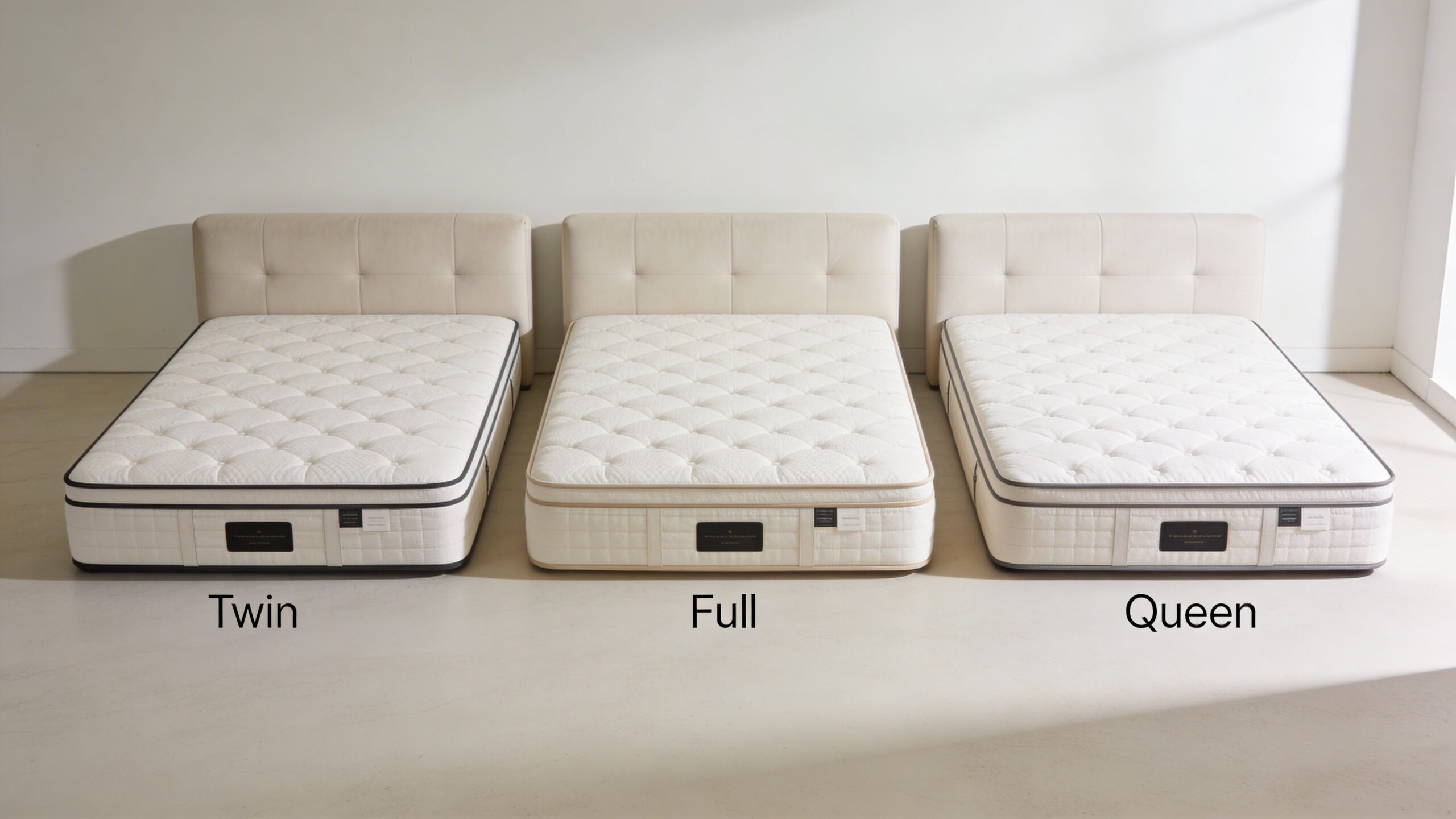
Twin, full, and queen are the sizes most buyers consider, but the label alone isn’t enough — sizing can vary slightly by frame style and manufacturer, so compare your frame against a futon mattress sizing chart for common frame dimensions before choosing.
- Twin: best for one sleeper, small offices, kids’ rooms, and tight apartment layouts.
- Full: the most flexible choice for mixed use — works well as a sofa and handles regular single-sleeper use or occasional use for two.
- Queen: better for couples or sleep-first setups, but asks more from the room and the frame. In sofa position, it has a larger visual footprint and more weight to manage.
For many buyers, full hits the balance point — enough sleeping surface without making the sofa side of the equation awkward.
Thickness decides how well the mattress handles both jobs
Size decides whether the mattress fits. Thickness decides whether it behaves.
A thinner mattress folds more easily and keeps a cleaner sofa profile. A thicker mattress cushions better at night, but can look bulky, feel heavier to lift, and resist a tight fold on some frames.
Around 6 inches
Best for a sofa-first or true occasional-use setup. It keeps the frame’s lines cleaner and tends to sit better upright. For guest use or lighter everyday sitting, 6 inches is enough if the internal build is solid.
Around 8 inches
Makes more sense when sleeping comfort matters more — more cushioning between the sleeper and the frame, which helps for frequent use. The trade-off: more thickness means heavier, rounder-looking in sofa mode, and less cooperative on frames with a tighter fold.
A decision framework instead of chasing the thickest option
If the futon will spend most of its life as a couch, stay closer to the lower end of the thickness range. If it will be opened several nights a week, move toward a thicker build — but only if the frame is designed to handle it cleanly. If it has to succeed at both jobs, aim for the middle. A medium-profile mattress is the safest answer for dual-use rooms, avoiding both common mistakes: too thin and feeling the frame at night, or too thick and ending up with a sofa that looks overstuffed and folds poorly.
The look matters too
- Thinner mattresses keep a sharper, more defined sofa look.
- Mid-profile mattresses give the best visual balance in mixed-use spaces.
- Thicker mattresses feel more bed-like, but can dominate a smaller room and make a sleek frame look clumsy.
Measure the frame in both positions. A futon mattress has to work flat and folded, or it’s the wrong fit.
Beyond the Fill: Firmness, Construction, and Covers
Sitting on two futon mattresses for thirty seconds and picking the one that feels better as a sofa is a common mistake — then wondering why it feels wrong at night. Dual-use success comes from a better filter: judge firmness for sleeping first, then check whether construction and cover still make sense for how the futon will look and live in the room.
Firmness has to satisfy the bed job without ruining the sofa job
Sleep position still matters, even on a futon. Side sleepers do better with more give at the shoulders and hips, back sleepers need steadier support through the midsection, and stomach sleepers tend to need the firmest feel. See our futon mattress buying guide for more on matching firmness to sleep position.
On a futon, that trade-off is more obvious because the mattress is built to fold and sit upright as well as lie flat. A mattress that feels great for sitting can be too hard for a side sleeper. A mattress that feels plush in bed mode can look sloppy in sofa mode and lose the neat, supportive seat feel people expect from a couch. For true dual use, start with the sleeping position that will use the futon most often, then sanity-check the sit feel — not the other way around.
Tufted versus non-tufted changes more than the appearance
Tufting helps keep the fill from shifting as the mattress is folded, opened, and used repeatedly — a practical choice for busy family rooms, guest spaces that convert often, and shoppers who prefer a more traditional futon look. You’ll feel some surface texture, and some sleepers notice it more than others.
Non-tufted mattresses give a cleaner top surface and a more polished look, suiting modern rooms better. The catch: the mattress relies more heavily on internal construction to stay even over time, so build quality matters more, especially under hard daily use.
Cover choice affects daily use more than showroom feel
The cover is what you touch, see, clean, and live with, and it changes how the futon reads in the room. Some fabrics feel casual and family-friendly; others sharpen the lines and make the piece look more finished.
- Durable woven fabrics hold up well in higher-traffic rooms.
- Microfiber-style covers are easier for homes where spills and cleanup are part of daily life.
- Cotton-rich covers feel softer and breathe better.
- Natural-looking fabrics work well for shoppers who want texture and a less synthetic finish.
If the mattress itself is right but the finish isn’t, a well-fitted set of futon covers can solve that without forcing a mattress compromise.
A simple decision framework for dual-use rooms
If the futon is mainly a sofa that becomes a bed occasionally: firmer seating, tufting for stability, a cover that’s easy to clean. If it’s mainly a bed that folds up during the day: firmness based on sleep position first, then a cover you’ll enjoy against the skin and construction that stays even over time. If it has to do both jobs equally well: avoid the extremes. Medium-firm is the safer middle ground, tufting holds up better under repeated conversion, and the best cover matches how rough the room will be on the mattress. A pretty fabric is easy to replace. Wrong firmness is not.
Why Your Futon Frame Matters More Than You Think

A mattress that feels right in the showroom, then feels uneven, stiff to fold, or less comfortable than expected once it’s home — in many of those cases, the mattress isn’t the primary problem. The frame is.
For a dual-use futon, the frame sets the rules. It decides how sharply the mattress has to bend, how well it stays supported in bed mode, and whether your best sofa-bed compromise will actually work day to day.
Start with the fold style
Bifold frames fold once, so they handle thicker and less flexible mattresses better — if you want the futon to feel more like a bed at night, this style gives more room to work with.
Trifold frames fold twice, putting more stress on the mattress. They pair better with thinner, more flexible builds. Put a bulky hybrid on the wrong trifold, and you’ll fight the frame every time you open or close it.
A mattress that sleeps well but resists folding is a poor fit for a room where the futon changes positions often.
Then check the support underneath
The base affects comfort more than many buyers expect. Slats spaced too far apart let the mattress sink into the gaps over time, creating an uneven surface and shortening the mattress’s useful life. As a general rule, bifold frames accept thicker mattresses more easily, while trifold frames work better with thinner, more flexible options in repeated conversion setups.
A solid frame can make a mid-range mattress feel better. A weak base can make a premium mattress feel worse.
What to check before you buy
- Measure it flat and upright. Some frames look standard but sit tighter once folded.
- Check the slat spacing. Closer, more even support gives better results.
- Confirm whether it’s bifold or trifold. That choice affects what mattress thickness and construction will work.
- Test the mechanism and overall rigidity. If the frame wobbles in sofa mode, you’ll feel it.
Compare futon frame styles and sizes to match the mattress to how the piece will be used.
What works and what fails
A sturdy bifold frame paired with a medium to thicker mattress gives the best balance for the sofa-and-bed problem in one piece — better sitting support than a soft sleep-only setup, better sleep performance than a thin, sofa-first mattress.
The failures are predictable: thick mattress on a tight trifold, thin mattress over wide slat gaps, heavy daily use on a frame with flex in the seat deck. These mismatches show up quickly in a showroom test. At home, they turn into sagging, poor folding, and the sense that the mattress was the wrong choice when the frame was the real limiting factor.
Picks for Every Use Case
Real buyers don’t shop in categories like “polyester blend” or “coil count.” They shop with a room, a budget, and a problem to solve.
The studio apartment sleeper
Sleeps on the futon most nights, converts it often. Comfort matters more than a razor-clean sofa profile. The right direction: a thicker sleep-focused futon mattress in a dense foam or innerspring hybrid build, for better support and more protection from frame feel. Foam-forward for pressure-point sensitivity; innerspring for a more conventional bed feel.
The guest room host
Wants visitors to sleep comfortably, but the futon doesn’t need to work as a main bed every night. A mid-thickness dual-use mattress is the smart answer — enough substance for guests, not so much bulk that the room feels overbuilt. Foam-and-cotton blends make practical sense here.
The family room workhorse
Gets sat on constantly, kids climb on it, guests sleep over sometimes. Choose durable construction and a forgiving cover strategy. Moderate thickness beats going extremely thick — the goal is easy living, decent sleep performance, and a shape that still looks respectable after regular use.
The minimalist floor sleeper
Doesn’t want a convertible frame mattress at all — wants a simpler, lower-profile setup. A shiki futon mattress is the right lane: better for floor use, storage flexibility, and a traditional feel. Not the same category as a sofa-frame futon mattress, and shouldn’t be forced into that role.
The natural-materials shopper
Cares about what’s inside the mattress, not just how it feels on day one. A natural or organic layered futon mattress — cotton, wool, and latex combinations — makes sense if the build also matches the intended use. Natural materials don’t remove the need for correct thickness, proper firmness, and frame compatibility.
Compare all of these directly in Futonland’s futon mattress range, which includes conventional futon mattresses, natural and organic options, and shiki futons — sorted by how the mattress will be used rather than by label alone.
The best recommendation is not a single mattress. It’s the right type of mattress for the room and the routine.
Your Futon Mattress Decision Made Simple
The best futon mattress isn’t the thickest one, the softest one, or the one with the longest feature list. It’s the one that matches the job.
If your futon is mainly a sofa, keep the profile controlled and the folding easy. If it’s mainly a bed, prioritize support and sleep comfort first. If it has to do both, decide which compromise you can live with more easily: a slightly bulkier sofa or a slightly firmer bed.
- Start with primary use
- Choose the fill based on that use
- Match thickness to the role
- Check frame compatibility before ordering
- Dial in firmness for the sleeper, not just the sitter
That’s the framework that prevents most return-worthy mistakes.
A futon can work beautifully in a studio, guest room, office, or family space — but only when the mattress, frame, and real-life use all line up. Once those pieces match, the futon stops feeling like a compromise and starts feeling intentional.