

Best Murphy Beds: Top Picks For Space-Saving Comfort
The best Murphy beds aren’t just furniture; they’re a clever design solution that blends seamless function with quality construction and style, turning any room into a multi-purpose space. A great one combines a reliable lift mechanism with durable materials, all while looking like it was always meant to be part of your home.
What Makes a Murphy Bed a Smart Space Solution

In a world where every square foot counts, a Murphy bed is more than just a fold-away mattress—it’s a strategic choice. It’s the hidden guest room in your home office, the instant bedroom in a studio apartment, and the secret to reclaiming valuable floor space for daily life. That dual-purpose nature is where the magic really happens.
The genius is in its adaptability. During the day, the room is a living room, office, or workout area. At night, it converts into a comfortable bedroom in just a few seconds. This is what defines the best murphy beds and makes them such a smart investment.
Core Benefits of Modern Wall Beds
Today’s designs are worlds away from the old-school concept of a bed in a box. Modern wall beds come with a whole suite of benefits that solve real-life problems, which is why they’ve become more popular than ever.
- Unmatched Versatility: A single room can wear multiple hats. A Murphy bed with an integrated desk or shelving system lets you switch from a productive workspace to a restful bedroom without compromising on either.
- Stylish Integration: High-quality wall beds are designed to blend right in with your existing decor. With a wide range of finishes and styles, they look just like elegant, custom-built cabinetry when closed.
- Space Efficiency: By storing the bed vertically against the wall, you free up an entire room’s worth of floor space. This is a total game-changer for small apartments, condos, and anyone looking to maximize their living area.
Thinking about how to make the most of your space can lead to some amazing ideas. For example, exploring book shelves that complement your Murphy bed can help create a cohesive, built-in look.
The Growing Demand for Smart Furniture
This shift towards multi-functional living isn’t just a fleeting trend; it’s a reflection of a huge market movement. When people talk about the “best Murphy beds,” they’re tapping into a category that has quietly become a multi-billion-dollar global industry.
Research shows the global wall bed market was valued at $3.47 billion in 2023 and is expected to hit nearly $7.0 billion by 2035. That kind of growth really highlights how much homeowners are prioritizing smart, space-saving furniture.
Choosing the right model is all about finding a solution that solves your unique space dilemma. Throughout this guide, we’ll walk through the different types of wall beds available, helping you find the perfect fit for your home and lifestyle.
Choosing Your Murphy Bed Style

Finding the right Murphy bed for your home starts with a simple question of geometry: how is your room laid out? Your answer will point you toward one of three main styles, each built to solve a different spatial puzzle. Getting a handle on the difference between a vertical, horizontal, or cabinet bed is the first big step toward a smart purchase.
Think of it like picking the right tool for a job. A hammer and a screwdriver both fasten things, but you wouldn’t use one where the other is needed. In the same way, each Murphy bed style is engineered for a specific room shape and ceiling height.
The Classic Vertical Murphy Bed
The vertical Murphy bed is what most people picture. When closed, it’s a tall, slim cabinet. When open, the bed extends straight out from the wall, with the headboard right against it. This makes it the perfect choice for rooms with standard or high ceilings.
Its biggest advantage is its small wall footprint. Because it stands tall instead of wide, it leaves you plenty of wall space on either side for bookshelves, art, or other furniture.
- Best For: Rooms with ceilings of 8 feet or higher and enough floor space for the bed to come all the way down.
- Common Sizes: Available from Twin to Queen, with Queen being a really popular pick for guest rooms.
This setup often feels the most like a traditional bed when it’s open, since you can walk up to it from the sides just like you would with a regular bed frame.
The Smart Horizontal Murphy Bed
But what if your room has low ceilings or it’s long and narrow? That’s where the horizontal Murphy bed really shines. Instead of folding up toward the ceiling, it folds up sideways against the wall.
When you open it, you sleep parallel to the wall, which dramatically cuts down how far the bed sticks out into the room. This makes it a fantastic solution for attics, basements, or any space where ceiling height is tight. It works beautifully along a long, empty wall.
A horizontal setup can make a room feel wider and more open, even when the bed is down. It’s a clever design trick for compact spaces where every inch of perceived space matters.
This style has become incredibly popular, especially in cities where quirky room layouts are the norm. It’s proof of how the Murphy bed market has adapted to the realities of modern living.
The Flexible Murphy Cabinet Bed
For total freedom, the Murphy cabinet bed offers a brilliant, freestanding design. Unlike traditional wall beds, these units don’t need to be mounted or installed at all. They look like a handsome chest or credenza but cleverly unfold into a comfortable bed.
This makes them a great option for renters who can’t drill into walls or for anyone who wants the flexibility to move their guest bed from one room to another. Setup is usually quick and painless, often taking just a few minutes.
The growing demand for Murphy beds as practical solutions is reflected in the market. Global sales hit $1.47 billion in 2023, and single wall beds accounted for over 40% of that. This just goes to show that compact, efficient designs are leading the charge—exactly what styles like Murphy cabinet and chest beds deliver.
To help you see the differences at a glance, here’s a quick comparison of the three main styles.
Murphy Bed Styles at a Glance
| Bed Type | Best For | Space Requirement | Installation |
|---|---|---|---|
| Vertical | Rooms with standard or high ceilings (8’+) | Requires more projection space into the room | Professional or advanced DIY wall mounting |
| Horizontal | Rooms with low ceilings or narrow layouts | Requires less projection space, more wall width | Professional or advanced DIY wall mounting |
| Cabinet Bed | Renters or those wanting flexibility | Freestanding, needs floor space for unfolding | None required; arrives ready to use |
Each style offers a unique solution, so think carefully about your room’s dimensions and how you plan to use the space. This will help you land on the perfect fit that feels like it was made just for you.
How to Select the Perfect Mattress
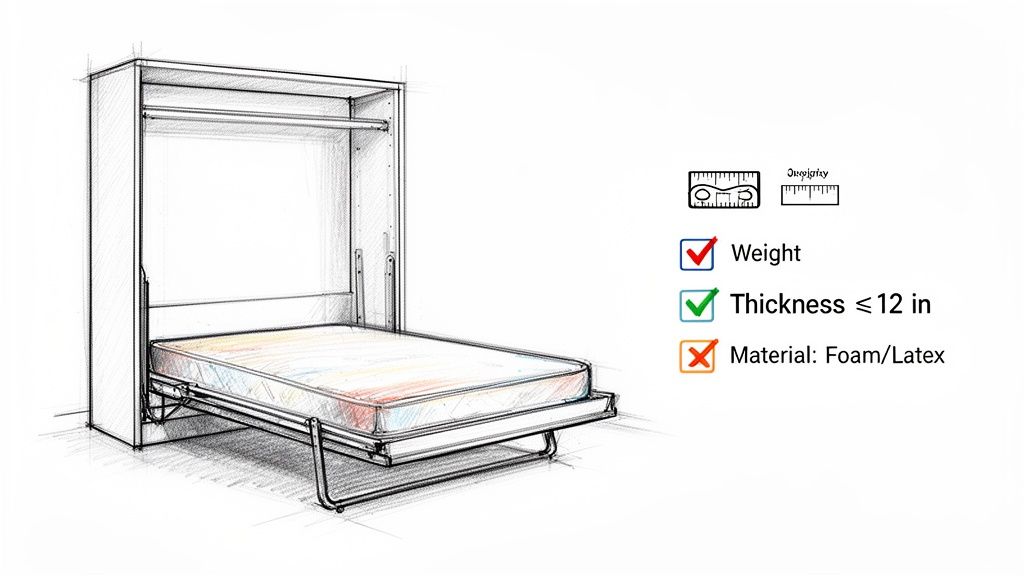
A Murphy bed frame is only half of the comfort equation; the mattress you choose is just as critical. Unlike a standard bed, a Murphy bed’s mattress has to work in perfect harmony with its lifting mechanism. Think of it like a finely tuned scale—if one side is too heavy or light, the whole system becomes clunky and hard to manage.
This is why you can’t just throw any old mattress in there. The best Murphy beds rely on a carefully calibrated balance of weight, thickness, and material to operate smoothly. Getting it right ensures the bed opens and closes effortlessly while giving you a fantastic night’s sleep.
The Three Pillars of a Murphy Bed Mattress
When you’re looking for a mattress, there are three factors that are absolutely non-negotiable: thickness, weight, and material. Nailing these three prevents unnecessary strain on the lifting system and guarantees the cabinet closes properly without any gaps.
- Thickness is a Hard Limit: Most Murphy bed systems are designed for a mattress no thicker than 12 inches. Anything more, and you risk the bed not closing securely, or even damaging the cabinetry over time.
- Weight is a Balancing Act: The lifting mechanism—whether it’s spring or piston—is engineered for a specific weight range. A mattress that’s too heavy can make the bed a workout to lift, while one that’s too light might refuse to stay down.
- Material Affects Longevity: Because the mattress will be stored vertically, materials like memory foam and latex are ideal. They hold their shape without slumping or sagging. Plus, they provide excellent support without needing an internal box spring, which simply won’t work with a Murphy bed.
A big decision you’ll face is whether an innerspring or memory foam mattress is the right fit. While some modern innerspring mattresses are compatible, foam-based options are usually preferred for their flexibility and even weight distribution. You can browse our collection of mattresses to find compatible options.
Your Quick Compatibility Checklist
Before you commit to a new mattress or try to use one you already own, just run through this simple checklist. It’ll tell you right away if your choice is a good match for a Murphy bed system.
- Check the Thickness: Is the mattress 12 inches tall or less? Make sure you measure from the very highest point of the surface.
- Confirm the Weight: Can you find the exact weight of the mattress? You’ll need to compare this number with the weight range recommended by the Murphy bed’s manufacturer.
- Identify the Type: Is it memory foam, latex, or a hybrid mattress that doesn’t use a box spring? These types are almost always your best bet.
Finding the best Murphy bed often comes down to the details that ensure long-term comfort and ease of use. A compatible mattress is one of the most important details for a system that feels light, safe, and reliable for years.
This focus on quality and compatibility is driving innovation across the industry. The global Murphy bed market was estimated at around $1.57 billion in 2024, with Europe alone accounting for over 30% of that revenue. This global competition pushes manufacturers to create better mechanisms and more comfortable, perfectly matched mattresses, raising the standard for what consumers can expect.
Understanding Build Quality and Mechanisms

The difference between a clunky, frustrating Murphy bed and one that feels effortless and secure all comes down to what’s happening behind the scenes. The engineering and materials are the heart and soul of the system, dictating its lifespan, safety, and how easy it is to use day-to-day.
A well-built Murphy bed should feel smooth and nearly weightless. It should never be a chore to open or close.
This smooth performance boils down to two key components: the lifting mechanism and the construction materials. Think of the mechanism as the engine and the cabinetry as the chassis. Both have to be high-quality and work together seamlessly for a reliable, long-lasting piece of furniture. Knowing what to look for empowers you to see past the surface finish and choose one of the best murphy beds on the market.
Piston Lifts vs. Spring Lifts
[Image close-up comparing a gas piston lift mechanism with a heavy-duty coil spring mechanism on a Murphy bed]
The lifting mechanism is what does all the heavy lifting, making a hefty mattress feel light as a feather. Modern Murphy beds primarily use two types, and each has a distinct feel and its own set of advantages.
It’s a bit like the suspension in a car. A luxury sedan’s suspension is designed for a smooth, quiet ride that absorbs every bump. A heavy-duty truck’s suspension is built for hard work and adjustability. Piston and spring lifts are similar—they get the same job done, just with different engineering philosophies.
Piston Lift Systems
A piston lift uses gas or air pressure inside a sealed cylinder to provide assistance. It’s the same kind of tech that holds open the hatchback on an SUV.
- Smooth and Silent Operation: Piston systems are known for their fluid, controlled motion. They open and close without any of the creaks or groans you might get from an older, less refined system.
- Self-Adjusting Feel: The pressure is pre-set from the factory, meaning it’s perfectly dialed in for a mattress within a specific weight range. This makes for a very simple, straightforward user experience.
- Durability: High-quality piston mechanisms are incredibly durable. They’re often rated for tens of thousands of cycles, which translates to decades of regular use without a problem.
Spring Lift Systems
A spring mechanism uses a series of heavy-duty coils that are tensioned to perfectly counterbalance the weight of the mattress and bed platform.
- High Adjustability: The biggest perk of a spring system is that the tension can often be adjusted. This is a huge plus if you ever change your mattress to one that’s slightly heavier or lighter, as you can re-calibrate the lift to match.
- Proven Reliability: Springs are a time-tested technology. While they can sometimes be a bit noisier than pistons, they are exceptionally reliable and built like a tank.
- Powerful Lift: A well-designed spring mechanism provides consistent and powerful assistance, making it a dependable workhorse you can count on for daily use.
Deciding between a piston or spring mechanism is less about which one is better and more about which one fits your needs. Pistons offer a sleek, modern feel, while springs provide robust adjustability.
The Importance of Build Materials
Beyond the mechanism, the materials used for the cabinet and bed frame are absolutely critical. They provide the structural integrity needed to support the entire system safely year after year. Cheaper materials like low-grade particleboard can warp or even fail over time under the constant stress of opening and closing.
For true longevity and safety, look for Murphy beds constructed from high-quality materials.
- Solid Wood: This is the gold standard, offering unmatched durability, strength, and a premium look. Hardwoods like oak, maple, and birch are excellent choices for the main frame and key structural components.
- Plywood: Don’t underestimate good plywood. High-grade, multi-layered plywood provides superior strength and resistance to warping compared to particleboard, making it an excellent and stable core material.
- Furniture-Grade Composites: Materials like Medium-Density Fiberboard (MDF) are often used for decorative elements and panels. When finished with a durable laminate or veneer, they provide a smooth, consistent surface that holds up well.
One last, crucial element to look for is the inclusion of safety features. The best Murphy beds include safety locks that prevent the bed from opening or closing accidentally. These mechanisms engage automatically or with a simple latch, giving you total peace of mind, especially in a home with children or pets.
Planning Your Space for Installation
Okay, you’ve narrowed down the style, mattress, and mechanism that feel right for you. Now it’s time to get practical. Proper planning and precise measurements are what separate a smooth installation from a frustrating one, so taking a moment to map everything out will save you a major headache later on.
Think of it like putting together a puzzle. You wouldn’t just start jamming pieces together without looking at the picture on the box first. The same idea applies here—you need a clear picture of your room’s dimensions and potential quirks before your Murphy bed shows up.
Measuring with Confidence
Accurate measurements are completely non-negotiable. Grab a tape measure and get these three key dimensions down on paper to ensure your new furniture fits perfectly.
- Wall Height: Measure from the floor straight up to the ceiling right where you plan to install the bed. This is especially crucial for vertical models that need plenty of overhead clearance.
- Wall Width: Measure the total horizontal space you have to work with. This will help you decide if a wider horizontal bed is a better fit or how much room you’ll have for any side cabinets.
- Bed Projection: This is the big one—how far the bed will stick out into the room when it’s open. Check the manufacturer’s specs and use some painter’s tape to mark this distance on your floor. It’s a simple trick to really visualize the footprint.
By mapping it out, you can see if you’ll have enough space to walk around the open bed and make sure it won’t block doors, windows, or other furniture. For a deep dive into the specifics, you can explore these comprehensive Murphy bed sizing charts to easily compare different models.
DIY vs Professional Installation
With your measurements in hand, the next question is how this thing actually gets installed. While a DIY approach is definitely possible for handy folks with some experience, it’s a job that demands both precision and muscle. You’ll typically need a stud finder, a level, a power drill, and most importantly, an extra set of hands.
But the benefits of letting the pros handle it are pretty significant.
Opting for professional assembly isn’t just about saving yourself the work; it’s a direct investment in safety and peace of mind. A pro team makes sure the unit is anchored securely to the wall studs, which is vital for safe operation and often a requirement to keep your warranty valid.
Professionals are also seasoned experts at navigating those little household challenges that can completely derail a DIY project. They know how to handle them quickly and correctly, saving you from a world of stress. If you’re in our area, you can learn more about our professional delivery and assembly services.
Before the big day, it helps to be prepared. This checklist will walk you through the key steps to ensure a seamless installation from start to finish.
| Phase | Task | Key Consideration |
|---|---|---|
| 1. Pre-Delivery Prep | Measure your space again | Double-check height, width, and depth. Confirm clearance for the open bed. |
| Clear the installation area | Move all furniture, rugs, and decor out of the way. | |
| Check your wall for studs | Use a stud finder to locate the studs where the bed will be anchored. Mark them lightly. | |
| Inspect the delivery path | Ensure there’s a clear path from your front door to the installation room. | |
| 2. Day of Installation | Unbox and inspect all parts | Before assembly begins, check for any shipping damage or missing hardware. |
| Confirm baseboard plan | Decide if a section of the baseboard needs to be removed for a flush fit. | |
| Level the cabinet | Use shims if your floor is uneven to ensure the unit is perfectly level before anchoring. | |
| 3. Final Assembly | Securely anchor to wall studs | This is the most critical safety step. Ensure the unit is firmly attached. |
| Test the mechanism | Carefully open and close the bed a few times to ensure it operates smoothly. | |
| Attach handles and final hardware | Add the finishing touches and do a final wipe-down. |
Following a checklist like this helps turn a potentially complex job into a straightforward process, ensuring you can start enjoying your new space right away.
Tackling Common Installation Obstacles
No room is perfect, and small imperfections can throw a wrench in the works. Here are a few common issues and how they’re typically handled.
- Baseboards: Most Murphy beds are designed to sit perfectly flush against the wall. This often means a section of the baseboard has to be carefully removed where the unit will be installed.
- Uneven Floors: If your floor has a slight slope, the cabinet can sit crooked, causing the doors to hang unevenly. Installers use thin shims to level the unit perfectly before securing it, which is essential for smooth and safe operation.
- Finding Wall Studs: Anchoring the bed to wall studs is the most critical safety step, period. Professionals use high-quality stud finders and have the experience to deal with different wall types, like plaster or tricky metal studs.
Planning for these potential hurdles ahead of time transforms installation from a daunting task into a manageable one, getting you one step closer to enjoying your new, incredibly versatile space.
Your Final Buyer’s Checklist
Alright, it’s time to connect all the dots. You’ve explored the different styles, figured out the mattress situation, and understand how the mechanisms work. Now, let’s bring it all together to make sure the Murphy bed you pick is the perfect fit for your home, your life, and your wallet.
Think of this as your final walkthrough before you commit. Running through these points one last time will give you the confidence that you’ve covered all your bases and found one of the best murphy beds for your space. This is the last step before you completely transform your room.
Space and Functionality
First things first: let’s confirm the bed will actually fit and that it’s right for the job you have in mind. Getting the dimensions wrong or choosing a model that doesn’t match its intended use are the biggest culprits of buyer’s remorse, but they’re also the easiest to avoid.
- Confirm Your Measurements: Have you double-checked your wall’s height and width? More importantly, have you measured how far the bed will stick out into the room when it’s open? A great tip is to use painter’s tape on the floor to map out the footprint.
- Define Its Primary Role: Is this going to be your everyday bed, or is it for the occasional guest? A daily sleeper needs a much tougher mechanism and a top-notch mattress to stay comfortable and hold up over the long haul.
- Choose the Right Orientation: Look at your room’s layout again. Does a tall, space-saving vertical model make the most sense, or would a low-profile horizontal bed work better?
Comfort and Quality
Next up, let’s talk about what directly affects your sleep and how long the bed will last. A Murphy bed is a real investment in your home, so you don’t want to skimp on quality materials or a good mattress. This isn’t just another cabinet—it’s a bed you or your guests will be counting on for a great night’s sleep.
A well-made Murphy bed feels like an intentional, permanent piece of furniture, not a temporary fix. Focusing on build quality and mattress compatibility is what elevates it from a simple space-saver to a truly functional and comfortable bed.
- Mattress Compatibility: Is the mattress you picked under the maximum thickness (usually 10-12 inches) and within the right weight range? This is a non-negotiable point; the lifting mechanism depends on it to work safely and correctly.
- Mechanism and Materials: Do you prefer the quiet, smooth glide of a piston lift or the time-tested adjustability of a spring system? Make sure the frame is built from solid wood or high-grade plywood for the best possible stability.
Logistics and Long-Term Value
Finally, let’s nail down the practical stuff—getting the bed into your home and making sure your investment is protected. Things like delivery, assembly, and the warranty are just as crucial as the bed itself. A company that stands behind its product will always offer solid customer support and a strong warranty.
This is where the plan becomes reality. Thinking through these last details ensures everything goes smoothly, from the day you order to your first night of restful sleep.
- Plan for Installation: Are you going to tackle the assembly yourself, or is it smarter to opt for professional white-glove service to protect your warranty and ensure safety?
- Review the Warranty: What exactly does the warranty cover, and for how long? A good sign of quality is a long warranty on the mechanism, often 10 years or more.
- Set a Realistic Budget: Have you found the right balance between the initial cost and long-term value? Sometimes, spending a little more upfront on a better-built model can save you a lot of money and headaches down the road.
Frequently Asked Questions About Murphy Beds
Even after digging into all the styles, mechanisms, and mattresses, you probably still have a few questions floating around. Let’s tackle the most common ones we hear from customers. This should clear up any last-minute uncertainties and help you feel totally confident about bringing a Murphy bed into your home.
Can I Use My Existing Mattress with a Murphy Bed?
This is a big one, and the short answer is: maybe, but you need to check the specs first. Most Murphy bed lift mechanisms are precision-engineered to work with a mattress of a specific weight and thickness—usually 10-12 inches max.
If your mattress is too heavy, it’ll strain the system and be a pain to lift. If it’s too thick, the cabinet might not close all the way. Before you get your heart set on using your current mattress, just look up the weight and thickness requirements for the Murphy bed you’re eyeing. It’s a simple check that guarantees your new bed works smoothly and safely for years.
Are Modern Murphy Beds Difficult to Open and Close?
Not at all. The days of those clunky, back-breaking wall beds you see in old movies are long gone. Today’s high-quality systems use advanced piston or spring lifts that do most of the work for you. They’re designed to perfectly counterbalance the mattress’s weight, making the whole unit feel surprisingly light.
You can often open or close it with just one hand and minimal effort. The secret to that effortless glide is professional installation. When the unit is assembled correctly and securely anchored, the mechanism works exactly like it’s supposed to—giving you a smooth, safe motion every single time.
Do All Murphy Beds Need to Be Bolted to the Wall?
For traditional vertical and horizontal models, the answer is a definite yes. Anchoring the unit securely to wall studs is an absolute must. This is a critical safety step that prevents the unit from tipping over when you open it, which is especially important in homes with kids or pets. Think of it as a permanent, secure fixture that’s built to last.
But what if you’re a renter or just don’t want to drill into your walls? That’s where a Murphy Cabinet Bed comes in. These are fantastic freestanding alternatives. They’re designed as self-contained chests that don’t need any wall installation at all, giving you total flexibility.
What Is a Realistic Budget for a Good Murphy Bed?
Prices for Murphy beds can vary quite a bit. The final cost depends on things like the size, what kind of mechanism it uses, the build materials, and any extra features like a built-in desk, sofa, or shelving. You can find solid, reliable systems starting around a thousand dollars.
For premium models—think solid wood, sophisticated features, and a long-term warranty—the price can climb into the several-thousand-dollar range. It’s helpful to see it less as a simple piece of furniture and more as a long-term investment. You’re not just buying a bed; you’re adding a whole room’s worth of function and value back into your home.
Ready to find the perfect space-saving solution for your home? Explore our extensive collection of high-quality wall beds and cabinet beds at Futonland and let our experts help you transform your space. Discover the best Murphy beds today.