Types of Wood for Furniture: A Guide to Rubberwood, Beech, Oak and More
Two futon frames can look almost identical in a product photo and still come from different trees. One is rubberwood stained to look like oak. Another is solid beech in a walnut-colored finish. A third really is oak. The wood underneath determines how a piece handles dents, humidity, daily conversion and refinishing, so it is worth knowing what each species brings before you pick a finish color.
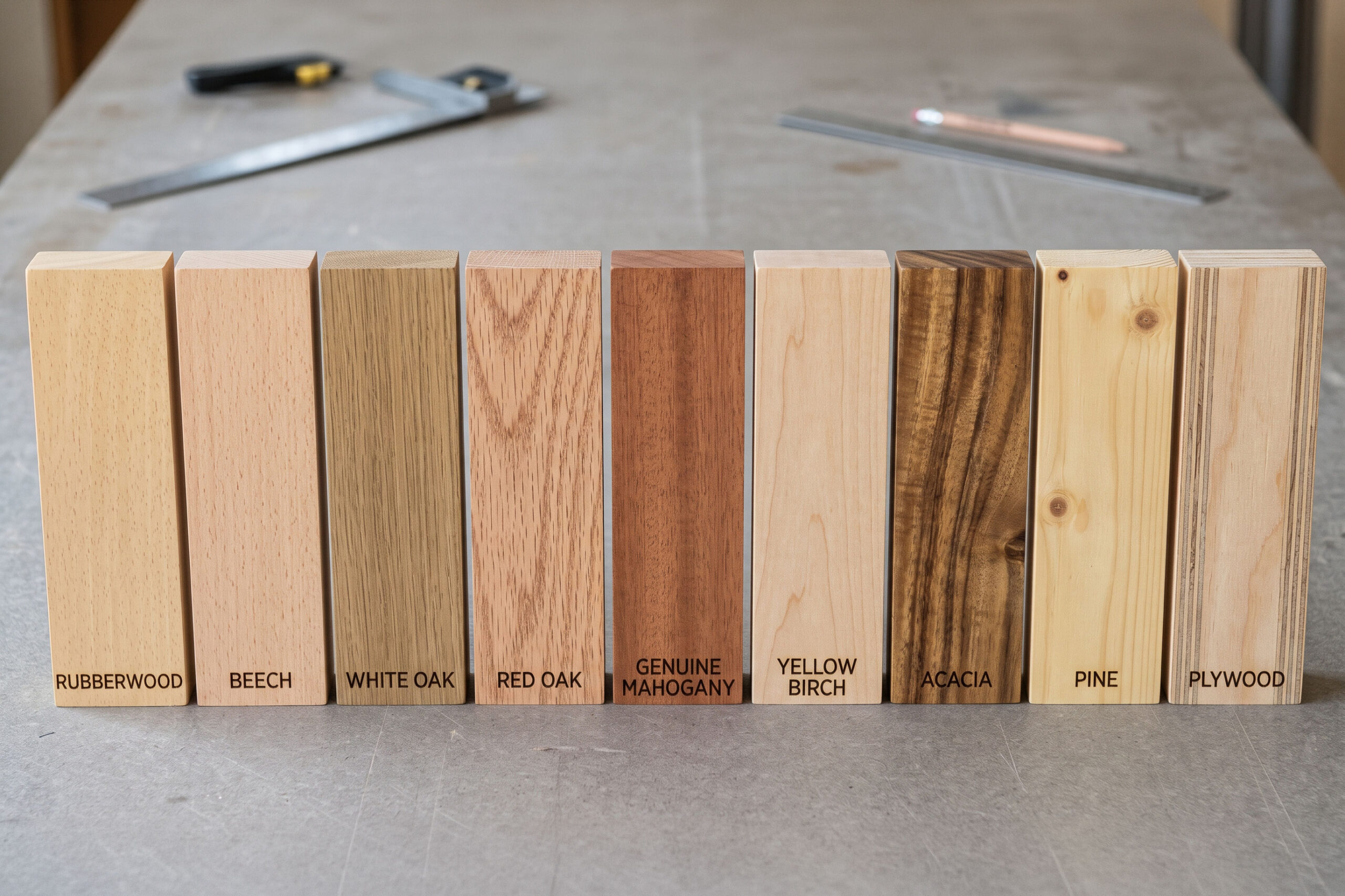
This guide covers the main types of wood used in the furniture Futonland carries: rubberwood, beech, red and white oak, American oak, mahogany, pine, birch and acacia. It also explains how to read product names, because labels like “Golden Oak” or “Mahogany” usually describe a finish color, not the wood.
How Furniture Woods Differ
Four properties matter most when you compare types of wood for furniture:
- Hardness: resistance to dents and scratches, usually expressed as a Janka rating.
- Grain and color: how the wood looks under a clear finish and how evenly it takes stain.
- Stability: how much the wood swells and shrinks as indoor humidity changes.
- Workability: how well it holds screws and bolts, glues and machines. This affects joinery quality as much as the species itself.
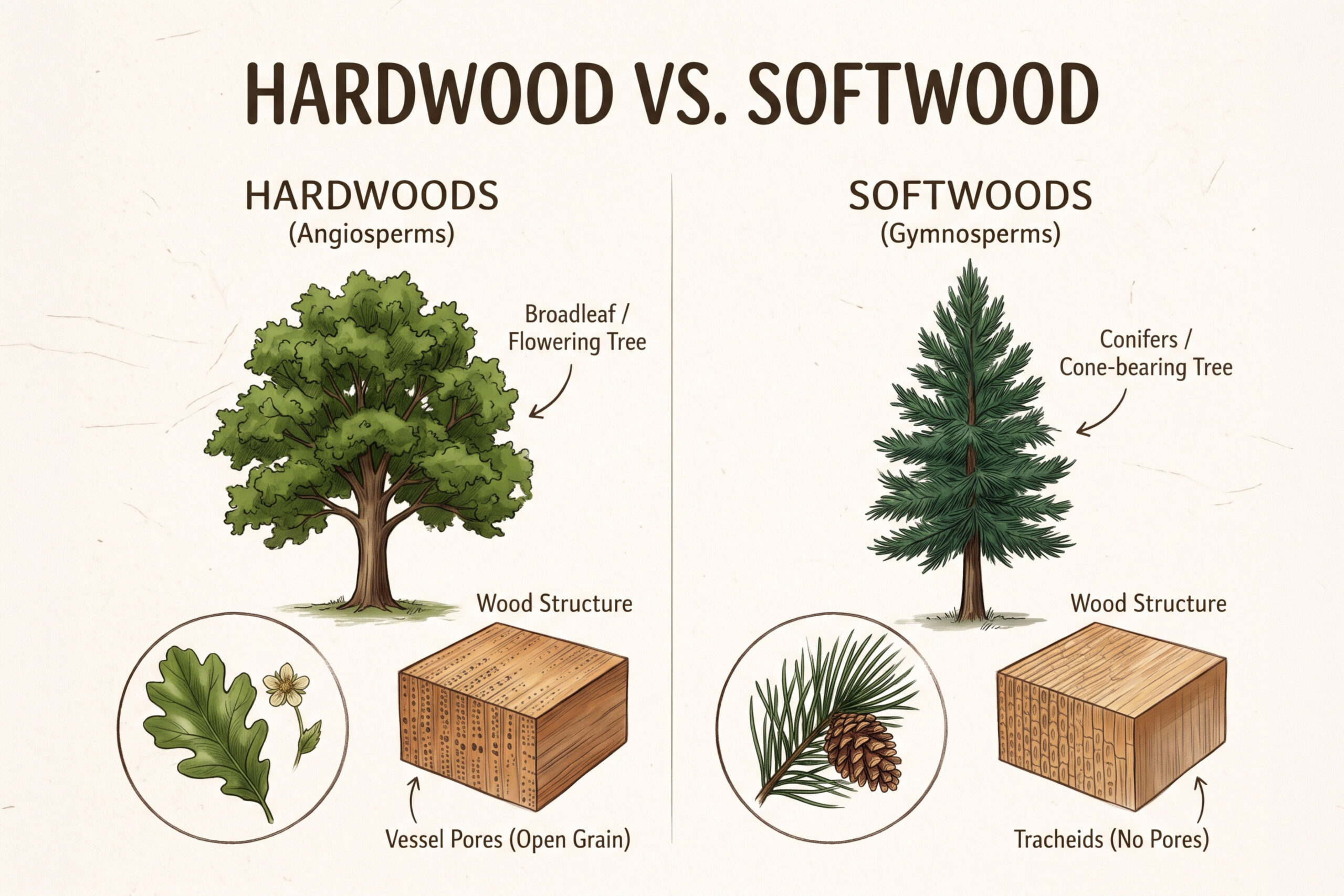
“Hardwood” and “softwood” are botanical categories, not hardness grades. Hardwoods come from broadleaf trees, softwoods from conifers. Most hardwoods are harder than most softwoods, but not all of them: genuine mahogany is a hardwood, yet it dents more easily than rubberwood. A listing that says only “hardwood” tells you the type of tree, not the species or how tough the surface will be.
Furniture Wood Hardness Compared
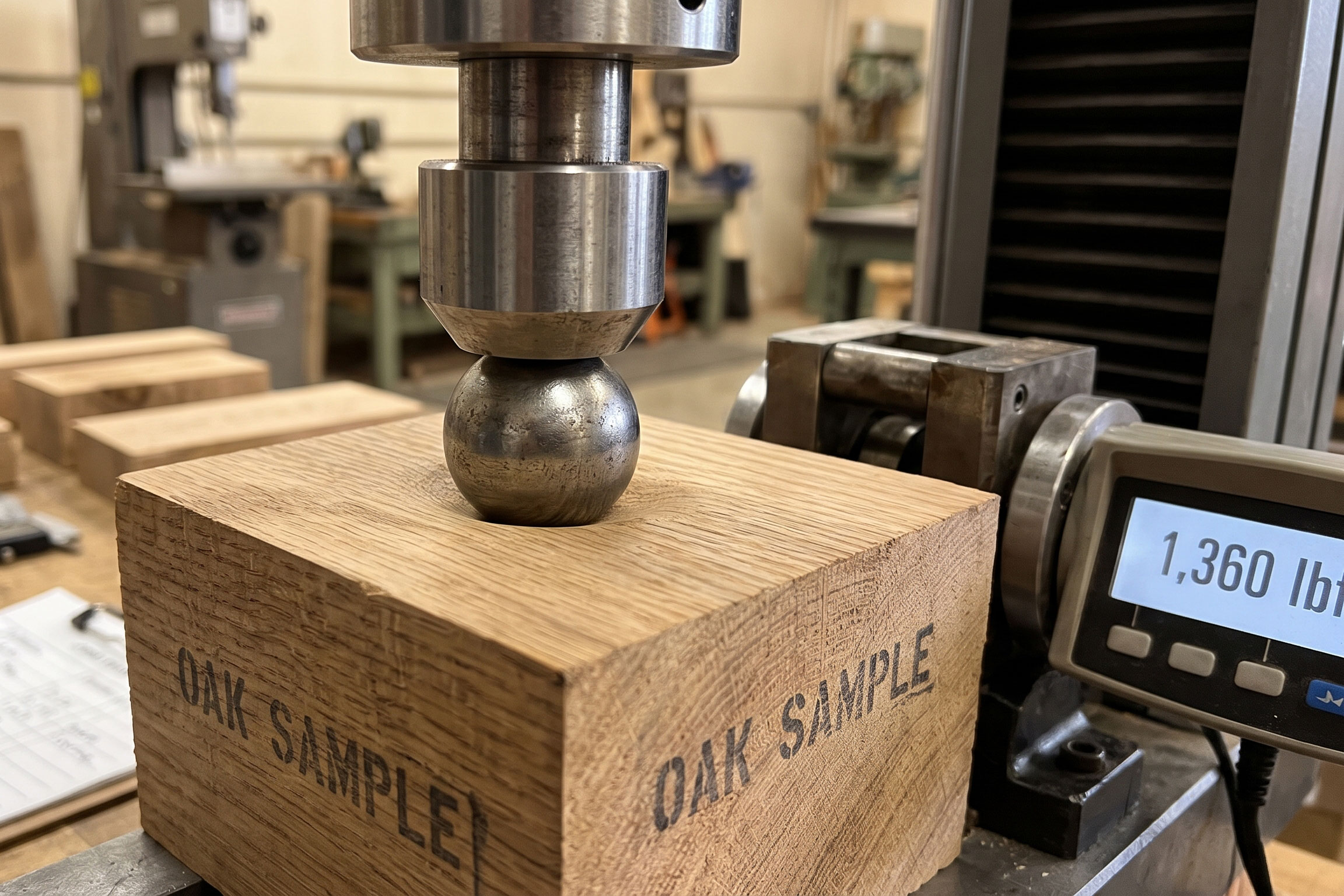
The Janka test measures the force needed to press a steel ball 0.444 inch (11.28 mm) in diameter halfway into a piece of wood. A higher number means better dent resistance. The values below are standard published figures for each species.
| Wood | Janka hardness (lbf) | Look and character |
|---|---|---|
| Beech (European / American) | 1,450 / 1,300 | Pale, tight, even grain with small flecks |
| White oak | 1,360 | Tan to olive-brown; closed pores; ray fleck when quartersawn |
| Birch (yellow / paper) | 1,260 / 910 | Light color, fine and even grain |
| Red oak | 1,220 | Pinkish cast; open pores; bold grain |
| Rubberwood | 980 | Light blond, uniform texture; takes stain evenly |
| Mahogany (genuine) | about 800 | Reddish-brown, fine and straight grain; very stable |
| Red pine (Norway pine) | 560 | Yellow to amber; visible knots |
| Ponderosa pine | 460 | Pale yellow with knots |
| Eastern white pine | 380 | Creamy white, ages to amber; very soft |
| Acacia | Varies widely by species | Strong color contrast; often wavy or interlocked grain |
Keep in mind: Janka measures surface dent resistance, not structural strength. How long a frame lasts depends as much on joinery, rail and slat thickness, and hardware as on the species.
Rubberwood
Rubberwood is the timber of Hevea brasiliensis, the tree tapped for natural latex. Plantations in Southeast Asia tap each tree for roughly 25 to 30 years. When latex yield declines, the trees are cut and replanted, and the trunks are milled into lumber. Furniture made from rubberwood uses a tree that has already served a commercial purpose instead of one felled only for timber.
Rubberwood is a medium-density hardwood. At about 980 lbf it is close to cherry in hardness and a step below oak and beech. Its light, uniform color is the reason manufacturers favor it: it accepts stain evenly and can be finished to resemble oak, teak, cherry, walnut or mahogany. Freshly cut rubberwood is vulnerable to fungus and insects, so it is treated (usually with a boron-based preservative) and kiln-dried before use. Properly dried and treated, it is dimensionally stable and holds bolts and screws well.
A common myth says rubberwood is related to maple. It is not. The rubber tree belongs to the spurge family (Euphorbiaceae), which has no connection to maples.
Rubberwood at Futonland
Most of the hardwood futon frames Futonland carries are rubberwood:
- Prestige bi-fold frames: the Japanese-style frame lines list rubberwood as the material, sourced from Indonesia.
- Night & Day Furniture: futon frames built from rubberwood timber from Malaysia.
- Strata Furniture: the full range of wall hugger futon frames is rubberwood, offered in finishes such as Black Walnut, Warm Cherry, Natural and Gray.
Where it works: futon frames, bed frames, dressers, nightstands and dining furniture used indoors. Where it doesn’t: outdoors or anywhere it stays wet. Rubberwood has little natural rot resistance, so standing water and spills should be wiped up promptly.
Beech
Beech is a dense, pale hardwood with a tight, even grain and small flecks from its rays. European beech rates about 1,450 lbf on the Janka scale and American beech about 1,300, both harder than red oak. Beech machines cleanly, holds fasteners well and bends readily when steamed, which is why it has been a staple of European chairs, frames and bentwood furniture for well over a century.
The trade-off is movement. Beech shrinks and swells more than oak as humidity changes. Keep beech furniture away from radiators, heating vents and direct humidifier spray, and expect slight seasonal changes in how tightly parts fit.
Beech at Futonland
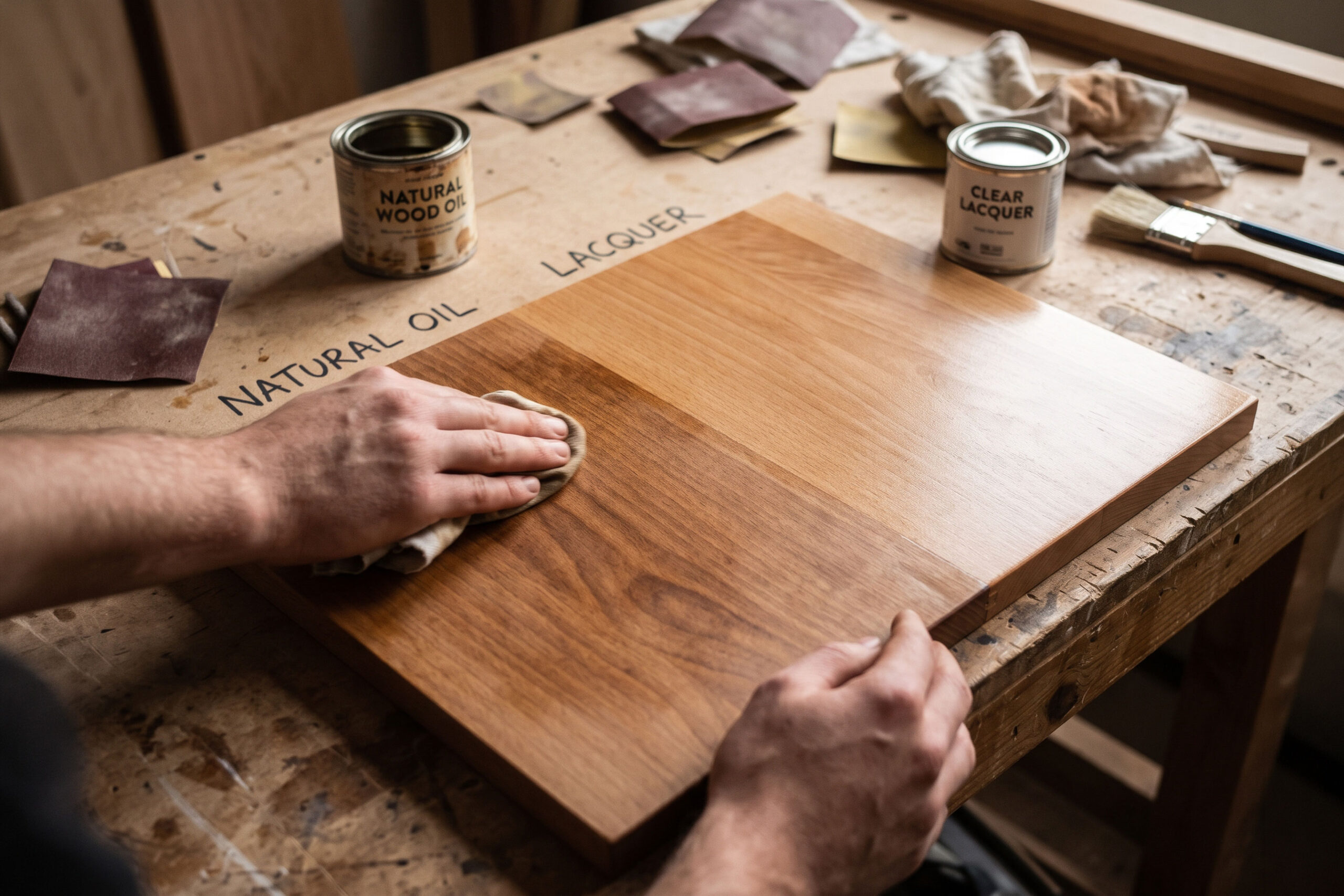
Most Comfort Pure wood furniture is solid beech, much of it in the eco collection: front-closing and tri-fold futon frames, platform beds, captain’s beds, nightstands and chests. These pieces are finished with a hand-rubbed natural oil instead of a lacquer coating, so the surface feels like wood rather than a film. An oil finish is easy to refresh and spot-repair, but it offers less spill protection than lacquer, so wipe up liquids quickly.
The colors in this line, such as Walnut, Wenge, Gray and Beige, are finishes applied over beech. A walnut-finish frame in this collection is still beech.
Oak: Red, White and American Oak
Oak is the reference point most people use for furniture wood. It is hard, strong, widely available and easy to recognize by its prominent grain. The name covers dozens of species, but furniture oak falls into two groups: red oak and white oak.
Red Oak vs. White Oak
| Property | Red oak | White oak |
|---|---|---|
| Janka hardness | About 1,220 lbf | About 1,360 lbf |
| Color | Light brown with a pinkish to reddish cast | Tan to olive-brown, cooler in tone |
| Pores | Open; air can pass through the end grain of a short piece | Plugged by tyloses (natural cell growths) |
| Moisture resistance | Moderate | Higher, which is why white oak is used for barrels and boats |
| Grain | Bold, with pronounced “cathedral” patterns on flat-sawn boards | Straighter; quartersawn boards show distinctive ray fleck |
| Staining | Absorbs stain deeply; grain shows strongly | Takes stain more evenly |
For indoor furniture, both are durable choices. White oak has the edge where moisture is a concern and suits lighter, cooler interiors. Red oak is often chosen for its warmer color and stronger grain pattern. Quartersawn white oak, with its ray fleck, is the classic material of Mission and Arts and Crafts furniture.
What “American Oak” Means
“American oak” refers to oak grown in North America, most often American white oak (Quercus alba) and related species, and sometimes northern red oak (Quercus rubra). The term separates domestic oak from European oak, which resembles white oak but usually has a milder color and grain. In furniture listings, “American oak” signals domestic lumber and often domestic construction.
Oak at Futonland
- Amish-made futon frames: the Comfort Pure Mission Flat Arm, Mission Bent Arm and Classic Bent Arm frames are built to order by a family-run Amish workshop in western Pennsylvania. Standard frames are solid American white oak. The same frames are also available as custom orders in Brown Maple Wood, Cherry Wood and Hickory Wood. Every version is solid hardwood throughout, slats included, with no particleboard, MDF or veneer, and uses mortise-and-tenon joinery with water-based glues.
- Comfort Pure oak frames and beds: some front-closing futon frames, platform beds and captain’s beds in the eco line are made in solid oak with the same hand-rubbed oil finish as the beech pieces.
- Oak futon frames: the full oakwood collection, for comparing styles side by side.
Mahogany
Genuine mahogany (Swietenia) is a reddish-brown hardwood with fine, straight grain that deepens in color with age. It is valued for stability and for how well it carves and finishes, not for hardness. At about 800 lbf it is softer than rubberwood, beech or oak.
Prestige Furnishings uses Indonesian mahogany across several product types, including tatami beds, futon frames and other furniture. “Indonesian mahogany” is a trade name: plantation mahogany grown in Indonesia is often Swietenia macrophylla, but the label can cover other species, so treat the Janka figure as a reference rather than a specification.
Mahogany’s stability suits low, wide pieces like tatami beds, where long rails and broad platforms need to stay straight and square through seasonal humidity changes. Its relative softness also shows why species alone does not determine strength. Prestige’s mahogany futon frames are reinforced throughout and rated for more weight than its rubberwood frames of the same size, even though mahogany is the softer wood. The added capacity comes from the construction.
Do not confuse Prestige’s mahogany pieces with Prestige frames sold in a “Mahogany Finish.” Those are rubberwood stained a mahogany color.
Pine
Pine is a softwood and the most common one in furniture. It is lightweight, affordable and easy to work, with a warm, casual look and visible knots. Over time it ages from pale yellow to honey or amber. Its weakness is surface hardness: eastern white pine rates about 380 lbf, ponderosa pine about 460 and red pine (also sold as Norway pine) about 560, a fraction of oak or beech. Pine dents from a dropped toy or a pen pressed through paper. Many owners see that as character; anyone who wants a surface that stays pristine should choose a hardwood.
Pine at Futonland
- Viking Log Furniture: log-style futon frames and bedroom pieces built from Norway and ponderosa pine.
- Innovations: platform beds, bunk and loft beds, desks, dressers and chests, built mostly from solid pine with some birch.
- Pinewood bunk and loft beds: including Pine Crafter and Innovations models. Pine’s light weight makes large bunk beds easier to assemble and move.
Birch
Birch is a light-colored hardwood with a fine, even grain. Yellow birch is the harder of the common species at about 1,260 lbf; paper birch is closer to 910. Birch takes paint well but can look blotchy under dark stain unless the finisher uses a conditioner first.
In Futonland’s catalog, birch appears in two forms: as solid wood in some Innovations pieces, and as birch veneer over a plywood or MDF core on some bedroom and dining case goods. Birch plywood, made of many thin cross-laminated plies, is one of the stronger and more stable sheet materials used in furniture.
Acacia
Acacia is a large genus with hundreds of species, and lumber sold under the name comes from several of them, much of it plantation-grown. Most furniture acacia is dense and durable, with strong color variation from light honey to dark brown within a single board and often wavy or interlocked grain. Hardness varies widely by species, so no single Janka figure applies.
At Futonland, acacia appears mainly in dining room furniture and some modern case goods, where its contrasting grain is the main appeal. Solid acacia tabletops wear well. Keep them away from direct heat and wipe spills promptly to prevent surface checking.
Finish Names Are Not Wood Species
Futon frames and bedroom furniture are commonly sold by finish color, and many finish names borrow from wood species. The name describes the color, not the material. Examples from the Futonland catalog:
| Listing says | Actual wood |
|---|---|
| Golden Oak, Teak, Mahogany or Dark Cherry Finish (Prestige bi-fold frames) | Rubberwood |
| Black Walnut or Warm Cherry (Strata wall huggers) | Rubberwood |
| Rosewood (Night & Day frames) | Rubberwood |
| Walnut or Wenge (Comfort Pure eco frames and beds) | Beech |
| Hokkaido line (Prestige) | Indonesian mahogany |
To find the species, look past the product title to the material or specifications section of the product page. Wording like “Solid Beech Wood” or “Solid Oak” names the species; a color followed by “Finish” does not. When a listing says only “hardwood,” ask before ordering, either in store or through Futonland customer service.
Solid Wood vs. Engineered Wood
Furniture labels mix several materials, and they behave differently:
- Solid wood: boards cut directly from the tree. Can be sanded and refinished, holds bolts through repeated assembly, and moves with humidity.
- Plywood: thin wood plies glued with alternating grain direction. Stable and strong; quality depends on the core and the number of plies.
- MDF (medium-density fiberboard): wood fibers and resin pressed into panels. Flat, smooth and paints well, but heavy, weak at screw holes and edges, and it swells if it gets wet.
- Particleboard: wood chips and resin. The least expensive panel, with the lowest screw-holding strength.
- Veneer: a thin slice of real wood glued over a plywood, MDF or particleboard core. It gives a real wood surface on a stable panel but can only be lightly refinished.
Engineered wood is not automatically inferior. Veneered panels stay flat in wide tabletops and cabinet sides where solid boards might cup. But anything that moves, carries a sleeper’s weight or is assembled and taken apart repeatedly, such as futon frames, bed rails and bunk beds, benefits from solid wood. That is why the futon frames described above are built from solid rubberwood, beech, oak, mahogany or pine.
Choosing the Best Wood for Your Furniture
There is no single best wood for furniture. The right choice depends on how the piece will be used:
| Use | Strong choices | Why |
|---|---|---|
| Futon frame converted daily | Beech, oak, rubberwood | Hard surfaces and good fastener holding; check joinery and hardware as well |
| Natural oil finish, minimal coatings | Beech or oak (Comfort Pure eco line) | Hand-rubbed oil instead of a lacquer film |
| Built-to-order, long-term piece | American white oak (Amish-made frames) | Solid hardwood throughout with traditional joinery |
| Kids’ bunk and loft beds | Pine or hardwood | Pine is lighter and costs less; hardwood resists dents better |
| Rustic or cabin style | Pine | Knots and amber aging are part of the look |
| Dining table | Oak, acacia, rubberwood | Dense surfaces; finish quality matters as much as species |
| Rooms with large humidity swings | White oak, rubberwood | White oak tolerates moisture well; kiln-dried rubberwood is dimensionally stable. Keep beech away from heat sources |
To compare species, styles and mechanisms in one place, browse all futon frames.
Caring for Wood Furniture
- Dust with a soft, dry cloth. For grime, use a cloth dampened with water and a little mild soap, wrung out well, and dry the surface right away.
- Know the finish. Lacquered and varnished pieces, which includes most rubberwood frames, need no oil. Skip silicone sprays and ammonia-based cleaners, which build up on or dull the coating. Oil-finished beech and oak need periodic re-oiling with the oil the manufacturer recommends, typically when the surface starts to look dry or dull.
- Control heat and humidity. Keep furniture away from radiators, heating and air-conditioning vents, and strong direct sun. Steam-heated apartments get very dry in winter; a room humidifier helps keep joints tight and slats from cracking.
- Retighten hardware. Wood compresses slightly around bolts in the first weeks and shifts with the seasons. Check futon frame and bed bolts after the first month and again when the heating season starts.
- Protect surfaces. Use coasters, felt pads and placemats, and lift objects instead of dragging them. Pine and mahogany dent more easily than oak or beech.
- Expect color change. Most woods shift with light exposure: cherry and mahogany darken, while oak and pine turn more amber. Move objects on tabletops occasionally so the color ages evenly.
Frequently Asked Questions
Is rubberwood good for furniture?
Yes. Rubberwood is a medium-density hardwood that is stable once kiln-dried and treated, holds bolts well and takes stain evenly. It is a sound choice for futon frames, beds and case goods used indoors. It is not suited to outdoor use or damp locations.
Is rubberwood as strong as oak?
Oak is harder: about 1,220 lbf for red oak and 1,360 for white oak, compared with about 980 for rubberwood. Both are durable for indoor furniture. Rubberwood is lighter, costs less and finishes more uniformly; oak has more pronounced grain and, in the case of white oak, better moisture resistance.
Beech vs. oak: which is better?
Beech is about as hard as oak (European beech is harder) and has a smooth, uniform look with little visible grain. Oak has bolder grain and, as white oak, handles moisture better. Beech moves more with humidity changes, so it needs more distance from heat sources. For a futon frame or bed, either is a strong choice; the decision usually comes down to appearance and finish.
Is red oak or white oak better for furniture?
Both perform well indoors. White oak is slightly harder and more water-resistant and has a cooler tone. Red oak has a warmer, pinkish color and a more dramatic grain. Choose white oak for moisture-prone areas or a lighter look, and red oak if you prefer warmth and strong grain.
Is pine good for furniture?
Pine is a good choice for rustic, casual and kids’ furniture, where its light weight and lower cost matter more than dent resistance. It is much softer than hardwoods, so it shows wear sooner. Solid pine still outlasts particleboard, and dents can be sanded or simply left as patina.
What is the best wood for a bed frame?
For daily use, solid hardwoods such as beech, oak and rubberwood are the most common choices because they hold bolts and resist wear. Pine works well for lighter use and kids’ rooms. Whatever the species, check the slat thickness and spacing, the center support and the joinery, since these determine stability as much as the wood does.
Does “mahogany finish” mean the furniture is made of mahogany?
No. A finish name describes the color. Prestige frames sold in a Mahogany Finish are rubberwood. The Prestige Hokkaido line is the one made from Indonesian mahogany.
Is solid wood always better than engineered wood?
Not always. Veneered plywood and MDF stay flat in wide panels and work well for cabinet sides and tabletops. For pieces that carry weight, move or get reassembled, such as futon frames, bed rails and bunk beds, solid wood is the better choice.
Wood species sets the baseline for how a piece looks and wears; construction, joinery and finish decide the rest. To see grain and finishes in person and compare how frames feel and convert, visit a Futonland showroom on the Upper West Side, in Greenpoint or in Newark. Locations and hours are listed on the store locations page.