
How to Shop for a Futon: A Comprehensive Guide
Futons are versatile pieces of furniture that serve as both a comfortable sofa and a convenient bed. Whether you’re looking to furnish a small apartment, a guest room, or a multipurpose space, how to shop for a futon requires careful consideration. In this guide, we will walk you through the essential factors to consider when shopping for a futon, ensuring you find the perfect one that meets your needs and preferences.

Determine Your Purpose
Before starting your futon shopping journey, determine the primary purpose of the futon. Will it be used as a main seating option, a guest bed, or both? Understanding the intended use will help you narrow down your options and choose a futon that suits your specific requirements.
Consider Size and Space
Evaluate the available space where the futon will be placed. Measure the dimensions of the area to ensure the futon will fit comfortably without obstructing other furniture or walkways. Additionally, consider the size of the futon when unfolded into a bed to ensure it provides enough sleeping space.
Select a Frame Material
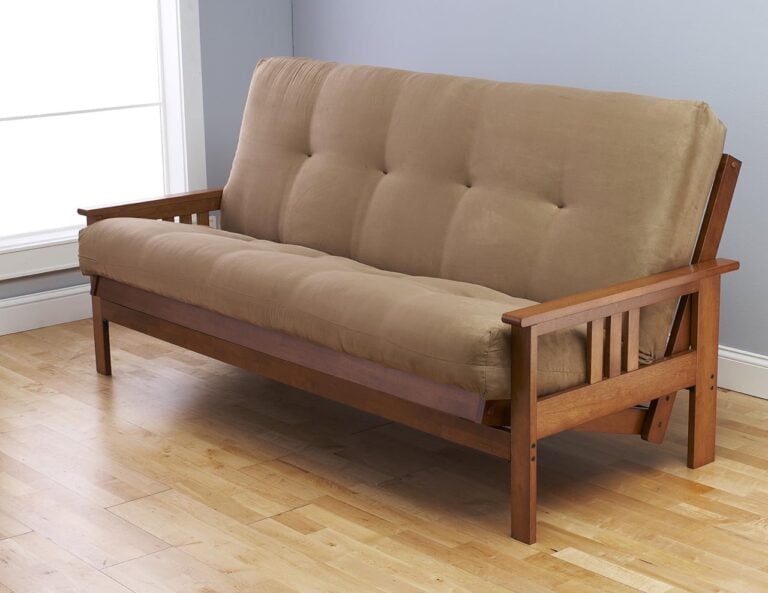
Futon frames are commonly made from wood or metal. Each material has its own advantages and aesthetic appeal. Wooden futon frames offer durability, a natural look, and a wide range of finishes, while metal frames provide a sleek and modern appearance. Consider your preferred style, maintenance requirements, and budget when choosing the frame material.
Evaluate Mattress Options
Futon mattresses are available in various materials, including foam, innerspring, and combination (foam and innerspring). Each type offers different levels of comfort and support. Foam mattresses are generally more affordable and lightweight, while innerspring mattresses provide better support for long-term use. Combination mattresses offer a balance between comfort and support. Test out different futon mattress types to determine the level of comfort you desire.
Check Mattress Thickness, Firmness, and Material Options
The thickness and firmness of the futon mattress are crucial factors in determining its comfort level. Thicker mattresses generally provide better cushioning, especially if you plan to use the futon bed frequently. Consider your personal preferences and the intended use of the futon when selecting the thickness and firmness of the mattress.
Additionally, when choosing a futon mattress, you can also explore natural and organic options. Natural and organic futon mattresses are made from materials that are free from harmful chemicals and synthetic materials. They are typically constructed using natural fibers such as organic cotton, wool, or latex. These mattresses are hypoallergenic and provide a healthier sleeping environment. If you prioritize eco-friendliness and sustainability, considering natural and organic futon mattress options would be a great choice.
Natural and organic futon mattresses offer benefits such as breathability, moisture-wicking properties, and resistance to dust mites and allergens. They are known for their durability and ability to conform to the body’s shape, providing optimal comfort and support. Exploring these options allows you to create a more environmentally friendly and health-conscious living space.
When selecting a futon mattress, consider not only the thickness and firmness but also the material composition, ensuring it aligns with your preferences and values. Take the time to research and compare different natural and organic futon mattresses to find the one that best suits your comfort needs and eco-friendly goals.
Remember, choosing a suitable mattress is essential for a good night’s sleep and overall well-being. By considering thickness, firmness, and material options, including natural and organic alternatives, you can make an informed decision when shopping for a futon mattress.
Evaluate Conversion Mechanisms
Futons come with different mechanisms for converting between sofa and bed positions. Common mechanisms include bi-fold, tri-fold, and click-clack. Bi-fold futons fold in half, while tri-fold futons fold into thirds. Click-clack futons feature a backrest that reclines to form a flat surface. In addition to the previously mentioned conversion mechanisms, there are two additional options to consider: front-loading and wall-hugging mechanisms.
Front-loading mechanism: This type of futon allows you to convert it into a bed by pulling the seat section forward, which then unfolds to create a flat sleeping surface. Front-loading futons are convenient when space is limited, as they don’t require extra clearance behind the futon for the conversion.
Wall-hugging mechanism: Wall-hugging futons are designed to minimize the amount of space required for conversion. They can be easily transformed into a bed without having to move the futon away from the wall. This mechanism is especially useful in smaller rooms or spaces where every inch counts.
Consider your specific space constraints and convenience preferences when choosing between these additional conversion mechanisms.
Assess Quality and Durability
As with any furniture purchase, it’s crucial to assess the quality and durability of the frame and mattress. Inspect the frame for solid construction, sturdy materials, and reliable hardware. Look for features like reinforced joints and durable finishes that can withstand regular use.
For the mattress, consider factors such as the density of foam or the quality of innerspring coils. Look for mattresses that offer good support, comfort, and durability. Reading customer reviews and checking for warranty information can provide valuable insights into the overall quality and longevity of the futon.
How to Read Futon Sofa Bed Reviews
A customer walks into a showroom after reading “best futon” lists for two nights straight. They usually have one of three reactions. They’re either convinced futons are all uncomfortable, convinced the cheapest one will be “good enough,” or completely stuck because every model seems to claim the same things.
The problem isn’t that reviews are useless. The problem is that most of them test a futon for a few minutes and stop there. They sit on it, fold it open, call it easy, and move on. That misses the part that matters most once the box is gone and the furniture is living in your home.
What matters is fit. Not fit as in style alone. Fit as in how your body uses it, how often you convert it, whether it lives in a studio or spare room, and whether you need sofa comfort, bed comfort, or a balance of both.
A futon that works for weekend guests can be miserable as a nightly bed. A sleek click-clack can look right in a studio but still disappoint if you want deep, loungey sofa seating. A thick mattress can feel good at first and still become annoying if the frame underneath isn’t built for frequent folding.
Most bad futon purchases happen when someone buys for the photo, not for the routine.
That’s why this guide doesn’t rank a fake “top ten.” There isn’t one universal winner. There are better and worse choices for specific lives.
Early on, it helps to compare the category at a glance.
| Buyer need | Prioritize first | Watch out for | Strong fit |
|---|---|---|---|
| Nightly sleeping | Mattress construction and support | Thin foam that feels fine for ten minutes | Hybrid or higher-grade sleep-focused mattresses |
| Guest use | Easy conversion and decent sleeping surface | Overpaying for features you won’t use often | Simple, reliable frame and moderate mattress |
| Main sofa in studio | Seat comfort and mechanism durability | Buying a “bed-first” futon that sits too stiffly | Well-designed modern convertibles |
| First apartment budget | Value, straightforward assembly, flexible size | Cheapest build quality and weak hardware | Entry to mid-tier futons with replaceable parts |
The Three Pillars of a Great Futon Sofa Bed
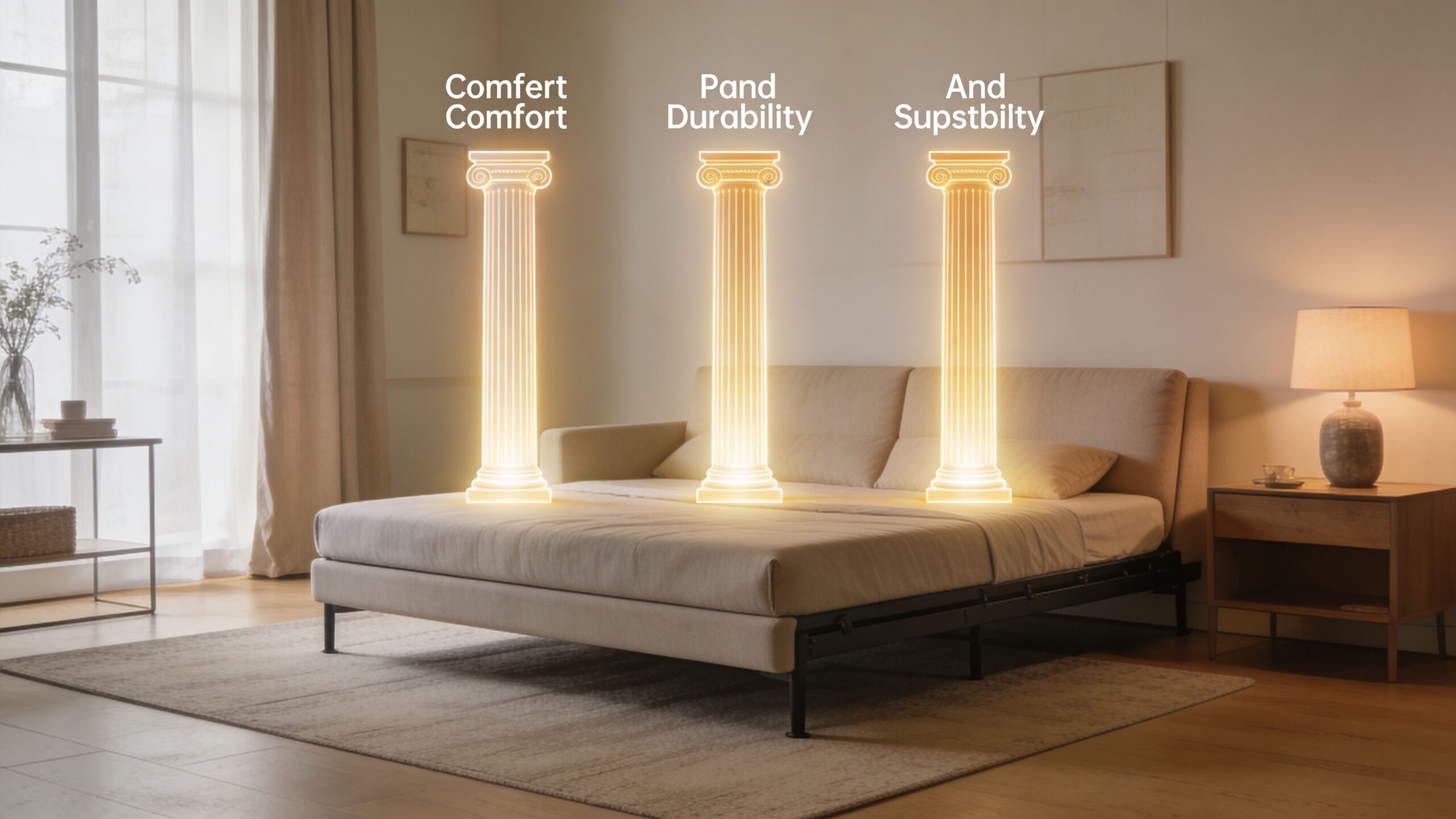
You can judge almost any futon sofa bed by three things: the mattress, the frame, and the conversion mechanism. If one of those is weak, the whole piece feels weak.
Many reviews focus on initial comfort but miss long-term durability. Rapid sagging and lumpiness are common complaints in real households, especially compared to how the same piece felt on the showroom floor or in an unboxing video.
The Mattress Tells You How Honest the Comfort Claim Is
This is the part people notice first, but they often judge it too quickly. A futon can feel soft in a showroom or in an unboxing video and still fail once the same spots take repeated pressure.
For sleeping, the question is whether the mattress keeps your weight from dropping through to the frame and whether it stays even over time. For sitting, the question changes. You want support that keeps you upright instead of sliding into a hammock shape.
Cheap mattresses often chase the first reaction. They feel plush for a moment, then compress unevenly. Better mattresses tend to feel more stable from day one, and they age more predictably.
The Frame Decides Whether the Futon Keeps Its Shape
A weak frame shows up in small ways first. You hear creaks. One side sits lower. The bed position doesn’t look fully level. Over time, those small problems become the complaint customers remember.
Frame quality affects more than strength. It affects how the mattress is supported, how stable the sofa feels when two people sit on it, and how confident you feel converting it. A better frame usually feels calmer. It doesn’t rock, shift, or fight back.
Here’s what to check in person or in product details:
- Joint stability: the frame shouldn’t twist when weight shifts from one side to the other.
- Support layout: slats, deck design, and center support all affect whether the mattress stays even.
- Hardware quality: bolts, hinges, and locking points should feel deliberate, not thin or loose.
Practical rule: If a futon feels unstable as a sofa, it won’t become more reassuring as a bed.
The Mechanism Is What You Live with Every Day
Polished reviews often become least helpful when they show a neat fold-open motion without showing whether the piece is easy for one person, whether the back catches, or whether the design still works smoothly after repeated conversions.
A good mechanism should feel intuitive. You shouldn’t need a second person just to avoid pinched fingers or awkward lifting angles. The motion should be smooth enough that you’ll consistently use it as intended.
A bad mechanism creates “conversion fatigue.” That’s when people stop opening the futon because it’s annoying, heavy, or inconsistent. Once that happens, the product stops doing the job you bought it for.
What Works and What Doesn’t
| Pillar | What works | What usually disappoints |
|---|---|---|
| Mattress | Even support, resilient materials, balanced sit/sleep feel | Thin padding, early lumpiness, bottoming out |
| Frame | Solid feel, good center support, durable hardware | Wobble, flex, creaks, uneven deck |
| Mechanism | Predictable conversion, manageable weight, stable locking | Sticky hinges, awkward lifting, unclear alignment |
The strongest futons don’t win because they photograph well. They win because all three pillars support each other. If the mattress is good but the frame is weak, comfort won’t last. If the frame is strong but the mechanism is annoying, daily use becomes a chore.
Consider Style and Design
Futons are available in a variety of styles and designs to suit different tastes and interior aesthetics. Consider the overall theme and decor of your space, and choose a futon that complements it seamlessly. Pay attention to details such as upholstery fabric, color options, and decorative features to ensure the futon aligns with your desired aesthetic.
Set a Budget
Before embarking on your futon shopping journey, it’s important to establish a budget. Determine the maximum amount you’re willing to spend on the futon, considering any additional costs such as mattress upgrades or accessories. Having a budget in mind will help you narrow down your options and find a futon that meets both your needs and financial constraints.
Finding Your Fit: Four Futon Buyer Profiles
The best futon sofa bed reviews stop being confusing once you sort yourself into the right use case. Most mistakes happen because shoppers buy for someone else’s routine. A guest futon gets used as a primary bed. A sleek studio piece gets expected to feel like a deep family sofa. A budget starter frame gets pushed into heavy daily service.
The Daily Sleeper
If this futon is your primary bed, stop thinking of it as accent furniture. You’re buying a mattress system first.
That means the mattress takes priority over almost everything else. You want support that stays even, enough resilience to handle nightly use, and a frame that doesn’t introduce bounce, tilt, or weak spots. To meet these requirements, traditional futon builds and stronger hybrid mattresses usually make the most sense.
Gold Bond belongs in this conversation because sleep-focused buyers often respond well to a more substantial futon mattress feel. Some people want plushness. Others want a flatter, more supportive surface. Daily sleepers usually do better when they choose support first and softness second.
What to prioritize:
- Sleep support: choose the mattress for eight-hour use, not ten-minute testing.
- Replaceable components: a separate frame-and-mattress setup gives you more long-term flexibility.
- Stable deck support: the frame should keep the sleep surface level across the width.
What not to overvalue:
- Trendy silhouette: a beautiful profile won’t matter if you wake up sore.
- Ultra-fast conversion: if it stays in bed mode most of the time, that matters less than support.
The Occasional Guest Host
This buyer needs balance, not maximum specification. You want guests to sleep comfortably, but you probably don’t need to buy as if someone will use it every night.
That opens the door to simpler setups. A solid frame with a decent mattress is often enough, especially in a guest room, office, or den. You don’t always need the thickest or most specialized mattress if overnight use is periodic.
Wood-frame futons often fit well here because they read as regular furniture when folded up and offer a familiar bed surface when opened. A straightforward build can be easier to maintain and easier to update later with a new cover or mattress.
Guests remember whether they slept comfortably. They rarely care whether the mechanism had the most features.
What to prioritize:
- Easy conversion: you shouldn’t need a rehearsal every time someone stays over.
- Respectable mattress support: not luxury, but not an afterthought.
- Room fit: make sure bed mode doesn’t block doors, desks, or storage.
What can stay secondary:
- High-end upholstery options
- Specialized sofa comfort for all-day lounging
The Small Studio Dweller
This is the hardest buyer profile because one piece has to do several jobs well. In a studio, your futon may be your main sofa, your main bed, and the visual center of the room.
That means compromises become more obvious. A very bed-forward futon can feel upright and stiff as a sofa. A very sofa-forward convertible can stop short on nightly sleep quality. You need a stronger middle ground.
Modern designs often make a lot of sense. Innovation Living is relevant for studio shoppers who want Scandinavian-style lines, smoother mechanism design, and a piece that looks intentional in a living space rather than temporary. If sitting comfort matters as much as sleeping comfort, pay close attention to seat depth, back angle, and how the edge feels behind the knees.
Priorities in a studio:
| Studio need | Why it matters |
|---|---|
| Comfortable seating posture | You’ll use it far more as a sofa than a guest-room futon would be used |
| Reliable conversion | Daily folding gets old fast if the mechanism fights you |
| Visual lightness | In one-room homes, bulky furniture dominates the space |
| Durable upholstery | The piece takes constant use, not occasional use |
What usually disappoints studio buyers is trying to save space by buying too small or too slight a piece. The room may be compact, but your body still needs a credible sofa and a credible bed.
The Budget-Conscious First-Timer
For a first apartment, dorm-adjacent setup, or temporary rental, value matters. That’s where futons often make practical sense. They’re typically less expensive than a comparable traditional sofa bed, and many models are designed for straightforward assembly without special tools.
That doesn’t mean the cheapest option is automatically smart. Budget buying works best when you identify what you can live without and what you can’t.
If you’re furnishing your first place, a simpler frame and a decent mattress often beat an over-featured bargain convertible. Replaceable covers, standard sizing, and straightforward hardware matter more than cupholders or flashy add-ons.
This is the one place worth thinking modularly. Futonland carries a range that lets buyers mix price points across frames, mattresses, and covers, which can be useful when you need to stay within a budget without choosing the lowest-grade version of every component.
What to prioritize:
- Basic structural integrity: don’t trade away stability to save a little more.
- Straightforward assembly: first-time buyers benefit from simpler builds.
- Upgrade path: it helps if you can improve the mattress or cover later.
What to accept:
- Less luxurious upholstery
- A firmer feel at entry price points
- Fewer mechanism refinements than premium models
One Profile Can Overlap Another
A lot of shoppers are a blend. Someone may be a budget buyer today but still need nightly sleep support. Someone may host guests now and move the futon into a studio later.
That’s why the right choice is usually the one that fits your hardest use case, not your lightest one. If a futon needs to survive daily sleeping, buy for that. If it mainly needs to look sharp and seat well in a studio, buy for that.
Test and Compare
To make an informed decision, visit furniture stores or explore reputable online retailers to test and compare different futon options. Sit on the futon, adjust the conversion mechanism, and evaluate the overall comfort and functionality. Pay attention to the ease of conversion, the quality of the mattress, and the stability of the frame. Comparing multiple models will allow you to choose the futon that best suits your requirements.
Shopping for a futon requires careful consideration of factors such as size, frame material, mattress type, conversion mechanisms, quality, style, and budget. By evaluating these elements and considering additional features like front-loading and wall-hugging mechanisms, you can find a futon that not only fits your space but also provides comfort, durability, and style. Remember to thoroughly test and compare different options before making your final decision. Happy futon shopping.