

Modular Sleeper Sofa with Storage Buying Guide
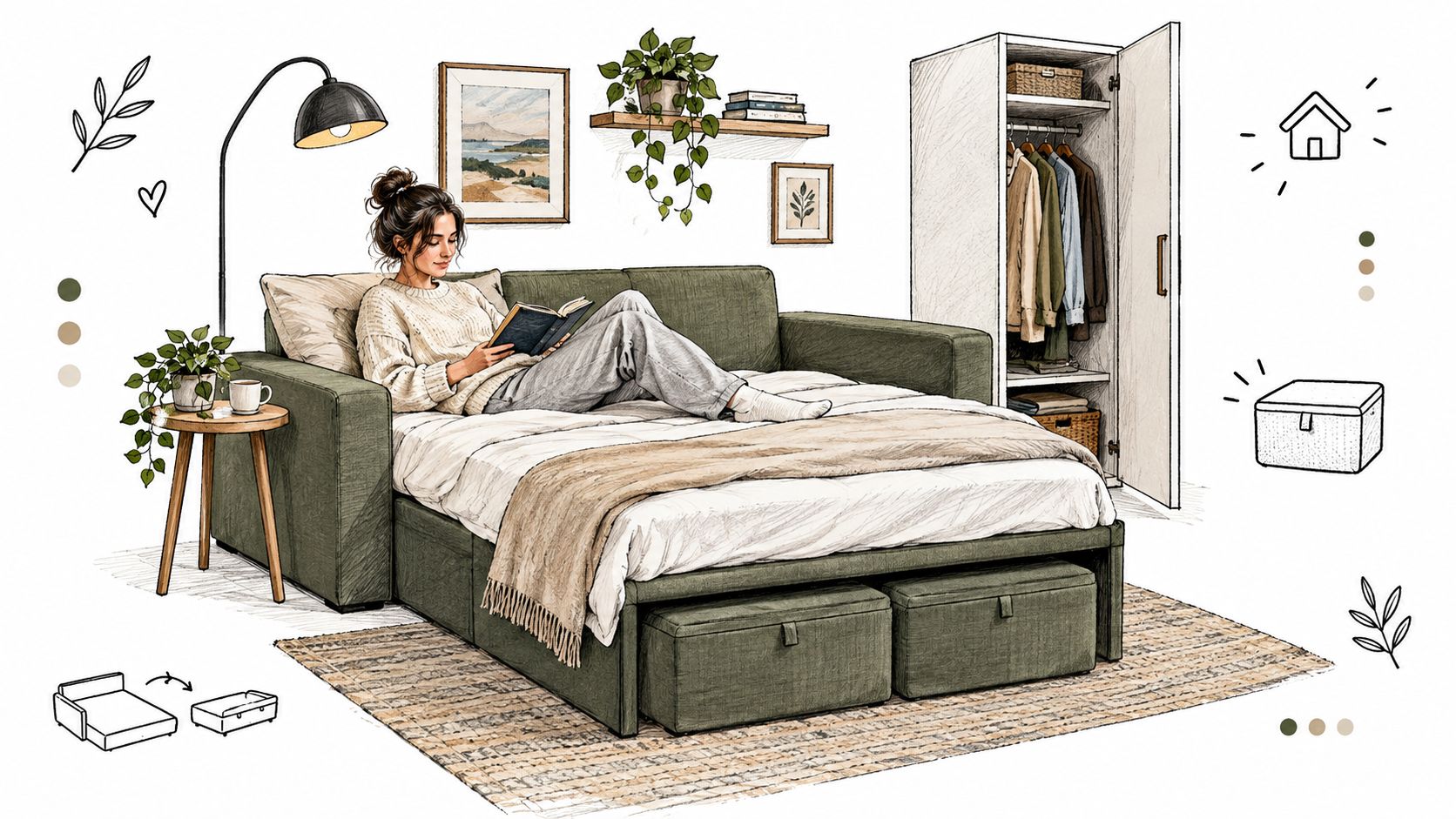
You're trying to make one room handle three jobs. By day, it's a living room for coffee and television. At night, it becomes a guest bedroom, while blankets, pillows, and spare sheets need somewhere to disappear. A modular sleeper sofa with storage can bring those functions into one coordinated system, but only when its modules, sleep mechanism, frame, and storage compartments work together.
That distinction matters. A sofa may look flexible in a product photograph yet become awkward when the bed is extended, the chaise blocks a walkway, or the storage lid strains under a crowded compartment. The right purchase depends less on a fashionable shape than on how the furniture behaves during ordinary use.
This guide treats the sofa as a structural system, not a versatile decorating piece. You'll learn how the modules connect, how storage geometry affects access, how mattresses change sleeping comfort, what measurements prevent delivery surprises, and which construction details influence long-term use. For broader room organization, resources on modular storage units can also help you think about storage as part of the room plan rather than an afterthought.
Introduction to Modular Sleeper Sofas With Storage
A first-apartment renter may use the sofa for daily lounging, open it for an overnight guest, and store bedding inside the chaise. A family may place the same type of sofa in a home office or playroom, keeping the room available for other work between visits. In each scenario, the furniture must earn its floor space through repeated, reliable use.
That reliability comes from more than a flexible shape. The module mix, load rating, sleeper mechanism, and storage geometry decide whether the sofa remains comfortable and practical after frequent changes. A poorly matched chaise can crowd a walkway, while a shallow compartment may hold little more than a blanket. Treat the sofa as a small structural system, much like modular storage units arranged to fit a room. Each part has a job, and the parts must work together.
The category reflects interest in furniture that combines several functions. One market report values the global modular furniture market at USD 89 billion in 2025 and projects approximately USD 145.6 billion by 2035, with a 5.1% CAGR according to Fortune Business Insights. These figures describe market projections, not a guarantee of comfort, durability, or storage capacity for any individual sofa.
Who benefits most
This format suits rooms that change purpose regularly:
- Studio residents: One footprint can support sitting, sleeping, and bedding storage.
- Home-office owners: A spare room can stay configured as an office until a guest arrives.
- Guest-hosting families: Visitors get a usable sleep surface without permanently losing a bedroom.
- Frequent movers: Separate modules may fit new layouts more easily than one fixed sectional.
Every function uses space and hardware. Storage occupies part of the base, the sleeper needs clearance to open, and connectors must hold sections in alignment. Start by checking those practical conditions, then compare fabric, color, and silhouette.
What a Modular Sleeper Sofa With Storage Really Is
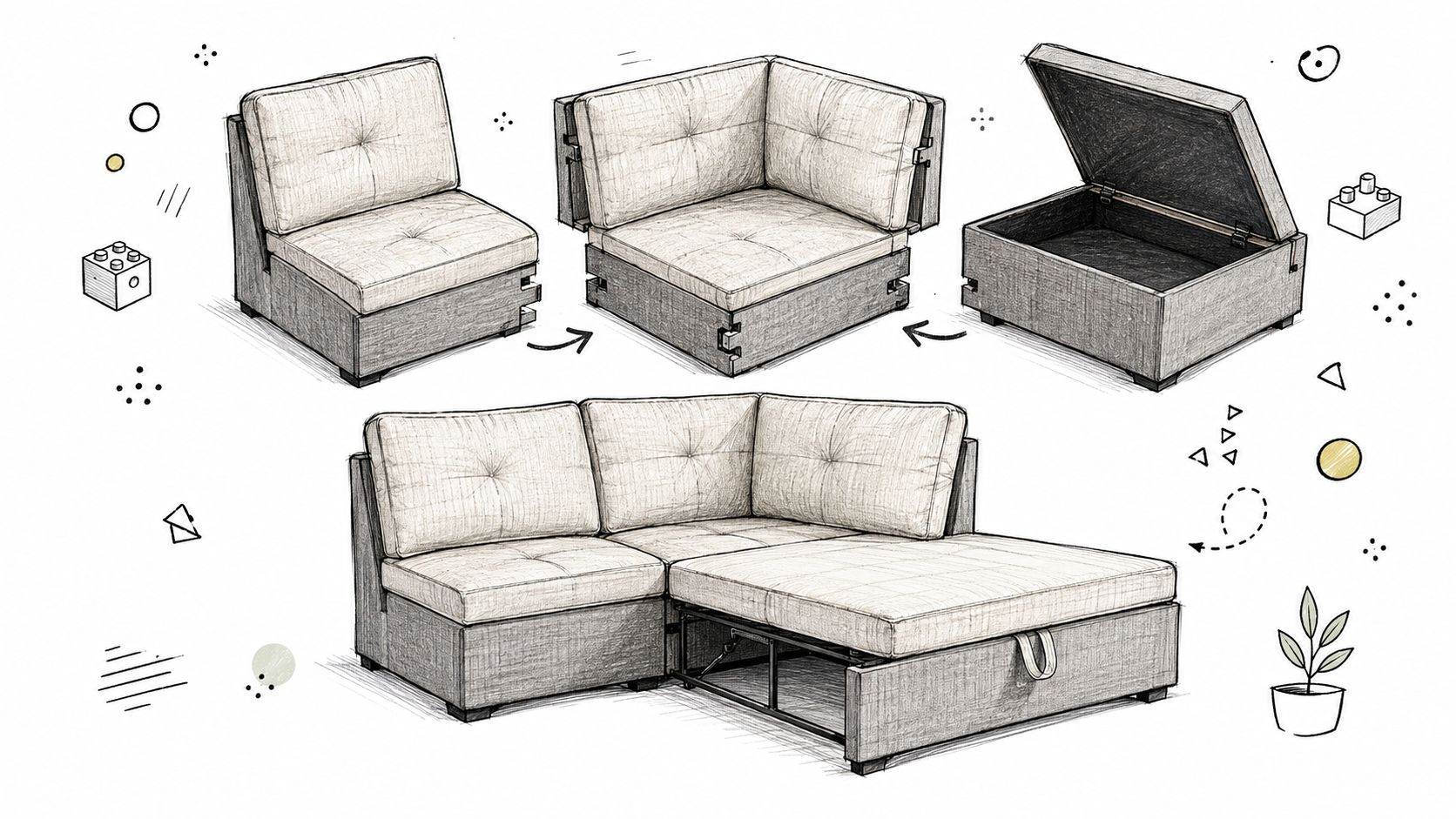
In a small apartment, the sofa may face a daily test: support sitting in the evening, open into a bed at night, then store bedding without blocking the room. A modular sleeper sofa handles these jobs through separate, connected components. An armless chair, corner unit, chaise, ottoman, and sleeper section can form a straight sofa, an L-shaped sectional, or a more open lounge. Connectors limit shifting, while the module mix sets the available seating, sleeping surface, and storage.
The sleeper function is another system within that arrangement. Cushions may fold down, slide forward, or open into a bed platform, depending on the design. Storage usually sits inside the fixed base of selected modules, not in a separate container. The sleeper section, chaise, and ottoman can therefore have different internal capacities.
Separate the three geometries
Evaluate the sofa through three kinds of geometry:
- Seating geometry sets seat height, depth, corner shape, and the feel of joined modules.
- Sleeping geometry sets the bed's width, length, opening direction, and mattress support.
- Storage geometry sets which compartment opens, how far a lid or drawer travels, and what can fit inside.
These dimensions work like coordinated parts of a frame. If one module sits higher, opens into the walkway, or leaves too little room for bedding, the complete arrangement becomes harder to use.
An independent reference design lists a sleeper module at W39⅜ × D31½ × H17¾ inches and a seat-with-storage module at W31½ × D31½ × H17¾ inches in IKEA's VALLENTUNA planning document. Matching heights help create a consistent seating plane, reduce uncomfortable edges, and support a steadier converted surface.
A traditional pull-out sofa places its frame and conversion mechanism in one unit. A modular sleeper sectional spreads those jobs across several pieces, giving more layout options while creating more connection points to inspect. Use convertible sofa beds as a category reference, then check whether the chosen design preserves bed support and storage access after rearrangement.
Practical rule: Buy the module combination you can operate comfortably, not the largest combination that fits on paper.
Storage Types Mattress Options and Comfort Tradeoffs
Storage and sleeping comfort often compete for the same interior volume. A deeper compartment may hold more bedding, while a thicker mattress or stronger platform may leave less room below. The best choice depends on whether storage access or overnight comfort will matter more often.
Compare storage formats first
Lift-top chaise storage usually offers a broad compartment for pillows, blankets, and bedding. It can be convenient because the top opens as one piece, but the chaise must have enough clearance to lift fully. If the sleeper mechanism uses that same area, you may need to restore the sofa before reaching the compartment.
Seat-base drawers provide direct access from the front. They're helpful for frequently used items because you don't have to remove the entire seat, but drawers require clear floor space and may offer less flexible volume. Rails also need to stay aligned, especially on rugs.
Ottoman storage is the most movable option. It can hold throws or guest bedding and may serve as a footrest, spare seat, or extension to a chaise. Its usefulness depends on whether the ottoman remains easy to move after the sleeper is opened.
| Option | How It Works | Best For | Tradeoff to Consider |
|---|---|---|---|
| Lift-top chaise | A hinged chaise lid exposes the base compartment | Bulky bedding and pillows | Needs overhead and side clearance |
| Seat-base drawer | A drawer pulls forward from beneath the seat | Items you access regularly | Requires an unobstructed floor path |
| Ottoman compartment | A removable or hinged ottoman stores items inside | Flexible layouts and guest accessories | Smaller or irregular interior space |
| Sleeper-base storage | Storage is built into a fixed sofa or sleeper module | Keeping bedding near the conversion area | The mechanism may occupy part of the base |
Match the mattress to actual use
Foam mattresses can feel stable and simple, especially for occasional guests. Innerspring mattresses add a more traditional spring response, while memory foam contours more closely to the body and may feel warmer. Hybrid constructions combine foam comfort with coil support, making them worth considering when the sofa will host guests often or serve as a regular sleeping surface.
Don't choose by material name alone. Ask about thickness, support underneath, how the mattress folds, and whether the seating cushions double as the sleep surface. A mattress designed for occasional use may be perfectly reasonable in a guest room but disappointing as a nightly bed.
For a closer look at mattress construction and firmness choices, compare futon mattresses alongside sofa-bed specifications.
| Lifestyle | Storage pairing | Mattress direction |
|---|---|---|
| Occasional guests | Lift-top chaise or ottoman | Foam or innerspring, depending on firmness preference |
| Frequent visitors | Easy-access drawer or chaise | Hybrid or coil-reinforced construction |
| Regular sleeping | Storage that doesn't interfere with conversion | Prioritize the sleep surface and support first |
| Small studio | Compact ottoman or front drawer | Choose comfort without sacrificing open-floor clearance |
Comfort test: Sit in sofa mode, lie in bed mode, and operate the storage in the showroom if possible. A feature that feels convenient only when unused isn't solving a daily problem.
How to Measure and Plan Your Space Without Guesswork
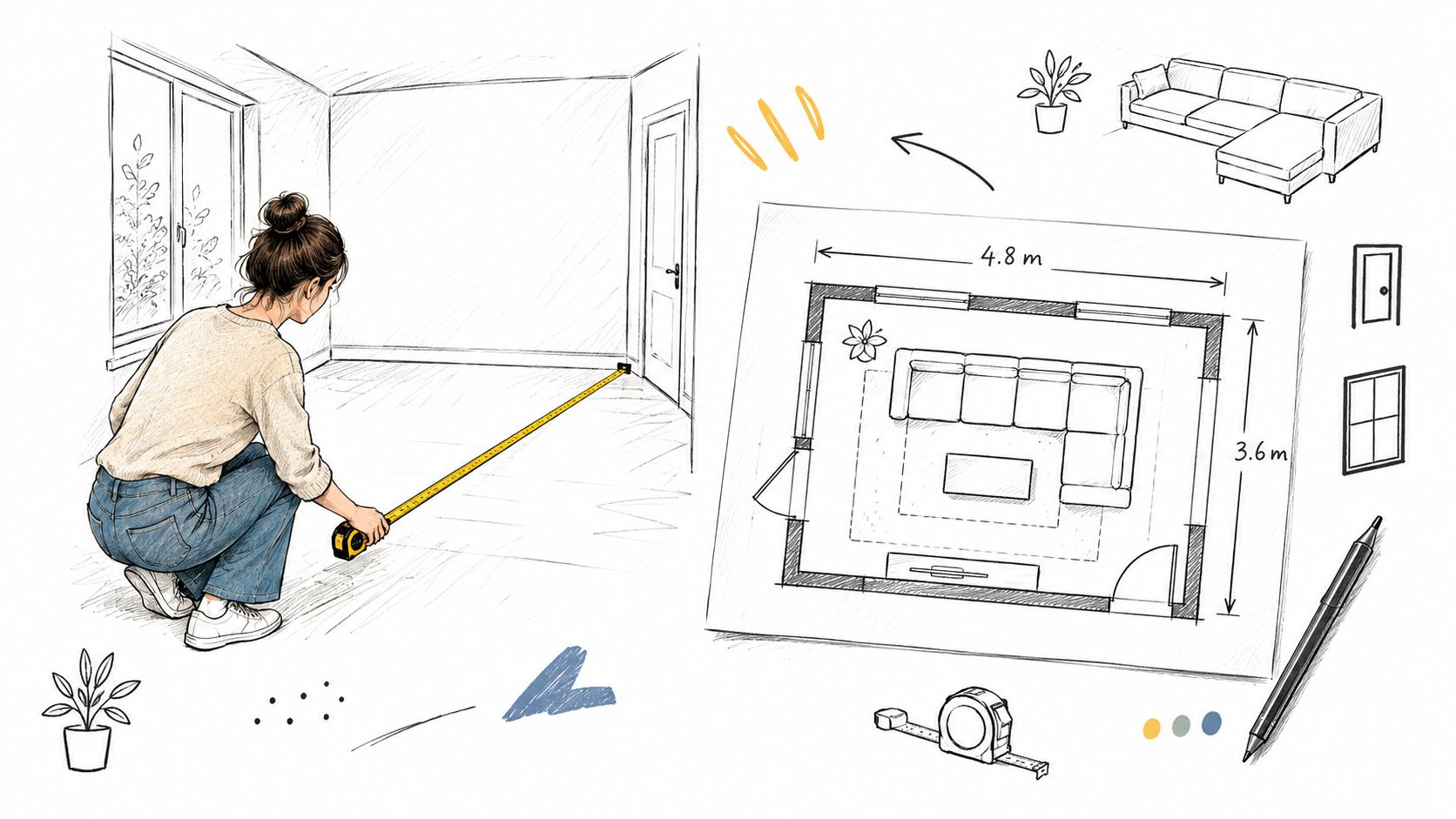
A sleeper sofa can fit its closed footprint and still fail in daily use. The planning test has two positions, sofa mode and bed mode, plus the clearance needed to walk around the mattress, open storage, and reach nearby doors.
Map both positions
Use a tape measure and painter's tape to mark the sofa's full width and depth on the floor. Add a second outline for the extended bed, including the chaise, arms, side tables, and the space required for the mattress to clear nearby furniture.
Use the reference dimensions from the VALLENTUNA design as a planning example. A sleeper module measuring W39⅜ × D31½ × H17¾ inches and a storage seat measuring W31½ × D31½ × H17¾ inches show how module depth can stay consistent while widths change. Treat these figures as an illustration for drawing separate pieces, not as a universal sofa size. Your chosen model's specifications should determine the final plan.
Use this measuring checklist
- Wall width: Measure usable wall space, excluding trim, radiators, outlets, and door swings.
- Closed depth: Measure from the back wall to the front edge, including arms and chaise.
- Open depth: Measure to the farthest point of the extended bed.
- Traffic path: Mark routes to doors, windows, bathrooms, and frequently used furniture.
- Storage clearance: Draw each drawer or lid at full opening, not only the sleeper extension.
- Delivery route: Measure the entrance, hallway turns, stair landings, and elevator opening.
In a compact apartment, the problem is often the walking route rather than the sofa's width. A bed may offer comfortable sleeping space while blocking the only path between the living area and the door. That is a layout problem, so changing the module mix or orientation may solve it better than choosing a smaller mattress.
Check the storage footprint
Storage capacity helps only when the mechanism can open fully. Keep the lid or drawer path on the floor plan, then decide where bedding will go before delivery. Product sizing charts can help compare sofa and mattress dimensions, while the exact manufacturer specifications should control the final layout.
Measure twice: Test sofa mode, bed mode, and storage access separately. If any position blocks a necessary path, change the configuration before ordering.
Materials Durability and What Affects Longevity
A storage-enabled sleeper deserves the same scrutiny as a small piece of machinery. People sit on it, sleep on it, lift panels, pull drawers, and reconnect modules. Each action places stress on a different part of the frame.
Start with the frame and rating
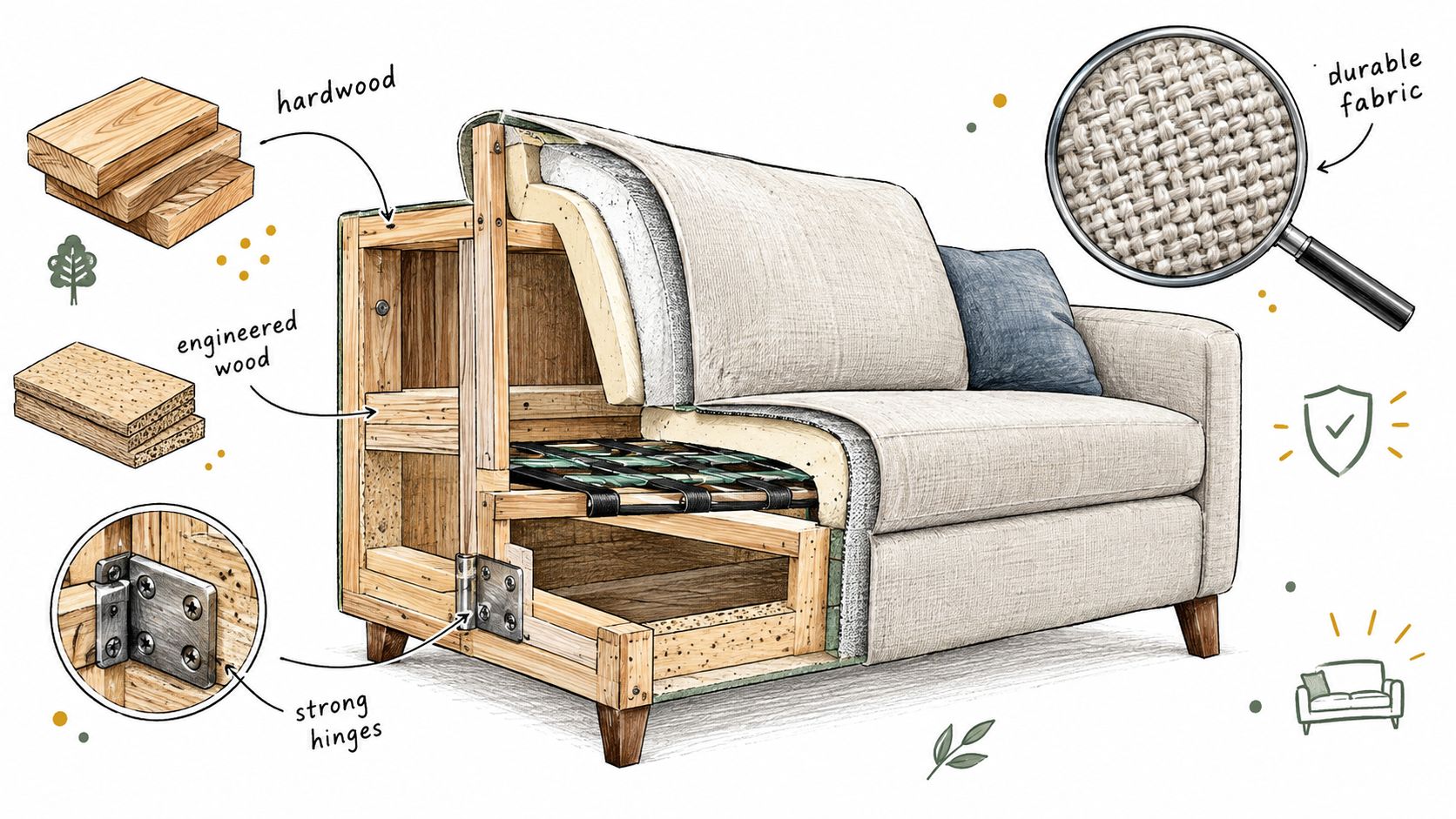
A wood frame can provide a sturdy foundation when joints are properly reinforced. Engineered wood isn't automatically poor quality, but you should ask where it appears, how the pieces are joined, and whether the manufacturer publishes a load limit. A storage base carries more than upholstery. It supports people, hinges, lids, and the items inside the compartment.
One independent product document lists a 1,500-pound total capacity and 300 pounds per seat on a four-seat configuration in its modular sleeper sectional documentation. The same documentation identifies a wood frame, foam seat fill, and foam-plus-wrapped-coil cushion construction. Treat those figures as product-specific benchmarks, not a standard for every sofa.
A published rating gives you a reference for household use. It also helps you avoid treating hidden storage as a decorative cavity. If people regularly sit on the lid or overload the compartment, hinges and frame joints experience more stress than the marketing photograph suggests.
Inspect cushions, hardware, and upholstery
Foam cushions can feel supportive when new, but foam-only construction may compress more noticeably under repeated use. Foam combined with wrapped coils can provide additional resilience and help the cushion resist bottoming out. Ask whether the coils are inside the cushion, beneath it, or part of the sleeper platform, because those are different components.
Hardware deserves a hands-on test:
- Lift panels: Open smoothly without twisting or dropping.
- Hinges: Sit flush and show no lateral movement.
- Connectors: Lock modules together without excessive force.
- Sleep mechanism: Move evenly from one side to the other.
- Drawer rails: Travel without scraping or binding.
For families and pet owners, performance fabric can simplify everyday cleaning, but no fabric is maintenance-free. Look for removable covers, cleaning instructions, seam placement, and replacement-cover availability. A tightly woven surface may hide routine wear better than a delicate texture, while a loose cover may be easier to remove and wash.
A higher load rating matters only when the frame, connectors, hinges, and platform all support it. Don't judge strength from the number alone.
Price Ranges and How to Choose the Right Value
Exact prices vary by configuration, upholstery, mattress, delivery, and assembly, so compare what the price buys, not only the number on the tag. A low-cost configuration may omit the storage module or use a basic sleep surface, while a higher-priced version may include stronger hardware, more fabric choices, or the ability to add modules later.
What usually changes as quality rises
At the entry level, expect fewer configurations, simpler upholstery, and a basic conversion design. The sofa may work well for occasional guests, but inspect the storage opening and frame joints carefully because replacing a failed mechanism can erase the initial saving.
A mid-range design often gives you a more balanced combination of modular choices, cushion support, cover options, and storage access. Many households should compare total ownership value, especially if the sofa will serve as the main living-room seat.
Premium configurations may add upgraded mattresses, wood-frame construction, refined connectors, replaceable covers, and future expandability. Those features matter most when the sofa will receive heavy daily use or when moving homes is likely.
Build a total-cost comparison
Include these line items before deciding:
- Base configuration: Count the exact sleeper, chaise, corner, storage seat, and ottoman modules.
- Sleep surface: Compare the included mattress or cushion system with the upgrade cost.
- Delivery: Confirm room-of-choice delivery, stairs, and building access.
- Assembly: Ask whether connectors, legs, storage lids, or mechanisms need installation.
- Future changes: Check whether matching modules and covers remain available.
- Durability information: Give more weight to published load ratings and frame details than to decorative extras.
If guests sleep there regularly, invest first in the mattress and platform. If the sofa is primarily for sitting, prioritize cushion construction, frame quality, and easy storage access. A higher aggregate rating and wood-frame build can justify additional cost when the furniture will handle frequent seating and repeated conversion, but those features don't compensate for a layout that leaves no room to open the bed.
Assembly Care and Everyday Maintenance Made Simple
Assembly should begin with the floor plan, not the screwdriver. Confirm each module's position, install connectors according to the instructions, and level the pieces before tightening everything fully. Uneven modules can create visible seams, rocking bases, and extra pressure on the sleeper mechanism.
Keep the care routine simple:
- Vacuum first: Remove crumbs and pet hair from seams, storage cavities, and tracks.
- Use the approved cleaner: Test any solution on an hidden area before treating the visible fabric.
- Rotate loose cushions: Change their positions when the design allows it, so one seat doesn't carry all the wear.
- Protect the mechanism: Keep blankets and objects out of hinges, rails, and folding joints.
- Load storage sensibly: Don't force the lid shut or sit on it unless the manufacturer explicitly permits that use.
- Operate evenly: Pull drawers and sleeper sections from the intended handles or release points.
A stiff conversion often comes from an unlevel module, a blocked track, or a connector that isn't seated correctly. Don't add lubricant or remove hardware unless the care instructions authorize it. If a lid shifts, a seam separates, or the mechanism begins grinding, stop using that function and contact the seller before the problem spreads.
For moves, protect upholstery with purpose-made Furniture Protectors For Moving, especially around door frames and stair corners. Once the sofa is installed, removable futon covers can provide a practical way to refresh the surface or change its appearance, provided the cover matches the exact dimensions and mechanism clearances.
Ownership habit: Store bedding loosely enough that the compartment closes without pressure. A convenient storage bay should reduce clutter, not become a packed box that strains its lid.
Your final buying checklist is straightforward. Confirm the module dimensions, open-bed footprint, storage access, frame material, cushion construction, load rating, delivery route, warranty, and replacement-cover options. Then choose the configuration that your household can convert, clean, and live with comfortably.
Measure your room in both sofa and bed mode, shortlist products with published construction details, and contact a furniture specialist with your floor plan before ordering. That small planning step can help you choose a modular sleeper sofa with storage that works on moving day and remains useful long after the first overnight guest.