

Murphy Bed Pros and Cons: Wall Bed vs. Cabinet Bed Guide
If you’re weighing Murphy bed pros and cons, you’re probably trying to solve a very New York problem. One room has to do too much — bedroom at night, office by day, and still presentable when someone drops by.
That tension shows up in our showrooms constantly. A customer wants a proper bed for guests but doesn’t want to stare at it all day. Another needs a primary sleep setup in a studio and can’t give half the room to a permanent frame. Then the practical questions follow: can the wall handle it, will the lease allow it, is a cabinet bed smarter, is a futon the more realistic choice?
A Murphy bed can be the right answer — or unsuitable, if your building rules, budget, or mattress expectations don’t match the product. The useful question isn’t whether Murphy beds are good or bad. It’s which version fits how you actually live.
The NYC Space Dilemma

Many apartments force a compromise before you’ve unpacked. The spare room isn’t really spare — it’s a desk, a workout corner, a Zoom background, coat storage, and maybe, if you’re lucky, a guest room.
In practice, that leads to one of three setups: a regular bed dominates the room, a sofa bed handles occasional guests with a compromise sleep surface, or the room stays open and guests get an air mattress — which solves nothing long term.
What shoppers are usually trying to fix
- A studio resident wants a proper bed without making the whole apartment feel like a bedroom.
- A renter with a home office needs the room to work five or six days a week but still host family.
- A homeowner wants a polished guest setup without a bed sitting open year-round.
Murphy beds promise a proper mattress, a cleaner footprint, and a room that switches roles without much effort. The hard part is sorting through the constraints: a wall-mounted bed may be perfect for an owner and impossible for a renter; a cabinet bed solves the drilling issue but changes the furniture layout; a futon costs less upfront but won’t feel like a conventional mattress.
In NYC, the right sleep solution isn’t just about comfort. It’s about lease terms, wall conditions, room flow, and how often you’ll use it.
If you’re comparing options, testing the mechanisms beats judging from photos — opening motion, cabinet depth, and finishes are easier to compare side by side at a Futonland showroom than on a product page.
The Core Benefit: Reclaimed Floor Space
The biggest advantage of a Murphy bed isn’t subtle — it gives floor space back every day. A folded bed occupies a small fraction of the footprint a standard bed needs when open, and wall-mounted models are built to sit close to the wall when closed. Exact figures vary by model and mattress size, so check the specific unit’s closed-depth spec if floor space is tight.
Why that matters in a real apartment
In a small room, the reclaimed area changes how the room works:
- A work zone with a desk and chair that don’t feel wedged beside a permanent bed
- A circulation path so you can move around the room without side-stepping furniture
- An open-use area for stretching, reading, or just making the room feel less crowded
A traditional bed asks the room to serve sleep first, everything else second. A Murphy bed flips that: during the day the room functions like an office, den, or living space; at night it returns to bedroom duty.
The visual effect is real too
Space savings isn’t only about measurement — it’s visual relief. When the bed stores vertically, the room feels tidier because the largest object in it is no longer spread across the floor. That matters in apartments where the living area is always in view.
Practical rule: If your room needs to perform more than one job every day, floor recovery matters more than almost any decorative upgrade.
Vertical, Horizontal, or Cabinet: Choosing a Style
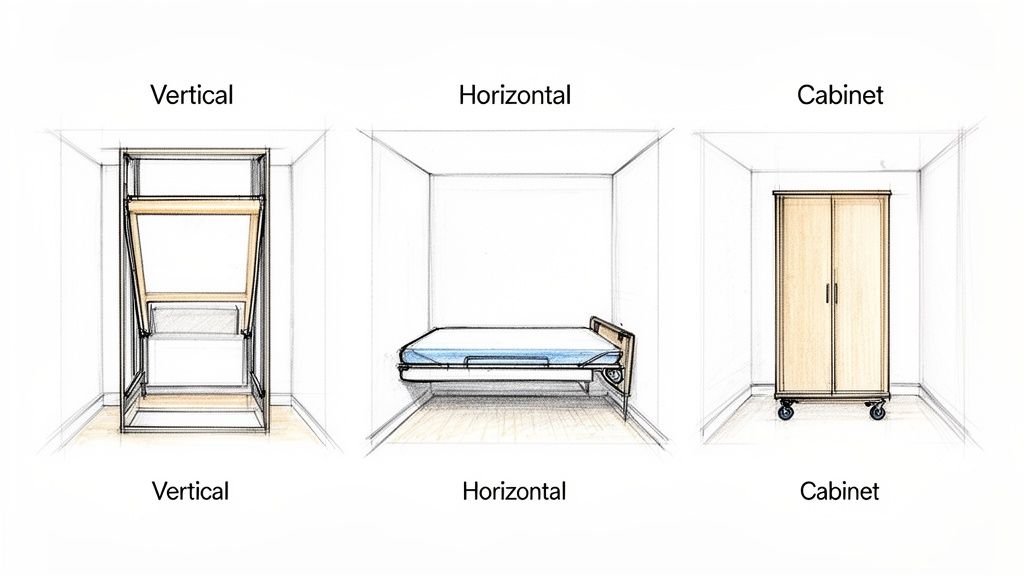
Finding the right Murphy bed for your home starts with a simple question of geometry: how is your room laid out? Your answer will point you toward one of three main styles, each built to solve a different spatial puzzle. Getting a handle on the difference between a vertical, horizontal, or cabinet bed is the first big step toward a smart purchase.
Think of it like picking the right tool for a job. A hammer and a screwdriver both fasten things, but you wouldn’t use one where the other is needed. In the same way, each Murphy bed style is engineered for a specific room shape and ceiling height.
The Classic Vertical Murphy Bed
The vertical Murphy bed is what most people picture. When closed, it’s a tall, slim cabinet. When open, the bed extends straight out from the wall, with the headboard right against it. This makes it the perfect choice for rooms with standard or high ceilings.
Its biggest advantage is its small wall footprint. Because it stands tall instead of wide, it leaves you plenty of wall space on either side for bookshelves, art, or other furniture.
- Best For: Rooms with ceilings of 8 feet or higher and enough floor space for the bed to come all the way down.
- Common Sizes: Available from Twin to Queen, with Queen being a really popular pick for guest rooms.
This setup often feels the most like a traditional bed when it’s open, since you can walk up to it from the sides just like you would with a regular bed frame.
The Smart Horizontal Murphy Bed
But what if your room has low ceilings or it’s long and narrow? That’s where the horizontal Murphy bed really shines. Instead of folding up toward the ceiling, it folds up sideways against the wall.
When you open it, you sleep parallel to the wall, which dramatically cuts down how far the bed sticks out into the room. This makes it a fantastic solution for attics, basements, or any space where ceiling height is tight. It works beautifully along a long, empty wall.
A horizontal setup can make a room feel wider and more open, even when the bed is down. It’s a clever design trick for compact spaces where every inch of perceived space matters.
This style has become incredibly popular, especially in cities where quirky room layouts are the norm. It’s proof of how the Murphy bed market has adapted to the realities of modern living.
The Flexible Murphy Cabinet Bed
For total freedom, the Murphy cabinet bed offers a brilliant, freestanding design. Unlike traditional wall beds, these units don’t need to be mounted or installed at all. They look like a handsome chest or credenza but cleverly unfold into a comfortable bed.
This makes them a great option for renters who can’t drill into walls or for anyone who wants the flexibility to move their guest bed from one room to another. Setup is usually quick and painless, often taking just a few minutes.
To help you see the differences at a glance, here’s a quick comparison of the three main styles.
Murphy Bed Styles at a Glance
| Bed Type | Best For | Space Requirement | Installation |
|---|---|---|---|
| Vertical | Rooms with standard or high ceilings (8’+) | Requires more projection space into the room | Professional or advanced DIY wall mounting |
| Horizontal | Rooms with low ceilings or narrow layouts | Requires less projection space, more wall width | Professional or advanced DIY wall mounting |
| Cabinet Bed | Renters or those wanting flexibility | Freestanding, needs floor space for unfolding | None required; arrives ready to use |
Each style offers a unique solution, so think carefully about your room’s dimensions and how you plan to use the space. This will help you land on the perfect fit that feels like it was made just for you.
Wall-Mounted Murphy Beds: The Permanent Solution
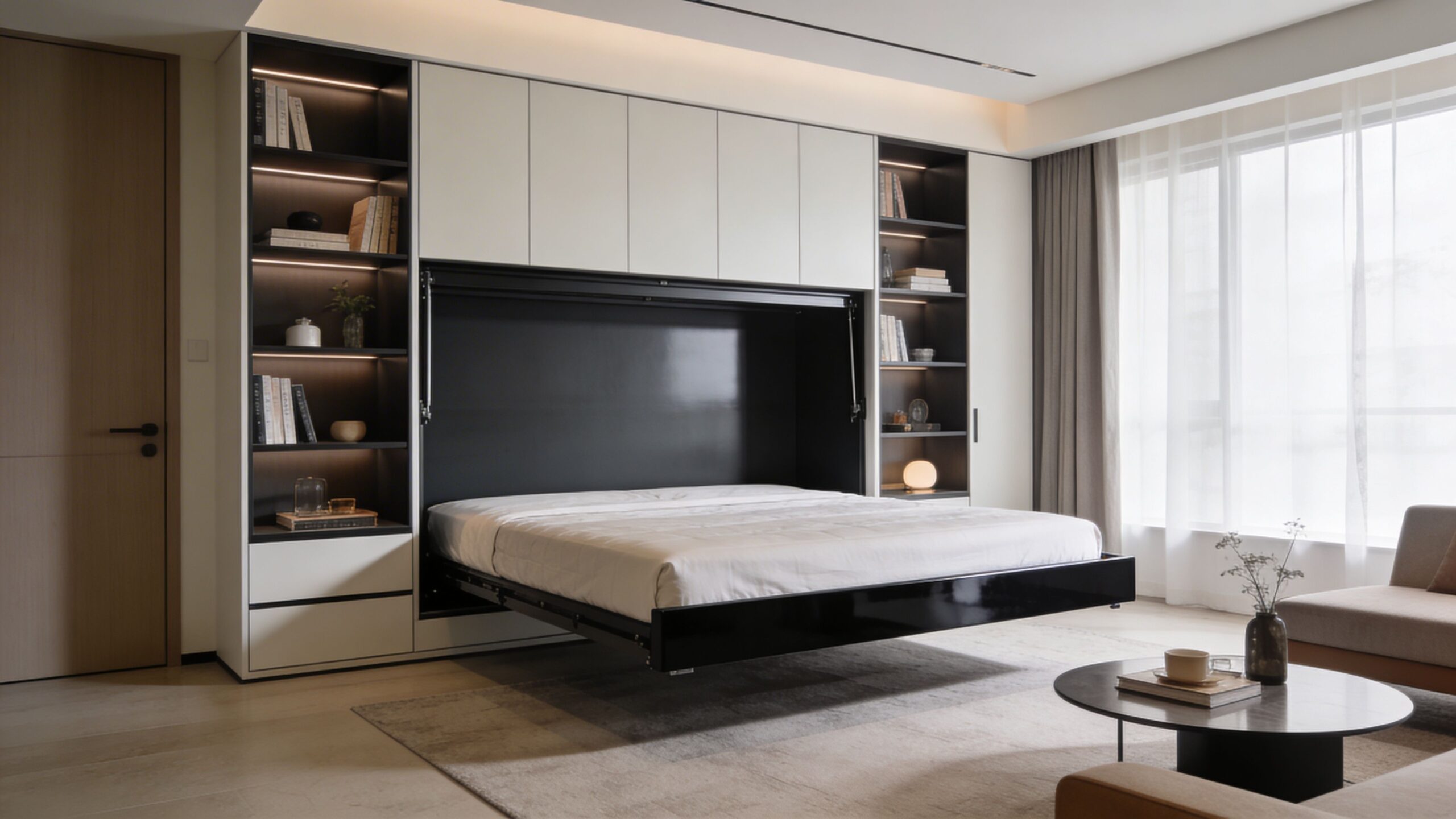
The classic Murphy bed remains the benchmark for people who want a built-in look and use the bed often. A vertical bed folds into a wall unit or cabinet face, then lowers into place when needed. William Murphy patented the original folding bed concept in the early 1900s to solve exactly this kind of space constraint in San Francisco apartments — modern versions still follow the same core idea.
Why owners often prefer them
A wall-mounted bed tends to feel more architectural than temporary — it can read as part of the room instead of an add-on piece. That matters when you’re furnishing a home office, guest room, or studio where visual order counts. Well-built cabinetry can look intentional, letting the bed disappear into the room’s design more neatly than most alternatives.
The practical advantages
- A more integrated look, since the bed is designed to live in one fixed location
- Strong daily usability when the mechanism and frame are well made
- Long service life with quality all-wood construction and a durable lift mechanism
- Good fit for dedicated planning when designing a room around one clear layout
Browse actual wall beds to see the difference between a simple bed cabinet and a more built-in style.
Specific cons for NYC renters
Wall-mounted beds aren’t difficult because the concept is flawed — they’re difficult because city housing adds restrictions. A proper installation means wall attachment, and that’s the sticking point for many renters: landlords and building managers often resist tenants drilling into walls, and even when a lease isn’t explicit, many shoppers don’t want the risk, the patching, or the approval process.
Fit is the other constraint. Wall-mounted models need specific ceiling height and open floor clearance to operate — these vary by model and mattress size, so confirm the manufacturer’s exact clearance requirements against your room before ordering. In some apartments that’s easy; in others, radiators, ceiling fixtures, tight walkways, or nearby furniture make the opening path less forgiving than expected.
If you’re renting, don’t fall in love with the idea before you confirm the wall, the clearance, and the lease.
Cost and commitment
Wall-mounted Murphy beds ask for a bigger upfront commitment than most convertible furniture — you’re buying cabinetry, hardware, a lift system, and often installation planning, not just a bed frame. For owners, that’s often worth it. For someone likely to move next year, it can feel heavy — a commitment to this apartment, this wall, this layout.
This category tends to make the most sense for:
- Owners furnishing a long-term home
- Renters with clear building approval
- Anyone building a polished multi-use room who’s willing to install properly
The No-Install Alternative: Cabinet Beds
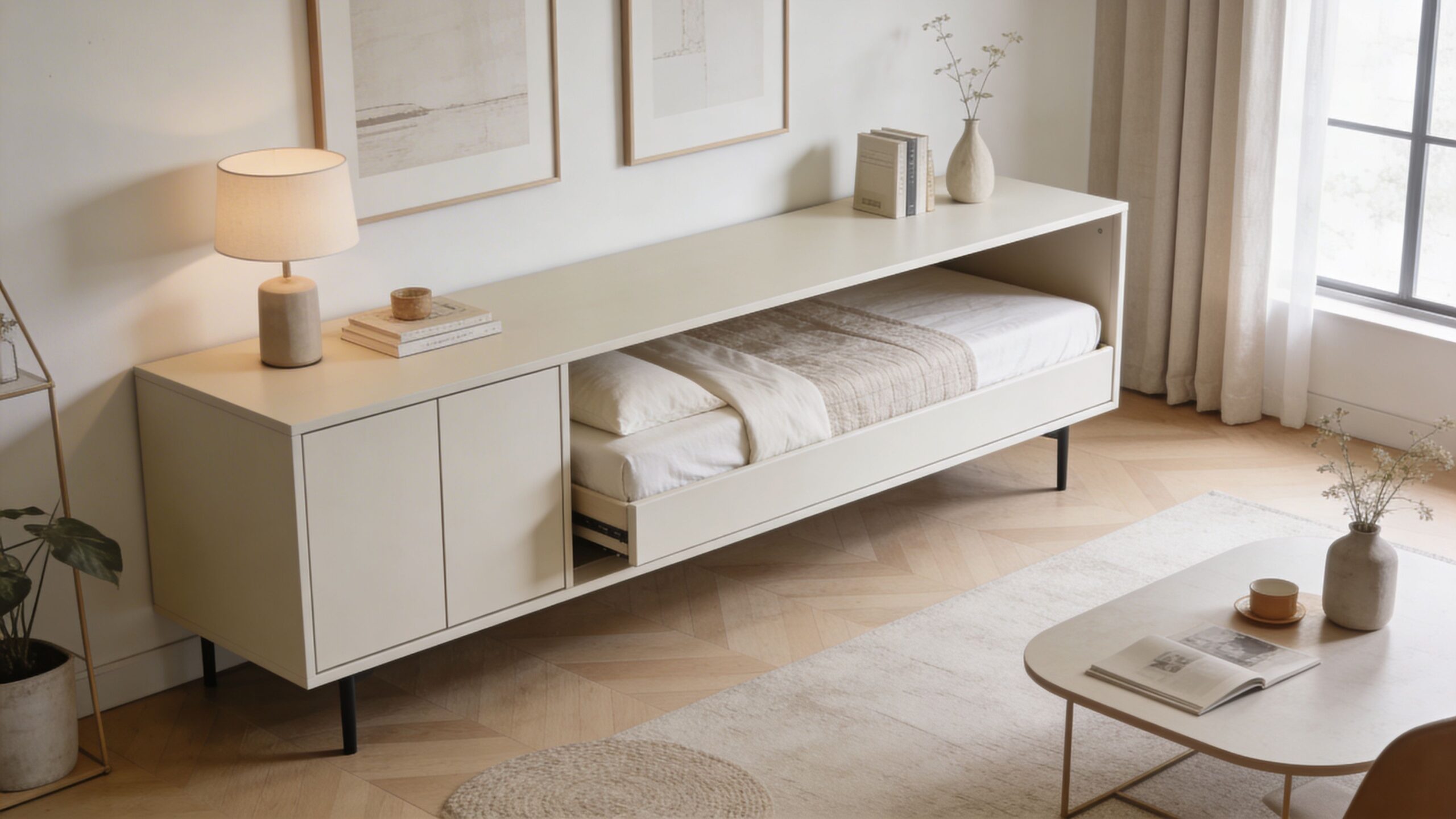
Many shoppers reach the wall-mounting question and stop — they can’t drill, don’t want to drill, or know they’re moving again. A cabinet bed is the answer in those cases: a freestanding piece that looks like a credenza or storage cabinet when closed, opening outward from its own structure instead of folding into a wall.
Why cabinet beds deserve more attention
Cabinet beds are often treated as a backup plan. In city apartments, they’re a first-choice category for the right buyer — solving a problem wall-mounted beds don’t solve well: how to gain flexible sleeping space without attaching furniture to the wall.
- No wall mounting means no negotiating with a landlord or building super.
- Better portability means the bed moves with you when your apartment changes.
- Cleaner exit strategy means no hardware or repair work left behind.
- Proper furniture presence means the closed piece looks intentional in a living room, office, or guest room.
Who usually benefits most
Cabinet beds fit best for people whose housing situation is flexible, uncertain, or constrained: a renter who expects to move within a year, a couple converting a den into occasional guest space, a household that wants a proper sleep surface on demand without a daily visual reminder the room doubles as a bedroom.
A cabinet bed isn’t a compromise when installation is the wrong fit. It’s a different category built for mobility and fewer permissions.
What to check before buying
Cabinet beds still need planning — room layout, the bed’s opening path, and whether the closed cabinet works with the rest of the furniture. Seeing one in person matters, since two things surprise most shoppers: how furniture-like the cabinet looks when closed, and how differently opening motions feel between designs.
Compare Murphy cabinet and chest beds alongside wall beds rather than after them — for renters, that’s the right order: settle what’s allowed in your apartment first, then decide which mechanism and footprint you prefer.
Mattress, Cost, and Durability
Once installation is settled, the decision gets more technical — a Murphy bed can look perfect online and still be wrong for your room, mattress expectations, or budget.
Mattress fit affects comfort and function
Murphy beds and cabinet beds can use a proper mattress — a real advantage over many sofa beds, which often give guests a thinner, more compromised surface. The limitation is compatibility: mattress thickness and weight both affect whether the frame closes properly and how much strain the lift mechanism handles, and the acceptable range varies by model. Check the manufacturer’s specified maximum thickness and weight before buying a mattress separately — a plush pillow-top that’s fine on a conventional bed frame can work against a lift mechanism.
Don’t choose the bed first and assume any mattress will work. In this category, bed and mattress have to be matched as a system.
Compare mattresses sized for convertible sleep furniture once you know your frame type.
Cost is higher, but the comparison should be fair
Murphy beds often cost more upfront than a futon or simple sofa bed. That’s true and shouldn’t be glossed over — but the fair comparison isn’t sticker price alone. A quality Murphy or cabinet bed is trying to deliver two things at once: meaningful space recovery and a genuinely conventional sleep surface.
If the bed will be used often, or the room has to switch functions constantly, the added cost often makes practical sense. If guests stay a few times a year, a simpler product may be the better buy.
Durability depends on materials and mechanism
What tends to hold up: all-wood construction instead of low-grade particleboard, a well-matched lift system that isn’t fighting the mattress weight, a mattress kept within the frame’s intended thickness range, and careful assembly so the hardware works as designed.
What tends to disappoint: buying by looks alone, using whatever mattress is already in the house regardless of fit, treating a frequent-use bed like a decorative spare, or choosing the cheapest version of a mechanism-heavy product.
Sleep Solution Snapshot
| Feature | Wall-Mounted Bed | Cabinet Bed | Sofa Bed / Futon |
|---|---|---|---|
| Best fit | Owners or approved renters planning a long-term layout | Renters and movers who want no wall attachment | Budget-minded shoppers or occasional guest use |
| Installation | More involved, often with wall attachment | No wall mounting required | Generally simpler than a Murphy-style system |
| Sleep surface | Can use a proper compatible mattress | Can use a proper compatible mattress | Varies widely by model |
| Room impact when closed | Clean, built-in look | Furniture-like cabinet presence | Seating stays visible full time |
| Main trade-off | Cost, installation, permanence | Footprint and furniture placement | Comfort can vary more depending on model |
Mechanisms and Installation
Piston Lifts vs. Spring Lifts
The lifting mechanism is what does all the heavy lifting, making a hefty mattress feel light as a feather. Modern Murphy beds primarily use two types, and each has a distinct feel and its own set of advantages.
It’s a bit like the suspension in a car. A luxury sedan’s suspension is designed for a smooth, quiet ride that absorbs every bump. A heavy-duty truck’s suspension is built for hard work and adjustability. Piston and spring lifts are similar—they get the same job done, just with different engineering philosophies.
Piston Lift Systems A piston lift uses gas or air pressure inside a sealed cylinder to provide assistance. It’s the same kind of tech that holds open the hatchback on an SUV.
- Smooth and Silent Operation: Piston systems are known for their fluid, controlled motion. They open and close without any of the creaks or groans you might get from an older, less refined system.
- Self-Adjusting Feel: The pressure is pre-set from the factory, meaning it’s perfectly dialed in for a mattress within a specific weight range. This makes for a very simple, straightforward user experience.
- Durability: High-quality piston mechanisms are incredibly durable. They’re often rated for tens of thousands of cycles, which translates to decades of regular use without a problem.
Spring Lift Systems A spring mechanism uses a series of heavy-duty coils that are tensioned to perfectly counterbalance the weight of the mattress and bed platform.
- High Adjustability: The biggest perk of a spring system is that the tension can often be adjusted. This is a huge plus if you ever change your mattress to one that’s slightly heavier or lighter, as you can re-calibrate the lift to match.
- Proven Reliability: Springs are a time-tested technology. While they can sometimes be a bit noisier than pistons, they are exceptionally reliable and built like a tank.
- Powerful Lift: A well-designed spring mechanism provides consistent and powerful assistance, making it a dependable workhorse you can count on for daily use.
Deciding between a piston or spring mechanism is less about which one is better and more about which one fits your needs. Pistons offer a sleek, modern feel, while springs provide robust adjustability.
The Importance of Build Materials
Beyond the mechanism, the materials used for the cabinet and bed frame are absolutely critical. They provide the structural integrity needed to support the entire system safely year after year. Cheaper materials like low-grade particleboard can warp or even fail over time under the constant stress of opening and closing.
For true longevity and safety, look for Murphy beds constructed from high-quality materials.
- Solid Wood: This is the gold standard, offering unmatched durability, strength, and a premium look. Hardwoods like oak, maple, and birch are excellent choices for the main frame and key structural components.
- Plywood: Don’t underestimate good plywood. High-grade, multi-layered plywood provides superior strength and resistance to warping compared to particleboard, making it an excellent and stable core material.
- Furniture-Grade Composites: Materials like Medium-Density Fiberboard (MDF) are often used for decorative elements and panels. When finished with a durable laminate or veneer, they provide a smooth, consistent surface that holds up well.
One last, crucial element to look for is the inclusion of safety features. The best Murphy beds include safety locks that prevent the bed from opening or closing accidentally. These mechanisms engage automatically or with a simple latch, giving you total peace of mind, especially in a home with children or pets.
Questions You Must Ask Installers
A few targeted questions will keep your budget on track and your expectations clear. Start by confirming licensing and insurance. Then dig into warranty specifics for both hardware and labor.- What licenses and certifications do you hold for carpentry or electrical work?
- Can you provide proof of insurance and bonding?
- What is your warranty period for hardware mechanisms?
- Do you guarantee labor and correct any issues at no extra charge?
- How do you handle scope changes or add-on requests?
How Long Does A Typical Install Take?
Putting in a standard Murphy bed with a professional crew usually wraps up in about 3–5 hours. If you tackle it yourself, expect a 1–2 day project—depending on your comfort level and whether you have an extra pair of hands. Common time frames include:- DIY Weekend: 8–12 hours for two people.
- Pro Half Day: 3–5 hours with a two-person team.
- Custom Builds: 1–2 weeks, counting design tweaks and finishing touches.
Making the Right Choice for Your NYC Space
The right answer becomes obvious once you stop asking which product is most impressive and start asking which one fits the room, the building, and how you’ll actually use it.
For a studio that needs a primary bed
If this is your main bed and the apartment has to feel open during the day, a Murphy-style solution makes sense if the daily transformation is worth the investment. Owners often lean toward wall-mounted because it feels integrated; renters need to think more defensively. If drilling is off the table, go straight to a cabinet bed — it solves the permission problem without forcing you into a sofa bed.
For a home office that hosts guests
This is one of the best use cases for the category. The room works as an office most of the time, and a foldaway bed keeps it from feeling like a part-time bedroom. A wall bed works well if the room is stable and you want a built-in appearance; a cabinet bed works well if the room may be rearranged or installation isn’t an option.
For a homeowner building a multi-purpose room
Here, wall-mounted models shine. If you’re staying put, have the right ceiling and floor clearance, and want the room to read as finished millwork rather than flexible furniture, permanence becomes a benefit instead of a drawback — the bed stops feeling like a workaround and starts feeling like part of the architecture.
When a sofa bed or futon is still the better call
Not every shopper should buy a Murphy bed. If budget is the top constraint, or the bed will only be used occasionally, a sofa bed or futon may still be the more sensible move — the decision comes down to how often the room needs to switch functions and how much you’re willing to spend on the mechanism versus the mattress.
The best small-space purchase is the one you’ll keep using without resenting the setup, the cost, or the daily routine.
A Murphy bed is a tactile purchase, and so is a cabinet bed — you learn a lot by opening the mechanism yourself, checking how the bed clears the room, and seeing whether the closed piece suits your space. That’s why this category is worth viewing in person before you decide.
If you’re weighing Murphy bed pros and cons in an NYC apartment, start with the hard realities: are you renting or owning, can you mount to the wall, does the room need to transform every day or only when guests visit? Once those answers are clear, the product choice gets much easier.
Frequently Asked Questions About Murphy Beds
Can I Use My Existing Mattress with a Murphy Bed?
This is a big one, and the short answer is: maybe, but you need to check the specs first. Most Murphy bed lift mechanisms are precision-engineered to work with a mattress of a specific weight and thickness—usually 10-12 inches max.
If your mattress is too heavy, it’ll strain the system and be a pain to lift. If it’s too thick, the cabinet might not close all the way. Before you get your heart set on using your current mattress, just look up the weight and thickness requirements for the Murphy bed you’re eyeing. It’s a simple check that guarantees your new bed works smoothly and safely for years.
Are Modern Murphy Beds Difficult to Open and Close?
Not at all. The days of those clunky, back-breaking wall beds you see in old movies are long gone. Today’s high-quality systems use advanced piston or spring lifts that do most of the work for you. They’re designed to perfectly counterbalance the mattress’s weight, making the whole unit feel surprisingly light.
You can often open or close it with just one hand and minimal effort. The secret to that effortless glide is professional installation. When the unit is assembled correctly and securely anchored, the mechanism works exactly like it’s supposed to—giving you a smooth, safe motion every single time.
Do All Murphy Beds Need to Be Bolted to the Wall?
For traditional vertical and horizontal models, the answer is a definite yes. Anchoring the unit securely to wall studs is an absolute must. This is a critical safety step that prevents the unit from tipping over when you open it, which is especially important in homes with kids or pets. Think of it as a permanent, secure fixture that’s built to last.
But what if you’re a renter or just don’t want to drill into your walls? That’s where a Murphy Cabinet Bed comes in. These are fantastic freestanding alternatives. They’re designed as self-contained chests that don’t need any wall installation at all, giving you total flexibility.