Platform Bed Bookcase Guide: Integrated vs. Modular Storage
A lot of small bedrooms fail in the same way. The bed goes in first, then a nightstand gets squeezed in, then a narrow bookcase, then a charger, a reading lamp, a stack of books, and suddenly the room feels tighter every week.
In apartments, that clutter usually isn’t a decorating problem. It’s a storage problem hiding beside the bed. If you need a place for books, glasses, devices, and a few personal items, a platform bed bookcase setup often solves more than one issue at once. It gives you a sleep surface, bedside access, and vertical storage without asking for another chunk of floor.
Your Bedroom Storage Solution Is Hiding in Plain Sight
The bed goes in first. Then a slim nightstand gets forced into the only open corner, a narrow shelf ends up on the far wall, and everyday items start drifting wherever they fit. In a small bedroom, that layout wastes the space you use most often, the area around the bed.
A platform bed bookcase solves that problem by treating sleep and storage as one zone instead of two separate purchases. Sometimes that means a single frame with shelving built into the headboard. Sometimes it means pairing a low platform bed with a standalone shelf unit placed tight to the headboard wall or along one side. That second approach matters because it gives you more flexibility on size, finish, and budget than many all-in-one beds can offer.

Why this setup works in compact bedrooms
In small apartments, every piece has to earn the floor area it takes up. A bed already claims the largest footprint in the room, so it makes sense to attach storage value to that footprint instead of spending more square footage on extra case goods.
The payoff is practical, not theoretical. Books stay near the pillow. Glasses, chargers, and a reading lamp get a fixed home. You stop building little clutter piles on the floor, windowsill, or radiator cover because the storage sits where you use those items.
This layout is worth prioritizing for rooms that cannot comfortably hold two nightstands and a separate bookcase. It usually feels cleaner because the storage is concentrated in one working zone instead of scattered across three.
Practical rule: If your bedroom needs both bedside storage and overflow shelving, combine at least one of those functions with the bed area first.
Integrated and modular setups both make sense
A lot of shoppers hear “platform bed bookcase” and picture one specific product. In practice, there are several ways to get the same result.
- Integrated setup: the bed frame includes shelving at the headboard, so the look is unified from day one.
- Drawer-and-shelf setup: a captain’s bed adds underbed storage while the headboard or upper section handles books and bedside items.
- Modular setup: a separate platform bed and shelving unit create the same function with more freedom to adjust the layout later.
The modular route is often the smartest move in city apartments. It is easier to get upstairs, easier to replace piece by piece, and easier to fit around baseboards, outlets, and uneven walls. If you want to compare standalone options before committing, browsing bedroom bookcases and shelves helps you judge shelf depth, height, and proportions against your actual bed wall.
Three Ways to Create a Platform Bed Bookcase
Some buyers assume this category means one very specific bed. It doesn’t. There are three practical ways to build the same core function, and each one suits a different room and budget.
The fully integrated bookcase bed
This is the straightforward option. The headboard and bed frame are designed as one unit, so the shelves sit exactly where you need them. It looks finished because everything lines up in height, depth, and finish from the start.
Many models in this category are larger than people expect — wide headboards with multiple compartments, adjustable shelves, and sometimes small wheeled drawers built directly into the base for organized bedside storage.
What works:
- Clean visual result: it looks intentional, not improvised.
- Useful reach zone: books, chargers, and small essentials stay close to the pillow.
- Simple planning: you buy one main piece instead of trying to match two.
What doesn’t:
- Less flexibility later: if you move or redecorate, you can’t separate the storage from the bed.
- Bulk at the headboard: in a very shallow room, the extra depth matters.
- Longer assembly: more parts, more hardware, more alignment work.
The captain’s bed hybrid
This version is for people who need storage everywhere, not just at head level. You get the bookcase-style headboard, plus under-bed drawers or cubbies. In a room with no dresser space, that can be the difference between a calm bedroom and one with bins shoved into every corner.
The trade-off is access. Under-bed drawers need clearance to open. If your bedroom layout is already tight, the storage may exist on paper but feel awkward in real life.
A captain’s bed is strongest when the room lacks closet space. It’s weaker when the walking path around the bed is already narrow.
This style also asks you to be honest about what you store. Daily clothing, extra linens, and guest bedding make sense. Rarely used items often get forgotten and turn the bed into deep storage you stop maintaining.
The modular platform bed plus separate bookcase
This is the option many shoppers overlook, and it’s often the smartest one. Instead of buying a prebuilt bookcase bed, you combine a low platform bed with a separate bookcase placed behind, next to, or slightly offset from the head area.
That approach gives you more control over width, shelf height, and budget. It also makes moving easier because the room relies on two simpler pieces rather than one large integrated unit. If you already own one of them, the savings can be meaningful without needing a custom build.
A modular setup works best when:
- You rent and may move again.
- You want to replace the bed later but keep the shelving.
- You need unusual proportions that integrated frames don’t offer.
- You want the storage effect without a permanent built-in look.
For shoppers comparing low-profile frames first, looking at platform bed options by size and style is the practical starting point.
Bookcase bed configurations at a glance
| Configuration | Best For | Flexibility | Assembly Effort | Futonland Solution |
|---|---|---|---|---|
| Integrated bookcase bed | Buyers who want one finished piece | Low | Moderate to high | Pair a platform bed with built-in headboard shelving |
| Captain’s bed hybrid | Rooms short on dresser or closet space | Low | High | Choose a storage-focused platform bed with headboard shelving |
| Modular bed plus bookcase | Renters, movers, and layout tinkerers | High | Moderate | Combine separate platform bed and shelving categories |
Which one usually works best
The integrated bed wins on neatness. The captain’s bed wins on raw storage. The modular solution wins on adaptability.
In practice, small urban bedrooms often reward adaptability. Radiators, odd corners, closet swing, and outlet placement create too many exceptions for one-size-fits-all advice. That’s why the modular route deserves more attention than it gets.
Build Quality, Materials, and Mattress Compatibility
A platform bed bookcase earns its place in a small bedroom only if the frame stays quiet, level, and solid after months of daily use. In apartments, that matters more than the showroom look. A bed that shifts under weight, squeaks at the joints, or lets the headboard wobble will make the whole room feel cheaper than it is.
Start with the base structure. On an integrated bookcase bed, inspect the side rails, center support, slat thickness, and how the headboard ties into the frame. On a modular setup, check one more point. The bookcase or shelf unit needs to sit in a way that feels intentional beside or behind the platform bed, not like two unrelated pieces pushed together.
A lighter frame can still work in a guest room or low-use space. For an everyday bedroom, especially with two adults and a heavier foam or hybrid mattress, stronger materials and better joinery are worth paying for.
Solid wood versus engineered components
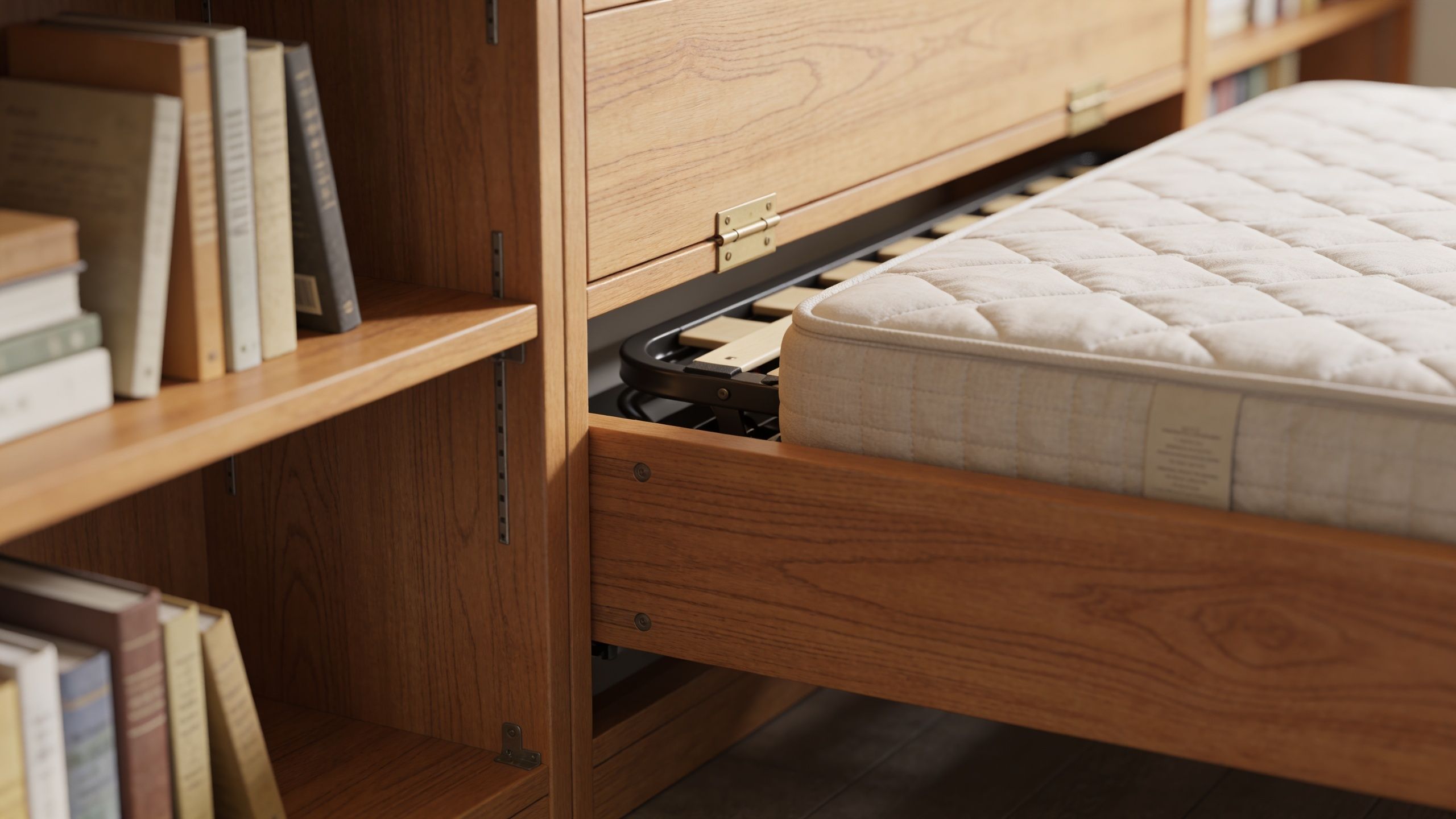
Solid wood usually holds screws better over time and resists racking more effectively. That shows up in fewer creaks, less sway, and a cleaner repair path if hardware loosens later. Engineered wood can still be a smart buy when the design includes proper reinforcement, decent hardware, and enough support under load.
For modular combinations, engineered wood often makes sense because it keeps the shelving affordable while you spend more on the platform frame itself. That split is practical. The bed carries the live weight. The shelves carry objects and visual bulk.
Check these details before buying:
- Slat support: the mattress should sit on a support system designed for platform use, without needing a box spring.
- Center reinforcement: full, queen, and king sizes need a dependable center leg or rail structure.
- Headboard attachment: if the shelves are built into the headboard, the connection points should feel tight and well-braced.
- Shelf material thickness: thin panels sag faster, especially with books.
- Drawer hardware: on storage beds, glides and drawer bottoms are often the first weak spots.
What the shelves can really hold
Bookcase headboards and companion shelving work best for items you keep within reach at night. Paperbacks, a phone, glasses, a small lamp, tissues, and a speaker are all reasonable. Dense textbooks, large planters, and heavy decor belong lower or elsewhere.
That trade-off matters even more in modular layouts. A separate bookcase gives you more capacity and often deeper shelves than an integrated headboard, but it can also crowd the bed if the proportions are wrong. An integrated headboard looks cleaner. A separate shelf unit usually gives you more honest storage.
Keep heavier items on the lowest, most stable shelf. Keep anything fragile away from pillow height.
Mattress pairing makes or breaks comfort
Platform beds are built to support a mattress directly, so the mattress profile has to match the frame. Slat spacing matters. So does mattress height. A very thick mattress can bury the lower headboard shelf and make nightly storage awkward. A mattress that is too soft for a flexible slat system can leave the bed feeling less supportive than expected.
The cleanest way to shop is to choose the frame style first, then match the mattress to the support system and the headboard height. If you’re comparing foam, hybrid, or latex options, review mattress types and sizes for platform beds before you commit.
In small bedrooms, overbuilt mattress height is usually worth avoiding unless you specifically want that look. Medium-profile mattresses tend to work better with bookcase beds because they preserve reach, sight lines, and shelf usefulness.
A practical durability checklist
Before you buy, or before you commit to pairing separate pieces, run through this list:
- Push the headboard or shelf unit lightly. It should feel planted, not shaky.
- Check shelf depth against real items. A shelf that only fits decor is not solving storage.
- Look under the mattress support. Slats need proper spacing and secure attachment.
- Read the hardware details. Wood screws, brackets, and connector bolts matter.
- Match the setup to your habits. If you keep heavy books near the bed, plan for that load instead of styling for a catalog photo.
Good build quality is less about one label and more about how the bed, shelves, and mattress work together. That is why the modular approach can be so effective. You can put your budget into a stronger platform bed, then add bookcases that fit the room and your storage habits instead of forcing everything into one prebuilt frame.
Smart Layout Planning for Small Apartments
Small bedrooms punish bad measuring. A bed can technically fit and still make the room miserable to use. The difference comes down to planning for movement, drawer access, and what lives around the bed, not just under the mattress.
Measure the room as a walking space
Start with the basic room dimensions, then mark doors, closet swing, windows, radiators, outlets, and any wall feature that changes usable depth. In apartments, those details decide whether the bed should sit centered, wall-hugging, or shifted off-axis.
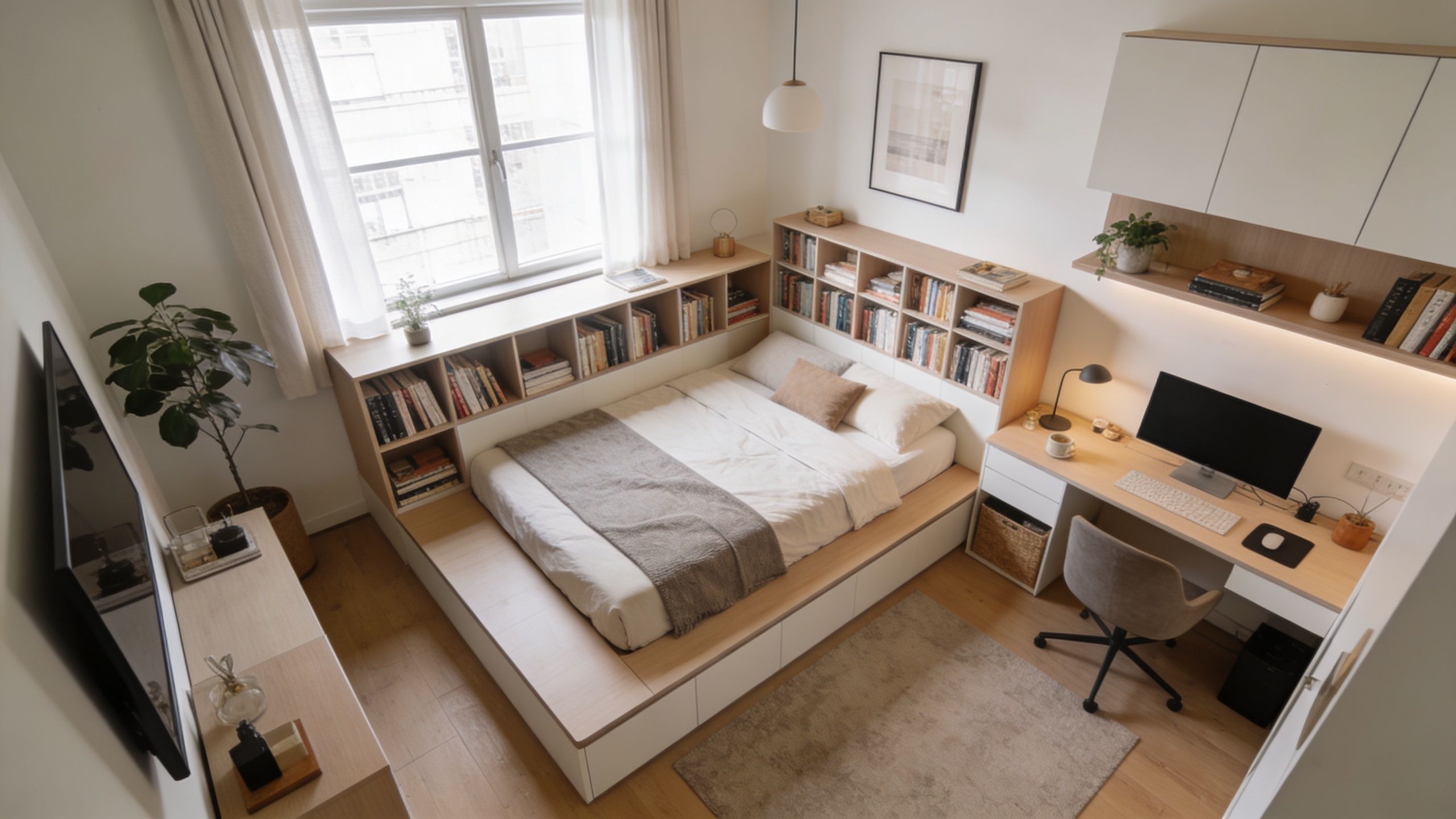
An integrated platform bed with a bookcase headboard can meaningfully cut a room’s furniture footprint by replacing what would otherwise be a separate nightstand and small bookshelf. That kind of gain matters in a room where every clear patch of floor affects how open the space feels.
Plan around use, not just footprint
A bed with drawers needs room to open. A modular bookcase setup needs breathing room so the shelves don’t feel like they are crowding the mattress. A headboard shelf needs access to an outlet if you plan to charge devices there.
Focus on these layout questions:
- Where do you stand to make the bed? If the answer is “from one narrow strip,” simplify the setup.
- Do drawers open into a walkway? If yes, they may annoy you every day.
- Can you reach the shelf from bed without twisting awkwardly? Good storage should feel natural.
- Will a lamp or sconce still work? Some headboards compete with wall lighting.
In a small bedroom, vertical storage helps only when access stays easy. A hard-to-reach shelf is just clutter parked higher up.
Three layout patterns that usually work
Wall-anchored integrated bed
Best for narrow rooms where adding side furniture would choke the path. The bed becomes the storage wall, and the rest of the room stays visually quiet.
Captain’s bed facing open floor
Best when the side with drawers has room to function. Keep the drawer side on the easier access path, not trapped near a wall.
Offset modular setup
Best for renters and awkward layouts. A standalone bookcase can sit behind or slightly beside the platform bed, creating storage without locking you into one configuration forever.
For sizing questions, a quick check of bed and mattress dimensions helps prevent the classic mistake of choosing the right bed size for sleep but the wrong size for the room.
One common planning mistake
Buyers often focus on how much storage they can add. The better question is how much storage they can use comfortably. A room works when the bed solves problems without creating new ones in the walkway, the closet approach, or the lighting plan.
Styling Your Bookcase Bed Without Adding Clutter
A platform bed bookcase can look sharp or chaotic. The difference usually isn’t the bed. It’s what gets piled onto the shelves.
Treat the headboard like a bedside edit
The best-looking bookcase beds aren’t packed edge to edge. They hold the things you need, plus a small number of visual elements that make the room feel finished.
A simple rule works well here. Keep everyday use on the easiest shelf, quieter display higher up, and anything messy inside a basket or lidded box if the design allows it.
Try this mix:
- Readable books: a few current titles, not your entire collection.
- Small contained storage: a box for cords, earbuds, or sleep accessories.
- One softening element: a framed photo or small object with texture.
- One lighting solution: a compact lamp if the shelf depth supports it safely.
Use balance instead of symmetry
You don’t need matching items on both sides. In fact, strict symmetry can make a compact room feel staged and stiff. A better approach is visual balance.
Stack a few books on one side, then offset them with a low object on the other. If one cubby is dense with paperbacks, leave another partly open. That empty space matters because it keeps the headboard from reading as packed storage.
Shelves beside the bed should look edited at night. If you can’t find your glasses in low light, you’ve styled too much.
Match the bed to the room’s tone
This category works especially well in cleaner styles because the furniture already has visual presence. If you like a Japandi or mid-century direction, keep the shelf contents restrained. Let the wood tone, bedding, and shape of the frame do most of the work.
A few practical moves help:
- Keep charging cables routed and hidden where possible.
- Limit open-shelf colors so the eye doesn’t bounce around.
- Use bins or baskets that fit the shelf dimensions cleanly.
- Don’t put every sentimental object at headboard level.
Handle lighting carefully
Reading lights are where styling and function often collide. A tall headboard may block the ideal location for a wall-mounted sconce, and a crowded shelf makes table lamps feel improvised.
Clamp lights, compact plug-in sconces, or a slim lamp placed on the widest shelf often work better than oversized bedside lighting. The goal is enough light for reading without turning the headboard into a utility station.
Assembly, Maintenance, and Long-Term Durability
A lot of retailers make these beds sound effortless. They aren’t. A bookcase bed can be a smart purchase, but it asks more from the owner than a plain platform frame.
Assembly is where quality starts to show
Integrated beds and captain’s beds usually arrive with more panels, more hardware, and more chances for small alignment errors. If the floor is uneven or the assembly sequence gets rushed, the first symptom is often a headboard that looks square but feels slightly off under pressure.
That doesn’t always mean the product is poor. It often means the build needs patience. This is one reason many buyers prefer professional setup, especially with larger storage beds.
Maintenance is the hidden trade-off
Retail listings usually highlight finish, style, and storage count. They rarely emphasize upkeep. That’s a mistake, because the maintenance difference between a plain bed and a bookcase bed is real.
Bookcase beds require regular dusting across multiple surfaces — far more surface area than a flat headboard — and enclosed drawers create their own cleaning and moisture concerns, especially in humid seasons. In a city apartment, that matters. Bedroom dust collects on horizontal shelf surfaces fast, especially near windows, radiators, and traffic-heavy streets.
What owners often underestimate
- Shelf dust: open cubbies catch dust more visibly than a flat headboard.
- Drawer interiors: stored textiles and paper goods need occasional airing out.
- Frame edges and rails: tight corners collect lint and debris.
- Wall-side cleaning: beds placed close to the wall can be awkward to maintain.
A storage bed saves floor space, but it doesn’t save cleaning time unless you keep the shelf contents disciplined.
What works for long-term care
The beds that age well usually have a predictable routine behind them.
Use a soft cloth for visible wood surfaces. Don’t let spills sit in shelving corners or drawer bottoms. Keep overcrowding in check, ensuring you can clean the storage you’ve paid for. In humid seasons, occasional airflow around stored bedding and papers helps prevent that stale closed-drawer feel.
Good ownership habits
- Edit the shelves monthly: fewer objects mean easier cleaning and less visual buildup.
- Check fasteners occasionally: storage beds carry more moving parts and connection points.
- Rotate what you store: items you never touch often become dust traps.
- Watch drawer glide behavior: resistance early on is easier to address than a fully stressed track later.
A plain bed asks less maintenance. A platform bed bookcase gives more function, but only if you’re willing to maintain the extra surfaces.
Finding Your Solution
A lot of bedrooms end up doing three jobs at once. Sleeping area, storage wall, and sometimes a work zone. In that kind of room, the right answer is not always a single prebuilt bookcase bed. Sometimes the better setup is a platform bed and a separate bookcase chosen to work together like one system.
Start with the constraint that matters most. If the room is tight and you want the cleanest footprint, an integrated bookcase bed can be a strong fit. If hidden storage matters more than open shelving, a captain’s bed often solves more problems, even though it asks for more clearance around the frame.
The modular option deserves serious consideration, especially for renters and anyone who expects to move or rework the room later. A separate platform bed paired with a bookcase can give you the same everyday function as a built-in look, with more flexibility if one piece wears out, the mattress size changes, or the next apartment has a different wall layout.
That flexibility is why shopping both categories together makes sense. Futonland carries platform beds and shelving as separate pieces, so you can build a bookcase-bed setup instead of limiting yourself to all-in-one frames.
Choose based on daily use
Good storage has to work at 11 p.m., half awake, in a room with very little spare space. Common design compromises in this category include headboards that block reading lights and under-bed drawers that reduce how easily you can access the sides of the mattress. Those are small details in a product photo. They feel much bigger after a few months of real use.
Use a short checklist before you buy:
- Can you reach the shelf from bed without sitting fully upright
- Will drawers or doors open without hitting another piece
- Does the frame support the mattress type you want
- Are you better served by open shelves, closed drawers, or a mix of both
- Would separate pieces give you a cleaner fit for this room
What tends to work best
The best choice usually solves one clear problem. Maybe that means replacing a nightstand with a headboard shelf. Maybe it means getting linens out of an overstuffed closet. In many small apartments, it means using a low platform bed with a separate bookcase beside or behind it, creating a built-in effect without locking the room into one fixed furniture footprint.
That is often the smartest buy. You keep the visual structure of a platform bed bookcase, but you gain options on price, layout, and future moves.
If your bedroom feels crowded, identify the storage job first, then choose the bed setup that handles it with the least wasted bulk.