

Slipcovers for Daybeds: The Complete Fit and Fabric Guide
A daybed can look perfectly useful and still be frustrating to live with. The upholstery may have faded near a sunny window, the fabric may collect pet hair, or the piece may no longer suit a room that has changed from guest space to home office. A standard sofa cover often seems like the obvious fix, but daybeds create fit problems that generic slipcover guides overlook.
The mattress, arms, back, and frame all compete for the same fabric. A cover that fits the seating area may pull across a thick mattress, bunch around the arms, or shift every time someone sits down. The right slipcovers for daybeds need to protect the furniture while respecting its dual role as sofa and bed.
Why Daybed Slipcovers Solve Real Problems
A tired daybed often becomes the piece everyone notices for the wrong reason. Its frame still works, the mattress is comfortable, and the footprint is valuable, but a faded cover or mismatched upholstery makes the room feel unfinished. In a small apartment, replacing the entire piece may also mean losing storage, sleeping capacity, or a flexible seating arrangement.
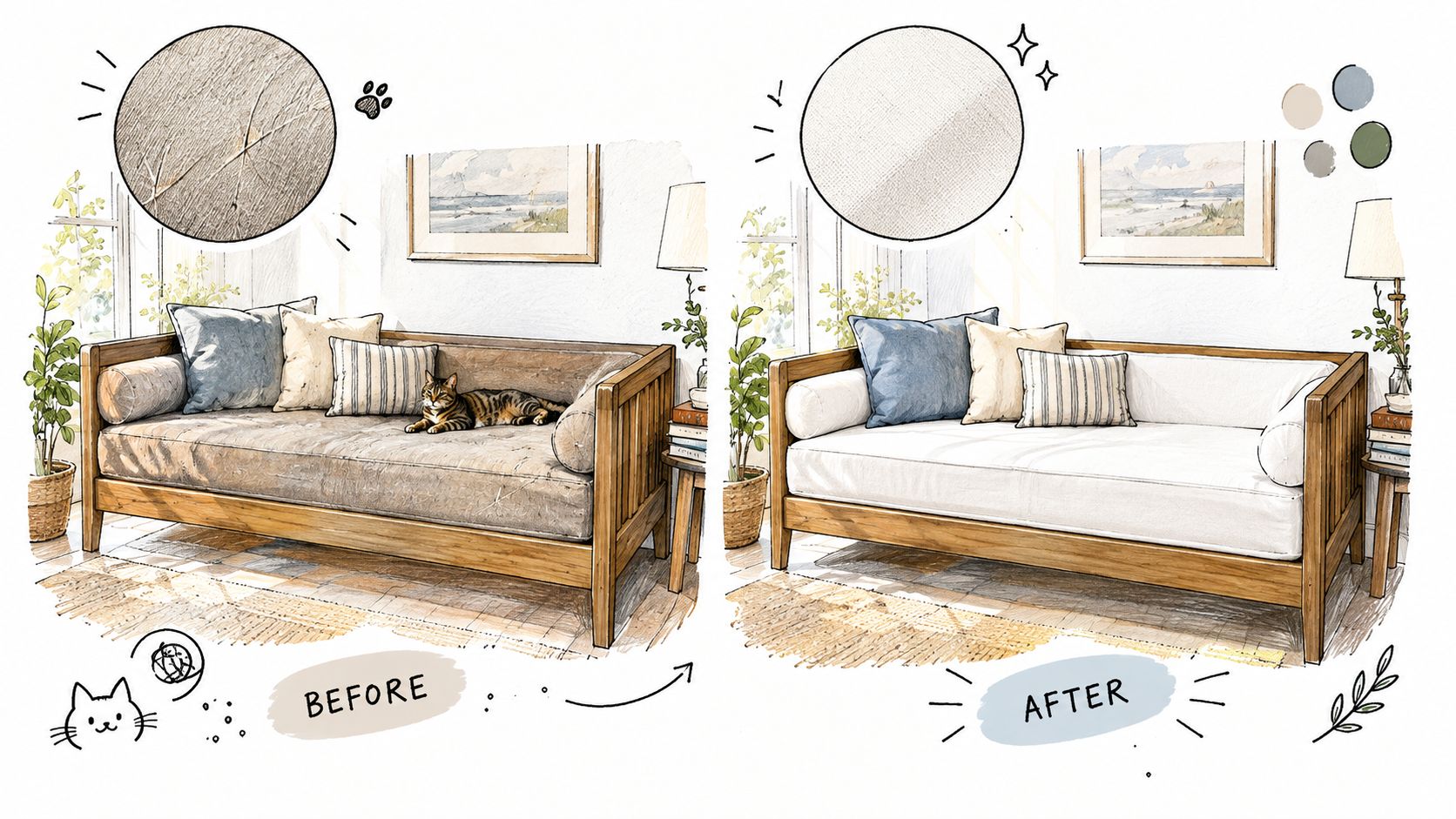
A removable cover addresses the surface problem without discarding the structure underneath. It can shield upholstery from dust, sunlight, spills, claws, and repeated contact, while giving the room a different visual direction. A neutral cover can make a daybed read as a sofa in a living area. A softer, more relaxed textile can make it feel ready for guests.
Protection has always been part of the job
Slipcovers aren't a new decorative invention. Historical design records document removable coverings for upholstered furniture from the 17th through early 19th centuries, with the terms “slips” and “cases” used by the 18th century. Large pieces, including beds, could be covered to protect textiles from fading, and state-bed designs used outside rods to enclose vulnerable fabric. Chipstone's historical account of protective furniture covers explains the older protective logic behind the modern removable cover.
That history matters because a daybed combines seating and sleeping. People sit on the front edge, lean against the back, lie across the mattress, and often use the piece more frequently than an occasional guest bed. Those different movements create wear in several directions, so a removable layer is practical rather than merely ornamental.
The commercial category has also matured. Sure Fit opened in 1914, introduced a knit slipcover in 1950, launched a home-delivery catalog in 1997, and introduced a form-fitting stretch knit cover in 2006, according to its company history reported by PR Newswire. U.S. consumer-unit spending on slipcovers and decorative pillows averaged $7.4 in 2023, as reported by Statista, which indicates an established but niche home-textile category.
When a cover is the right solution
Choose a slipcover when the frame and mattress are still sound but the outer surface no longer suits the room or household. It works especially well for:
- Pet-heavy rooms: A washable cover catches hair and everyday grime before they reach the original upholstery.
- Multipurpose spaces: One daybed can look more like a sofa for daily use and more like a bed when guests arrive.
- Sunlit rooms: A removable layer can take the brunt of light exposure instead of the original fabric.
- Style changes: You can update color and texture without replacing a functioning daybed.
A cover won't repair a sagging frame, a damaged mattress, or a broken arm. It also won't hide poor measurements. If the structure is stable, however, a well-fitted cover can extend the useful life of a flexible piece and make it easier to live with. For shoppers comparing frame styles and configurations, the day-bed collection at Futonland provides useful examples of how daybeds differ in construction.
How to Measure Your Daybed for a Perfect Fit
A daybed can have a sofa-style frame, a thick mattress, exposed hardware, and arms that change shape from front to back. Those details determine whether a slipcover lies flat or pulls out of position. Measure the furniture in its usual setup, with the mattress installed. A tape measure, notebook, phone camera, and second person will cover most fitting work.
Measure the frame first
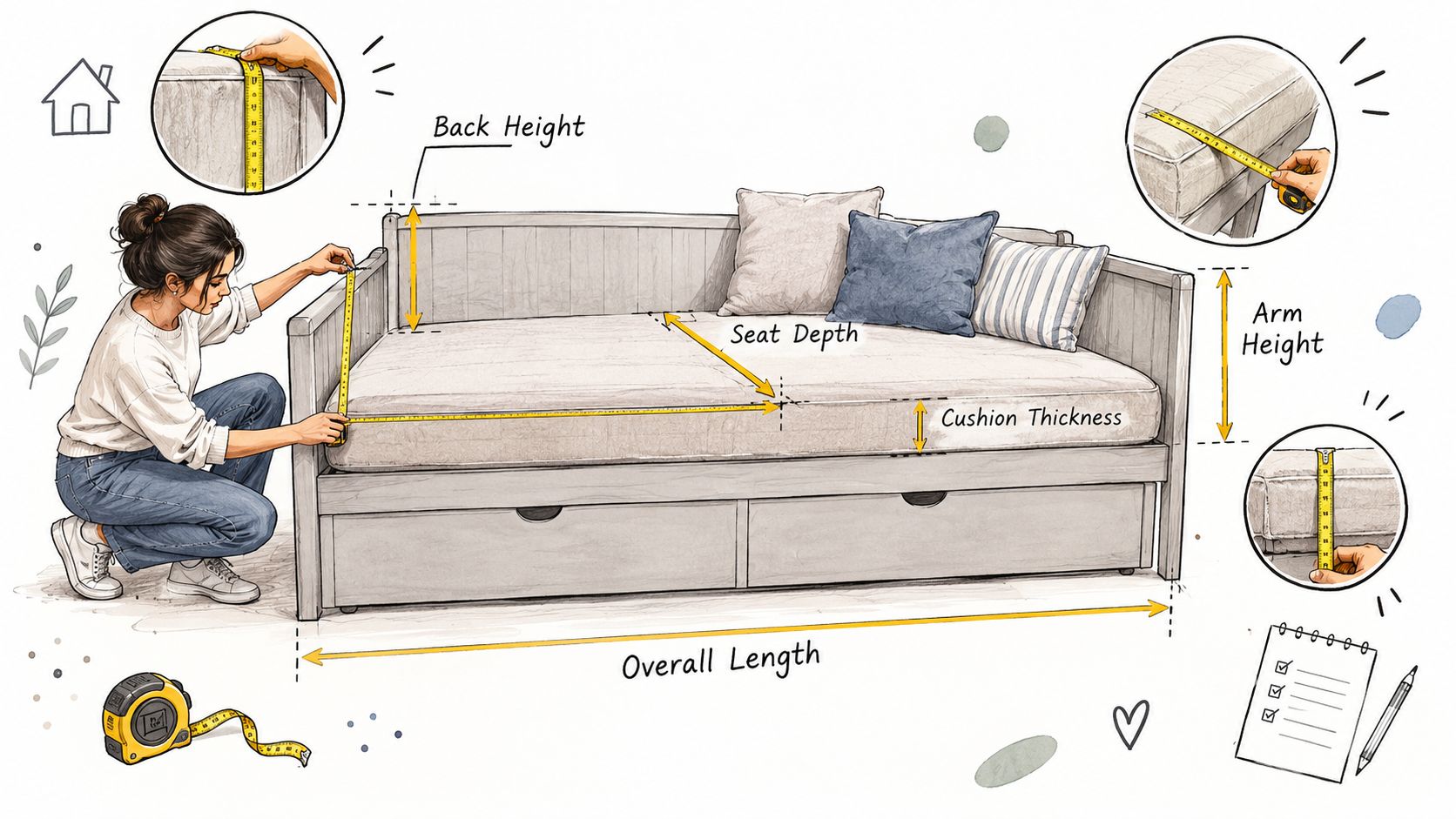
Start with the maximum outside width, from the farthest point of one arm to the farthest point of the other. Include rolled edges, curves, and hardware that the cover must pass over. If the arms flare, record both their narrow and wide points. One width measurement can miss the fabric needed at the front.
Measure outside depth from the back of the frame to its foremost edge, with the mattress in place. Then record mattress depth separately. A full-cover design may wrap around both components, so treating the daybed as a flat seat cushion can produce a cover that is too short or too tight.
Record overall height from the floor to the highest point of the back. Measure each arm's height, width, and depth as well. For a curved arm, keep the tape against the contour and photograph its position. Measuring straight across the curve understates the actual fabric path.
Measure the mattress separately
Mattress thickness causes many fitting failures. Record length, width, and thickness at the center and near an edge, without compressing the filling. Quilted mattresses can flatten under a tape measure. Note rounded corners, piping, or other edge shapes, and photograph them from several angles.
Measure how far the mattress projects beyond the frame. Check the clearance needed for a trundle, drawer, handle, lift point, or conversion mechanism. A cover that fits the mattress but blocks one of those parts is not a workable fit.
Use this checklist before ordering:
- Outside width: Widest arm-to-arm point.
- Outside depth: Back edge to front edge.
- Overall height: Floor to highest back point.
- Arm profile: Height, width, depth, and curve.
- Back profile: Straight, angled, slatted, or upholstered.
- Mattress size: Length, width, and actual thickness.
- Clearance points: Trundle, drawers, legs, handles, and conversion hardware.
- Attachment areas: Safe locations for ties, elastic, or grippers.
Measuring rule: Photograph every measurement with the tape visible. The images give a custom maker or retailer context that a list of numbers cannot provide.
Do not add ease by guesswork. Some designs require movement room, while others stay smooth through close tension. Compare your figures with the seller's sizing charts, and confirm whether the listed dimensions describe the cover or the furniture it fits.
For the sleeping surface, use a separate protective layer when a fitted furniture cover would interfere with drawers or conversion hardware. Pandemonium Millinery explains how to order a cruelty-free bed blanket, which can suit an unusual daybed mattress.
Choosing the Right Fabric for Daily Use
Fabric choice determines whether the cover remains tidy after repeated sitting, lying, washing, and repositioning. Color matters, but it shouldn't be the first filter. Start with abrasion, dimensional stability, cleaning requirements, sunlight exposure, and contact comfort.
Upholstery references commonly place 15,000 to 25,000 Wyzenbeek double rubs in general domestic-use territory, while 30,000 or more is associated with heavier-duty applications, as outlined by Revolution Fabrics. A daybed used every day as seating and a guest sleeper deserves a tight weave or performance textile. A lightly used guest-room daybed has more flexibility.
Compare the main fabric groups
| Fabric Type | Durability Rating | Washability | Best For |
|---|---|---|---|
| Cotton | Often suited to lighter domestic use, depending on weave | Usually comfortable to wash, but shrinkage must be controlled | Casual guest rooms and relaxed interiors |
| Linen | Varies by weave, with a naturally relaxed appearance | Can wrinkle and may require careful laundering | Low-to-moderate use where texture matters |
| Polyester blend | Commonly stable and resistant to distortion | Often easier to launder than pure natural fibers | Everyday seating with moderate maintenance demands |
| Performance fabric | Commonly selected for heavier use when its rating supports it | Often designed for practical cleaning, but instructions vary | Pets, children, daily seating, and frequent spills |
Cotton feels familiar and breathable, but lightweight cotton can wear and distort more quickly under repeated sit-and-lie cycles. Linen brings texture and airflow, though its wrinkles are part of the look rather than a defect. A cotton-polyester blend can reduce some of the looseness and wrinkling associated with pure natural fibers.
Polyester blends generally offer better dimensional stability than cotton. That doesn't make every polyester cover durable, however. A thin, loosely constructed fabric can still look tired, so inspect the weave, seam construction, and care label rather than choosing by fiber name alone.
Match the textile to the household
For cats and dogs, tightly woven performance fabrics are usually more forgiving than open, looped textures that claws can catch. For a sunny room, investigate colorfastness and consider resources such as fade-resistant fabric information from Joey'z Shopping. No fabric should be treated as immune to fading, and direct sunlight can still affect the room's original upholstery underneath.
Stretch can improve appearance when the cover has to move around shaped arms or changing cushions. Broader textile guidance describes stretch fabrics with roughly 5 to 20% elasticity as better at recovering their shape, while synthetics generally shrink less than cotton, according to Slipcovers by Shelley and its fabric guidance. Stretch helps, but it can't compensate for a wrong pattern.
Before ordering, ask these questions:
- Will skin touch it often? Choose a surface that feels comfortable for sitting and sleeping.
- Will it be washed regularly? Confirm the complete care method, not just whether the label says washable.
- Will pets climb on it? Favor a tight weave and avoid easily snagged loops.
- Will the cover face strong light? Check colorfastness and use window protection where possible.
- Will the daybed convert? Avoid excessive bulk around hinges, drawers, and trundles.
Look for reinforced corners, reliable seams, and an attachment system that matches the furniture. A beautiful fabric that shrinks, stretches, or catches on hardware will create more work than it saves. For comparing hand feel and color before committing, Futonland's futon cover fabric sample swatches offer a practical way to inspect textiles in the room's actual light.
Ready-Made Versus Custom Slipcovers
Ready-made covers make sense when the daybed has a common rectangular shape, predictable arms, and a mattress that falls within the seller's stated range. They're easier to buy, usually faster to receive, and simpler to return if the policy allows returns on opened or tried-on covers.
The compromise is pattern control. A generic cover may fit the overall width but leave excess fabric at the back, pull across thick mattress corners, or cover an arm in the wrong direction. Those defects become obvious when the daybed serves as both sofa and bed.
Where ready-made covers work
Choose off-the-shelf when:
- The arms are straight and symmetrical.
- The back and seat form a simple, consistent profile.
- The mattress thickness matches the listed range.
- You can tuck excess fabric without blocking a trundle or drawer.
- The retailer publishes clear dimensions and return conditions.
Ready-made is also sensible when protection is temporary, such as during a move, renovation, or a period of heavy pet use. In that situation, a practical cover can do its job without the expense or waiting period associated with custom sewing.
When custom earns its place
Custom work becomes more valuable when the daybed has rolled or angled arms, an unusually thick mattress, exposed wood, a removable back, or conversion hardware that must remain accessible. It also helps when you need separate panels for the frame, mattress, and back cushions instead of one loose shell.
A reliable custom process starts with photographs, a measurement sheet, and a discussion of how the daybed is used. The maker should ask whether the mattress stays in place, where the cover must stop, how the cover will attach, and what happens after laundering. A paper pattern, test fitting, or muslin sample can prevent a costly mistake when the shape is difficult.
Custom doesn't automatically mean perfect. Poor measurements, unclear seam placement, or a maker who doesn't understand daybed conversion can still produce a troublesome cover. Ask for finished dimensions, fabric composition, cleaning instructions, seam details, and the alteration policy before placing the order.
Fit judgment: Pay for customization when the cover must follow the furniture's geometry. Don't pay for it merely to reproduce a simple rectangle.
Compare total ownership, not just the initial price. A cheaper ready-made cover may require extra grippers, alterations, or replacement if it shifts and wears at stress points. A custom cover may cost more and take longer, but its value improves when it protects an unusual daybed and remains usable after cleaning.
One practical option is a daybed system with purpose-designed covers rather than a universal cover. Futonland lists a Tatami Daybed Sofa Sleeper with customizable slipcovers and pillowcases, including custom-order cover sets for the mattress and back cushions. Treat that as one product configuration to compare with universal and independently made alternatives, not as a substitute for measuring.
Installation Tips That Prevent Bunching and Slipping
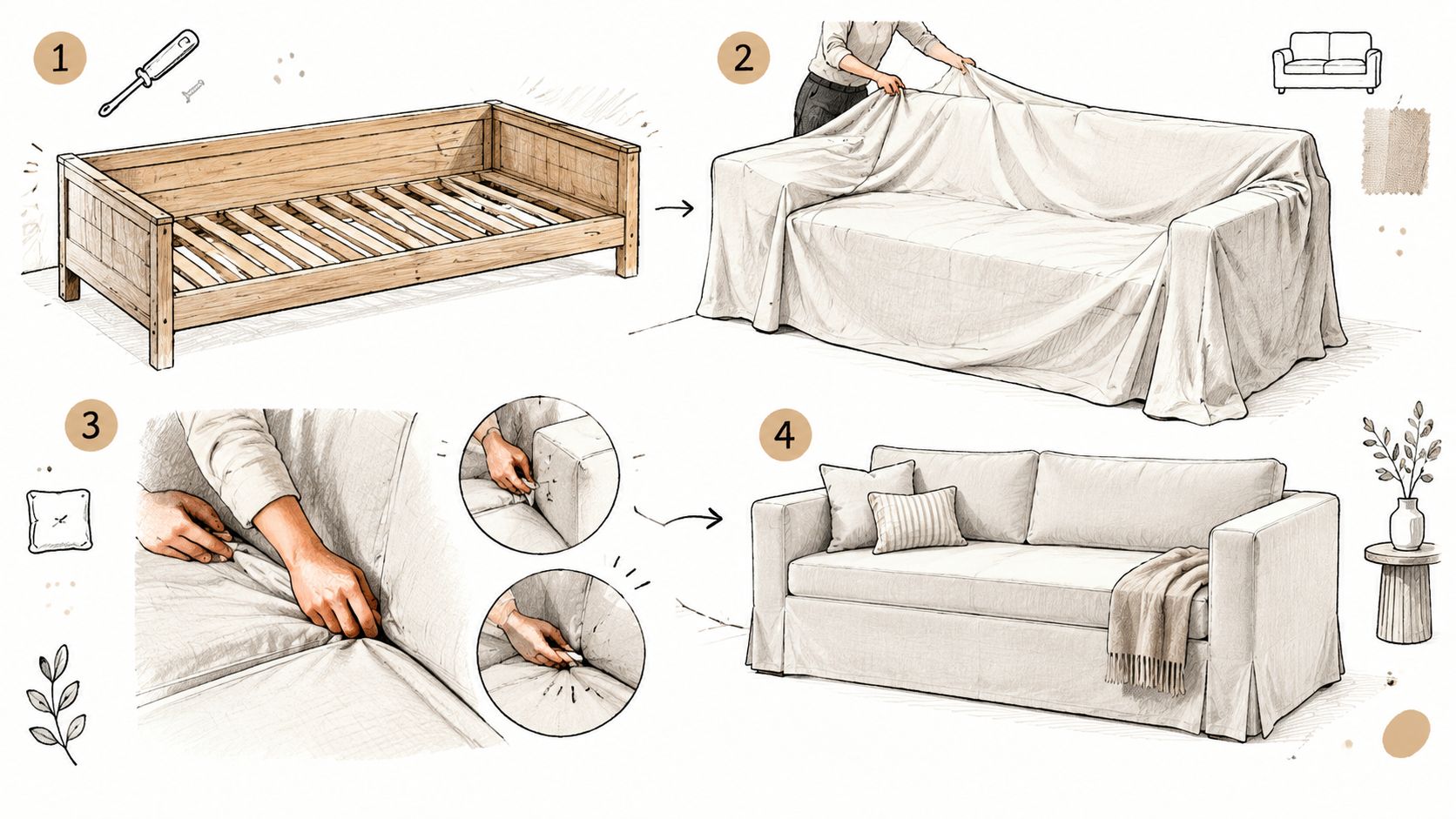
Installation starts before the cover touches the daybed. Remove loose cushions, vacuum the frame and mattress, and check that no sharp hardware or rough wood can catch the textile. Read the cover's orientation marks, then place the cover loosely over the entire piece before pushing fabric into corners.
Work from the fixed points
Find the back center, arm seams, and front corners first. Align those points before tucking anything. If you start by forcing one corner into place, you may pull the entire cover off-center and create hidden tension along the opposite arm.
Smooth the fabric from the center outward. Push excess material into the crease where the mattress meets the back or arms, then use a wooden tuck tool or a blunt spatula rather than a sharp object. Keep the tuck deep enough to hold, but don't force fabric into a mechanism or ventilation gap.
For separate mattress covers, center the cover on the mattress and pull evenly from opposite sides. Check that seams sit along the edges rather than twisting underneath. A cover that shifts during sleep usually needs better tension or a more suitable attachment method, not aggressive tucking alone.
Secure high-movement areas
Elastic hems work well around consistent edges. Ties are useful when the daybed has defined anchor points, while grippers can help hold fabric in the seat and back creases. Use non-slip strips and grip pads for futons when the cover needs additional friction, but position them so they don't interfere with conversion hardware or damage a delicate textile.
Install large covers with two people. One person centers and holds the back while the other works the arms and front edge. After installation, sit in the usual seating spots, lie on the mattress, and operate any trundle or drawer. This test reveals movement that a cover can hide while the daybed is empty.
The first wash may change the fit even when the cover is advertised as preshrunk. Reinstall it while slightly damp only if the care instructions permit that method, and reshape the seams by hand as it dries. If the cover pulls sharply at one corner, stop stretching it. The pattern or shrinkage may be wrong, and force will only increase seam strain.
Cleaning and Care for Long-Term Performance
A daybed cover lasts longer when cleaning protects its shape. Vacuum crumbs, dust, and pet hair between washes. Blot spills promptly instead of rubbing them into the weave, since friction can deepen stains and roughen the surface.
Follow the care label for water temperature, detergent, agitation, and drying. High heat can alter dimensions, weaken finishes, and leave the cover misaligned at the corners. Air drying or low heat may be safer, but the manufacturer's instructions take priority.
Shrinkage begins before the first wash
Confirm the fabric's shrinkage history before the cover is cut. Residual shrinkage can cause seam strain, looseness, or poor corner alignment after cleaning. Synthetic fibers generally shrink less than cotton, so fiber content affects how much fit change to expect. Slipcovers by Shelley's fabric guidance also explains why fabric preparation matters for slipcover fit.
For a washable custom cover, ask whether the maker prepared the fabric before cutting. If you are washing the fabric yourself, use the laundering method the finished cover will require. Fabric left untreated can fit well on installation day and become difficult to pull over the mattress, arms, or back after its first proper cleaning.
Build care into daily use
Heavy use calls for a spare cover, particularly when the daybed must stay ready for guests. Rotate covers so one does not take every wash cycle, and store the clean spare fully dry in a breathable container. Sealing a damp cover in plastic can trap moisture, create odor, and damage the textile.
Use mild detergent unless the label specifies another product. Avoid unapproved bleach, fabric softener, and stain treatments that could affect water-repellent finishes. Professional cleaning makes sense when the label requires it, the cover has a complex lining, or an approved spot treatment has not removed the stain.
Check the cover after every wash for changed dimensions, twisted seams, and tighter corners. Those signs often point to heat or an unsuitable laundering method rather than an installation problem.
The practical test is simple. Can one person remove, clean, and reinstall the cover without changing its shape? If not, the design may look good but does not suit the way the daybed operates in your home.
Styling Ideas for Small Spaces and Guest Rooms
In a studio, a daybed needs to look intentional from the room side, not like an uncovered mattress pushed against a wall. A neutral cover can give it the visual language of a sofa, especially when paired with two structured back cushions and a small number of contrasting pillows. Keep the front edge clear so the frame reads as furniture rather than bedding.
A guest room allows more softness. Use a textured cover with layered pillows, a folded throw at the foot, and bedding that coordinates without matching exactly. When guests arrive, remove decorative cushions and let the mattress function as a bed. The room changes purpose without requiring another large piece of furniture.
In a home office, choose a calm solid color and a fabric that won't show every crease. In an open-plan room, a darker back panel or coordinated side treatment can help the daybed act as a visual divider. Seasonal changes are easiest when the base cover remains versatile and the variation comes from pillows, throws, and a washable mattress layer.
Patterns can also solve scale problems. A small check or restrained stripe adds structure without overwhelming a compact room, while a larger pattern may make a narrow daybed feel more prominent. Always test a fabric sample near the floor, walls, and natural light before ordering. The room will reveal undertones that a product photograph can't.
Measure the frame and mattress separately, choose fabric for the way the daybed is used, and treat shrinkage as a fit issue rather than a minor care detail. Before you buy, photograph every measurement, confirm the cover's attachment method, and request fabric samples. If your daybed has unusual arms, a thick mattress, drawers, or a trundle, contact a furniture-cover specialist for a pattern review or custom-fit recommendation instead of relying on a universal sofa cover.