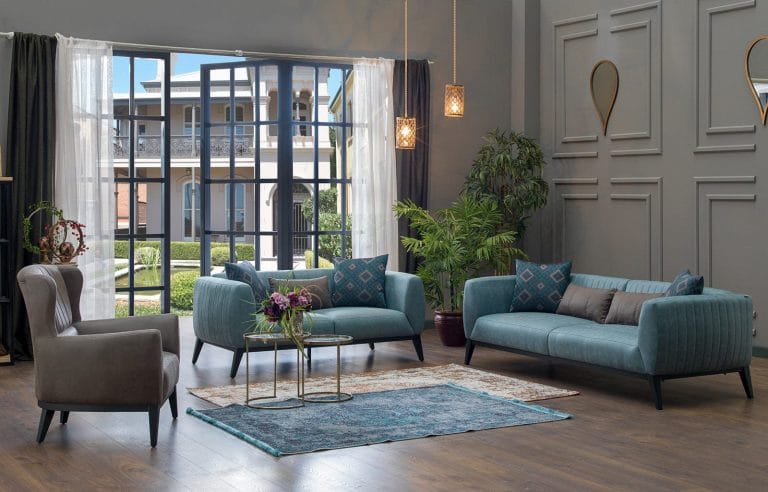

Best Sleeper Sectional: A Complete Buyer’s Guide for 2026
A 500-square-foot apartment can feel perfectly manageable until a friend says they’re staying for the weekend. Suddenly, the sofa needs to seat guests comfortably, open into a usable bed, and leave enough floor space to walk around it. The wrong sleeper sectional makes that nightly conversion feel like moving furniture through a hallway. The right one handles the change with a clear pull, a stable sleeping deck, and upholstery that still looks like a sofa the next morning.
The best sleeper sectional isn’t the largest model, the softest one in the showroom, or the sectional with the most attractive chaise. It’s the one matched to sleep frequency, mattress construction, mechanism effort, room clearance, delivery access, and fabric maintenance. Sectionals are a well-established, popular category of sofa in general — that popularity is exactly why the differences between individual sleeper mechanisms matter so much when you’re choosing one.
| Buyer priority | Strong starting point | Main compromise |
|---|---|---|
| Daily or near-daily sleeping | Thick mattress, rigid frame, platform or premium pull-out mechanism | More weight, cost, and conversion space |
| Weekly overnight guests | 5 to 6-inch mattress with supportive foam or innerspring construction | Some firmness in the closed sofa |
| Occasional visitors | Click-clack or futon-style sectional | Less mattress depth and a more casual sleep surface |
| Small apartment | Reversible chaise, compact depth, easy one-motion conversion | Lower deck height or reduced lounging depth |
| Family living room | Storage chaise, durable cover, generous seating | Larger footprint and more complex delivery |
| Dedicated guest space | Traditional pull-out with upgraded mattress | Heavier frame and greater front clearance |
What a Sleeper Sectional Actually Solves
The useful question isn’t, “Which sectional looks best?” It’s, “What must this piece do every week?” In a small apartment, the answer may be three jobs at once: provide everyday seating, create a proper place for guests to sleep, and store bedding without adding another cabinet. A sleeper sectional earns its footprint by solving those needs in one coordinated design.
Before browsing sectional sofa configurations, answer three questions:
- How often will the bed be used? A guest bed used a few times a year has different requirements from one used weekly or every night.
- Which dimensions are fixed? Note the maximum sofa width, depth, chaise projection, and open-bed length.
- Does storage matter? A storage chaise or ottoman can hold bedding, but its structure may make the seat firmer and the base heavier.
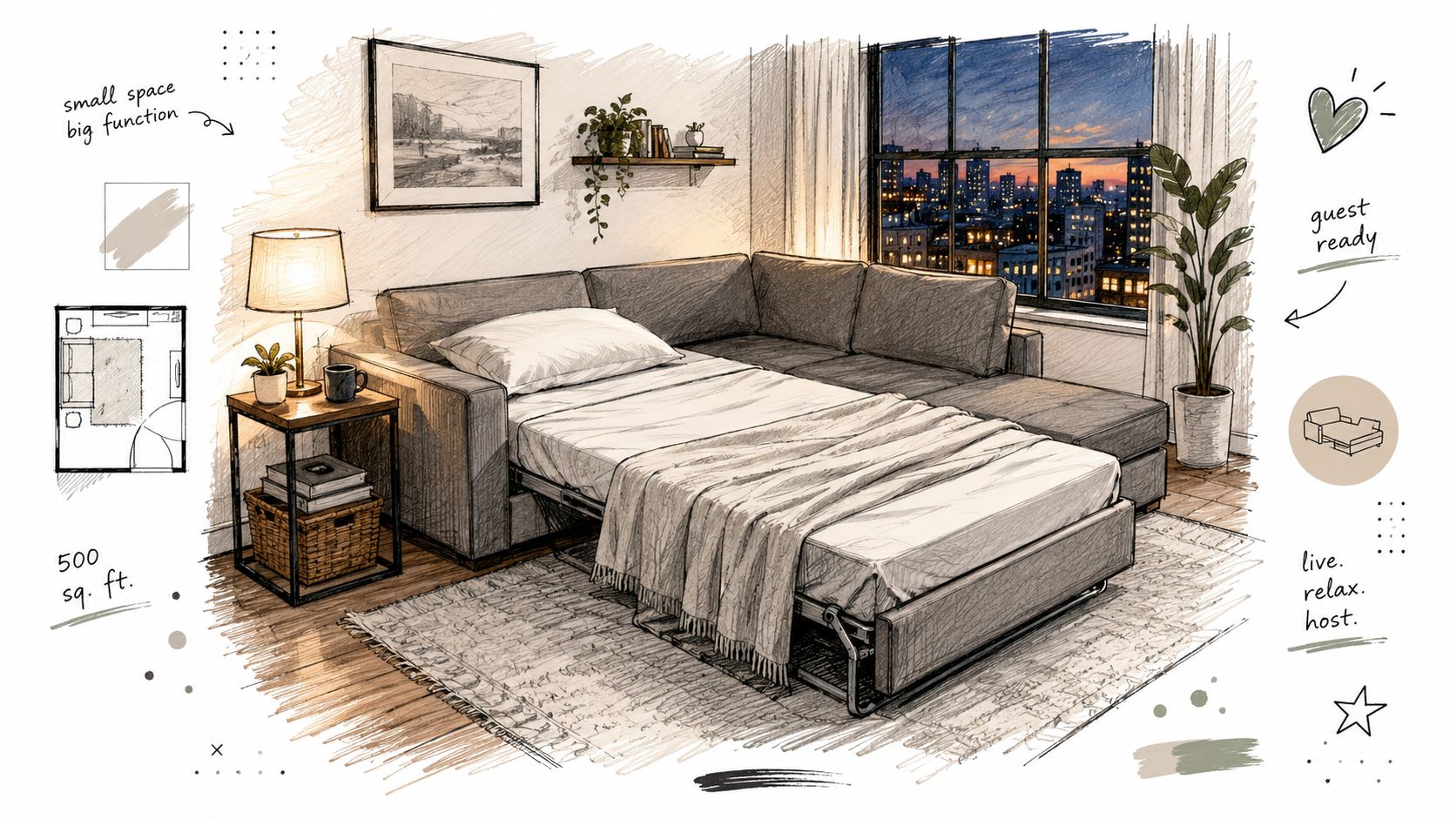
The compromises happen underneath
A sectional sleeper isn’t a standard sectional with a sofa bed stapled into it. The frame, mechanism, upholstery, and mattress deck must tolerate both upright seating and horizontal sleeping. A pull-out system adds weight and usually requires a sturdier base. A fold-down design reduces hardware but often uses the seat cushions as the mattress, which changes both sitting feel and bed support.
Pay attention to mattress deck height. A low deck can feel easy to access but may leave sleepers close to the floor. A higher pull-out can feel more bed-like, yet its mechanism may weigh more and demand additional clearance. Also distinguish a reversible chaise from a fixed ottoman. The chaise may switch sides and provide useful lounging flexibility, while an ottoman often moves independently and may offer storage without becoming part of the sleeping surface.
Showroom rule: Convert the exact model you’re considering, then sit on it closed and lie on it open. A sectional can feel excellent in one posture and disappointing in the other.
The category is well established, but that doesn’t mean every design suits every home. The trade-offs between mechanisms below matter more than the overall popularity of sectionals as a furniture type.
Comparing Sleeper Mechanisms Side by Side
The mechanism determines how much effort you’ll use at bedtime, how the sectional feels during the day, and how much floor you surrender at night. Three formats cover most showroom conversations: traditional pull-out, click-clack, and futon-style platform fold.
| Mechanism | Conversion effort | Typical mattress depth | Front clearance needed | Best for |
|---|---|---|---|---|
| Traditional pull-out | Remove cushions, lift or pull the deck, unfold the mattress | Usually supports the thickest sleeper mattresses, commonly around 4 to 6 inches | At least 3 feet in front when opened | Frequent overnight guests and comfort-focused buyers |
| Click-clack | Lift, click, and fold the back into a flat position | Commonly uses a thinner integrated cushion, often around 4 to 5 inches | Less than a full pull-out in many layouts, but verify the model | Tight rooms and occasional visitors |
| Futon-style platform fold | Fold or slide the seat and back into a horizontal platform | Often uses a folding futon mattress, commonly around 4 to 6 inches | Moderate clearance, depending on seat depth and hinge travel | Casual rooms and shoppers familiar with futon frames |
Pull-out systems
A pull-out sleeper usually requires the most physical sequence. You remove seat cushions, lift a handle or bar, draw the deck forward, and unfold the mattress. In return, you typically get a separate, flatter mattress surface and more opportunity for thicker foam or coil construction.
The trade-off is weight. The frame must carry the mechanism and mattress, and the bed needs open floor in front of the sectional. The convertible sofa bed range is useful for comparing pull-out and fold-down formats, but don’t rely on photographs alone. Ask how the deck is supported and whether the sleeping surface contains metal bars, a sprung deck, or a platform.
Click-clack and futon-style folds
Click-clack models convert in one broad motion. The back lifts, releases, and folds flat against the seat. They suit smaller rooms because there’s no full mattress compartment to pull forward, but the sleeping surface is closely tied to the sofa cushions. That can mean easier conversion and a more casual appearance, with less mattress depth.
Futon-style platforms fold the back and seat into a low sleeping surface. They’re familiar, straightforward, and often lighter in visual weight. They work well for occasional visitors, home offices, and flexible spaces where a low bed isn’t a concern.
The deciding question: How much open floor is available in front of the sectional, and who will convert it at 11 p.m.?
Metal bar feel remains a real issue. A sprung deck can distribute weight more evenly than a basic bar-supported frame, while a platform fold avoids bars but may feel firmer. Frequent guests usually benefit from a true mattress and a stable deck. Occasional visitors may prefer the simplicity of a click-clack or futon-style design.
Mattress Thickness and Fill Options
Choose mattress thickness by sleep frequency, not by how comfortable the closed sofa feels in a showroom. A seat cushion can feel plush for ten minutes while the underlying sleeper mattress remains too thin for an adult guest.
The practical bands are straightforward. Mattresses under 4 inches are generally unsuitable for regular adult sleeping. 4 to 5 inches is the minimum tolerable range for occasional overnight use. 5 to 6 inches is the practical comfort balance between support and foldability. Mattresses above 6 inches can feel more bed-like, but they also add weight and may make conversion harder — and may not fit every mechanism at all.
| Use frequency | Recommended thickness | Best fill options | Watch-outs |
|---|---|---|---|
| Occasional guest use | 4 to 5 inches | Foam, basic innerspring, cotton or wool batting | Thin builds can expose frame feel |
| Weekly overnight use | 5 to 6 inches | High-density foam, memory foam, quality innerspring, hybrid construction | Check that the mechanism accepts the depth |
| Regular adult sleeping | 5 to 6 inches where the mechanism limits depth, or a thicker compatible design | High-density foam, supportive memory foam, innerspring, platform-compatible hybrid | Weight, heat, folding resistance, and warranty coverage |
| Traditional futon use | Compatible folding thickness | Cotton or wool batting, layered foam, hybrid futon construction | Requires rotation and regular flipping |
What each fill feels like
Innerspring mattresses feel responsive and supportive, but they’re heavier and can transmit more movement. High-density foam offers predictable support with less mechanical noise and usually weighs less than an equivalent coil build. Memory foam provides pressure relief, though some sleepers find it warmer and slower to respond.
Cotton and wool futon batting feels breathable and traditional. It also changes with use, so it needs regular flipping and rotation to reduce uneven compression. When comparing foam options, ask the manufacturer for the specific density rating rather than judging by feel in a showroom — higher-density foam generally holds up better under repeated use. For an innerspring build, ask about coil count and gauge directly as well. Treat any spec as a screening question, not a guarantee — construction, layering, and the deck underneath still matter.
Mechanism depth sets the ceiling. A 4-inch memory foam mattress and a 6-inch innerspring mattress aren’t interchangeable if the sleeper compartment can’t close around the thicker build. Ask for the exact mattress dimensions, fill composition, and compatible replacement options through Futonland’s futon mattress selection.
Measuring Your Room the Right Way
The most frustrating sleeper sectional returns often begin before delivery. The sofa fits the room drawing, but it can’t clear the entry door, make the hallway turn, or extend fully into bed mode. Measure the path and the deployed footprint, not just the wall where the sectional will sit.
Start with the delivery path
Use a tape measure and write down:
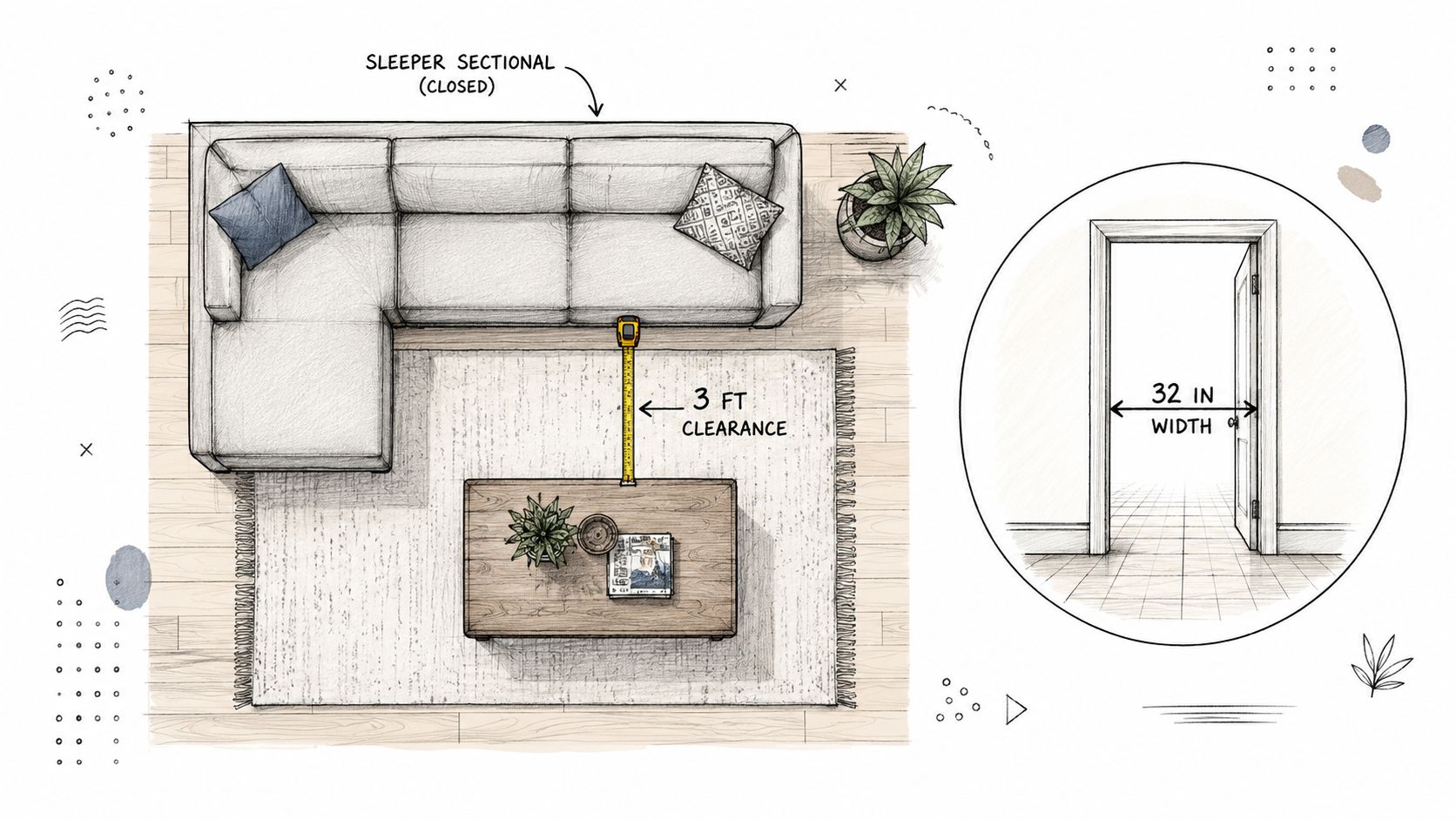
- Doorway width: plan for roughly 32 inches of clear doorway width as a comfortable minimum for delivery access — measure the actual clear opening, not the door slab.
- Doorway diagonal: a narrow opening may still work if the piece can tilt, but the diagonal measurement helps the delivery team assess that turn.
- Hallway and stair turns: record the narrowest point and the angle available at each landing.
- Ceiling obstacles: note ceiling fans, light fixtures, low beams, and stairwell ceilings along the route.
Mark the open-bed footprint
Once the sofa is inside, tape the sectional’s full closed footprint on the floor. Then extend the tape to show the mattress edge and maintain at least 3 feet of clearance in front of the sofa when opened. Include the chaise, ottoman, coffee table, radiator, baseboard, and any furniture that will remain in the room.
Baseboards can interfere with pull-out travel when the sectional sits too close to the wall. A chaise may project farther than the mattress, while a storage ottoman can become an obstacle that someone must move every night. Measure both left-facing and right-facing configurations if the chaise is reversible.
Practical test: Tape the open-bed outline for a full evening. Walk around it, open nearby doors, and check whether someone can reach the bathroom without stepping over the bedding.
Take the completed notes to a showroom and compare them with the model’s closed width, closed depth, open length, mattress height, package dimensions, and minimum wall clearance. Sleeper furniture sizing charts can help organize the specifications, but the manufacturer’s exact package measurements should control the final decision.
Durability and Lifespan by Use Frequency
A sleeper sectional’s workload should determine its construction. A bed used every night places repeated stress on the frame, mechanism, deck, and mattress. A model opened only for occasional visitors faces a very different demand. Upholstery affects appearance and maintenance, but the mechanism and frame usually decide whether the piece remains usable.
As a general pattern, sleepers used nightly tend to need replacement or major service sooner than ones used weekly, which in turn wear out sooner than ones opened only a few times a year. That’s an intuitive relationship rather than a fixed timetable — use it to match the purchase to your expected sleeping schedule, not as a guaranteed lifespan.
| Use frequency | General expectation | Frame type | Mechanism priority |
|---|---|---|---|
| Daily sleeping | Shortest service life under heavy use — invest accordingly | Kiln-dried hardwood with strong spring or platform support | Highest priority, serviceable parts and strong warranty |
| Weekly guest use | Moderate service life | Plywood or solid wood with reliable webbing or springs | Smooth operation and reinforced stress points |
| Occasional guest use | Longest service life relative to purchase price | Engineered frame can be adequate | Simplicity, secure locking, and easy conversion |
Inspect the load-bearing parts
For regular adult sleeping, push the arms in opposite directions and watch for racking or twisting. Kiln-dried hardwood and strong spring systems are suitable starting points for demanding use. Plywood and webbing can serve weekly guests when the joints and mechanism are well built. Engineered frames may suit occasional use, particularly when lower weight and budget matter more than intensive service.
Examine the hinge points, deck supports, drawer slides, and locking hardware. Ask how the mechanism is tested, then request specific information rather than accepting a general assurance. Warranty terms should identify the frame, mechanism, mattress, and upholstery separately.
A useful in-store test: Sit on the front edge, shift your weight, and open the bed without dragging the frame sideways. Excessive flex, scraping, or a catch in the travel path deserves an explanation before you buy.
A durable frame still needs a mechanism that can be serviced. Ask whether replacement parts are available and who handles repairs after delivery. If the sectional will open every night, access to service may matter as much as the initial materials.
Fabric wear remains relevant, especially when the sofa is also the household’s main seating. A beautiful cover cannot correct a bending deck or loosening hinge. For frequent use, give structural quality and repair access priority over a delicate finish. Complete listings should disclose frame materials, mattress construction, mechanism details, care instructions, and warranty exclusions. Missing specifications call for more questions before purchase.
Matching Sleeper Sectionals to Real Households
The same sleeper sectional can feel completely different depending on the household using it. Before comparing size or style, confirm two things: who will sleep on it and how often, and whether the main walkway stays clear once the bed is open. That narrows the field faster than dimensions or looks alone.
| Household type | Recommended configuration | Best mechanism | Upholstery priority |
|---|---|---|---|
| Studio dweller | Compact reversible chaise or apartment-size L shape | Click-clack or futon-style fold | Performance fabric with a manageable texture |
| Family household | L-shaped or U-shaped sectional with storage chaise | Easy-convert pull-out or sturdy platform fold | Washable or removable cover, stain-resistant surface |
| Guest host | Full or queen pull-out sectional with dedicated sleeping deck | Traditional pull-out | Stain-treated upholstery, fitted cushions, durable finish |
Studio dwellers
A studio dweller should first confirm whether the open bed will block the entry, a desk, or a dining table. A reversible chaise can be repositioned to fit the furniture around it, and click-clack or futon-style folds usually need less front clearance than a traditional pull-out frame. The trade-off is a sleeping surface that sits lower and often depends more directly on the sofa’s own cushions.
If the sleeper sectional doubles as the main seat, dining spot, and occasional bed, a tightly woven performance fabric is usually easier to live with than a delicate surface. Seat depth should be enough to relax into without pushing the open bed’s footprint too far into the room. In tight layouts, an in-home design consultation can help confirm the delivery path, open-bed clearance, and chaise orientation before the furniture is inside the apartment and it’s too late to change course.
Family households
Households with children usually need enough seating first, then a sleeping surface that can handle spills, roughhousing, and occasional overnight stays. An L-shaped or U-shaped configuration with a storage chaise keeps sheets and pillows nearby, though the storage base can add weight and firm up the seat slightly.
A removable, washable sofa cover is a real advantage for families — provided the manufacturer actually offers a removable design for that specific model. Confirm before buying whether the cover comes off the actual product, whether a replacement cover can be ordered separately, and whether the care instructions allow machine washing. If the bed mostly sees kids or occasional adult guests, a mattress in the 4.5 to 5-inch innerspring or hybrid range is often enough — just verify the actual fill and deck support rather than going by the product name alone.
Custom covers let a family update the look later without replacing the whole sectional — confirm which fabrics are compatible, how they’re cleaned, and the ordering process before you need one.
Guest hosts
Households that regularly host adult overnight guests should prioritize sleep frequency over size. If the bed is used only a few times a year, a simpler sleeping system is fine. If guests stay monthly or weekly, choose a traditional pull-out with a dedicated sleeping deck — that surface usually feels closer to a real bed than one built directly into folded-out seat cushions.
This configuration needs more front clearance and tends to be heavier. Tape out the open footprint first, then confirm it against elevator, stairwell, and doorway dimensions. White-glove delivery is worth considering for a large sectional, especially in an apartment with a tight corner or narrow hallway. If you plan to change the room’s color scheme later, a custom cover option can preserve the existing sectional instead of requiring a full replacement.
Practical Next Steps Before You Buy
A showroom conversation should end with documentation, not a vague impression that the sectional “felt good.” Bring your measurements, identify the intended sleep frequency, and ask questions that force the salesperson to separate the sofa from the sleeper components.
Ask for the specifications in writing
- Mechanism details: ask what action converts the bed, what the deck is made from, and whether the mechanism contains bars, springs, or a platform.
- Weight information: confirm the sleeper frame’s weight rating and whether that rating applies to the entire sleeping surface or each side.
- Mattress facts: request the exact thickness, fill type, dimensions, and replacement availability.
- Cover samples: get swatches of the actual cover fabric, not only a digital color image. Test them near your flooring, walls, and natural light.
- Configuration terms: confirm chaise orientation, storage capacity, arm width, delivery dimensions, and whether a custom configuration can be returned.
Read the warranty in separate parts
A sleeper sectional contains several systems, so one general warranty may not tell the whole story. Ask for separate coverage details for the frame, sleeper mechanism, mattress, cushions, and upholstery. Find out whether labor, removal, replacement parts, and service calls are included or excluded.
Return policies deserve equal attention. Custom upholstery and made-to-order configurations may have different terms from stock pieces. Keep the written quote, fabric code, configuration diagram, delivery notes, and warranty document together.
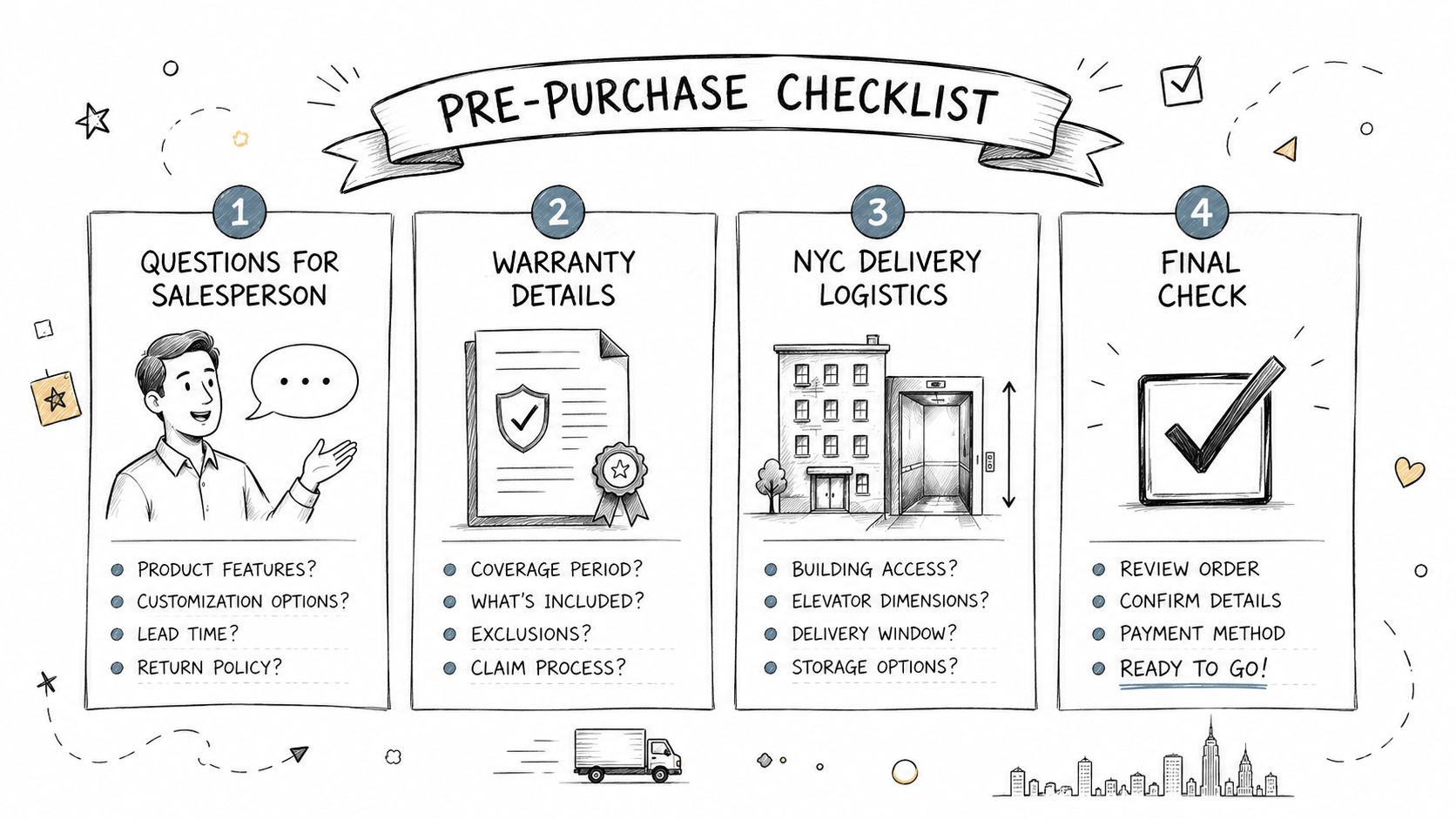
Plan the delivery, especially in New York City
Apartment delivery involves more than choosing a date. Confirm stair fees, elevator access, building certificates of insurance requirements, loading restrictions, and whether timed delivery windows are available. Ask whether the team will assemble the sectional, remove packaging, and take away an old sofa or mattress where the service applies.
Futonland offers custom covers, in-home or online design help, white-glove assembly and debris removal, and NYC delivery services. Treat those services as practical buying levers. A design consultation can test chaise orientation and bed clearance before the order, while a custom cover may support future upholstery changes.
Use this final checklist before signing:
- Measure the doorway, route, room, and open-bed footprint.
- Decide whether the bed is for nightly, weekly, or occasional use.
- Test conversion with the actual cushions and mattress.
- Record mattress thickness, fill, deck design, and frame material.
- Confirm separate warranty coverage and custom-order return terms.
- Schedule delivery only after checking building access and assembly requirements.
A sleeper sectional is a multi-year commitment, so choose the mechanism and construction before falling in love with the fabric. Bring your measurements to a Futonland showroom or request an in-home design consultation, then ask the team to demonstrate the exact model in both seating and sleeping positions before you place the order.
Contact Futonland or arrange a design consultation with your room measurements, doorway details, and preferred sleep frequency ready. Ask for a hands-on comparison of pull-out, click-clack, and futon-style sleeper sectionals, along with fabric swatches and a written delivery plan.