
The Best Futon Mattress for Boats and RVs: A Practical Guide to Sleeping Well in Humid Spaces
Most people don’t think much about their mattress until it becomes a problem. On land, in a climate-controlled bedroom, even a mediocre mattress can last years without issue. But put that same mattress in a boat cabin or an RV, and the problems show up fast — a persistent musty smell, a clammy feeling at night, or visible mildew on the underside after a few months of use.
The difference isn’t just about quality. It’s about materials. The fibers a mattress is made from matter enormously in environments where humidity is a constant, airflow is limited, and the mattress sits on a solid platform with no room to breathe underneath. Understanding that distinction is the first step toward actually solving the problem.
Why Boats and RVs Are Harder on Mattresses Than You Think
A boat or camper isn’t just a smaller version of a house. The sleeping environment is fundamentally different in ways that most mattress manufacturers don’t design for.
Temperature swings are more dramatic. A boat that sits in the sun all afternoon heats the hull, and when the air cools at night, that temperature differential causes condensation to form on surfaces — including the underside of your mattress. The same thing happens in an RV parked on a cold night after a warm day. You may not see the moisture, but it’s there, working its way into the materials over time.
Ventilation is another problem. In a home, a mattress on a bed frame has airflow on all sides. In most boat berths and RV sleeping areas, the mattress sits directly on a plywood platform, fiberglass base, or a solid surface with no gap underneath. That means whatever moisture forms has nowhere to go. It just sits there.
Finally, marine and mobile environments tend to have higher baseline humidity than most homes. You’re near water, or driving through different climates, or simply dealing with the condensation that comes from multiple people breathing in a confined space overnight. Even in dry climates, the combination of body heat and a sealed environment creates conditions that accelerate material breakdown.
The Problem with Cotton in High-Humidity Environments
Cotton has a well-earned reputation as a breathable, natural material. In dry conditions, that reputation holds up. Cotton allows air to move through it, wicks sweat away from the body, and feels comfortable against the skin. It’s why cotton sheets and cotton-fill mattresses have been popular for generations.
The problem is that breathability and moisture absorption are two sides of the same coin. The same properties that make cotton breathable also make it highly absorbent. In a humid environment, cotton doesn’t just allow moisture to pass through — it holds onto it. A cotton-fill mattress in a boat cabin or RV acts like a slow sponge, gradually accumulating moisture from the air, from condensation on the platform below, and from body heat above.
Once cotton gets damp, it dries slowly. Unlike synthetic materials that can release moisture relatively quickly when conditions change, saturated cotton can stay wet for days. That sustained dampness creates the ideal conditions for mold and mildew growth — which is why so many boat and RV owners find dark patches on the underside of their mattresses after a season of use, even when they’ve been careful about keeping things dry.
The damp feeling you notice when you lie down isn’t your imagination, either. A cotton mattress that has absorbed ambient moisture over weeks or months retains that heaviness, and it transfers to the sleeping surface in a way that’s genuinely unpleasant and difficult to fix without replacing the mattress entirely.
What Makes Otis Bed Different
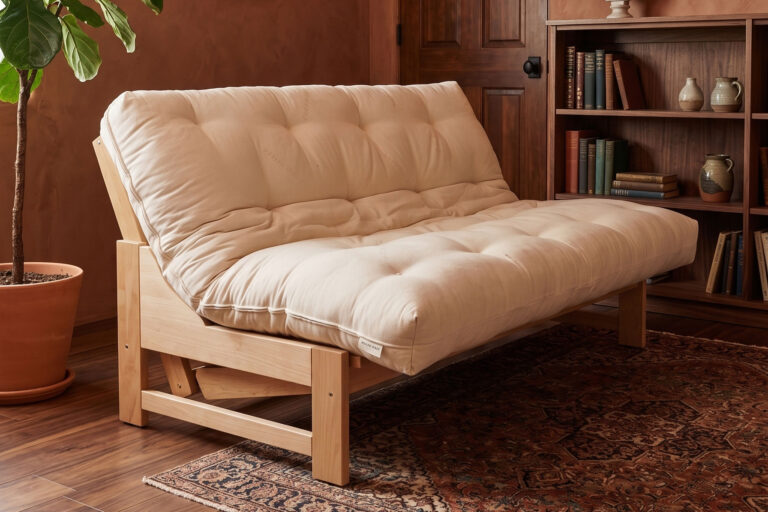
Otis Bed futon mattresses are built without cotton fill. That’s the core distinction, and it matters more than any other spec when you’re choosing a mattress for a marine or mobile environment.
Instead of cotton, Otis Bed uses high-density performance foams and specialized polyester fiber layers. These materials provide support without absorbing moisture the way cotton does. Polyester fibers allow air to move through the mattress while resisting the kind of moisture retention that leads to mildew. High-density foam maintains its structure over time and doesn’t compress permanently the way cotton batting does after repeated exposure to dampness.
The practical result is a mattress that doesn’t develop the musty smell, doesn’t feel damp after a few weeks in a boat cabin, and doesn’t show mold growth on the underside after a season of use. It also maintains its support characteristics for longer, because the foam and fiber construction isn’t being degraded by repeated wet-dry cycles the way cotton is.
It’s worth being accurate about what “moisture-resistant” means here. Otis Bed mattresses are not waterproof. If you spill something on them or lay them on a soaking wet platform, they will absorb some of that water. What they resist is the ambient humidity, the slow accumulation of condensation, and the ongoing moisture that’s present in every marine and mobile sleeping environment. That’s the problem that ruins most boat and RV mattresses, and that’s what Otis Bed is designed to handle. Adding a breathable mattress protector is still a sensible precaution and extends the life of any mattress in these conditions.
The Custom Size Problem — and Why It Matters More Than It Seems
Anyone who has tried to fit a standard mattress into a boat berth knows the frustration. Bow staterooms often have angled or curved edges. RV sleeping areas come in sizes — short queen, three-quarter, RV twin — that don’t correspond to anything sold at a regular mattress store. Van conversions have sleeping platforms built around wheel wells and storage compartments that make every dimension a custom one.
The usual workaround is to buy the closest standard size and cut a foam pad down to fit. That works in the short term, but a trimmed foam pad is not the same as a properly constructed mattress. The cut edges don’t have the same structural integrity, the cover doesn’t fit correctly, and the overall sleeping experience reflects those compromises.
Otis Bed mattresses are available in custom sizes, which changes the calculation significantly. A mattress built to the actual dimensions of your berth or RV sleeping platform fits cleanly, doesn’t shift around, and covers the full surface the way it’s supposed to. Combined with the structured, supportive construction of the foam and fiber layers, it sleeps more like a proper mattress than the foam-pad compromise most boat and RV owners settle for.
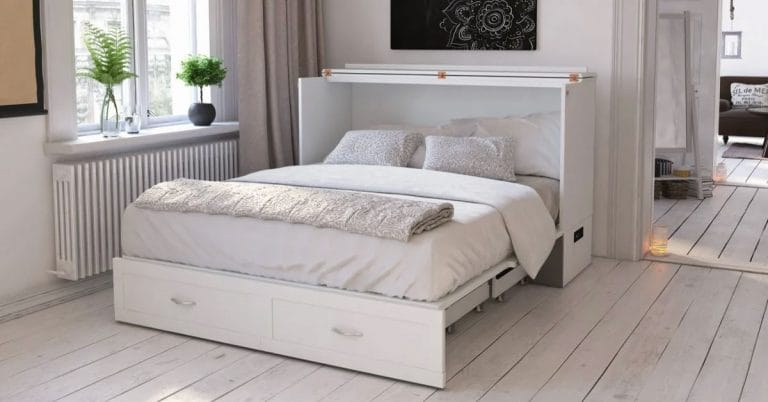
The other advantage in convertible setups — futon frames, fold-down berths, dinette beds — is that Otis Bed’s construction is resilient without being rigid. It handles the repeated folding and unfolding that convertible sleeping setups require without losing its shape the way a conventional innerspring or all-foam mattress would.
How to Get the Most Out of Any Mattress in a Boat or RV
Choosing the right mattress is the most important variable, but how you maintain it matters too. A few habits make a significant difference in how long any mattress holds up in a high-humidity environment.
If your sleeping platform is solid with no airflow underneath, consider adding a slatted insert or a moisture-wicking underlayment between the platform and the mattress. Products designed specifically for this purpose — sometimes called mattress ventilation pads or boat mattress bases — create enough of a gap to allow moisture to escape rather than accumulate. It’s a low-cost addition that extends mattress life considerably.
Airing out the mattress regularly is simple but often overlooked. Propping the mattress on its side for a few hours when the boat or RV isn’t in use gives the underside a chance to dry out and allows accumulated moisture to escape. Doing this after any extended period of use makes a noticeable difference over a season.
Before laying the mattress back down after any break — whether it’s been stored, cleaned, or just propped up — make sure the platform underneath is completely dry. A damp platform re-introduces moisture from below immediately. If you’ve been dealing with condensation, running a small fan or a dehumidifier in the sleeping area for an hour before making up the bed helps.
A mattress protector is worth using regardless of what the mattress is made from. In a marine or mobile environment, look for one that’s breathable rather than fully waterproof — fully waterproof protectors can trap heat and moisture against the mattress surface, which creates its own problems. A breathable, water-resistant cover gives you spill protection without impeding airflow.
Who Should Consider an Otis Bed Mattress
The short answer is anyone who sleeps regularly in a boat or RV and has been frustrated by mattress performance. If you’ve noticed a musty smell, felt the dampness that comes with a cotton mattress in a humid environment, or found yourself replacing mattresses more often than you should have to, the material problem is almost certainly the cause.
Otis Bed futons make particular sense for yacht cabins and sailboat berths, where humidity is essentially unavoidable and the sleeping area is often sealed for extended periods. They work well in Class A and C motorhomes, travel trailers, and fifth wheels, where the short-queen or RV-specific sizing requirements make standard mattresses a poor fit anyway. They’re also a practical choice for van builds and camper conversions, where every dimension tends to be custom and the sleeping surface doubles as a seat or lounge area during the day.
For anyone who uses their boat or RV seasonally and stores it between trips, the durability advantage is compounded. A cotton mattress that sits in storage through a humid summer can be in noticeably poor condition by fall. A cotton-free construction handles that cycle considerably better.
Coming Soon: RV-Specific Sizes
Futonland will soon be stocking Otis Bed mattresses in RV-standard sizes — cut to fit the most common RV sleeping footprints and available off the shelf without the lead time of a custom order. If you’ve been waiting for a straightforward solution to the RV mattress size problem, that option is coming.
In the meantime, the full range of Otis Bed futon mattresses is available at Futonland, including custom sizing for non-standard berths and platforms. If you’re not sure which model or size is right for your setup, the team at Futonland has been helping people work through exactly these kinds of problems since 1995.